







MOQ for startup clothing brand decisions should be treated as a product-planning question, not just a negotiation target. In apparel manufacturing, a realistic minimum order quantity depends on how many variables you add at the same time: fabric type, colorways, size range, decoration method, trims, labels, and packaging. Startups often focus on the lowest possible unit count, but the more useful question is what quantity allows the product to be made well, consistently, and at a cost level that still fits the brand plan.
If you are comparing startup-friendly clothing manufacturing options, it helps to look beyond headline MOQ numbers. In our manufacturing work, we usually guide new brands to match order quantity with garment complexity, fabric availability, logo application, private label details, and future repeatability. That approach makes it easier to control sampling costs, avoid unnecessary SKU spread, and move into bulk production with fewer surprises.
What MOQ means in clothing manufacturing and why it changes so much
MOQ means the minimum order quantity a factory can produce under a workable production setup. It is not a random number. It reflects fabric sourcing realities, cutting efficiency, sewing line planning, trim purchasing, decoration setup, and packaging labor.
That is why two garments with a similar silhouette can have very different minimums. A basic cotton T-shirt in stock fabric with one screen print is usually much easier to make at a lower quantity than a fully custom jacket with contrast panels, multiple zipper colors, woven labels, and branded polybags.
From our manufacturing perspective, startups get the best results when they ask what kind of MOQ is realistic for this exact product build. A low MOQ becomes more achievable when the product uses fewer custom components and more production-ready inputs.
What is a realistic clothing MOQ for startups across common product types?
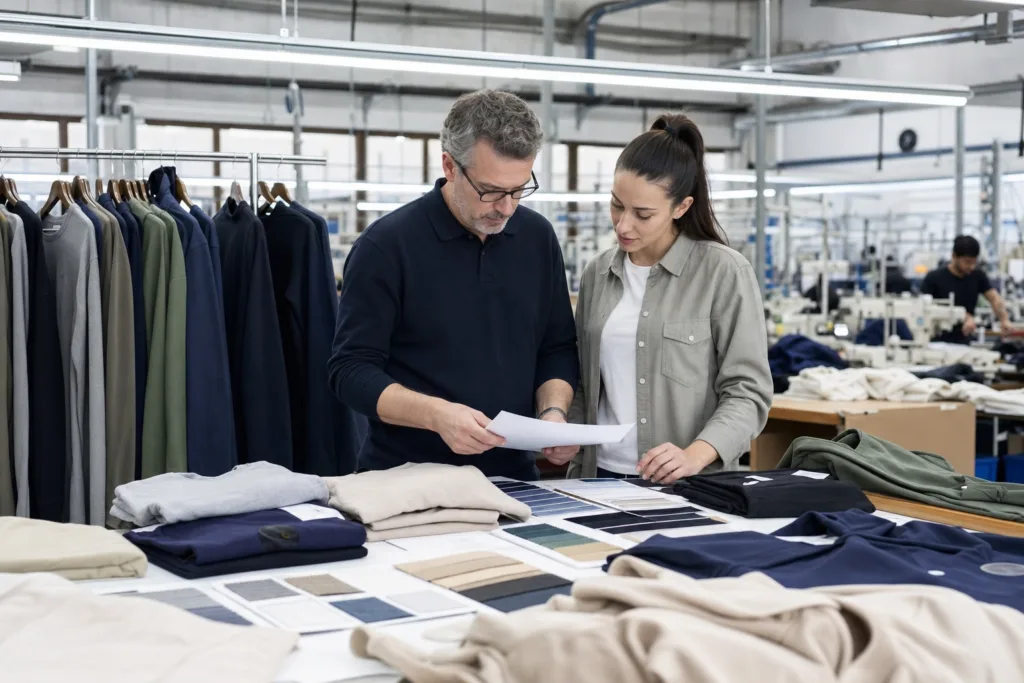
The most realistic MOQ for startup clothing brand projects usually sits in a middle range rather than at the absolute lowest number a buyer hopes for. Exact minimums vary by factory and sourcing route, but garment category still gives a useful starting point.
| Garment type | More realistic startup MOQ range | What usually keeps MOQ lower | What usually pushes MOQ higher |
|---|---|---|---|
| T-shirts | 50 to 150 pcs per style | Stock jersey fabric, shared body color, simple print | Custom dyed fabric, many colorways, oversized fit changes |
| Polo shirts | 80 to 200 pcs per style | Stock pique, simple embroidery, standard placket | Yarn-dyed collars, tipping, branded buttons |
| Hoodies and sweatshirts | 100 to 250 pcs per style | Stock fleece, basic rib, one logo placement | Heavy brushed fleece, wash effects, multiple panels |
| Sportswear sets | 100 to 300 pcs per style | Standard performance knit, simple heat transfer | Compression fabrics, many panels, full sublimation programs |
| Jackets | 150 to 400 pcs per style | Shared shell fabric, standard lining, limited trims | Waterproof fabrics, padding, many hardware items |
These are not universal rules, but they reflect how production complexity affects feasibility. If a startup wants lower minimums, the product usually needs to become simpler somewhere else.
Key takeaway: The easiest path to a workable startup MOQ is usually a simpler garment with fewer custom materials, fewer colors, and fewer branded trim elements.
Which factors increase or reduce MOQ the most?
The biggest MOQ drivers are usually fabric, color, size spread, decoration method, and packaging requirements. Buyers sometimes expect MOQ to be set only by sewing capacity, but a large part of the minimum is decided before sewing even starts.
Fabric type and sourcing route
Fabric often determines whether a project can start small or needs a larger commitment. If we can use in-stock fabric or mill-ready fabric already available in practical colors, the MOQ can often stay lower. If the project needs custom knitting, custom dyeing, special finishing, or a specific blend that must be produced from scratch, the minimum usually rises.
This is especially important for startups trying to launch many SKUs at once. Every new fabric base increases sourcing work, testing risk, and bulk coordination.
Color count
Fewer colorways usually mean a more realistic first order. Three colorways across five sizes can quickly turn one style into fifteen SKU lines, and small quantities per line become harder to cut efficiently and keep consistent.
For a startup, one or two strong launch colors often perform better operationally than a broad palette. It also makes repeat ordering easier if one color proves stronger than the others.
Size range and grading
A broader size run can push the minimum up because pattern grading, marker planning, and size balancing all become more complex. Cornell’s explanation of size grading and size-run planning for startup clothing brands is a useful reference for understanding why each added size creates more development and production planning work.
If a startup launches with XS to 3XL, the quantity per size may become too thin unless the total order is large enough. A narrower first size run is often more realistic, provided it still matches the intended customer.
Decoration method
Logo application has a direct impact on MOQ flexibility. Screen printing often works well for bulk consistency, but setup cost becomes less efficient at very low quantities. Digital or transfer-based methods can sometimes be more practical for smaller runs, depending on artwork and fabric behavior. Cornell’s sourcing notes on fabric sourcing and print-method choices that affect MOQ help explain why some print routes support short runs better than others.
Embroidery also has limits. Small chest logos are usually manageable, but large embroidery areas, many color changes, or thick fabric combinations can raise cost and production time quickly.
Packaging and trim requirements
Custom neck labels, woven size tabs, branded hangtags, barcode stickers, zip bags, tissue paper, and carton markings all add purchasing and handling steps. None of these items is necessarily difficult on its own, but together they can make a low-volume order less practical.
- Use stock or factory-available fabric when possible.
- Limit launch colorways to one or two.
- Keep the first size range commercially focused.
- Choose one main logo method instead of mixing several.
- Simplify trims and packaging on the first order.
How customization complexity changes the minimum order quantity
The more custom the garment becomes, the less realistic very low quantities usually are. This is the core issue many startup founders miss. MOQ is not only about the body shape of the garment; it is about how many separate custom decisions need to be executed reliably.
| Customization level | Typical features | MOQ effect | Startup suitability |
|---|---|---|---|
| Light private label | Stock fabric, standard fit, printed neck label, simple logo | Lower | Very suitable for first launches |
| Moderate customization | Custom woven label, hangtag, selected fit adjustment, custom color | Medium | Suitable with focused SKU planning |
| Full OEM development | Custom pattern, new fabric, multiple trims, special packaging | Higher | Better when demand is clearer |
For example, a startup may ask for 80 hoodies, but if those hoodies require custom heavyweight brushed fleece, oversized grading, enzyme wash, silicon patch logos, branded drawcord tips, and custom packaging, the request is no longer a simple 80-piece order. It becomes a multi-component development project.
That does not mean startups should avoid customization. It means they should choose where customization creates brand value and where standardization protects budget and timing.
What low-MOQ options are most realistic for startups?
The most realistic low-MOQ path is usually not “custom everything.” It is a controlled launch using standard inputs where they do not damage the brand concept.
In practice, these routes often help reduce the minimum:
- Stock fabric instead of custom-milled fabric
- Fewer colorways in the first drop
- Standard body blocks with minor fit refinement
- Printed neck labels instead of custom woven neck labels
- One decoration method per style
- Shared trims across multiple products
- Basic folded packing instead of highly customized packaging kits
For startups comparing options, our low MOQ vs no MOQ guidance is useful because it separates realistic production logic from marketing language. “No MOQ” often means using very limited customization, existing blanks, or print-on-demand logic rather than true custom garment manufacturing.
If the goal is a real brand product and not just decorated stock merchandise, lower MOQs are still possible, but they usually require discipline in the product brief.
When private label is easier than fully custom OEM development
For many startup brands, private label is the most practical first step. It allows you to establish a brand identity without carrying the full cost and complexity of building every garment from zero.
Private label is often easier when the startup needs a faster launch, lower development risk, and a cleaner learning curve. A standard block that already fits the market can be customized with labels, logo placement, color selection, and selected packaging upgrades without forcing a full OEM process.
Fully custom OEM development makes more sense when the product itself is the core competitive advantage. That could mean a signature fit, a technical sportswear construction, or a garment that needs unusual paneling, fabric behavior, or trim engineering.
At Ninghow, we often advise startups to decide whether their first collection wins through brand presentation or through technical product differentiation. That answer usually makes MOQ planning much clearer.
Buyers who need a middle path often look for flexible small-batch production support so they can keep launch volume manageable while still adding selected private label elements. This is usually more realistic than trying to launch with fully custom development across many styles at once.
How sample development and approval affect MOQ decisions
Sampling is where many MOQ expectations get corrected. Before bulk production starts, the sample process reveals whether the fit, fabric, logo method, and construction are actually suitable for the intended quantity and budget.
If the first sample shows that the fabric is too unstable for the print method, the size grading needs revision, or the trim combination is too costly, the startup can still simplify before bulk commitments are made. This is why sample approval is not just a design step. It is also a quantity-planning step.
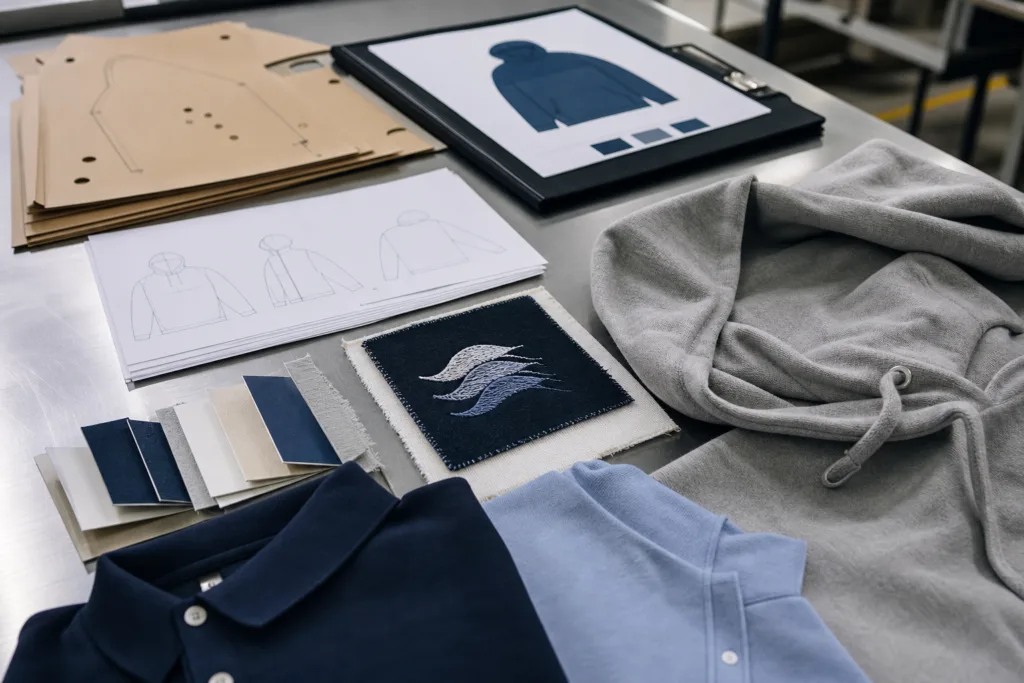
We recommend that startups understand the apparel sampling process clearly before confirming MOQ expectations. A good sample round can save much more money than it costs because it prevents bulk orders from being built on assumptions.
- Confirm fabric composition, weight, and hand feel.
- Check fit on the intended base size.
- Review logo size, position, and durability.
- Approve labels, trims, and packaging details.
- Decide what can be simplified before bulk.
Key takeaway: A startup should not lock its MOQ target before it sees whether the sample build is technically and commercially workable.
How to estimate MOQ against your real startup budget
Startups often ask for the lowest MOQ because they want to control cash flow, which is sensible. But lower quantity does not always mean lower business risk. If the quantity is too low, the unit cost may become so high that retail pricing, margin, or reorder planning stops making sense.
The better question is how the total budget spreads across development and bulk. The first order usually includes sample cost, pattern work, decoration setup, labels, packaging preparation, and sometimes test or approval costs. When those fixed costs are spread over too few units, each piece becomes expensive.
| Cost area | Behaves like fixed cost | Behaves like variable cost | Why startups should care |
|---|---|---|---|
| Pattern and development | Yes | No | Very low orders absorb this poorly |
| Fabric | Sometimes | Yes | Custom sourcing can create minimum commitments |
| Printing or embroidery setup | Yes | Partly | Low quantity raises unit cost quickly |
| Sewing labor | No | Yes | Scales with actual pieces |
| Labels and packaging | Sometimes | Yes | Custom components can be inefficient in small runs |
So the realistic MOQ for startup clothing brand planning should be tested against target selling price, expected margin, and reorder confidence. Sometimes increasing the order from 80 pieces to 150 pieces improves cost structure enough to make the whole launch healthier.
What can be simplified without damaging brand positioning?
Not every detail creates equal value in the eyes of the end customer. A strong startup brand can still look polished if it simplifies the parts that buyers do not notice first.
In many cases, these can be simplified without hurting positioning too much:
- Reduce the number of launch colorways
- Use one branded label instead of several label types
- Choose one premium logo placement instead of multiple placements
- Use standard polybags and cartons for the first run
- Launch with fewer styles but better consistency
Areas that usually should not be simplified too aggressively are fit, fabric hand feel, and obvious logo quality. Those are often the first things the customer notices when wearing the garment.
What mistakes make startup MOQ requests unrealistic?
The most common mistake is asking for a very low MOQ while specifying a very high-customization product. Those two goals often conflict.
Another mistake is spreading a small order across too many SKUs. For example, a 120-piece order split across two styles, three colors, and five sizes can become difficult to execute cleanly. Quantity exists on paper, but not in a useful per-SKU distribution.
We also see startups underestimate timing. If a project includes custom fabric, revised fit, branded trims, and imported accessories, the minimum may be only one issue; the actual production sequence becomes another. Good production timeline planning helps founders understand whether the desired launch window matches the complexity they want.
- Requesting bulk quotes before clarifying fabric and fit
- Using too many colors in a first launch
- Adding several decoration methods to one style
- Expecting custom packaging at ultra-low volume
- Ignoring size distribution logic
- Treating sample approval as optional
How should startups prepare a product brief to get a realistic quote?
A realistic quote starts with a realistic brief. The clearer the product information, the easier it is for a manufacturer to tell you what MOQ is workable and where simplification could reduce risk.
Your brief should ideally include the following:
- Garment type and intended use
- Reference images or sketch
- Target fabric composition and approximate GSM
- Preferred colors
- Expected size range and size ratio
- Logo method and placements
- Label, hangtag, and packaging requirements
- Target quantity per style and per color
- Target price range and launch deadline
If some of this is not fixed yet, that is fine. But explain what is decided and what is still flexible. That allows the factory to suggest a more workable path instead of quoting an overcomplicated concept as if all details are mandatory.
What questions should startups ask manufacturers before committing?
The best startup buyers do not ask only for price. They ask what production route fits their brand stage.
- Is the MOQ based on style, color, or total order?
- Can stock fabric or stock trims reduce the minimum?
- Which customization details are driving the MOQ up?
- What part of the project is best handled as private label instead of full custom?
- How many sample rounds are usually needed?
- What quality checkpoints happen before and during bulk?
- Which details may delay repeat orders later?
- At what quantity does unit pricing improve meaningfully?
These questions help reveal whether a manufacturer is thinking in a practical, production-based way. They also help startups compare suppliers on problem-solving quality, not just on headline minimums.
Example MOQ planning scenarios for different startup brand models
Streetwear startup launching one hero hoodie
If the brand wants one hoodie style with one color and one front print, it may be possible to keep MOQ moderate. If the same hoodie adds acid wash, oversized grading, custom drawcords, silicon patch branding, and luxury packaging, the minimum and cost pressure will rise quickly.
Golf or polo-focused brand testing market response
A startup golf brand often benefits from beginning with one or two polo colors in a stable pique fabric, plus chest embroidery. Custom collar tipping, branded buttons, and many color options can wait for the second phase once the fit and demand are proven.
Teamwear or sportswear startup
If the business model depends on many team color combinations, MOQ planning should focus on decoration and panel strategy early. Some sportswear programs work better with grouped color systems than fully unique combinations for every customer.
Fashion startup with several silhouettes
If budget is limited, it is often smarter to launch fewer styles with stronger quantities per style than to spread the order thinly. Better depth usually creates better factory control and clearer sales feedback.
When is it smart to increase MOQ?
Increasing MOQ can be the right move when it improves cost, consistency, and repeatability enough to offset the inventory risk. This usually happens when the style is already validated, the target customer is defined, and the startup understands likely sell-through.
A higher quantity may be worthwhile when:
- Fabric price breaks become meaningful
- Decoration setup cost spreads more efficiently
- Size ratios become healthier
- Bulk color consistency matters strongly
- Reorder timing would otherwise be too slow
In other words, the lowest MOQ is not always the most efficient MOQ. Sometimes a slightly larger first run creates a more stable product and a more workable business model.
How to choose a realistic MOQ path for your brand stage
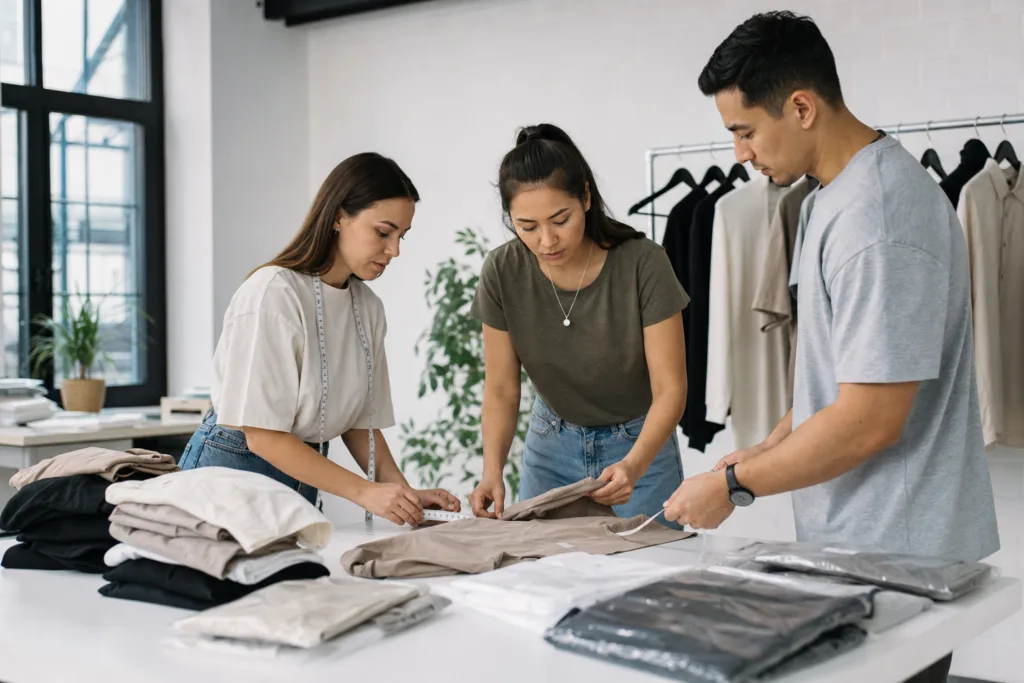
The right MOQ path depends on where your startup is today. If you are still validating fit and customer response, private label or light customization is often the safer route. If you already have demand signals and a clear product identity, deeper OEM development may become justified.
For most startup founders, the practical sequence is simple: reduce unnecessary variation, protect the details customers will feel and see, and let the order quantity match the true production complexity. That approach usually leads to better costing, smoother bulk execution, and a stronger chance of reorder success.
When buyers come to us with a product idea, target quantity, and customization plan, we usually look at the whole package rather than the MOQ in isolation. That is often the fastest way to find a workable balance between brand ambition, production feasibility, and cash-flow reality.
FAQs
What is a good starting MOQ for a startup clothing brand?
A good starting MOQ for a startup clothing brand is usually the lowest quantity that still supports acceptable quality, workable costing, and a clean SKU structure. For many simple products, that may be a small to moderate run per style, but the right number depends on fabric sourcing, decoration, size range, and how custom the garment really is.
Can I get a very low MOQ with full custom design?
Very low MOQ and full custom design do not usually match well in apparel manufacturing. If the product needs custom fabric, special trims, multiple colors, revised patterns, and branded packaging, the factory has more setup work and purchasing complexity, so the minimum usually needs to rise or the design needs to be simplified.
Is private label better than OEM for a first launch?
Private label is often better for a first launch when the goal is to test the market with lower risk and faster development. It allows a startup to build brand identity through labels, logos, and selected customization while avoiding the full cost and complexity of creating every garment component from scratch.
Why does adding more sizes increase MOQ pressure?
Adding more sizes increases MOQ pressure because the total quantity gets spread across more size lines, and each size requires grading, marker planning, and balanced production allocation. If the overall order is too small, the quantity per size can become inefficient for cutting, sewing, and quality consistency.
Should startups prioritize low MOQ or lower unit cost?
Startups should prioritize the balance between low MOQ and healthy unit economics rather than chasing either one in isolation. A lower MOQ reduces inventory exposure, but if the unit cost becomes too high for margin or retail pricing, a slightly larger order may actually be the safer business decision.
What should I send a manufacturer to get a realistic MOQ quote?
To get a realistic MOQ quote, send the manufacturer a clear brief with garment type, reference images, fabric preference, color plan, size range, logo method, trim and packaging needs, target quantity, and deadline. The more clearly you define what is fixed and what is flexible, the easier it is for the factory to suggest a workable quantity and customization route.