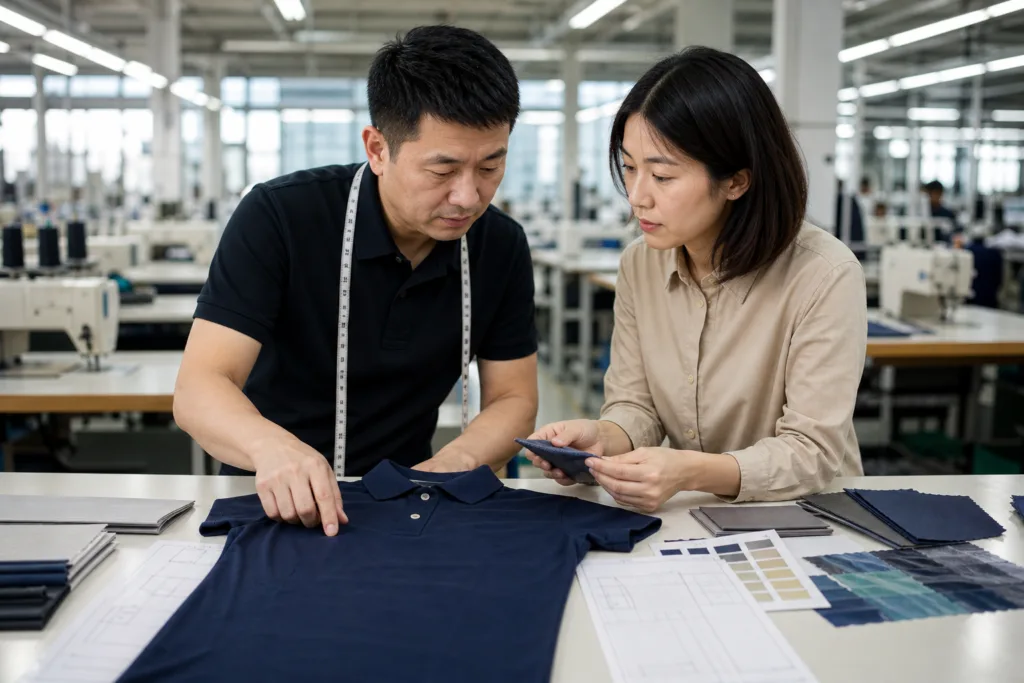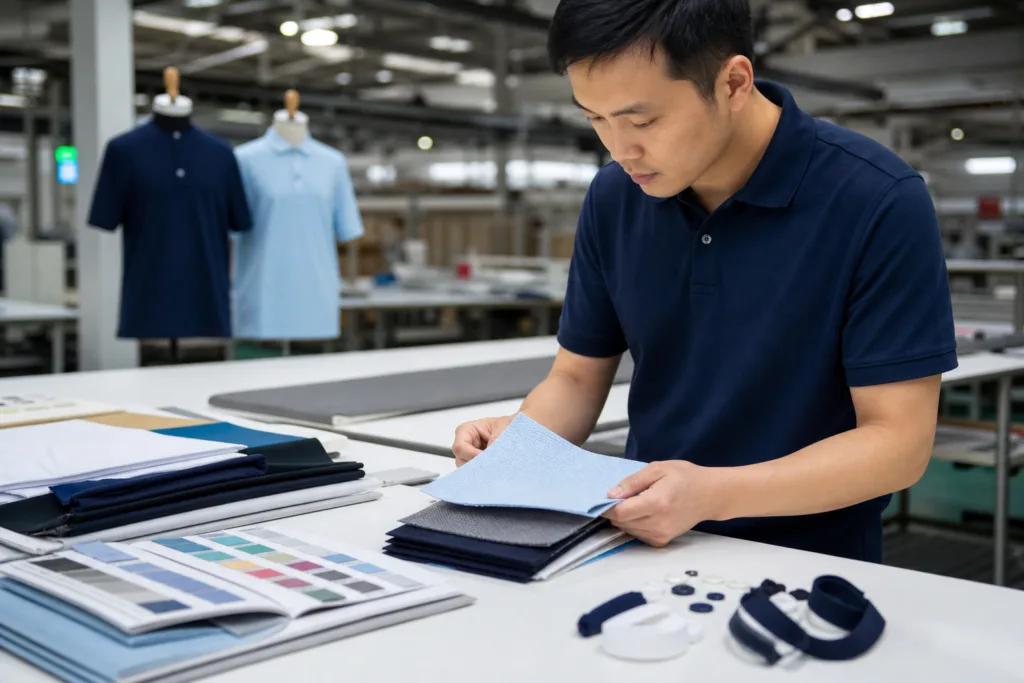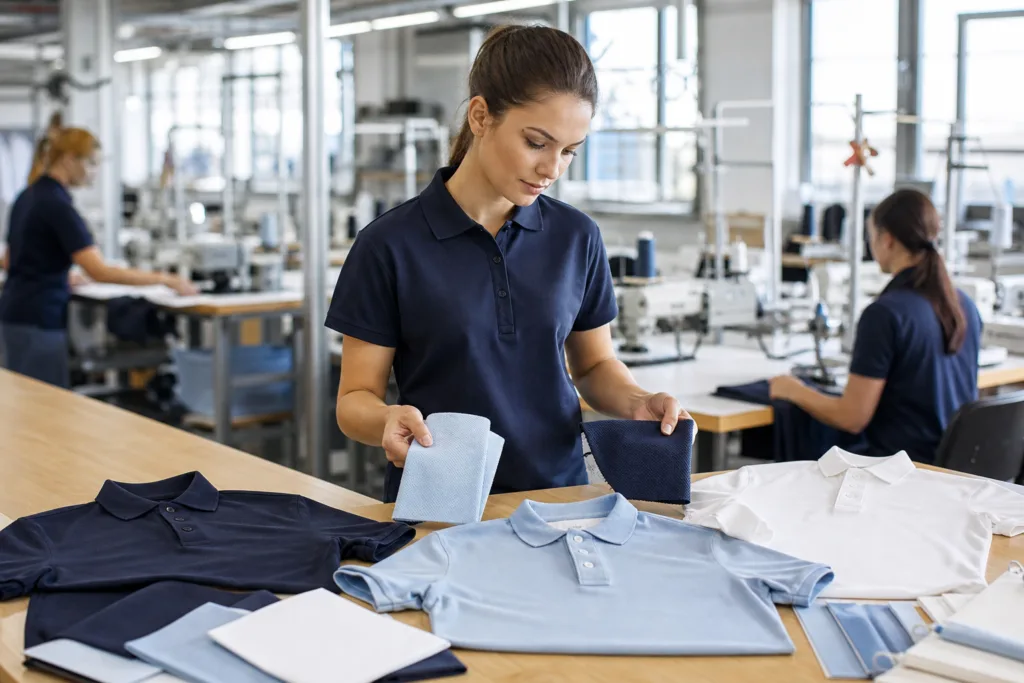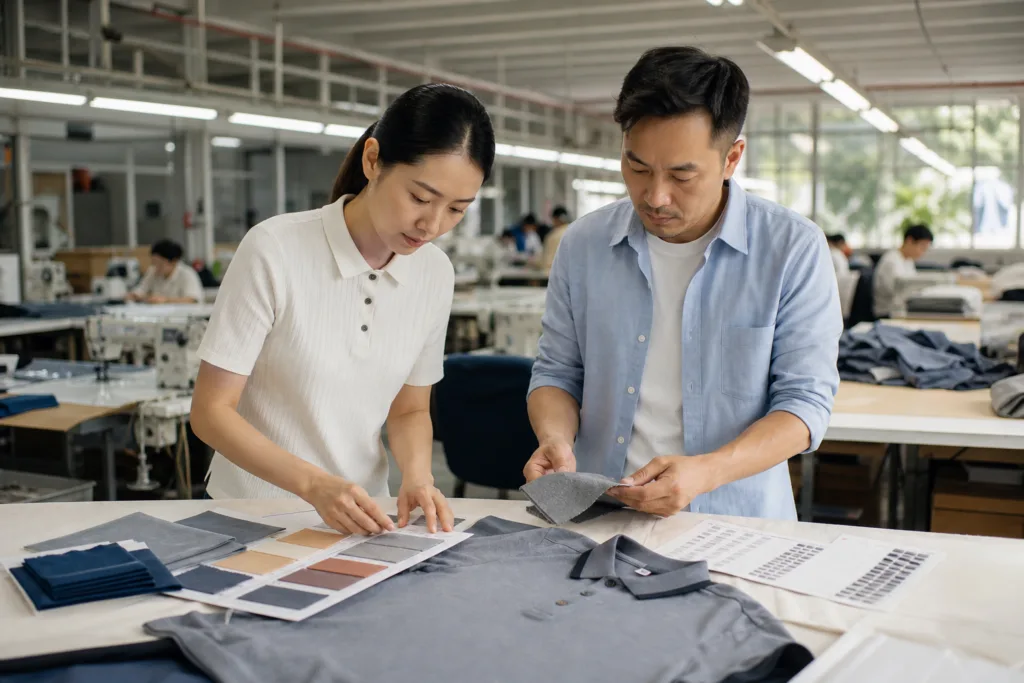
A professional manufacturing team compares fabric swatches and sample garments during early product planning for a clothing brand.

How to Choose the Right Custom Clothing Manufacturer for Your Brand

Choosing the right custom clothing manufacturer is one of the most important decisions a brand can make. The factory you select affects far more than production cost. It shapes fabric quality, fit consistency, sampling speed, customization options, delivery reliability, and how smoothly your product moves from idea to repeatable bulk production. If you are comparing […]

How to Choose the Right Custom Clothing Manufacturer for Your Brand Read More »

A realistic apparel development scene showing early product planning with sample garments, color cards, and production notes.

How to Plan Your First Small Clothing Order Without Overcomplicating SKU, Color, Size, and Decoration Decisions

Your first small order should be simple enough to execute well and specific enough to test real demand. In our manufacturing work, the biggest problem we see is not that a first-time buyer orders too little, but that they try to launch too many colors, too many sizes, too many logo methods, and too many

How to Plan Your First Small Clothing Order Without Overcomplicating SKU, Color, Size, and Decoration Decisions Read More »

A realistic factory development scene showing polo shirt fabrics, collar structures, and placket options being reviewed for private label product planning.

Private Label Polo Shirts: A Complete Guide for Apparel Startups

Private label polo shirts are a practical starting product for many apparel startups because they sit between casualwear, uniform, sport, and smart-casual categories. From a manufacturing perspective, they are also flexible: you can begin with a proven base style, add simple branding, and later move into custom fabrics, trims, fit blocks, and full packaging as

Private Label Polo Shirts: A Complete Guide for Apparel Startups Read More »

A realistic apparel development table showing practical low-MOQ branding elements such as labels, tags, and simple logo applications.

Which Customization Options Work Best for Low MOQ Custom Clothing Orders?

Low MOQ custom clothing options work best when the customization plan stays focused, scalable, and realistic for the order size. For most small runs, the easiest path is usually stock fabric, standard garment patterns, limited colorways, and low-complexity branding such as neck labels, hangtags, basic prints, or simple embroidery. When buyers try to combine custom

Which Customization Options Work Best for Low MOQ Custom Clothing Orders? Read More »

A product development table showing fabric options, color references, and polo construction details for brand-focused polo creation.

How Brands Can Develop Custom Polo Shirts That Truly Match Their Positioning: Fabric, Fit, Logo, and Packaging Options

Custom polo shirts for brands work best when every development choice supports positioning, not just appearance. Fabric hand feel, GSM, fit shape, collar construction, logo method, trims, and packaging all influence whether the final product feels corporate, sporty, premium, fashion-forward, or value-driven. From our manufacturing perspective, strong polo development starts by defining the customer, price

How Brands Can Develop Custom Polo Shirts That Truly Match Their Positioning: Fabric, Fit, Logo, and Packaging Options Read More »

A realistic small-batch garment production environment that reflects flexible low MOQ manufacturing.

Is Low MOQ Clothing Manufacturing More Expensive? A Practical Cost Breakdown for Apparel Brands

If you are comparing quotes, it often looks like is low MOQ clothing manufacturing more expensive has an easy answer: yes, the unit price is usually higher. But the more useful answer for apparel buyers is that low MOQ changes how costs are distributed, not just how much each piece costs. For many brands, the

Is Low MOQ Clothing Manufacturing More Expensive? A Practical Cost Breakdown for Apparel Brands Read More »

A professional manufacturing team compares polo fabrics, collars, and specs before production planning.

How to Choose a Polo Shirt Manufacturer for Custom Bulk Orders

Choosing the right polo shirt manufacturer is not only about price. For custom bulk orders, the better decision usually comes from comparing fabric options, fit consistency, logo application methods, sampling control, MOQ logic, and the supplier’s ability to keep bulk production stable from first sample to final carton. A polo shirt may look simple, but

How to Choose a Polo Shirt Manufacturer for Custom Bulk Orders Read More »

A realistic apparel development scene showing a buyer and factory team reviewing fabrics, quantity planning, and production details for small orders.

Low MOQ vs No MOQ in Clothing Manufacturing: What They Really Mean and Why Buyers Should Not Confuse Them

Buyers often use low MOQ and no MOQ as if they mean the same thing, but in clothing manufacturing they describe very different production realities. If you are sourcing for a startup brand, pilot collection, teamwear order, or private label test run, understanding the difference can save time, prevent unrealistic quotes, and help you compare

Low MOQ vs No MOQ in Clothing Manufacturing: What They Really Mean and Why Buyers Should Not Confuse Them Read More »

A professional sourcing team reviewing activewear samples, fabric swatches, and production details during country comparison planning.

Best Countries to Source Gym Clothing in 2026: Comparing the USA, China, Portugal, and the UK for Speed, MOQ, Fabric Capability, and Cost

Choosing where to manufacture gym clothing is no longer just a cost decision. In 2026, brands are comparing speed, minimum order quantity, access to performance fabrics, private label flexibility, and the total cost of getting finished garments into stock. For many buyers, the real question is not simply whether one country is cheaper than another,

Best Countries to Source Gym Clothing in 2026: Comparing the USA, China, Portugal, and the UK for Speed, MOQ, Fabric Capability, and Cost Read More »

A professional sourcing review scene showing how buyers assess quote clarity, documents, and factory communication at the start of supplier evaluation.

Clothing Manufacturer Red Flags: 12 Warning Signs Buyers Should Not Ignore When Evaluating Apparel Suppliers

Clothing manufacturer red flags are often visible long before a bulk order goes wrong. Buyers usually see them in pricing, communication, sampling, fabric explanations, QC language, and how the supplier handles basic production questions. If those warning signs are ignored, the result is often delayed samples, inconsistent bulk quality, cost disputes, or a supplier relationship

Clothing Manufacturer Red Flags: 12 Warning Signs Buyers Should Not Ignore When Evaluating Apparel Suppliers Read More »

Scroll to Top

Get in Touch with Ninghow

Start your clothing business…

Response Time Notice

To help you get the fastest support:

  • 💬 For instant replies, click the “WhatsApp us” icon at the bottom right of this page.
  • 📧 Emails sent by clicking our email address:  [email protected] are typically replied to within 10 minutes.
  • 📝 Form submissions may take more time to receive a response.

If you do not receive a reply within 24 hours via email, please check your spam or junk folder.