








Low MOQ private label clothing can be a practical path for new brands, test collections, and buyers who want branded garments without committing to large bulk volumes too early. The key point is that low MOQ is not a universal shortcut to full customization. In real apparel production, small-order private label works best when the product plan matches material availability, branding complexity, and realistic production efficiency.
If your project involves branded basics, startup collections, clubwear, or small-batch retail testing, it helps to review private label apparel development options before locking in styles and quantities. At Ninghow, we support buyers with fabric and trim review, logo application planning, label and packaging setup, sample development, and bulk coordination so the private label route fits the actual stage of the brand rather than an idealized version of it.
What low MOQ really means in private label apparel manufacturing
Low MOQ does not mean unlimited flexibility at tiny quantities. It usually means a manufacturer can support smaller production runs than standard bulk programs, but within certain conditions. Those conditions often depend on fabric stock, available trims, production line efficiency, and the complexity of customization.
From our manufacturing perspective, MOQ is tied to how many units are needed to run cutting, sewing, printing, labeling, finishing, and packing in a controlled and efficient way. A low MOQ is more feasible when the garment uses existing base fabrics, standard colors, and simpler branding methods.
Buyers should also separate low MOQ from no MOQ. If you need clarity on that difference, it helps to understand the difference between low MOQ and no MOQ orders before comparing suppliers. Many confusion issues start when brands expect full factory customization under conditions that are closer to sample-level production.
Key takeaway: Low MOQ is usually a structured small-batch production model, not a promise that every fabric, trim, and design detail can be customized with no volume requirement.
Which brands are best suited for low MOQ private label clothing
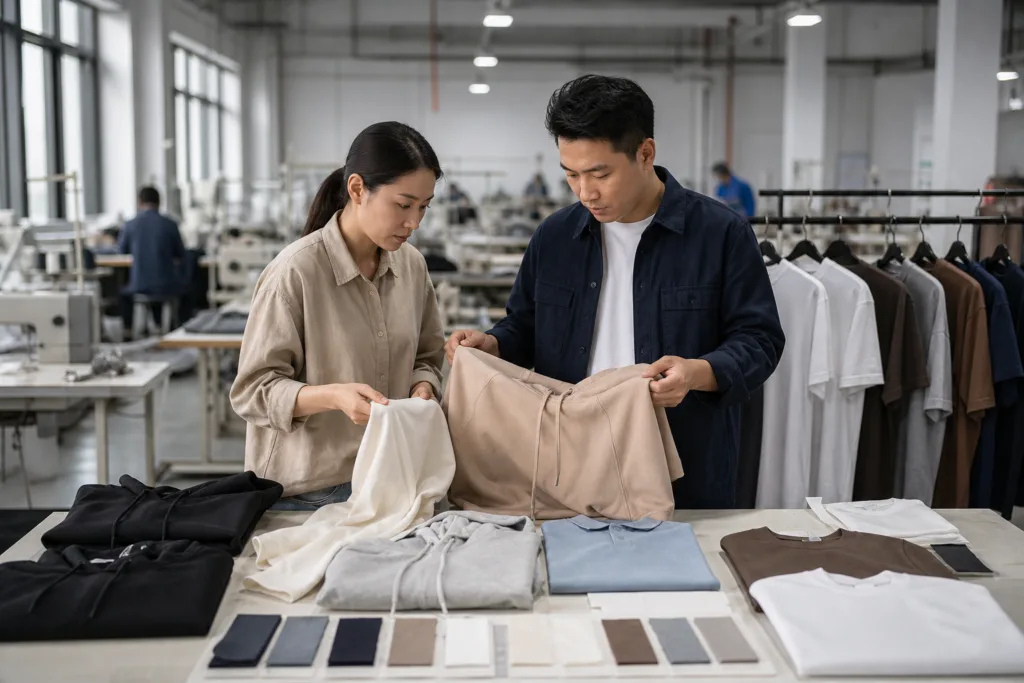
Low MOQ private label clothing is most suitable for brands that need a controlled launch, not maximum design freedom from day one. The model works especially well when the brand wants to validate demand, test fit, or enter a market with a small range of proven products.
In practice, the best-fit buyers often include:
- startup clothing brands launching their first capsule collection
- sportswear or golf brands testing one or two hero products
- schools, clubs, and teams needing branded apparel in moderate quantities
- retailers adding a private label line without building everything from zero
- distributors evaluating a new category before expanding volume
These buyers usually benefit most when they choose products with stable demand such as T-shirts, polos, hoodies, sweatshirts, or training wear. When the product category is already commercially proven, a smaller MOQ becomes a smarter planning tool rather than a compromise.
If you are still deciding on brand direction, it is useful to weigh whether private label clothing suits a small brand before spending too much on complex development.
The main advantages of ordering private label clothing in small quantities
The biggest advantage is lower entry risk. Instead of funding a large inventory commitment, brands can test demand with fewer units, collect real sales feedback, and refine the product before scaling.
Small-batch private label can also improve speed when the product path is simple. If the base garment, fabric, and construction are already established, production planning becomes easier than fully original OEM development.
Other benefits include:
- reduced cash tied up in inventory
- easier size ratio testing
- more room to compare logo placements and branding details
- better control when entering new sales channels
- less pressure to guess future demand too early
For some buyers, low MOQ is also a learning stage. It gives product developers and founders a chance to understand approvals, measurement tolerance, packaging requirements, and labeling decisions before they manage larger bulk programs.
The real limitations of low MOQ production
The limitations are real, and they usually appear in four areas: material sourcing, customization depth, pricing, and lead time. These constraints do not mean low MOQ is a poor option. They mean the project needs to be matched to the right production method.
Fabric sourcing can be the biggest constraint
Many fabrics are not sold in tiny quantities, especially if the buyer wants a custom composition, exact pantone dyeing, brushed finish, technical performance treatment, or a specialized knit structure. Mills often have their own minimums, which can be higher than the garment factory’s sewing MOQ.
That is why low MOQ projects usually work better with in-stock or repeat-order fabrics. Once a project moves into custom knitting, custom dyeing, or exclusive finishing, the minimum can rise quickly.
Customization depth is narrower
At smaller quantities, buyers can usually personalize the product, but not reinvent every part of it. Labels, hangtags, polybags, simple embroidery, heat transfer logos, and standard color choices are often manageable. Fully unique pattern blocks, multiple special trims, garment washes, or unusual construction details can become inefficient at low volume.
Pricing is higher per unit
The unit price on small runs is almost always higher because development, setup, cutting, printing, sewing changes, and QC still require time. A factory does not save labor simply because the order is small. In many cases, the opposite happens: small orders can involve more handling per piece.
Lead time is not always dramatically shorter
Smaller quantity does not automatically mean instant production. Material confirmation, sample approval, logo testing, trim preparation, sewing, finishing, and inspection still need to happen. The broader idea of manufacturing cycle time is useful here, because production time includes order handling, assembly, and checking, not just sewing minutes on the line.
Key takeaway: A small order reduces inventory exposure, but it does not remove the technical and operational steps needed to make a consistent private label garment.
What can usually be customized at low MOQ
Most low MOQ private label projects are strongest when buyers focus on branding layers rather than full structural redevelopment. This is where private label is often most efficient.
| Customization Area | Usually Feasible at Low MOQ | Notes |
|---|---|---|
| Main label | Yes | Woven or printed neck labels are common if artwork and size details are clear. |
| Care label | Yes | Fiber content, care instructions, and origin details must be accurate. |
| Hangtag | Yes | Often practical with standard string or pin attachment options. |
| Packaging | Yes | Custom polybags, size stickers, and carton marks are often manageable. |
| Embroidery logo | Often | Best for stable placements and moderate logo complexity. |
| Heat transfer logo | Often | Useful for activewear and small logo applications. |
| Screen print | Sometimes | Depends on color count, placement, and quantity efficiency. |
| Stock color selection | Often | Works better than requesting a fully custom dye lot. |
For many startup and growth-stage brands, this level of customization is enough to create a sellable product with clear brand identity. The result can still look professional if the fit, fabric hand feel, logo execution, and packaging are controlled properly.
At Ninghow, we often guide buyers to simplify early-stage customization so they can put budget into the areas customers notice most: fabric feel, fit consistency, branding clarity, and clean finishing.
What is harder to customize at low MOQ
Some requests become difficult not because they are impossible, but because they are inefficient or dependent on upstream minimums. Buyers should know these pressure points before building a cost plan.
- custom-developed fabrics with unique blends or knitting structures
- special dyeing or garment wash effects requiring controlled batch processing
- major pattern redevelopment with multiple fit tests
- complex cut-and-sew panels with many contrast parts
- molded trims, custom zippers, or unique hardware
- sublimation or all-over print programs needing dedicated setup
- full OEM or ODM development based on a new concept rather than an existing base style
Unique fabric development is a common example. A brand may want a very specific cotton-poly-spandex blend, exact GSM, brushed back finish, and custom seasonal color. Each of those decisions can affect yarn sourcing, knitting, dyeing, finishing, and testing. For small volume, the total process may become expensive or impractical.
Likewise, a heavily revised fit can require multiple prototype rounds. If the original block changes across chest width, shoulder slope, sleeve shape, body length, cuff opening, and hem construction, sample time increases. That can still be worthwhile, but it is no longer a simple low MOQ private label project.
How MOQ affects sample development, production efficiency, and unit cost
MOQ directly shapes how a project moves from development into bulk. Small runs can be excellent for validation, but they need tighter approval discipline because the margin for error is smaller and per-piece cost is higher.
Sampling matters more than many buyers expect
Before bulk production, a sample should confirm fabric quality, logo position, construction, measurement points, and finishing expectations. In low MOQ orders, sample approval is often the moment where a buyer decides whether to keep the program simple or add complexity that pushes cost and lead time upward.
We strongly recommend confirming sample yardage, trims, and material behavior before scaling. Guidance on sampling, fabric testing, and quality control before bulk order supports this logic well: material review before larger commitment helps reduce specification and quality risk.
Efficiency drops when variation increases
If a small order includes too many colors, logos, size ratios, or trim changes, production becomes harder to organize. Cutting losses increase, sewing line balancing becomes less efficient, and finishing checks take longer.
That is why low MOQ works best with a disciplined assortment. One or two core colors, a controlled size range, and a limited number of branding applications usually create a better result than trying to launch a full-scale collection in one small order.
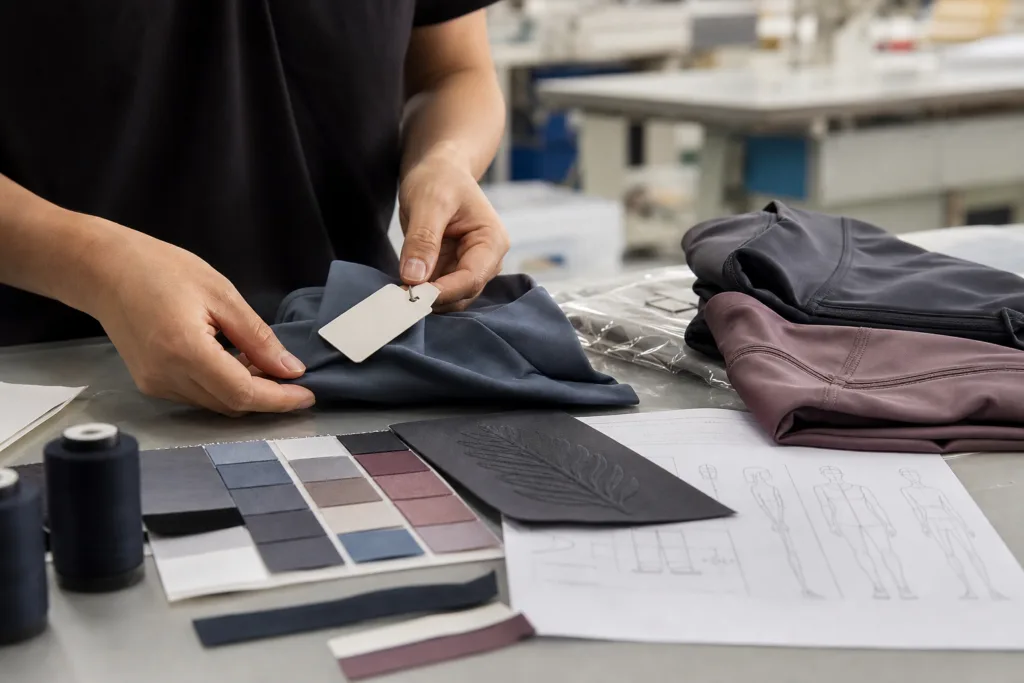
Unit cost rises for understandable reasons
The fixed work behind a garment does not disappear at low volume. Pattern review, marker planning, logo setup, label printing, cutting, sewing supervision, ironing, inspection, and packing all still happen. When those steps are spread over fewer units, the cost per garment goes up.
| Order Path | Development Load | Customization Level | Typical Unit Cost Direction |
|---|---|---|---|
| Stock base + branding | Lower | Basic to moderate | Lower relative cost |
| Modified private label | Medium | Moderate | Medium relative cost |
| Fully custom OEM/ODM | Higher | High | Higher relative cost |
Key takeaway: If you want low MOQ to remain cost-effective, keep the first order focused, approve the sample carefully, and avoid unnecessary variation.
Choosing the right product path before you order
Most buyers should choose among three practical paths rather than treating private label as one single model. The best route depends on how original the product needs to be and how much development cost the brand can support.
Stock base plus branding
This is usually the fastest and safest option. The garment body already exists, the factory knows the construction, and the buyer mainly adds labels, hangtags, packaging, and a logo treatment.
This route is ideal for testing demand, proving a brand concept, or launching classic categories such as tees, polos, hoodies, and training basics.
Modified private label
This middle path uses an existing base but changes selected details such as fabric weight, pocket design, cuff shape, drawcord color, neck tape, or placement branding. It gives more distinction without requiring full redevelopment.
For many brands, this is the best balance between identity and control. Buyers looking to evaluate low MOQ clothing manufacturing options often find that modified private label offers the most realistic commercial result.
Fully custom OEM or ODM
This is the right route when a brand truly needs original pattern development, distinct construction, or proprietary product direction. It can produce stronger product differentiation, but it usually demands more samples, more time, and higher MOQ logic upstream.
Low MOQ and full OEM are not always incompatible, but they rarely deliver the same efficiency as stock-based private label. The more original the product, the more planning discipline is required.
How to evaluate if your brand is ready for low MOQ private label clothing
A brand is ready when it has enough clarity to make stable decisions. Low MOQ helps reduce inventory risk, but it does not solve unclear product direction.
Before placing an order, buyers should be able to answer these questions:
- What is the exact target customer and use scenario?
- Which garment category is most commercially proven for the launch?
- Do we need stock-based private label or a modified product?
- Which branding elements are essential, and which are optional?
- What size range and color range are truly necessary?
- What target price can the end market support?
- Can we approve a sample quickly and clearly?
If several of these answers are still uncertain, the better move is often to simplify the launch. Many startups benefit when they set a realistic MOQ for an early-stage clothing launch instead of chasing the smallest possible number without a stable product plan.
Key questions to ask a clothing manufacturer before ordering
Good supplier communication reduces more risk than aggressive price negotiation. A buyer who asks the right questions early will usually avoid delays, revisions, and mismatch between expectation and production reality.
- Is the MOQ based on style, color, fabric, or total order quantity?
- Are the fabrics in stock, or do they require new sourcing?
- Which branding methods are realistic at this order size?
- What sample stages are recommended before bulk?
- How will sizing and grading be confirmed?
- What are the measurement tolerances in bulk production?
- What quality checkpoints happen before packing?
- Can packaging, labeling, and carton marks be customized?
- What factors could increase lead time after sample approval?
When buyers come prepared with logo files, label artwork, size specifications, and a clear product reference, communication becomes faster and much more accurate. That is especially important in low MOQ private label programs, where every revision can affect cost efficiency.
Common mistakes brands make when requesting small orders
The most common mistake is asking for too much originality at too little volume. A small order can still look premium, but it needs design discipline.
Other frequent mistakes include:
- treating sample approval casually and assuming bulk will fix issues
- requesting too many colors and size splits in one small run
- focusing only on unit price instead of total development cost
- not clarifying print method, logo size, or embroidery stitch count
- ignoring packaging and label details until late in the process
- expecting custom fabric sourcing with unrealistic budgets or timing
Another mistake is comparing suppliers only by minimum quantity. A more useful comparison looks at product suitability, fabric access, branding capability, sample quality, communication clarity, and QC discipline.
How to reduce risk when starting with low MOQ orders
The safest way to begin is to narrow the first order to the products most likely to repeat. In our experience, a clean first run creates better data for the next production than a highly experimental launch with too many variables.
Risk reduction usually comes from simple operational decisions:
- choose commercially proven silhouettes
- use available or repeatable fabrics
- limit color count in the first order
- approve all labels, logos, and packaging before bulk
- confirm exact measurement points and tolerances
- request clear pre-production confirmation where needed
- plan a reorder path if the first run sells well
We also advise buyers to think beyond the opening order. If the product succeeds, can the same fabric be reordered? Can the branding method scale cleanly? Can the size range expand without changing the core pattern logic? Those questions matter because the best low MOQ programs are built to transition smoothly into repeat production.
When to move from low MOQ to larger bulk production
You should move to larger bulk production when the product has proven demand and the design has stabilized. That usually means the fit has been approved, customer response is positive, size sales are becoming predictable, and branding details no longer need frequent revision.
The shift to higher volume often creates better fabric options, lower unit pricing, and more room for deeper customization. It can also justify more advanced packaging, exclusive colors, or improved trim programs.
At that stage, the earlier low MOQ order has done its job. It reduced uncertainty, exposed product issues early, and gave the brand real selling feedback instead of assumptions.
How to choose the most practical private label path for your brand
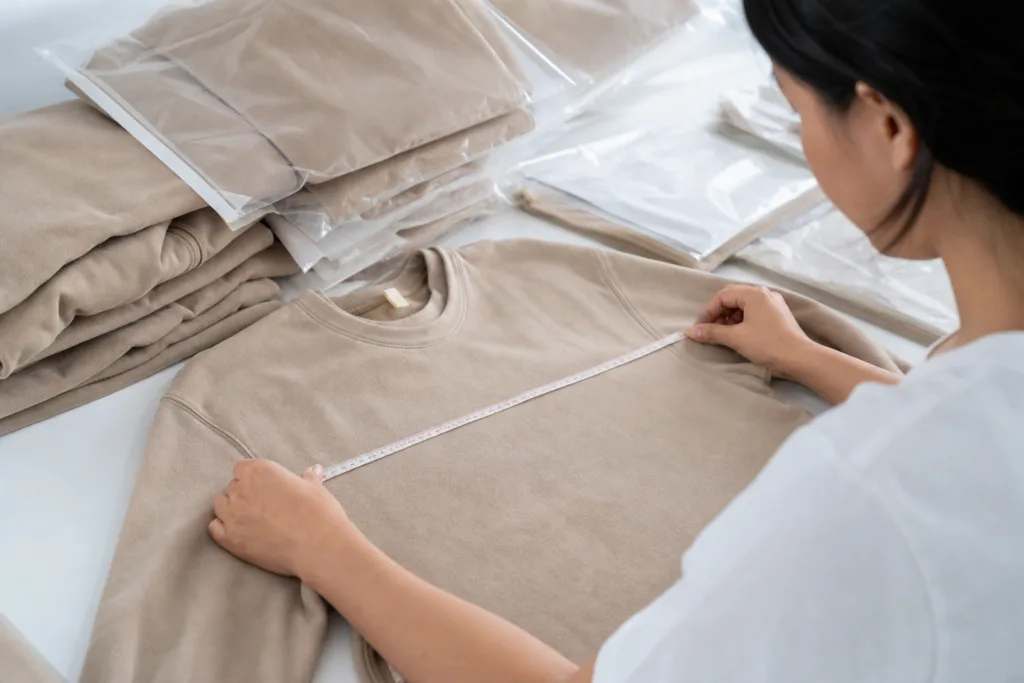
The best decision is usually the one that matches your current brand stage, not your long-term ideal product roadmap. Low MOQ private label clothing is highly useful when you need branded garments with controlled risk, but it works best when the customization path is realistic.
If your priority is testing the market, start with a stock base plus branding. If your brand needs some distinction without excessive development, choose a modified private label route. If the product itself is your core brand value, prepare for a more custom path with more samples, more planning, and potentially higher minimums.
At Ninghow, we help buyers align product type, fabric choice, branding method, sample workflow, and bulk planning so the manufacturing approach fits the commercial goal. That usually leads to better decisions than chasing the lowest number on paper.
FAQs
Is low MOQ private label clothing suitable for a new brand?
Yes, low MOQ private label clothing is often suitable for a new brand when the first collection focuses on a small number of proven products and realistic customization. It works best when the brand wants to test demand, control inventory risk, and build identity through labels, packaging, and logo application instead of trying to create a fully original product line immediately.
What is usually included in low MOQ private label customization?
Low MOQ private label customization usually includes main labels, care labels, hangtags, standard packaging, and selected logo methods such as embroidery or heat transfer. Some projects can also support minor garment detail changes, but custom fabrics, complex washes, or major pattern redevelopment are usually harder to achieve efficiently at small volumes.
Why is the unit price higher for small private label orders?
The unit price is higher because the factory still has to complete sampling, logo setup, cutting, sewing, finishing, inspection, and packing even when the total quantity is small. Those development and handling costs are spread across fewer units, so the price per garment rises compared with larger bulk production.
How many sample rounds should a buyer expect before production?
Most buyers should expect at least one clear development sample and, when needed, a revised sample if fit, logo placement, or construction details need correction. The exact number depends on how customized the style is, but approving a strong sample before bulk is one of the most important steps for reducing production mistakes in a low MOQ order.
Can low MOQ orders still have good quality control?
Yes, low MOQ orders can still have good quality control if the manufacturer uses clear specifications, approved samples, measurement checks, logo verification, and finishing inspections before packing. Small quantity does not guarantee quality on its own, so the buyer should still confirm the QC process, tolerances, and approval points before production starts.
When should a brand move from low MOQ to larger production?
A brand should move from low MOQ to larger production once demand is proven, repeat orders look likely, and the product details are stable enough to scale confidently. That is usually the point where higher volume starts to improve unit cost, material flexibility, and deeper customization options without adding unnecessary product risk.
Related Reading
- compare private label and custom clothing routes for startups
- see how sampling helps test fit and branding before production
- review typical apparel production timing before placing an order
- understand quality control checkpoints for small production runs
- follow the apparel order process from inquiry to bulk production