






Choosing between private label and custom production early can save a startup brand time, money, and costly revisions later. In practical terms, private label usually helps founders launch faster with lower development complexity, while custom clothing offers stronger differentiation but requires more planning, sampling, and budget discipline. For startups comparing the two, the real decision is not which route sounds more premium, but which model fits your launch deadline, cash flow, product category, and long-term brand position.
If your brand is still shaping first-drop quantities, fabric choices, logo applications, or packaging details, our startup-friendly clothing manufacturing support is built around those exact early-stage needs. We help founders compare practical garment routes, refine private label and custom product ideas, review fit and trim requirements, and plan sampling and bulk production in a way that matches realistic MOQ, lead time, and brand-building goals.
What private label clothing means for startups
Private label means using a manufacturer’s existing base product, then customizing it with your own branding and selected finishing details. For a startup, that often includes adding neck labels, hangtags, packaging, embroidery, screen printing, color selection, or slight fit adjustments without creating a garment from zero.
This route reduces development risk because the pattern, construction method, and production flow are already established. In our manufacturing work, private label is often the more efficient option when a founder wants to validate demand first before investing in unique patterns or highly specific fabric developments.
Private label does not automatically mean generic. A strong startup can still build a clear brand through fabric choice, color story, logo placement, finishing quality, labels, and packaging, especially in categories like T-shirts, polos, hoodies, sweatshirts, and basic sportswear.
What custom clothing manufacturing means for startups
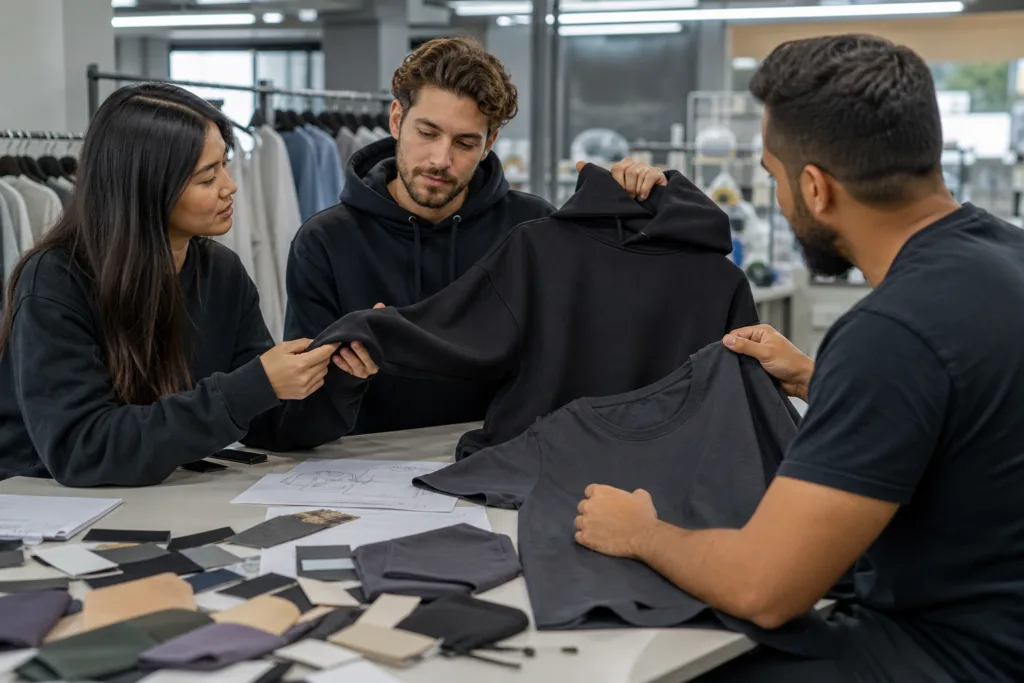
Custom clothing means the garment is developed specifically for your brand rather than selected from an existing blank or standard factory style. That usually involves custom pattern making, fit development, fabric sourcing or customization, trim selection, construction details, grading, sample revisions, and a more detailed approval process before bulk production.
Custom manufacturing gives more control over silhouette, proportions, paneling, stitch details, functional features, and overall market positioning. If your brand strategy depends on a signature fit, a technical activewear construction, a unique uniform concept, or a very defined premium identity, custom development can support that better than basic relabeling.
The trade-off is that custom work takes more input from the brand. Buyers need clearer tech packs, measurement specs, artwork files, trim details, and revision discipline. It also usually requires more patience during the sampling stage because fit, grading, and fabric behavior need to be checked carefully before approving mass production.
Private label vs custom clothing for startups: the core differences at a glance
| Factor | Private Label | Custom Clothing |
|---|---|---|
| Launch speed | Faster because the base product already exists | Slower because development starts from concept or tech pack |
| Upfront cost | Lower development cost | Higher due to pattern, sample, and revision work |
| MOQ pressure | Often lower or more flexible depending on stock fabric and trims | Often higher because custom materials and setup are involved |
| Brand uniqueness | Moderate, driven by branding and finishing | High, driven by unique fit, construction, and materials |
| Technical complexity | Lower | Higher |
| Fit control | Limited to the available base pattern or minor adjustments | High control over silhouette and grading |
| Best for | Fast launch, test orders, simpler categories | Distinct products, technical categories, long-term differentiation |
Key takeaway: Private label is usually the faster and safer route for testing a startup concept, while custom clothing is often the better route when the garment itself is the brand’s main differentiator.
How budget changes the decision
If budget is tight, private label usually wins. The reason is simple: fewer development steps mean fewer paid revisions, less pattern engineering, and less trial-and-error before production.
For startups, upfront cost is not only the sample invoice. It also includes artwork preparation, trim development, packaging setup, shipping, fitting reviews, and the cost of delays. A founder can spend more than expected on custom work simply because each change creates another round of pattern or sewing adjustment.
Where private label usually saves money
- Lower pattern development cost
- Fewer sample rounds in many cases
- Simpler material planning
- More predictable production cost per style
- Lower risk of expensive mistakes in first orders
Where custom clothing can justify the higher cost
- When fit is your main value proposition
- When your category needs functional construction details
- When brand positioning depends on exclusivity
- When you are building a repeatable long-term core style
At Ninghow, we often advise startups to match investment level to proof of demand. If your first goal is market testing, simpler private label apparel development options may protect cash flow better than a full custom launch.
How launch speed differs between the two routes
Private label is normally faster because development starts from an approved or production-ready shape. That means fewer unknowns in pattern, sewing method, and fit balance.
Custom manufacturing takes longer because the first sample is usually a starting point, not the final answer. In many categories, you may need to review shoulder balance, body width, sleeve opening, fabric shrinkage, trim placement, or print scale before the style is production-ready.
| Stage | Private Label Timing Logic | Custom Timing Logic |
|---|---|---|
| Style selection | Choose from existing factory options | Develop from sketch, reference, or tech pack |
| Pattern work | Minimal or limited adjustment | Required from the start |
| Sampling cycles | Often fewer | Often more, especially for fit-sensitive products |
| Material coordination | Simpler if standard fabrics are used | More time if custom sourcing or dyeing is needed |
| Bulk readiness | Faster after branding approval | Depends on final sample approval and grading confirmation |
Startups that need a near-term launch should compare not only production lead time but total development time. A garment that sews in 25 days can still take months to finalize if the fit and construction are not defined early.
Founders who are comparing factory routes should also understand OEM and ODM production pathways for new brands, because the best route often depends on whether your line is based on an existing product framework or a more original concept.
How much brand differentiation do you really need?
If your brand story depends mostly on identity, community, graphics, and presentation, private label may be enough. If your brand story depends on a distinctive garment shape, technical feature set, or fit architecture, custom clothing usually makes more sense.
This is where many startups overestimate their need for full custom development. A premium brand feel can come from better GSM selection, cleaner finishing, stronger embroidery execution, more thoughtful packaging, and more disciplined color consistency. Those are often achievable without rebuilding the entire garment from scratch.
On the other hand, if you are launching compression wear, golf apparel with a specific drape, performance teamwear, or uniforms with function-driven pocketing and panel construction, the product itself may need custom engineering. In that case, differentiation is structural, not just visual.
Signs private label may already be enough
- Your first collection focuses on core silhouettes like tees, hoodies, sweatshirts, and polos
- Your main brand assets are logo design, print concept, and packaging
- You want to test audience response before developing signature fits
- You need to keep SKU count manageable
Signs custom is the better strategic route
- You want a recognizable fit that customers cannot easily compare to blanks
- You need technical fabric behavior linked to garment construction
- You are targeting wholesale or team buyers with specific use-case demands
- Your long-term plan depends on proprietary core products
How MOQ affects early-stage brands
MOQ is one of the most misunderstood parts of startup manufacturing. It is not just a factory preference. MOQ is shaped by fabric availability, dyeing minimums, trim sourcing, printing setup, and production efficiency.
Private label often supports lower or more flexible order planning because the base style, common fabrics, and standard trims may already fit existing production systems. Custom clothing usually raises MOQ pressure because every unique element creates more setup and less shared efficiency.
From a factory perspective, startups should ask whether MOQ is based on color, fabric, logo method, or total style quantity. A style that looks simple can still become MOQ-heavy if it needs custom rib, special zipper colors, or multiple print placements.
If your order plan is still small, it helps to discuss flexible low MOQ production for early orders before locking in fabrics, trims, and colorways that make the first run unnecessarily complex.
Key takeaway: Lower MOQ is usually easier when you simplify fabric, color, and trim decisions. Complexity, not just quantity, is what pushes small orders into difficult production territory.
How product development effort changes the workload
Private label requires product decisions, but custom clothing requires product development. That difference matters because the founder’s workload expands quickly once pattern revisions, grade rules, and sewing details enter the process.
For private label, a buyer may only need to confirm size specs, branding placements, label content, packaging details, and final approval samples. For custom, the buyer usually needs reference garments or a tech pack, graded measurements, construction notes, trim references, and a clearer approval process.
This is also why startups should respect fit development. Custom sizing is not only about making a garment looser or slimmer. It involves body balance, tolerance, fabric recovery, shrinkage behavior, and consistency across sizes. Technical references on fit, sizing, and grading in custom apparel help show why this work takes time and why repeated sample review is normal rather than a sign of poor planning.
Before scaling, we usually recommend founders build enough time for sample development before scaling a collection, especially when the product includes a new fit block, activewear stretch behavior, or trim details that affect wear and presentation.
What quality control and consistency really require
Private label often starts with more stable quality expectations because the factory may already know the garment’s sewing sequence, measurement points, and production risks. That does not remove the need for QC, but it can reduce variability in early runs.
Custom clothing needs stronger pre-production discipline. The more unique the style, the more important it is to define approved measurements, fabric test expectations, artwork positions, seam details, labels, and packaging standards before bulk cutting begins.
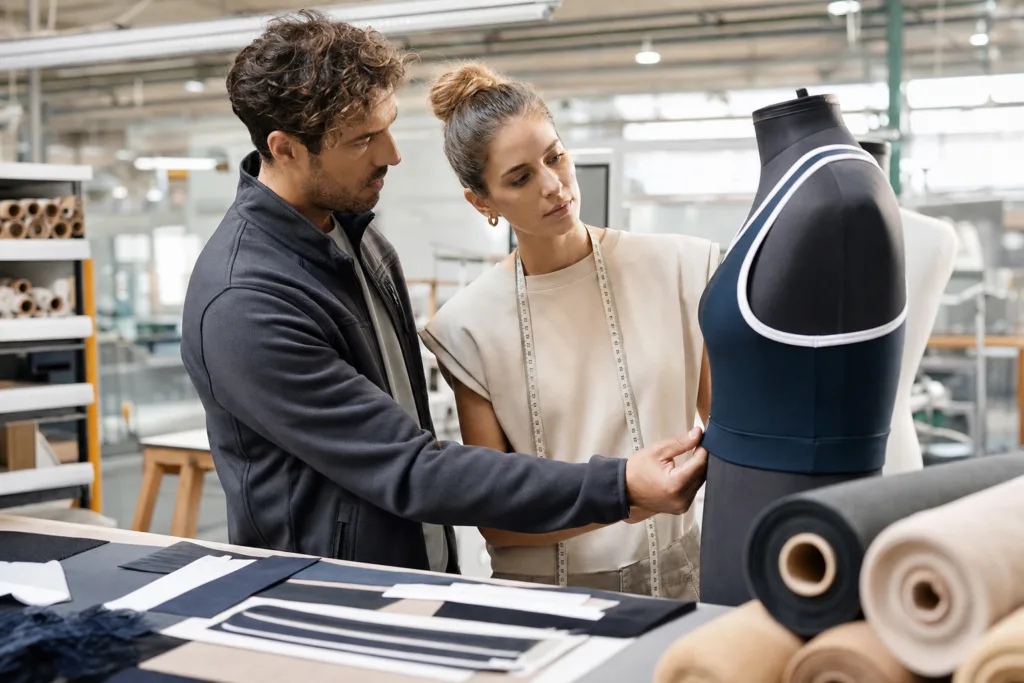
Buyers should also remember that compliance and safety can matter alongside aesthetics. Product category, fabric choice, and end market can affect testing and launch readiness, so apparel teams should review apparel safety and flammability compliance when planning materials for certain garments and markets.
| QC Area | Private Label Focus | Custom Clothing Focus |
|---|---|---|
| Measurement consistency | Confirm factory base spec and final approved tolerance | Confirm custom spec, grade rules, and sample-to-bulk consistency |
| Fabric performance | Check shrinkage, colorfastness, and hand feel match | Check all of the same plus behavior of custom-selected materials |
| Logo execution | Placement and finish consistency | Placement plus interaction with custom panels or seams |
| Trims and labels | Branding accuracy | Branding accuracy plus compatibility with the unique garment build |
| Bulk risk | Generally lower if style is established | Higher unless pre-production approvals are detailed |
When private label is the better choice
Private label is usually the better choice when launch speed and budget control matter more than owning a fully original pattern. It works well for startup brands that want to test market response, build social proof, and understand customer preferences before investing heavily in custom product architecture.
- You are launching your first collection with limited capital
- You need faster sampling and easier production coordination
- You are selling basics, merch-driven apparel, teamwear, or standard silhouettes
- You want to focus on branding, content, and sales first
- You need lower operational complexity in the first season
This route can be especially useful for graphic-led brands, entry-level streetwear drops, starter golf polos, schoolwear, and simple sportswear assortments where brand identity can be built through execution rather than new pattern engineering.
When custom clothing is the better choice
Custom clothing is usually the better choice when the garment itself needs to communicate your competitive edge. If fit, function, premium feel, or a recognizable silhouette is central to the business model, custom development can create stronger long-term value.
- You need a signature fit or non-standard silhouette
- You are entering a technical or performance category
- You want proprietary core products that are hard to copy
- You are targeting a higher-end market position
- You have enough time and budget for development discipline
Custom is often worth the extra effort in activewear, golf apparel, technical outerwear, and purpose-built uniforms, where pattern, paneling, and material behavior influence comfort, mobility, and brand perception in obvious ways.
Best product categories for each route
| Category | Private Label Fit | Custom Fit |
|---|---|---|
| T-shirts | Very strong for startup testing, graphics, and branded basics | Useful if you need a signature cut, special wash, or premium fabric story |
| Hoodies and sweatshirts | Strong for early launches and merch-led collections | Useful for unique oversized blocks, heavyweight builds, or special details |
| Activewear | Possible for simple products | Often better for compression, paneling, support, and performance fit |
| Uniforms | Works for standard needs | Better when pockets, durability, or function details matter |
| Polo shirts | Good for clubs, teams, and basic branded programs | Better for refined fit, collar engineering, and fabric positioning |
| Basics collections | Ideal for lean startup assortments | Better once customer feedback defines what should be improved |
How fabric choice, GSM, fit, and trims affect both models
Whether you choose private label or custom, fabric decisions shape the final product more than many founders expect. GSM affects weight and drape, composition affects softness and performance, and knit or weave structure affects appearance, stretch, and recovery.
For example, a 180 GSM cotton tee and a 260 GSM cotton tee can serve very different brand positions even if the pattern is similar. One may feel lighter and more basic, while the other may feel more substantial and premium. The same principle applies to fleece weight in hoodies, pique quality in polos, and stretch ratios in activewear.
Fit and trims also matter. A basic silhouette can feel stronger with the right rib quality, drawcord finish, zipper tone, woven label, and packaging. Conversely, a custom pattern can still feel weak if the fabric and trims do not support the intended price point or user experience.
From our manufacturing perspective, many startup problems are not caused by choosing the wrong production route alone. They come from mismatching product ambition with material reality.
How customization changes the final brand experience
Brand experience is created through a stack of details, not just the garment shell. Printing, embroidery, labels, hangtags, and packaging all influence how the customer perceives quality and coherence.
What to think about for logo application
- Screen printing works well for larger artwork and scalable cost on volume
- Embroidery adds texture and durability but can affect hand feel on lighter fabrics
- Heat transfer can be useful for technical or small-detail applications
- Sublimation is relevant mainly for certain polyester-based products
What private label can still customize effectively
- Main label and size label setup
- Hangtags and barcode stickers
- Polybag labeling or custom packaging
- Logo placement and decoration method
- Selected colorways and finishing details
Startups often underestimate how much these details affect perceived value. A clean neck label, correct print scale, stable embroidery density, and consistent packaging can make a private label product feel deliberate rather than generic.
That is also why many brands work with Ninghow first on execution quality and product planning before expanding into more complex custom development.
Common mistakes founders make when choosing between the two routes
The most common mistake is choosing custom production for emotional reasons instead of commercial reasons. Many founders assume custom always means better, when in reality it often means slower, more expensive, and harder to control in an early-stage launch.
- Starting with too many SKUs, colors, or size ranges
- Requesting custom development without clear fit references
- Ignoring MOQ impact from trims and color fragmentation
- Underestimating sample revision time
- Using premium packaging before product-market fit is tested
- Confusing logo customization with true garment development
Another frequent issue is not aligning the product route with the sales channel. If you are testing direct-to-consumer demand online, private label may be the smarter start. If you already have wholesale buyers who need a very specific functional garment, custom may deserve the added complexity.
A practical decision framework for startup brands
If you need a simple decision rule, use three filters: budget, differentiation, and deadline. Those three usually reveal the right manufacturing route faster than abstract brand discussions.
| Your Priority | Usually the Better Route | Why |
|---|---|---|
| Lowest upfront development cost | Private Label | Less pattern and sample engineering |
| Fastest launch window | Private Label | Existing base products reduce development time |
| Most unique fit and silhouette | Custom Clothing | Full control over pattern and grading |
| Small first order with lower risk | Private Label | Simpler setup and often better MOQ flexibility |
| Technical performance positioning | Custom Clothing | Fabric and construction must work together |
| Long-term hero product strategy | Custom Clothing | Better for building proprietary core styles |
Key takeaway: If two of your three priorities are speed, lower cash exposure, and simpler execution, private label is usually the better startup route. If two are differentiation, technical product value, and fit ownership, custom usually makes more sense.
Questions to ask a clothing manufacturer before starting
Before confirming either model, founders should ask direct operational questions. Clear answers here reduce delays later.
- What is the MOQ per style, color, and size range?
- Which fabrics are stock-supported and which require custom sourcing?
- How many sample rounds are usually needed for this category?
- What lead time assumptions depend on artwork, trims, or color approval?
- Can labels, hangtags, and packaging be included in the same production plan?
- What quality checkpoints happen before cutting, sewing, and packing?
- What information do you need from us to quote accurately?
Good manufacturer communication should make the route clearer, not more confusing. If the product category is technical, the factory should explain risk areas honestly rather than treating every style as equally simple.
Recommended manufacturing model by business stage
Very early brands usually benefit from proving demand first, then customizing deeper later. That sequence is often healthier than trying to launch with maximum complexity from day one.
Idea validation stage
Private label is often the safer choice. It lets the brand test audience response, pricing, and repeat purchase potential without carrying excessive development cost.
Early traction stage
A hybrid approach often works best. Keep core volume products in private label or lightly modified ODM formats, while developing one or two custom styles that can become signature pieces.
Growth stage
Custom clothing becomes more attractive once the brand has reliable feedback, stronger cash flow, and a clearer view of what product details customers truly value.
Which route is better for your startup and how should you move forward?
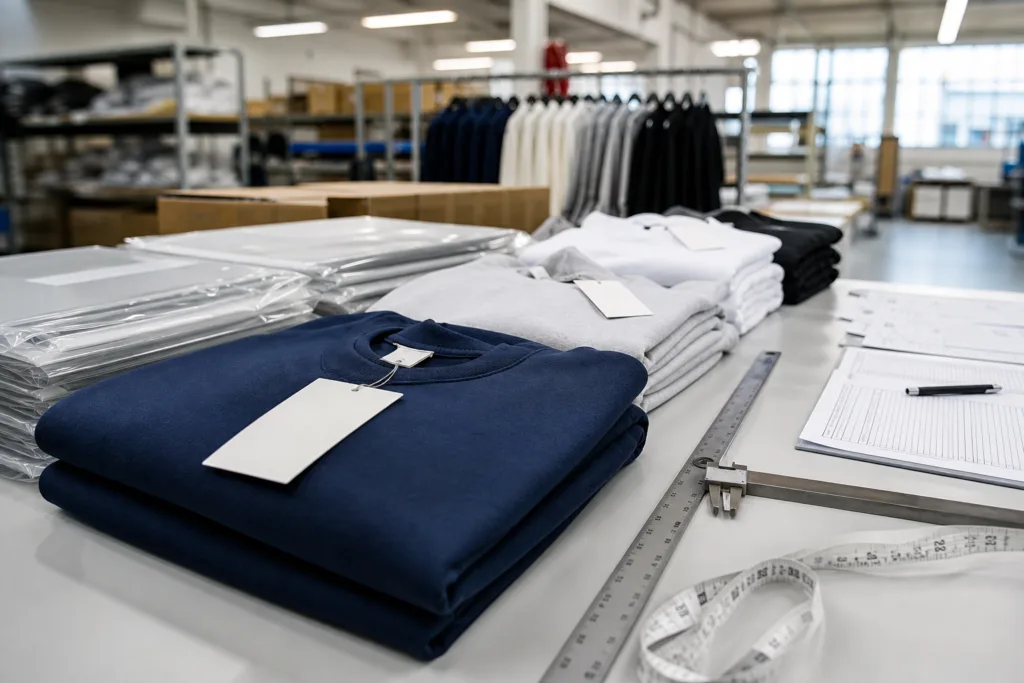
For most startups, private label is the better first move when speed, budget control, and launch simplicity are the main priorities. Custom clothing becomes the better route when your product differentiation depends on fit, function, and a more original garment identity.
The right answer is not ideological. It depends on what you are selling, how quickly you need to launch, what your first order size looks like, and whether your customer is buying the logo, the lifestyle, the fit, or the technical performance.
In practice, many successful brands use both routes at different stages. They launch with disciplined private label basics, learn from customer feedback, then invest in custom hero products once they know exactly what should be different.
FAQs
Is private label better than custom clothing for most startup brands?
Yes, for many first-time brands private label is the more practical starting point because it usually lowers development cost, reduces complexity, and supports a faster launch. It is especially useful when the startup is testing demand, building brand identity through graphics or packaging, and trying to avoid long sample cycles before the first sales period.
Does custom clothing always have a higher MOQ?
Custom clothing often has a higher effective MOQ, but not always in the same way for every project. The real driver is usually fabric sourcing, dyeing minimums, custom trims, and production setup, so a relatively simple custom garment may still be manageable while a highly detailed one can become difficult at small volume.
Can a startup still build a strong brand with private label apparel?
Yes, a startup can build a strong brand with private label apparel if the branding decisions are thoughtful and consistent. Fabric weight, decoration quality, label design, packaging, color direction, and product presentation can create a clear identity even when the base garment is not developed entirely from scratch.
How many samples should a startup expect before bulk production?
A startup should expect at least one approval sample, and custom clothing often needs more than one round before bulk production is ready. The exact number depends on fit sensitivity, fabric behavior, logo applications, and how complete the original product information is when the project begins.
When should a startup move from private label to custom development?
A startup should usually move from private label to custom development after it has customer feedback, a clearer hero product idea, and enough budget to support pattern work and sample revisions. That timing helps the brand invest in custom details that are commercially meaningful instead of guessing what customers may value.
What information should founders prepare before speaking with a manufacturer?
Founders should prepare product category details, target quantity, expected launch timing, logo files, reference images or tech packs, preferred fabric direction, decoration method, labeling needs, and packaging ideas. The clearer this information is, the easier it is for a manufacturer to recommend whether private label or custom production is the better route.