






Before you place a sample request or production order, the quality of your questions matters almost as much as the factory’s answers. The right checklist helps you confirm whether a supplier is truly suitable for your product category, quality target, customization plan, and timeline. If you are searching for practical questions to ask clothing manufacturer China suppliers, the goal is not to sound technical for its own sake. The goal is to reduce avoidable risk before money, fabric, trims, and production capacity are committed.
If your project involves teamwear, fashion basics, sportswear, uniforms, or private label garments, it helps to review custom apparel manufacturing support before you compare factories. A useful manufacturing partner should be able to discuss fabric options, sample development, logo application, labeling, packaging, MOQ logic, and bulk planning in one connected process. That is especially important when your order is not just about sewing a garment, but about building a repeatable product that fits your brand and target market.
This checklist is written for brand founders, sourcing teams, merchandisers, distributors, clubs, schools, and bulk buyers who need clear decision support. From our manufacturing perspective, the best buyer questions are specific, commercial, and product-focused. They help reveal whether a Chinese clothing manufacturer can actually deliver the garment you want at the level of consistency your business needs.
Why these questions matter before you place an order
The biggest sourcing mistakes usually happen before production starts. Buyers sometimes approve a supplier based on a few product photos, a quick quote, or a low MOQ promise without testing how the factory thinks through fabric, fit, construction, and production control.
A strong manufacturer should answer questions in a way that shows process clarity. If answers are vague on fabric composition, pattern ownership, revision rounds, lead times, or defect handling, that uncertainty often becomes delay, rework, or quality disputes later.
Key takeaway: A good checklist does more than compare prices. It helps you test production fit, communication quality, and risk awareness before the first sample or deposit.
Who should use this checklist

This article is especially useful if you are in one of these situations:
- You are launching a clothing brand and need a first production partner.
- You are moving from a trader to a direct manufacturer.
- You are developing custom teamwear, golf apparel, sportswear, polos, T-shirts, hoodies, or uniforms.
- You need private label support including woven labels, hangtags, care labels, and packaging.
- You are comparing several Chinese clothing manufacturers before placing a sample or bulk order.
Even experienced buyers can benefit from a structured comparison. When multiple factories answer the same questions, differences in capability become much easier to see.
Questions to ask about factory capacity and production fit
Start with product fit, not just factory size. A large supplier is not automatically the right one if your product category, construction details, or customization method do not match its strengths.
What products do you make most often?
Ask which categories the factory handles regularly. A manufacturer that mainly produces basic knit tees may not be the best fit for lined jackets, compression sportswear, or golf polos with strict collar standards.
What is your normal order size range?
This question helps you understand whether your order is too small, too large, or operationally inconvenient for the supplier. Some factories accept low MOQs but perform better on medium-volume repeat programs. Others are efficient only when lines are loaded with larger runs.
How many production lines and operators support this category?
You do not need every internal detail, but you do want a realistic sense of whether the factory has stable capacity. Capacity is not only about worker count. It also depends on line balancing, machine type, fabric complexity, and finishing requirements.
Have you made similar garments with similar customization?
Ask for examples of garments close to your own in fabric type, weight, fit, and branding method. A supplier that has already handled similar embroidery placement, screen print scale, or private label packaging usually moves more smoothly into sampling and bulk production.
When buyers ask us these questions, we usually advise them to evaluate not just “can you make it?” but “can you make it efficiently and consistently within our quality target?” Those are different questions, and the second one is more useful.
Questions to ask about fabric sourcing, composition, GSM, and available materials
Fabric is one of the most common areas of misunderstanding in apparel sourcing. Buyers may request “thick cotton” or “premium stretch fabric,” but those descriptions are too loose for production planning. You need to ask about composition, GSM, knit or weave structure, finishing, and availability.
What fabric options do you recommend for this garment and use case?
A manufacturer should be able to explain trade-offs. For example, a 100% cotton jersey T-shirt can feel soft and breathable, while a cotton-poly blend may offer better shape retention and price stability. A sports polo may need moisture management, while a school uniform polo may prioritize durability and wash performance.
What is the exact composition and GSM?
Ask for percentages and weight ranges, not approximate descriptions. A difference between 180 GSM and 220 GSM can change drape, opacity, warmth, print performance, and cost.
Is the fabric in stock, mill-order, or custom-developed?
This question affects MOQ and lead time immediately. In-stock fabric may support lower-risk sampling and shorter development cycles. Custom-dyed or custom-knit fabric usually increases commitment, especially if you need exact color matching or a special hand feel.
| Question | Why it matters | What to watch for |
|---|---|---|
| What is the composition? | Affects comfort, care, shrinkage, and price | Vague answers like “good cotton blend” |
| What is the GSM? | Changes weight, structure, and garment feel | No tolerance range provided |
| What finish is applied? | Impacts softness, performance, and appearance | Factory cannot explain washing or finishing |
| Is the fabric available now? | Determines MOQ and lead time risk | Unclear fabric source or reorder timing |
For private label projects, ask whether fabric test reports or performance checks are available when relevant. If your product has functional claims, schoolwear durability needs, or repeated wash expectations, those points should be discussed before sampling, not after bulk production.
Questions to ask about sampling, pattern development, and revision cycles
Sampling tells you far more than whether a garment looks good in a photo. It reveals whether the factory can follow specs, interpret details correctly, and control workmanship from the beginning.
Before requesting a sample, ask the manufacturer to explain its apparel sampling process. That should include pattern development, sample lead time, revision expectations, fabric substitutions during development, and what happens once the sample is approved.
Will you develop the pattern from my tech pack, reference sample, or both?
This matters because not all sample routes are equal. A detailed tech pack can improve accuracy, but many startup buyers also rely on an existing garment for fit direction. The supplier should clarify how your inputs will be translated into a working pattern.
How many sample revisions are normal?
Most custom programs need at least one revision, especially when fit, collar shape, stitch details, or print placement are important. It is better to ask this early than assume one sample will solve everything.
Will the sample use the same fabric and trims planned for bulk?
If not, ask what substitutes will be used and how that may affect fit, drape, color, or print appearance. A sample made in a similar but different fabric can still be useful, but only if you understand the difference.
- Ask whether sample fees are refundable or credited against bulk orders.
- Ask who approves each revision milestone.
- Ask how sample comments should be submitted to avoid version confusion.
- Ask whether final approved measurements become the bulk production standard.
Key takeaway: A sample is not only a product preview. It is a test of communication, pattern accuracy, workmanship discipline, and process control.
Questions to ask about sizing, grading, and fit consistency
Fit problems are expensive because they can affect the entire order, not just a few defective pieces. If your product has a fashion fit, athletic fit, unisex conversion, or school-size range, you should ask detailed sizing questions early.
Do you work from POM measurements and graded size specs?
A factory should understand point-of-measure standards and how those specs are applied across the size range. If size grading is handled casually, bulk consistency becomes much harder to control.
How do you check fit consistency between sample and bulk?
Ask whether there are pre-production measurement checks, inline measurement checks, and final random measurement inspections. Good suppliers do not wait until packing to discover size drift.
What tolerances do you use for key measurements?
Tolerance should reflect garment type and fabric behavior. Stretch activewear, heavyweight fleece, and woven shirts do not behave the same way in sewing and finishing.
At Ninghow, we often remind buyers that size consistency depends on three linked elements: stable patterns, controlled cutting, and disciplined in-line measurement checks. A clean size chart alone does not guarantee a clean bulk result.
Questions to ask about customization methods: embroidery, printing, labels, and packaging
Customization affects both appearance and production complexity. Buyers should ask not only what branding methods are available, but also which method suits the garment fabric, logo detail, target price, and wash expectations.
Which logo method do you recommend for this garment?
Embroidery, screen printing, heat transfer, and sublimation each have different strengths. Embroidery gives texture and durability, but can add stiffness on lightweight fabrics. Screen printing works well for many graphics, while sublimation is often preferred for polyester sportswear with all-over designs.
Can you match my brand trims and packaging requirements?
Ask about woven labels, printed neck labels, hangtags, barcode stickers, polybags, size stickers, carton marking, and folding instructions. Small packaging details often create avoidable delays if they are discussed too late.
What files and artwork formats do you need?
Vector logo files, Pantone references, print size dimensions, and label content should be confirmed before sample approval. The more complete your artwork package is, the fewer interpretation problems appear in development.
| Customization method | Best use | Buyer question to ask |
|---|---|---|
| Embroidery | Polos, caps, uniforms, premium branding | Will backing or stitch density affect fabric appearance? |
| Screen printing | T-shirts, hoodies, large logos | How many colors are included in the quote? |
| Heat transfer | Sportswear numbers, detailed logos | What is the wash durability and application temperature? |
| Sublimation | Polyester teamwear and performance apparel | Is the fabric and panel setup suitable for color consistency? |
If your order includes several customization elements, also ask how they are sequenced in production. For example, some graphics are applied before sewing, while labels and final folding happen at the end. Knowing the order helps you spot schedule risk.
Questions to ask about quality control, defect standards, and inspection process
If a factory says “we check quality,” that is not enough. You need to know what is checked, when it is checked, and what standard is used to accept or reject goods.
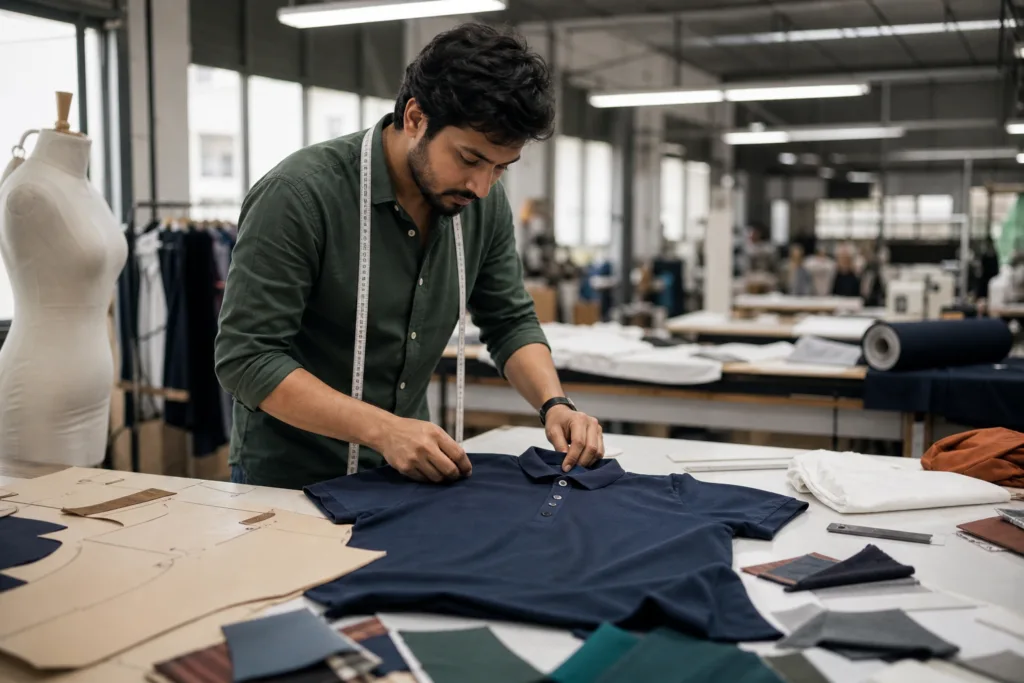
A practical discussion should cover fabric inspection, cutting control, inline sewing checks, logo placement checks, measurement checks, finishing review, packing verification, and final inspection. You can also ask the supplier how it manages quality control checkpoints for apparel orders across sampling and bulk stages.
What defects are considered major, minor, or unacceptable?
This is a key buyer question. Loose threads may be minor. Wrong fabric, wrong size labeling, off-center logo placement, shade inconsistency, or open seams may be major depending on product type and customer use.
Do you inspect fabric before cutting?
Fabric inspection matters because shade issues, knitting defects, contamination, or width variation discovered too late can affect the whole run. Factories that skip this stage increase risk even if sewing quality looks good.
Can third-party inspection be arranged before shipment?
For many buyers, especially new importers or larger volume programs, the answer should be yes. Even if you do not always use third-party inspection, the manufacturer’s reaction to this question is revealing.
- Ask for measurement check frequency.
- Ask how print and embroidery placement is verified.
- Ask how packed quantity is counted and cross-checked.
- Ask what corrective action happens if an issue appears during inline inspection.
Clear quality questions reduce conflict later because they turn expectations into agreed checkpoints rather than assumptions.
Questions to ask about MOQ, unit price, payment terms, and deposit structure
Price comparison only makes sense when the scope is the same. A low quote can hide thinner fabric, simpler packaging, fewer size checks, different logo methods, or excluded freight terms.
What is the MOQ by style, color, and size ratio?
MOQ is rarely one simple number. It may depend on fabric availability, dye lot requirements, print setup, trim sourcing, and whether the garment is fully custom or based on available materials.
What is included in the unit price?
Ask whether the quote includes fabric, trims, labels, packaging, logo application, carton packing, and export packing. If not, ask for a line-by-line clarification.
What are your payment terms and deposit stages?
Many orders follow a deposit plus balance structure, but you should confirm timing linked to sample approval, bulk start, inspection, and shipment release. Make sure payment milestones align with real production milestones.
Key takeaway: Do not compare prices until product specs, branding details, packaging scope, and trade terms are aligned. Otherwise, you are comparing different products, not different suppliers.
Questions to ask about lead time, production schedule, and rush order risk
Lead time should be broken into stages. A single promise such as “25 days” is less useful than a schedule showing fabric booking, sample approval, trim readiness, production start, finishing, inspection, and shipment release.
It helps to request production timeline planning for bulk orders so you can see where your project may face bottlenecks. In our experience, many delays come not from sewing itself but from late artwork approval, trim sourcing, custom fabric dyeing, or packaging confirmation.
When does lead time start?
Some factories count from deposit receipt. Others count from final sample approval or fabric arrival. This difference can change your real calendar by weeks.
What could delay this order?
A useful supplier should mention realistic risks such as fabric stock issues, holiday scheduling, print queue load, label lead time, or sample revision cycles. If the answer is “no problem,” ask for more detail.
How do you handle rush orders?
Rush production may be possible, but buyers should confirm whether that affects price, quality risk, air shipment needs, or line availability. A rushed promise with no process explanation should be treated carefully.
Questions to ask about export experience, shipping terms, and documentation
Export readiness matters because a good garment factory is not automatically good at shipment coordination and document accuracy. Ask whether the supplier regularly handles your target market and what documents it can prepare.
Which shipping terms are you quoting?
This is one of the most important commercial questions. Buyers should confirm whether pricing is based on EXW, FOB, CIF, DDP, or another term, because these terms change cost responsibility and risk allocation. The Incoterms 2020 framework is a useful reference when clarifying who manages freight, insurance, customs handling, and delivery points.
What export documents can you provide?
Depending on the market, you may need a commercial invoice, packing list, carton marks, COO support, or product-specific information for customs or retailer intake. Ask this before shipment, not after goods are packed.
Do you have experience shipping to my country or channel?
Shipping to a distributor, Amazon prep location, club buyer, retailer warehouse, or direct importer can involve different packing and document expectations. The manufacturer should understand these differences clearly.
Questions to ask about communication, project management, and order tracking
Communication quality is often the earliest predictor of sourcing success. A factory may have good sewing capacity, but if approvals, comments, changes, and shipment updates are poorly managed, the order becomes harder to control.
Who is my main contact from sampling to shipment?
Ask whether one merchandiser or project manager owns the order throughout the process. Handing off the order too often can create version confusion, especially on logos, labels, and size specs.
How will you track approvals and changes?
Good project handling should document sample comments, revised specs, artwork approvals, and packaging confirmation. Buyers should also review the manufacturer’s apparel order process and handoff steps to understand when each decision is locked for production.
How often will I receive updates during bulk production?
Update frequency does not need to be excessive, but it should be defined. For example, buyers may want updates at fabric readiness, pre-production confirmation, mid-line progress, finishing stage, and pre-shipment stage.
Red flags that signal higher sourcing risk
Some warning signs appear early if you know what to look for. They do not always mean the factory is unsuitable, but they do mean you should slow down and verify more carefully.
- The supplier avoids direct answers on fabric composition, GSM, or customization method.
- MOQ and price change repeatedly without a clear reason.
- Sample lead time is promised without confirming materials or artwork readiness.
- There is no clear answer on size tolerances or bulk measurement control.
- Quality claims are broad, but defect standards and inspection stages are undefined.
- Trade terms and payment terms are quoted casually or inconsistently.
- Communication becomes unclear when technical details are discussed.
From a manufacturer viewpoint, clarity is a positive sign. Factories that ask intelligent return questions about your fabric, fit, print, packaging, and shipment plan are often safer than those that simply say yes to everything.
How to compare answers from multiple Chinese clothing manufacturers
Use the same checklist for each supplier and compare answers side by side. This makes evaluation more objective and helps you avoid choosing purely on unit price.
| Comparison area | Strong answer looks like | Weak answer looks like |
|---|---|---|
| Product fit | Specific category experience and similar examples | General claim to make everything |
| Fabric clarity | Exact composition, GSM, availability, finish | Generic descriptions only |
| Sampling | Clear revision process and realistic timing | Unclear sample route or unrealistic speed |
| QC | Defined checkpoints and defect handling | “We check carefully” with no detail |
| Lead time | Stage-based production schedule | One total number only |
| Communication | Named contact and documented approvals | Scattered responses from multiple people |
If two suppliers are close on price, the better choice is often the one with clearer process control and better technical communication. That usually reduces hidden cost later.
Buyer checklist summary: what to confirm before approving a sample or PO
Before you approve a sample or place a purchase order, make sure these points are confirmed in writing:
- Garment style, fabric composition, GSM, and color references
- Size chart, grading rules, and fit comments
- Logo method, artwork files, placement, and color standards
- Label set, hangtags, packaging, folding, and carton marks
- Sample approval status and what changes carry into bulk
- MOQ by color and size ratio
- Unit price scope and any excluded costs
- Payment terms and production start condition
- Lead time start point and shipment target date
- Quality checkpoints, inspection plan, and defect handling method
- Trade term, shipping responsibility, and export documents
This is the stage where disciplined sourcing saves time. If the answers are incomplete, keep asking. Clear factory answers before order placement are far cheaper than correction after bulk cutting starts.
Conclusion
The best questions to ask clothing manufacturer China suppliers are the ones that connect product design, commercial terms, and production control into one decision. You are not only choosing a price. You are choosing a process partner for fabric, fit, branding, consistency, and delivery.
At Ninghow, we encourage buyers to ask detailed questions early because strong production outcomes usually begin with strong pre-order alignment. Whether you are sourcing polos, sportswear, hoodies, uniforms, or private label basics, a clear checklist helps you compare suppliers with much less guesswork and much more confidence.
FAQs
What is the most important question to ask a Chinese clothing manufacturer first?
The most important first question is whether the factory regularly makes products similar to yours. That answer quickly tells you if the supplier understands your garment category, fabric behavior, branding method, and likely production risks before you spend time on samples and pricing.
How can I tell if a low MOQ offer is realistic?
A low MOQ offer is realistic only if the supplier explains how fabric, trims, colors, and logo methods will be sourced at that volume. If MOQ is quoted without discussing material availability or setup requirements, the number may not hold once development starts.
Should I approve bulk production based only on one good sample?
No, one good sample is not enough by itself. You should also confirm the approved measurements, fabric specification, trim details, packaging requirements, and how the factory will control consistency between the sample stage and bulk production stage.
What payment terms should buyers clarify before placing an order?
Buyers should clarify the deposit amount, the balance timing, which production milestone triggers each payment, and whether inspection or shipment release affects the final payment stage. Clear payment structure reduces misunderstanding and keeps expectations aligned on both sides.
Why do fabric composition and GSM matter so much when comparing quotes?
Fabric composition and GSM matter because they directly affect hand feel, durability, opacity, shrinkage behavior, and cost. Two garments that look similar in photos can perform very differently in real use if the fabric specification is not the same.
How should I compare multiple manufacturers without focusing only on price?
You should compare them using the same checklist across product experience, fabric clarity, sample process, quality control, lead time logic, communication quality, and trade terms. That approach shows which supplier is most likely to deliver the product correctly, not just quote it cheaply.