





Import clothing from China to USA becomes much easier when the buyer treats the order as a sourcing and compliance project, not just a purchase order. The garment itself may be simple, but the shipment still needs the right importer details, product description, labels, and packing information before it reaches U.S. customs.
If you are building a first order or trying to reduce delays on a repeat order, this import clothing from China to the USA guidance is a useful starting point because it connects the factory side with the shipping side. At Ninghow, we help buyers prepare apparel for sampling, labeling, and bulk production so the documents, carton marks, and inner labels are ready before the shipment leaves the factory.
Why U.S. buyers import clothing from China
Most U.S. buyers source apparel from China because they want a workable balance of price, fabric options, production capacity, and customization control. That is especially true for tees, polos, hoodies, sweatshirts, sportswear, golf apparel, team uniforms, and other repeat-order garments where consistency matters more than fashion speed.
The strongest sourcing projects usually have one thing in common: the buyer understands why the factory is a fit. A manufacturer can help with yarn and fabric selection, size grading, embellishment methods, and bulk production planning, but the buyer still needs a clear commercial goal.
- Lower unit cost at scale: useful when the order is large enough to absorb setup, sampling, and freight.
- Broader fabric choice: helpful when the product needs a specific hand feel, stretch level, or GSM.
- Customization flexibility: useful for embroidery, screen print, heat transfer, woven labels, and packaging.
- Capacity for repeat programs: valuable for brands, clubs, schools, and distributors that reorder the same style.
Key takeaway: Chinese manufacturing works best when the buyer has a defined product spec, a realistic budget, and enough time to handle sampling and compliance correctly.
Who is responsible for what in an apparel import shipment
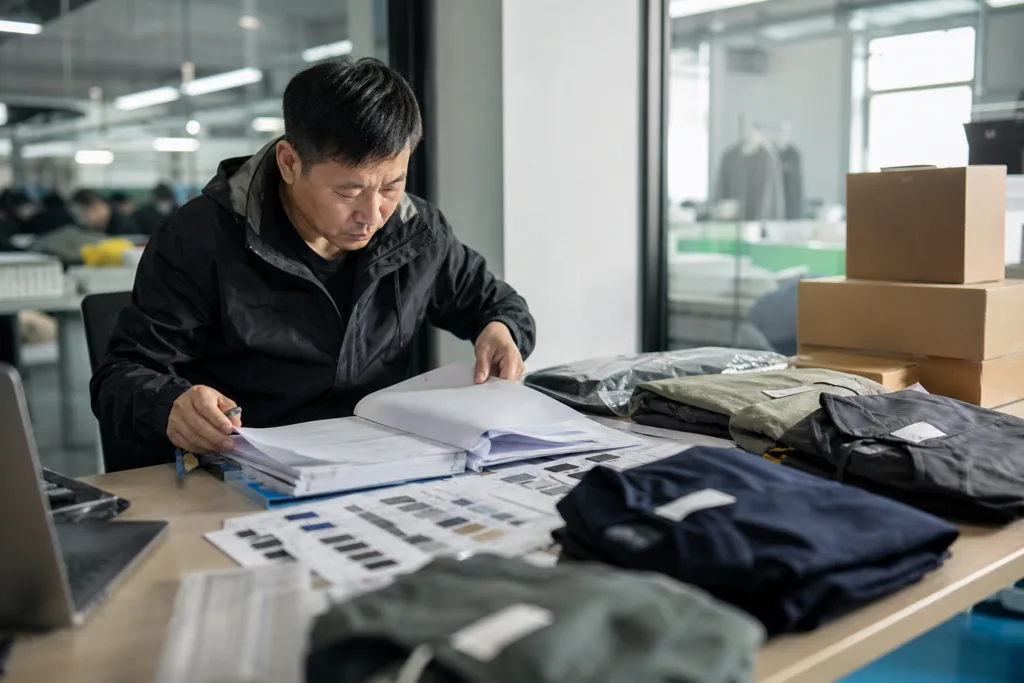
Many first-time buyers assume the factory handles the entire import process. In practice, the work is shared, and the legal responsibility usually sits with the U.S. importer of record. Knowing who owns each step prevents confusion when the shipment is booked, labeled, and cleared.
| Role | What they handle | What the buyer should verify |
|---|---|---|
| Buyer | Product decision, commercial terms, importer setup, approval of labels and packing | Style spec, quantities, values, label copy, and who will be the importer of record |
| Manufacturer | Garment production, sampling, label application, packing, and carton preparation | That production matches the approved sample and the packing list |
| Freight forwarder | Books transport and coordinates movement from factory to port or airport | Shipment timing, pickup details, and handoff instructions |
| Customs broker | Files the entry, helps classify goods, and supports clearance | That the paperwork matches the actual product and shipment values |
| Importer of record | Legal owner of the customs entry and duty obligations | That the business entity is allowed to import and can keep records |
The most common mistake is assuming the freight company or factory will fix everything after the goods ship. They can help, but they do not replace the buyer’s responsibility for the entry, the description, and the paperwork trail.
Confirm who will act as the importer of record
Before you import clothing from China to USA, confirm which business entity will be listed as the importer of record. That entity is the one that customs will look to for the entry, duty payment, and recordkeeping obligations.
For a U.S. brand or startup, this often means confirming that the legal business is active, has the right tax identifiers, and can work with a broker. If you are buying through a distributor, retailer, or trading company, the structure may be different, but the legal responsibility still needs to be clear before the goods move.
- Verify the company name, address, and tax details before booking freight.
- Confirm whether the shipment needs a customs bond.
- Make sure the broker knows who will sign for the entry and pay the duties.
- Keep the importer information consistent across the invoice, packing list, and customs filing.
Key takeaway: A shipment can stall if the importer of record is unclear, so this should be settled before production is complete.
Documents that should be ready before the garments ship
Apparel imports move more smoothly when the factory and buyer agree on the document set before pickup. The goal is simple: every document should describe the same goods in the same way, with no gaps between the commercial invoice, packing list, and physical cartons.
| Document | Why it matters | Common error |
|---|---|---|
| Commercial invoice | Shows the seller, buyer, product, value, and sale terms | Weak product descriptions or mismatched values |
| Packing list | Shows carton counts, sizes, weights, and packing breakdown | Carton numbers that do not match the actual shipment |
| Bill of lading or air waybill | Proves transport details and shipment routing | Wrong consignee or shipment reference |
| Customs entry documents | Used by the broker to file the import entry | Missing product data or inconsistent values |
For apparel, the description should be specific enough that a broker can classify the goods correctly. A vague line like “shirts” is not as useful as a clear line such as “men’s knitted cotton polo shirts” or “women’s polyester performance tees” if that is what you are actually importing.
How to classify apparel correctly with HS codes
HS code classification is one of the most important steps in any clothing shipment because it affects duties, documentation, and customs review. The classification should reflect the actual garment type, construction, fabric content, and intended use, not just the name the sales team uses internally.
If you are still matching styles to tariff lines, our guide on choosing the right clothing HS code explains why fiber content, garment structure, and knit or woven construction matter. A wrong code can lead to the wrong duty amount or a customs question that delays release.
From a manufacturer perspective, the safest approach is to classify the garment after the sample is finalized, not before the product is fully defined. A hoodie, a sweatshirt, and a jacket may look similar in a sales mockup, but customs treatment can change if the construction changes.
- Confirm whether the garment is knit or woven.
- Confirm the main fiber content, including blends.
- Check whether the style is a shirt, top, sweater, pant, short, or outerwear item.
- Review the final sample, not only the flat sketch.
Country of origin rules: when clothing is considered made in China
For U.S. import purposes, country of origin is not always just the place where the fabric was cut or the final package was assembled. The legal origin can depend on where the substantial manufacturing process occurred, which is why the final production story matters.
For a deeper factory-side view, our country of origin label rules for apparel imports explains how origin is declared and why the label must match the actual production story. If the product is sewn, finished, and labeled in China, the origin is typically declared accordingly, but the details should always be checked against the final workflow.
Buyers should not treat origin as a line added at the last minute. It should be fixed early, because it affects label copy, carton marks, customs filing, and sometimes tariff treatment.
Labeling requirements for imported clothing
Labels are one of the easiest ways to avoid customs and retail problems, yet they are also one of the most common sources of error. The buyer should approve the label copy before bulk production so the factory does not print, sew, or pack the wrong details.
Our apparel labeling requirements for imported clothing guide breaks down how those labels should be prepared before bulk shipment, which is especially useful when multiple colorways or size runs are involved. A small label mistake can create rework, delayed release, or chargebacks after delivery.
| Label element | What to verify | Why it matters |
|---|---|---|
| Fiber content | The material breakdown should match the finished garment | Incorrect fiber statements can create compliance issues |
| Country of origin | The origin statement should match the real production path | Customs and retail partners need consistent origin marking |
| Care instructions | Washing and drying guidance should suit the fabric and finish | Helps buyers and end users care for the garment correctly |
| Identity mark | Manufacturer name, RN, or approved identity information if required | Supports traceability and product identification |
Before shipment leaves the factory, verify where the label is sewn in, whether hangtags are attached correctly, and whether any private label packaging matches the approved copy. If the product is going to retail, double-check that all visible and hidden labels tell the same story.
How customs clearance usually works when apparel arrives in the USA
Once the shipment arrives at port or airport, customs clearance starts with the broker filing the entry and matching the shipment to the paperwork. If the documents are clean and the classification is reasonable, the process is usually straightforward. If the product description, origin, value, or label story is unclear, customs may ask for more information or hold the shipment for review.
- The shipment arrives and the carrier sends an arrival notice.
- The broker reviews the invoice, packing list, and transport documents.
- The customs entry is filed using the product description and HS code.
- Duties and fees are assessed based on the entry details.
- Customs may release the shipment, request documents, or inspect selected cartons.
A smooth clearance process depends on consistency. The factory should not describe the garment one way on the invoice and another way on the carton label, because those mismatches make customs review harder than it needs to be.
What to budget for beyond factory price
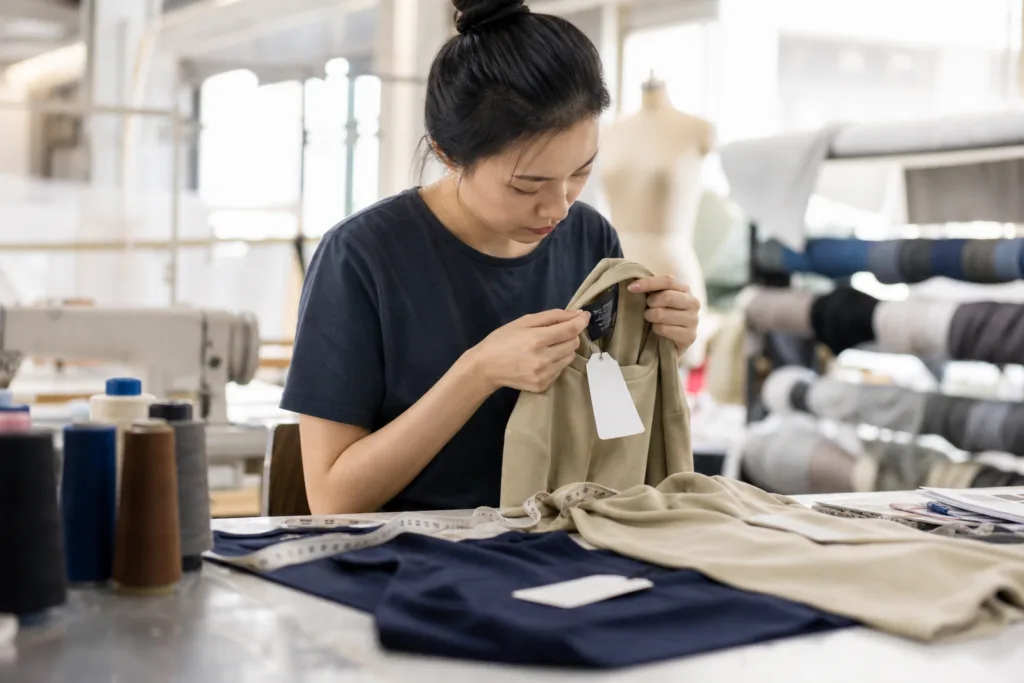
When buyers compare suppliers, they sometimes look only at the FOB or ex-factory price. That can lead to a misleading picture of the real landed cost, especially for apparel where freight, brokerage, duties, and packaging choices can change the final number quickly.
Even if the unit price looks attractive, the total cost should include the full path from factory to warehouse. If you want a deeper commercial view of import duties on clothing from China and how they affect landed cost, that planning step is best done before the order is finalized.
- Factory price for the garments.
- Sampling and development cost if the style is new.
- Freight charges for air or ocean transport.
- Customs brokerage and entry filing fees.
- Duty, tariff exposure, and possible additional fees.
- Inland delivery from port or airport to your warehouse.
Key takeaway: A good sourcing plan looks at landed cost, not just the garment quote, because cheap product pricing can still produce an expensive shipment.
Restricted or regulated apparel that deserves extra review
Some apparel categories need more care than basic tees or hoodies. The most common risk is assuming every garment can be imported the same way when certain products have safety, performance, or age-specific requirements.
- Children’s clothing: often needs extra attention on flammability, fit, and labeling.
- Sleepwear or flame-resistant items: should be checked for the correct claims and proof before production.
- Special performance apparel: may need testing or technical documentation if it carries specific claims.
- Protective or utility garments: can involve additional standards beyond ordinary fashion apparel.
If a product is marketed with a safety claim, that claim should be supported by the actual garment, not just by a hangtag or sales sheet. Buyers should ask for proof early rather than try to fix the claim after the bulk goods are already finished.
How packaging, carton marks, and inner labels should be prepared
Packaging may look like a small detail, but it affects warehouse handling, retail readiness, and customs clarity. A well-prepared shipment should tell the same story on the carton, the polybag, the hangtag, and the packing list.
- Use carton marks that match the style number, color, size, and quantity.
- Keep size breakdowns clear if the order contains mixed ratios.
- Mark outer cartons in a way that helps the warehouse receive and sort quickly.
- Confirm that polybags, hangtags, and inner labels match the approved brand artwork.
- Make sure the factory packs the exact ratio that appears on the packing list.
For private label apparel, this is where many issues appear. A buyer may approve the garment sample but forget to confirm packaging details, which can lead to a product that is technically correct but still not ready for retail.
What to check before sample approval and bulk shipment
The sample is the best chance to reduce downstream risk. Once the sample is approved, the buyer should make sure the approved version is the one the factory uses for bulk production, trimming, labeling, and packing.
- Check the sample against the tech pack, not just against memory.
- Confirm measurements, grading, and fit on the correct size range.
- Verify color, hand feel, and fabric composition.
- Review logo placement, print size, and embroidery quality.
- Approve label copy, hangtags, and package inserts before mass production.
- Confirm the size breakdown and colorway count for the actual order.
| Pre-shipment check | What good looks like | Why it reduces risk |
|---|---|---|
| Measurements | Match the approved spec sheet within agreed tolerance | Prevents size complaints and return issues |
| Labeling | Fiber, origin, and brand details are correct | Reduces customs and retail compliance problems |
| Packing list | Carton counts and size ratios match the real boxes | Avoids receiving disputes and broker questions |
| Carton marks | Style, color, size, and quantity are easy to read | Speeds warehouse handling and inspection |
Common beginner mistakes when importing clothing from China to the USA
Most first-time import problems are preventable. They usually come from unclear instructions, rushed approvals, or assumptions that someone else will catch the error before the cargo ships.
- Using a vague garment description on customs documents.
- Approving labels after bulk production has already started.
- Choosing an HS code before the sample is finalized.
- Ignoring the real landed cost and focusing only on unit price.
- Assuming the factory will handle legal import responsibility.
- Sending a packing list that does not match the finished cartons.
- Skipping a final label and carton verification step.
The easiest way to avoid these mistakes is to slow down before shipping and make sure the product story, the paperwork, and the physical goods are all aligned.
A simple pre-shipment checklist for first-time apparel importers
Use this checklist before the goods leave the factory. It will not solve every customs issue, but it will remove many of the avoidable ones.
- Confirm the importer of record and broker contact details.
- Match the invoice description to the actual garment.
- Verify the HS code with the finished sample in hand.
- Check country of origin, fiber content, and care label text.
- Review carton marks, carton counts, and size ratio.
- Approve the packing list against the finished quantity.
- Make sure all photos, artwork, and specs are archived for reference.
- Ask the factory for final inspection photos before pickup.
A first order goes better when each team member knows exactly what they are checking. The buyer checks commercial accuracy, the manufacturer checks production accuracy, and the broker checks customs accuracy.
When to ask for help from a customs broker, compliance specialist, or manufacturer
Ask for help early if the product type is unclear, the label text is not final, or the tariff classification may affect landed cost. That is especially true when the order includes mixed styles, special claims, or a new private label program that has never shipped before.
At Ninghow, we often see buyers lower risk simply by aligning the tech pack, label copy, carton marking, and packing list before booking freight. That alignment saves rework at the factory and helps your broker clear the shipment with fewer surprises.
A broker can help with customs entry and clearance, but the manufacturer can help make the shipment easier to clear by producing the garment the right way from the start. When both sides work from the same product details, the import process becomes much cleaner.
Final buyer takeaway
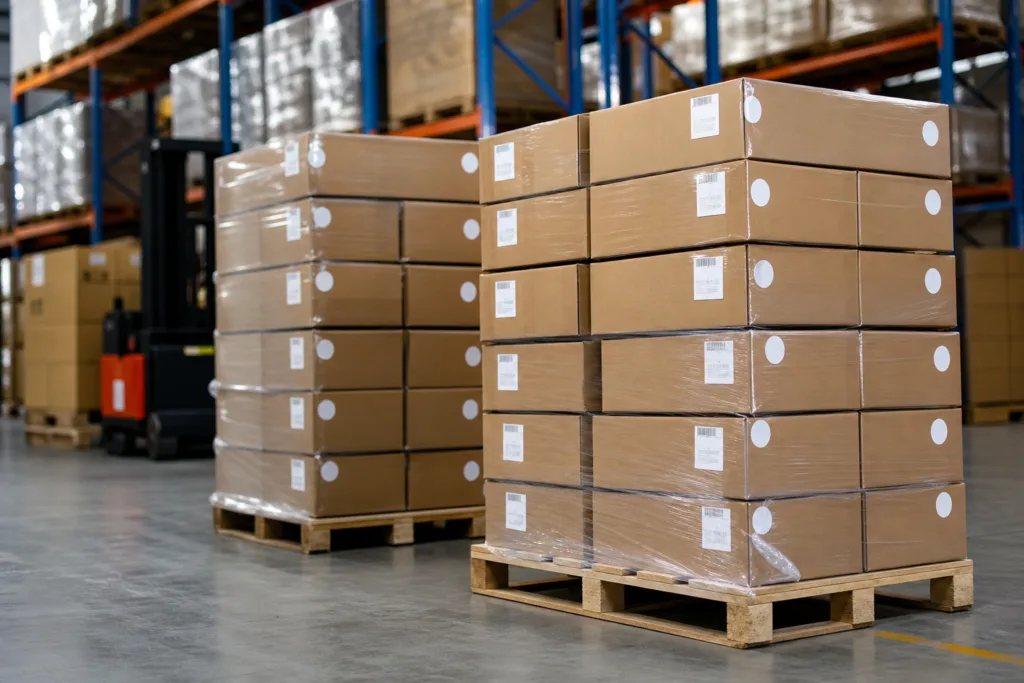
When you import clothing from China to USA, the safest approach is to build the order around clarity. Confirm the importer of record, finalize the product description, lock the label copy, check the HS code, and keep every document consistent with the actual cartons.
That process may sound detailed for a simple apparel order, but those details are what protect your timeline and landed cost. If you treat compliance, labeling, and packaging as part of product development, your first shipment has a much better chance of clearing smoothly and arriving ready for sale.
Frequently Asked Questions
What documents do I need to import clothing from China to the USA?
You usually need a commercial invoice, packing list, bill of lading or air waybill, and the customs entry paperwork your broker files. The important part is that product names, quantities, values, fiber content, and carton counts match across all documents and the actual shipment.
Who is responsible for customs compliance in an apparel shipment?
The importer of record is responsible for the entry, duty payment, and recordkeeping, even if the manufacturer and broker handle parts of the process. The factory, forwarder, and broker each have a role, but they do not replace the buyer’s legal responsibility.
What labels must imported clothing have?
Imported clothing normally needs fiber content, country of origin, and the identity of the manufacturer or registered identification mark if used, plus care instructions when applicable. The exact label format should be checked before production so the factory does not sew in the wrong information.
How do I choose the right HS code for apparel?
Start with the garment type, then confirm construction, fabric composition, and intended use before assigning a tariff classification. A wrong HS code can change duty exposure and trigger customs questions, so it is worth verifying before shipment.
What should I check before the factory ships my order?
Confirm the approved sample, size breakdown, colorway list, label artwork, carton count, and packing list against the bulk order. A final pre-shipment audit helps catch label mix-ups, short counts, and carton marking errors while the goods are still in the factory.
When should I ask for help from a broker or manufacturer?
Ask for help as soon as the product is unclear, the labels are not final, or the HS code and duty exposure are uncertain. Early support is cheaper than fixing a shipment at the port.