








For small apparel brands, the short answer is yes: private label clothing can be worth it when your product direction is clear, your margins are realistic, and you are ready to manage sampling, inventory, and repeat ordering with discipline. It gives you stronger control over branding, presentation, and customer experience than buying generic blanks, but it also asks for better planning because cash is tied up earlier in labels, packaging, fit approval, and production.
If you are comparing launch paths and want to review private label apparel development options, it helps to look beyond the logo alone. In our manufacturing work, private label projects usually involve decisions about fabric selection, size specs, labeling, trims, packaging, sample revisions, and MOQ strategy. For small brands, the best results usually come when these choices are aligned with a focused first product line rather than a broad launch with too many SKUs.
What does private label clothing really mean for a small brand?
Private label clothing usually means a manufacturer produces garments that carry your brand identity instead of the factory’s or a generic wholesaler’s identity. That can include neck labels, woven labels, hangtags, packaging, care labels, size labels, custom colors, and in some cases custom fit or fabric development.
For small brands, private label sits between two extremes. It is more brand-owned than simply printing on ready-made stock, but often less complex than building every garment completely from zero with highly specialized construction.
This distinction matters because many founders assume private label always means full custom development. In practice, there are different levels. Some projects use existing factory blocks with brand-specific trims and labels, while others involve custom patterns, unique fabrics, or detailed technical requirements.
Who is private label clothing best suited for?

Private label is usually best for brands that already know what market they want to serve and what type of product customers will buy again. That could be a startup focused on golf polos, teamwear basics, premium T-shirts, gym tops, or lifestyle hoodies with a consistent fit and brand presentation.
It is less suitable when the brand is still testing completely different audiences, price points, and product categories at the same time. In that stage, too much customization can increase cost before the market signal is strong enough.
- Brands with a clear product niche and target customer
- Founders who want consistent labeling and packaging from the start
- Businesses planning repeat orders rather than one-off promotional sales
- Teams that can manage size specs, approvals, and inventory carefully
- Buyers comparing long-term margin and brand value, not only first-order cost
Key takeaway: Private label tends to work best when the brand already has direction. It becomes much harder when the product idea, customer, and price strategy are still uncertain.
Is private label clothing worth it when brand control matters?
Yes, private label is often worth it if brand control is a core business goal. You control how the product looks when customers receive it, how the label reads, how the garment feels, and how consistent the presentation is across repeat orders.
That control matters because customers rarely judge a garment by logo decoration alone. They notice hand feel, fit, label comfort, packaging quality, and whether the item feels intentional. A well-developed private label product creates a more complete brand impression than a blank garment with a print added later.
From our manufacturing perspective, stronger brand control also improves internal consistency. If you define label placement, fabric type, GSM target, logo application, packaging method, and measurement tolerance early, bulk production becomes easier to repeat with fewer surprises.
Where branding control creates real value
- Better perceived value through custom labels and cleaner presentation
- Stronger product identity across online listings and retail packaging
- More consistent repeat buying when fit and quality stay stable
- Clearer differentiation from other small brands using the same stock blanks
- Greater flexibility to build collections instead of isolated items
Small brands often underestimate how much repeat customer value depends on consistency. A customer who likes your first polo or hoodie is more likely to reorder when the second production run feels the same in fabric, shape, and finish.
Where private label can fail for small brands
Private label usually fails when founders overestimate demand, choose too many styles, or approve products before the technical details are ready. The problem is not private label itself. The problem is launching it without enough control over inventory, cash flow, and product focus.
The biggest pressure point is finished stock. Unlike print-on-demand or low-commitment sourcing, private label normally requires a production commitment, and that means money is tied up in goods before all sales are realized.
This is why inventory discipline matters. Practical guidance on inventory management and reorder planning is useful because small brands need to watch stock levels, reorder timing, and slow-moving sizes carefully if they want private label to remain healthy rather than become a cash drain.
| Risk Area | What Happens | Why It Hurts Small Brands |
|---|---|---|
| Over-ordering | Too many units or colors are produced | Cash gets trapped in unsold stock |
| Weak fit approval | Bulk order follows an unrefined sample | Returns and poor reviews increase |
| Too many SKUs | Sizes, colors, and styles multiply early | MOQ and inventory complexity rise fast |
| Unclear cost targets | Packaging and trims expand unexpectedly | Margin becomes weaker than planned |
| Unstable demand | Reorders are difficult to forecast | Production planning becomes risky |
What costs should small brands expect upfront?
The upfront cost is one of the main reasons founders ask whether private label clothing is worth it. Compared with buying decorated stock goods, private label usually adds spending in sample development, labeling, packaging setup, and minimum production commitments.
These costs are not all equal. Some are one-time setup costs, while others repeat with every order. Knowing the difference helps you judge whether the model fits your budget.
| Cost Area | Typical Purpose | One-Time or Repeating |
|---|---|---|
| Pattern or fit refinement | Improve shape, sizing, and consistency | Usually upfront, then updated if needed |
| Sampling | Approve construction, fabric, branding, and measurements | Upfront with possible revisions |
| Labels and hangtags | Create brand identity inside and outside the garment | Usually repeating after first setup |
| Packaging | Support retail presentation and shipping readiness | Repeating |
| Fabric sourcing | Match hand feel, composition, and color target | Repeating, affected by order volume |
| Bulk production | First commercial run | Repeating |
For many small brands, the cost question should not be limited to the first order total. A better question is whether the product can produce acceptable margin across the first run and then become easier to reorder with more predictable costs.
At this point, many founders benefit from understanding how apparel order planning works from sampling to bulk. The order path affects both budget timing and risk because label sourcing, fit approval, and production scheduling all influence when money is spent and when stock becomes saleable.
Why MOQ matters more for small brands than for established labels
MOQ matters because it decides how much inventory and cash you must commit before the product proves itself in the market. Larger brands can spread that risk across bigger sales volume, stronger forecasting, and broader distribution. Small brands usually cannot.
MOQ is also not just a factory policy issue. It is shaped by fabric availability, dyeing requirements, trim sourcing, production efficiency, and whether the style is based on an existing program or a more custom build.
In our production work, low MOQ is more realistic when the product uses available fabrics, standard construction methods, and simpler trim packages. MOQ becomes harder when a brand wants custom colors, special fabrics, multiple logo applications, and fully customized packaging on a small unit count.
Brands that need low MOQ production options for early-stage orders should treat MOQ as a planning variable, not just a negotiation point. Sometimes the smartest move is reducing color count, simplifying trims, or launching one hero product first.
What small brands should check about MOQ
- MOQ per style, not just per total order
- MOQ per color and size range
- Whether labels and packaging have their own minimums
- How custom fabric or dyeing changes minimums
- Whether a repeat order can use the same trims and packaging stock
How private label supports market differentiation
Private label becomes more valuable when your market is crowded. If many competitors use similar blank garments, custom branding and product consistency can help your brand feel more complete and more intentional.
Differentiation does not always mean dramatic design. Often it comes from a focused combination of fit, fabric hand feel, color palette, neck label comfort, embroidery quality, and packaging presentation. These details are small individually, but together they shape how customers remember the brand.
This is one reason we encourage founders to keep the first line narrow. It is easier to differentiate one well-developed product than six average ones. For a small apparel brand, a clear product identity is usually more valuable than a large opening catalog.
Why packaging, trims, and labels affect perceived value
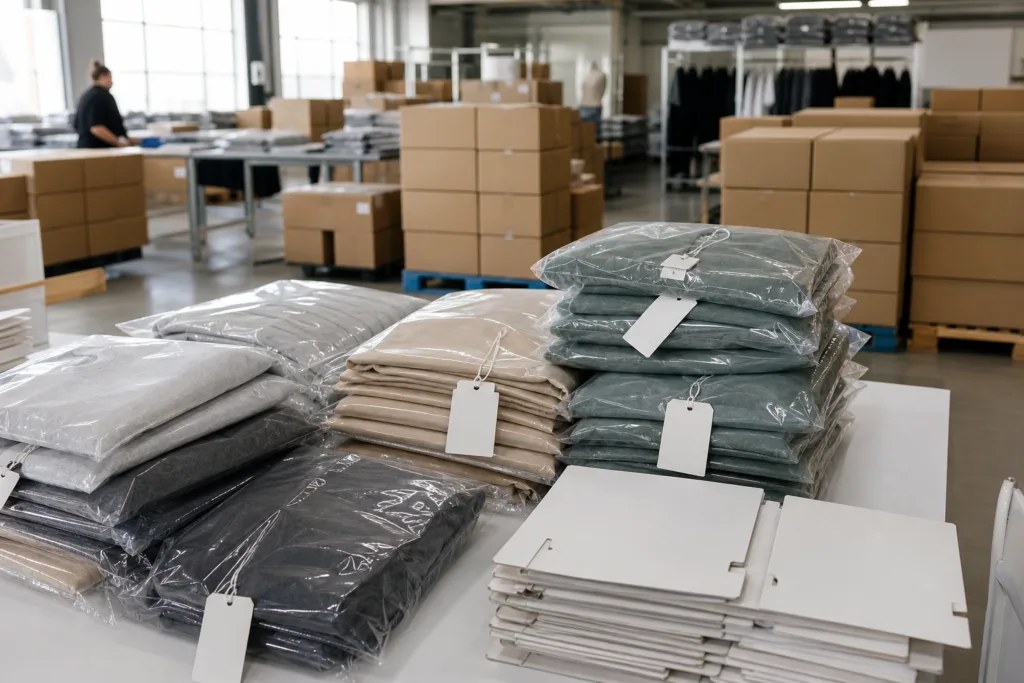
These details matter because customers read them as signs of seriousness. A garment with a scratchy neck label, weak hangtag string, inconsistent polybag presentation, or poor care label layout can make the product feel less premium even if the fabric itself is good.
From a manufacturer viewpoint, trims and labels also affect production coordination. Size labels, brand labels, care labels, zipper pulls, drawcords, and packaging all need approval before bulk runs smoothly.
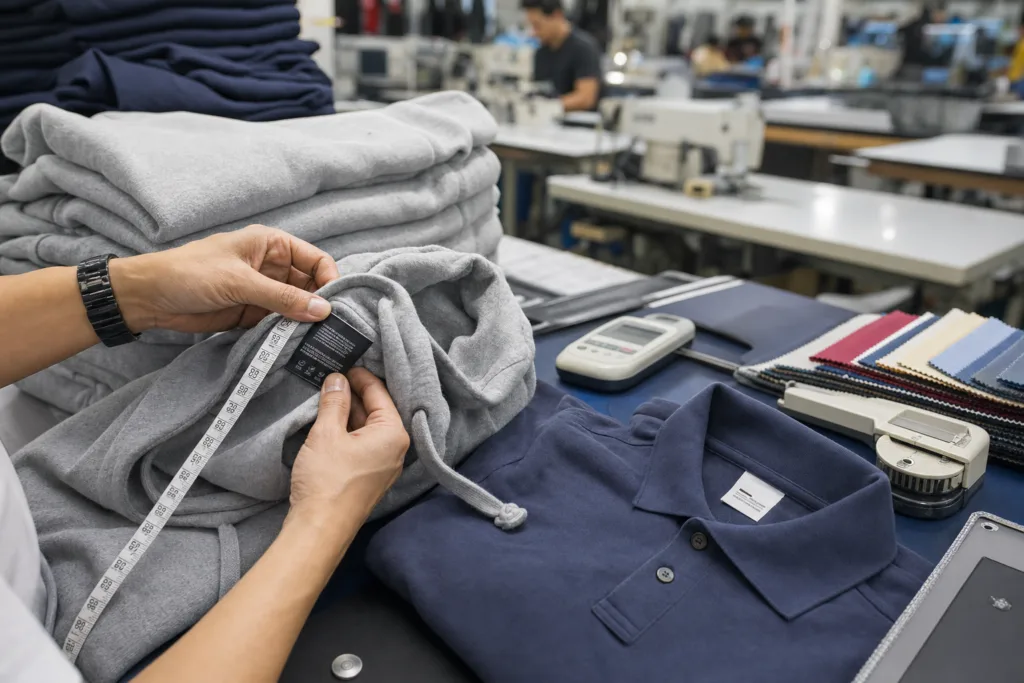
- Neck labels affect comfort and brand visibility
- Care labels affect compliance clarity and customer trust
- Hangtags support retail storytelling and pricing presentation
- Outer packaging affects fulfillment consistency
- Trim consistency helps repeat orders look more professional
Care labeling should not be treated casually. If your garments are sold across regulated markets, fiber content and care information should be accurate and understandable, and the FTC textile labeling guidance is a useful reference point when reviewing what needs to appear on labels for applicable products.
Which product category is smartest for a first private label launch?
The best category is usually the one with the clearest repeat demand and the simplest path to quality consistency. For many small brands, that means starting with a core product such as a T-shirt, polo, hoodie, sweatshirt, or training short rather than a highly technical outerwear piece.
A good first product has understandable sizing, manageable fabric sourcing, and broad repeat potential. It should also match your customer’s daily or weekly buying behavior. Customers reorder basics and reliable core pieces more often than highly seasonal statement items.
| Category | Why It Can Work First | What to Watch |
|---|---|---|
| T-shirts | Simple construction, strong repeat potential | Fit and fabric hand feel are highly noticeable |
| Polo shirts | Good for golf, uniform, and smart-casual branding | Collar quality and placket construction matter |
| Hoodies | High perceived value and branding space | GSM, shrinkage, and fleece quality affect results |
| Shorts | Useful for sportswear and lifestyle categories | Waist fit and pocket construction need testing |
| Jackets | Higher selling price potential | More complexity, more trim dependencies, higher risk |
Key takeaway: Your first private label product should be easy to sell again, not just exciting to launch once.
How fabric, fit, and quality affect long-term retention
Fabric and fit are where many private label brands either build loyalty or lose it. If the fabric feels right, the GSM matches the intended use, and the fit stays consistent across orders, customers are far more likely to come back.
For example, a premium-feel T-shirt may need a denser, smoother fabric with better recovery, while an active polo may prioritize breathability, stretch, and shape retention. A hoodie aimed at cooler-weather casual wear may need higher GSM and a stable fleece interior. These are not only style decisions; they affect price, wear comfort, and reorder confidence.
Pattern control matters just as much. A garment can use a good fabric and still underperform if shoulder width, sleeve opening, body length, or grading is inconsistent. This is why sample development support before full production is so important for smaller brands that cannot afford quality mistakes in their first commercial run.
Manufacturer checks that influence repeatability
- Fabric composition and GSM consistency
- Shrinkage behavior after washing
- Color matching from lab dip to bulk
- Measurement tolerances across sizes
- Logo placement and decoration durability
- Sewing quality at stress points
- Final finishing and packing accuracy
When OEM, ODM, or ready-to-brand products may be smarter
Private label is not always the right first move. If your brand is still testing demand, a lighter development path may be smarter. That could mean adapting an existing factory style, simplifying custom details, or starting from a proven product block with your own labels and packaging.
This is where clothing manufacturing support for startup brands becomes relevant. Small brands often need help deciding whether to begin with a near-stock development route, an existing silhouette with brand customization, or a deeper private label program.
At Ninghow, we usually see better outcomes when founders match the development level to the actual business stage. If demand is unproven, full complexity may not be the most practical use of early cash. If the product category and customer are already validated, stronger private label control can make much more sense.
How should small brands judge profitability?
Private label is worth it only if the numbers work after all real costs are included. That means not just fabric and sewing, but also samples, labels, packaging, shipping, possible duties, content creation, returns risk, and the cost of holding inventory.
Small brands should judge profitability using four connected measures: unit cost, gross margin, sales velocity, and reorder potential. A low unit cost alone does not help if the product sells slowly or needs excessive discounting.
| Profitability Factor | What to Ask | Why It Matters |
|---|---|---|
| Unit cost | Is the landed cost still workable at your selling price? | Determines baseline margin |
| Gross margin | Can margin cover marketing, operations, and returns? | Shows whether the model is sustainable |
| Sales velocity | How quickly will the first run likely sell? | Affects cash recovery speed |
| Reorder potential | Can the style be repeated with confidence? | Improves long-term efficiency |
In practical terms, a brand with moderate margin but strong repeat demand can be healthier than a brand with high theoretical margin and weak reorder behavior. Repeatability is where private label often becomes more efficient over time.
What mistakes do small brands make most often?
The most common mistake is trying to launch too much at once. That can mean too many categories, too many colors, too many logo methods, or too much custom packaging before the product-market fit is clear.
Another frequent issue is approving a sample too quickly. Small differences in collar shape, body length, cuff tension, print size, or fabric weight can become large problems in bulk if they are not resolved before production.
- Choosing product categories based on trend excitement instead of repeat demand
- Ignoring size grading and only checking one sample size
- Underbudgeting for trims, packaging, and revisions
- Using too many SKUs in the first run
- Failing to plan reorder timing before launch
- Comparing suppliers only on price and not on communication clarity
Key takeaway: For most small brands, disciplined simplification is more valuable than ambitious complexity in the first private label launch.
When is private label clothing worth it, and when is it not?
Private label is usually worth it when you have a focused category, realistic margins, controlled SKU count, and a product you expect to reorder. It is not worth it when demand is highly uncertain, cash is too tight to support inventory, or the launch relies on too many custom details too early.
A simple decision framework can help.
| If This Is True | Private Label May Be Worth It | Private Label May Not Be Worth It Yet |
|---|---|---|
| You know your customer well | Yes | No, if audience is still unclear |
| You have one strong launch category | Yes | No, if product mix is scattered |
| You can fund samples and inventory | Yes | No, if cash flow is too fragile |
| You need stronger brand identity | Yes | Less urgent if testing concept only |
| You expect repeat orders | Yes | No, if demand is event-driven only |
How should you prepare before talking to a clothing manufacturer?
Preparation saves time, sample rounds, and cost. The clearer you are before the first discussion, the easier it is for a manufacturer to assess whether private label is feasible at your expected volume and price point.
- Define your first product category and target customer
- Set a realistic target retail price and target margin
- List must-have branding details such as labels, hangtags, and packaging
- Decide which details are essential and which can wait until later
- Prepare logo files, reference photos, size intent, and fabric preferences
- Estimate launch quantity by style, color, and size
- Know your timeline for sampling and bulk delivery
In many cases, founders do not need every answer perfectly defined. But they do need enough clarity for the manufacturer to recommend the right path, whether that is simplified private label, a lower-risk MOQ approach, or a more developed OEM route.
Conclusion
So, is private label clothing worth it for small apparel brands? Often yes, but only when it is approached as a planned product system rather than a branding shortcut. The strongest private label programs are built on focused category choice, careful sampling, realistic MOQ planning, and disciplined inventory management.
From our side as a manufacturer, the most successful small-brand projects usually begin with one clear product, one workable cost structure, and one repeatable quality standard. When those pieces are in place, private label can strengthen differentiation, improve perceived value, and create a better platform for long-term growth.
If a brand is still early in its decision process, the practical next step is to compare development depth, MOQ feasibility, and presentation requirements before committing to a first run. That approach leads to better product decisions and reduces the risk of building inventory around an idea that is not yet ready.
FAQs
Is private label clothing worth it for a new brand with a small budget?
It can be, but only if the launch is tightly focused and the first order is financially manageable. Small-budget brands usually do better when they start with one core product, limited colors, simple trims, and a realistic quantity instead of trying to build a wide collection immediately.
What is the biggest cost difference between private label and buying blanks?
The biggest difference is that private label adds development and branding costs before sales happen. Sampling, labels, packaging, fit refinement, and MOQ commitments all increase the upfront investment, even though they can also improve brand value and long-term consistency.
How many units do I usually need for private label clothing?
There is no single number because MOQ depends on the garment type, fabric, color count, trim requirements, and production method. For small brands, the practical question is not only the minimum order size, but whether that quantity fits your cash flow, sales forecast, and SKU strategy.
Can private label improve profit margins?
Yes, it can improve margins if the product supports a stronger selling price and repeat demand. However, better margins only happen when all real costs are included, including packaging, sampling, shipping, and inventory holding, and when the product sells at the planned pace.
Should I start with full custom development or a simpler private label model?
A simpler private label model is often better for a first launch because it reduces complexity and helps you validate demand faster. Many small brands benefit from using a proven factory base style with their own labels, packaging, and controlled customization before moving into deeper custom development.
What should I send a manufacturer before requesting a quote?
You should send a clear product brief with the garment type, target quantity, color plan, logo method, labeling needs, packaging ideas, size direction, and target market position. Even if some details are still flexible, this information helps the manufacturer recommend a practical development path and identify possible MOQ or cost issues early.