


Choosing between pique cotton vs polyester polo shirts is not just a fabric question. For apparel brands, uniform buyers, golf programs, and distributors, the fabric decision shapes market positioning, wearer comfort, logo appearance, repeat-order satisfaction, and even how the product is priced at retail or in bulk tenders.
If your project requires a clearer comparison before development starts, it helps to review polo shirt manufacturing options in a practical way. At Ninghow, we support polo programs through fabric selection, sampling, embroidery or printing planning, private label details, size specification review, and bulk production control so buyers can match the right polo fabric to the right market instead of choosing on price alone.
From our manufacturing perspective, the right answer depends on who will wear the polo, how often it will be washed, what image the garment should project, and how the logo will be applied. Cotton pique and polyester can both work well, but they perform differently in breathability, moisture behavior, wrinkle resistance, care, and long-term appearance.
What is pique cotton and what is polyester in polo shirts?
Pique cotton usually refers to a cotton-based knitted fabric with a textured surface, often associated with traditional polo shirts. The texture gives the shirt a more structured, slightly elevated look than a basic jersey knit, which is one reason cotton pique remains popular in corporate, casual, and premium uniform programs.
Polyester polo fabric can be made in pique structure too, or in smoother performance knits. In polo production, polyester is commonly selected for moisture management, shape retention, lower wrinkle risk, and easier care, especially in active, outdoor, promotional, or work-related use cases.
The key point is that buyers are often comparing not just fiber type, but also knit structure, yarn quality, GSM, finish, and expected end use. A low-cost polyester polo and a premium performance polyester polo do not feel the same. The same is true for cotton pique across budget and upgraded programs.
How does the pique knit structure affect look, breathability, and hand feel?
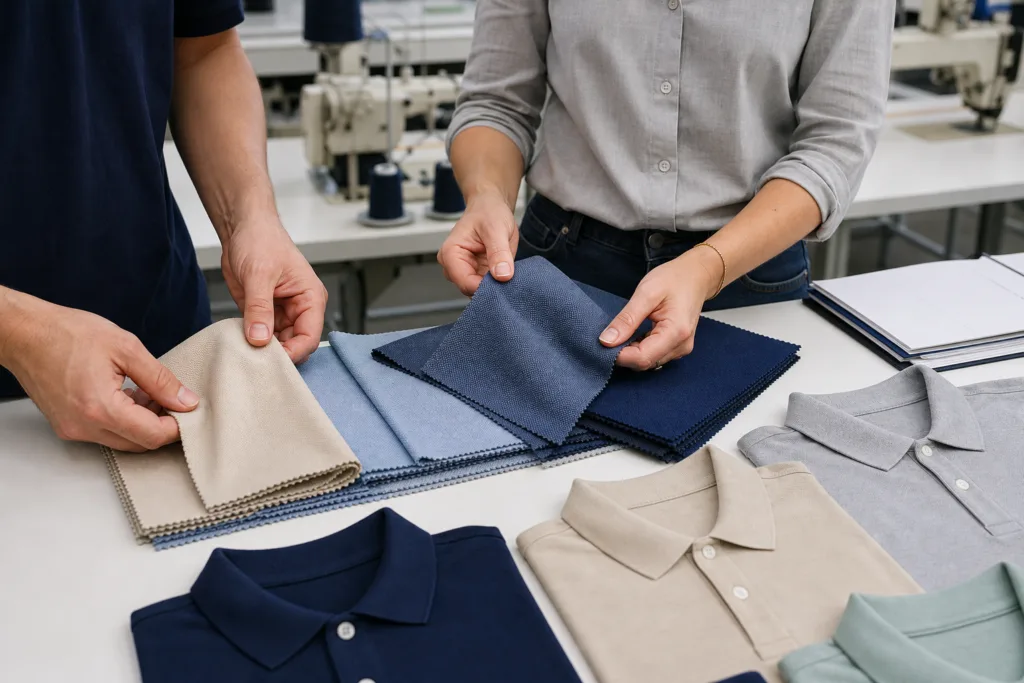
Pique is a knit structure that creates a subtle raised texture. That texture matters because it changes both the appearance and the way the shirt sits on the body. Compared with flat jersey, pique often looks more refined and less clingy, which is why it is widely used in polos for office, golf, hospitality, and schoolwear.
The small textured surface can also help airflow and reduce the visual effect of sweat compared with a very smooth knit. In practical sourcing terms, that means pique structure can improve perceived quality even before a buyer touches the garment.
Hand feel still depends heavily on fiber and finishing. Cotton pique usually feels softer, more natural, and more matte. Polyester pique often feels lighter, cooler, or slicker depending on yarn type and finishing chemistry.
| Fabric element | What it affects | Buyer impact |
|---|---|---|
| Pique texture | Surface interest and structure | More classic polo appearance |
| Fiber type | Moisture, softness, drying speed | Changes comfort and care profile |
| GSM | Weight and drape | Affects price, opacity, and market fit |
| Finish | Softness, wicking, anti-pilling | Influences performance and repeat wear |
Key takeaway: When buyers compare pique cotton vs polyester polo shirts, they should evaluate fiber and knit together, not fiber in isolation.
Pique cotton polo shirts: where they work well and where they need caution
Cotton pique polos are usually the better choice when the buyer wants a classic, natural, and more premium-casual image. They are often favored for office uniforms, lifestyle retail, clubs, hospitality, and markets where hand feel matters as much as technical performance.
Cotton absorbs moisture well and often feels comfortable next to skin. Guidance on cotton fiber structure and moisture behavior helps explain why cotton can feel breathable and soft, while also retaining more moisture than polyester during heavy activity or slow drying conditions.
In production, cotton pique also tends to deliver a familiar visual language that many end users already associate with a quality polo shirt. The fabric often has a richer, less synthetic look, which can support a stronger perceived value in certain retail and uniform categories.
Strengths of cotton pique polos
- Natural hand feel with a softer and more traditional polo impression
- Good comfort for low to moderate activity
- Strong appeal for premium casual, office, hospitality, and schoolwear markets
- Often very suitable for embroidery because of fabric body and stable appearance
- Usually presents a matte, less technical visual style
Limitations buyers should expect
- Slower drying than polyester in active or hot conditions
- Higher wrinkle risk after washing or packing
- Possible shrinkage if fabric and finishing are not controlled well
- Can feel heavier when wet
- Appearance retention may drop faster in very high-wash programs
For brands targeting clean office presentation, resort wear, or elevated basics, cotton pique can still be the right answer. But buyers should align that choice with realistic care expectations, especially if the end user will wash the polo frequently at home and may not follow careful laundering habits.
Polyester polo shirts: where they perform best and what trade-offs to manage
Polyester polos are usually the more practical choice when the product must dry quickly, resist wrinkles, hold shape, and support repeated use. They are common in golf apparel, outdoor programs, event uniforms, school sports, teamwear, and many promotional categories.
From a factory standpoint, polyester can be easier to standardize for bulk consistency in colorfastness, dimension stability, and repeat manufacturing, although quality still varies significantly by yarn grade, GSM, and finishing. A cheap polyester polo may feel shiny or harsh, while a better-developed one can feel refined and performance-focused.
Polyester also allows stronger performance positioning. For buyers planning custom golf polo shirt solutions, polyester is often selected because golfers and club programs usually prioritize lightweight feel, sun-friendly wearability, and faster drying during active use.
Strengths of polyester polos
- Fast drying and strong moisture-wicking potential
- Lower wrinkle risk and easier daily care
- Better shape retention after repeated washing
- Often lighter in weight for active programs
- Well suited to sports, events, teamwear, and performance categories
Limitations buyers should manage
- May feel less natural than cotton
- Can look too technical for some premium casual markets
- Surface shine or synthetic feel may reduce perceived value if yarn quality is low
- Heat sensitivity matters during printing and finishing
- Odor management may need special treatment in some use cases
Polyester is not automatically lower quality than cotton. The real question is whether the fabric supports the market story. In many active and service environments, performance convenience matters more than a natural hand feel.
Pique cotton vs polyester polo shirts: side-by-side comparison buyers can use
The simplest comparison is this: cotton pique usually wins on traditional feel and classic appearance, while polyester usually wins on drying speed, care ease, and active performance. The final selection depends on the balance your market expects.
| Factor | Pique cotton polo | Polyester polo |
|---|---|---|
| Appearance | Classic, matte, traditional | Performance-driven, can be smooth or textured |
| Hand feel | Softer, more natural | Cooler or slicker depending on finish |
| Breathability | Good in daily wear | Good when engineered for airflow |
| Moisture behavior | Absorbs moisture, dries slower | Wicks and dries faster |
| Wrinkle resistance | Moderate to low | Usually high |
| Shrinkage risk | Higher if not pre-controlled | Usually lower |
| Durability in heavy wash use | Good but depends on yarn and finish | Often better for frequent wash cycles |
| Care convenience | More care-sensitive | Easier for mass programs |
| Image | Premium casual or classic uniform | Technical, active, practical |
Surface durability should also be discussed during development. Recognized methods for pilling resistance and surface durability are useful when buyers want clearer standards for appearance retention, especially in retail, corporate uniform, and repeat-wash applications.
Key takeaway: Cotton pique often sells on feel and image, while polyester usually sells on performance and maintenance convenience.
Which fabric handles moisture, comfort, and climate better?
For hot offices, moderate daily wear, and customers who value a natural touch, cotton pique can feel more pleasant at the start of wear. It absorbs perspiration and often feels less synthetic, which many users interpret as comfort.
For heat, movement, outdoor use, and repeated wear across the day, polyester usually performs better because it moves moisture and dries faster. That matters for golf, hospitality outdoor staff, school sports, and event teams.
There is also an important middle ground. Some performance-cotton programs use engineered finishing to improve drying behavior. Information on performance cotton moisture management helps explain why cotton-based options can sometimes support a more balanced comfort-performance story for premium polos.
In our production work, climate should be discussed early. Humid markets, tropical distribution, and outdoor staff programs often benefit from polyester or blends. Cooler indoor markets can support heavier cotton pique more successfully.
What buyers should know about embroidery, printing, and logo performance
Logo application should not be treated as a final-step decision. It should influence fabric choice from the beginning because the same logo can behave very differently on cotton pique and polyester.
Embroidery usually works well on both fabrics, but the visual effect changes. Cotton pique often gives embroidery a classic branded-uniform look. Polyester can also embroider well, but lightweight fabrics may require stabilizer adjustment to avoid puckering or distortion.
Printing decisions are more technical. If your project needs large graphics, event branding, or fashion-driven artwork, it helps to plan printed polo shirt customization paths around fabric heat tolerance, ink compatibility, logo size, and the desired finish.
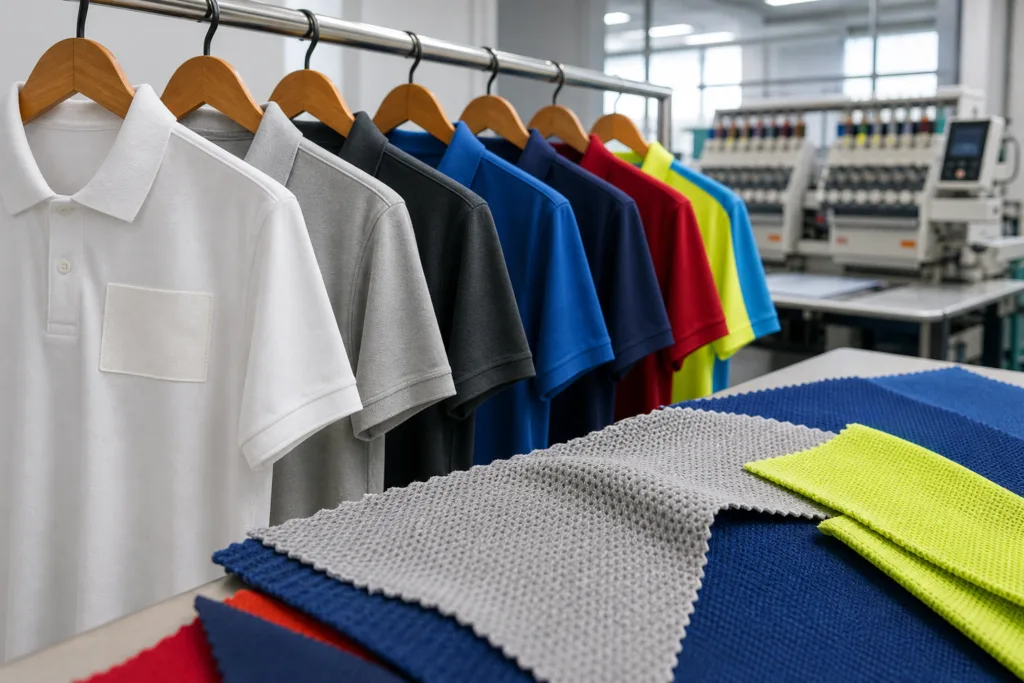
| Decoration method | Cotton pique | Polyester | Best use case |
|---|---|---|---|
| Embroidery | Strong traditional look | Good with proper stabilization | Corporate, hospitality, school, golf |
| Screen printing | Can work for selected layouts | Needs correct ink system | Promotional or graphic-led polos |
| Heat transfer | Useful for detail graphics | Common for sports and event use | Names, numbers, small logos |
| Sublimation | Not suitable for cotton | Best on polyester | Teamwear and all-over design |
Buyers should also ask whether the polo placket, chest area, and fabric stretch will affect logo placement. A polo is not a flat T-shirt, so decoration planning needs to consider buttons, seams, fabric texture, and end-use washing conditions.
How does fabric choice change cost and retail positioning?
Fabric choice changes cost through yarn price, GSM, finishing, dyeing, performance treatment, and expected defect tolerance. A basic answer is that there is no single rule saying cotton is always more expensive or polyester is always cheaper. The actual cost depends on specification level.
For example, a low-GSM standard polyester polo can be cost-efficient for promotions. A premium heathered performance polyester with anti-pilling treatment and branded trims may cost more than a basic cotton pique style. Similarly, combed cotton pique with better yarn quality and wash finish will sit above entry-level cotton programs.
From a market standpoint, cotton pique often supports higher perceived value in classic casual channels. Polyester often supports stronger cost-performance logic in active and high-turnover programs. When brands compare margin opportunities, they should consider return rates, repeat wash appearance, and logo longevity, not just ex-factory price.
Common cost drivers
- Fabric GSM and yarn grade
- Dyeing and finishing complexity
- Moisture-wicking or anti-pilling treatments
- Embroidery count or print method
- Private label trims, hangtags, and packaging
- Order volume and color count
Best fabric for custom polo shirts by market segment
The best fabric depends on the selling environment. Instead of searching for one universal answer, buyers should match fabric behavior to end-user expectations.
| Market segment | Usually better option | Why |
|---|---|---|
| Corporate uniforms | Cotton pique or cotton-rich blend | Professional appearance and comfortable daily wear |
| Golf apparel | Polyester or performance blend | Moisture management and active comfort |
| Workwear | Polyester or durable blend | Easy care and repeat-wash resilience |
| Retail casual | Cotton pique | Texture, hand feel, and classic image |
| Promotional programs | Depends on budget and use length | Short-term events differ from repeat uniforms |
| Teamwear | Polyester | Performance and decoration flexibility |
Buyers planning office and service uniforms often start by reviewing custom corporate polo shirt options because image consistency, embroidery quality, and wash appearance matter more there than pure athletic performance.
For industrial staff, field service, and higher-wash environments, durable work polo shirt production usually needs a tougher conversation about abrasion, color retention, care simplicity, and realistic fabric lifespan.
How should brands choose based on climate, activity, image, and order volume?
Start with the use environment. A boardroom-facing uniform and a tournament polo do not need the same fabric behavior. If the wearer will sit indoors most of the day, cotton pique may satisfy the brief better. If the wearer moves outdoors, sweats frequently, or needs quick dry performance, polyester usually makes more sense.
Then consider brand image. Cotton pique supports a heritage, premium-casual, or understated look. Polyester supports a modern active or practical image. Neither is better by default; they communicate different product identities.
Order volume matters too. Larger programs need more attention to shade consistency, replacement continuity, and repeatable sourcing. In these situations, working with Ninghow or another experienced manufacturer means discussing fabric continuity, testing expectations, trim stock, and replenishment strategy before bulk approval.
- Choose cotton pique when feel, tradition, and casual-premium image lead the brief.
- Choose polyester when moisture control, care ease, and repeat-use performance lead the brief.
- Consider blends when the project needs both a softer hand and stronger functional behavior.
MOQ, sampling, and production considerations for custom polo shirt development
MOQ depends on fabric availability, color development, decoration complexity, and whether the program uses stock or custom trims. Cotton pique and polyester can both support lower MOQ in some scenarios, but true flexibility depends on what can be sourced efficiently without creating unstable production conditions.
Sampling is where many fabric decisions become clearer. A buyer may prefer cotton in theory, then switch after seeing shrinkage, drape, or logo effect. Another buyer may expect polyester to feel cheap, then approve it after sampling a higher-grade yarn with a better finish.
In our apparel production work, we recommend confirming these points before bulk production:
- Final fabric composition and GSM tolerance
- Pantone or color standard approval
- Wash result and shrinkage expectation
- Logo method, size, and placement approval
- Size spec and grading confirmation
- Label, hangtag, and packaging details
- Carton assortment and shipping plan
Key takeaway: Fabric selection should be approved through samples, not only through swatches or price sheets.
Common sourcing mistakes when choosing polo shirt fabrics
The most common mistake is choosing fabric by touch alone. A hand feel review is useful, but it does not show wash performance, shrinkage, drying speed, embroidery behavior, or long-term appearance retention.
Another mistake is comparing price quotes without matching the true specification. Two polos described as cotton pique may differ in yarn quality, GSM, compactness, softness, and finishing. The same problem appears in polyester when one supplier quotes a basic performance knit and another quotes upgraded moisture-management fabric.
We also see delays when buyers finalize artwork before confirming fabric suitability. Some logos need embroidery density adjustment, and some print effects are better on polyester than cotton. Early alignment saves both sample rounds and production risk.
- Do not approve by composition alone.
- Do not skip wash testing for uniform or repeat-use programs.
- Do not assume all polyester polos feel the same.
- Do not ignore care label implications for your target market.
- Do not finalize bulk without size, color, and decoration approval.
What questions should buyers ask before placing a bulk polo order?
The right questions help prevent avoidable quality disputes. Buyers do not need to be textile engineers, but they should ask for the information that affects real wearing results.
- What is the exact fabric composition and finished GSM?
- Is the fabric pre-shrunk or dimensionally stabilized?
- What wash test results are available for shrinkage, colorfastness, and appearance?
- How will the logo be applied, and what limitations does the fabric create?
- Will replacement orders use the same fabric source and color standard?
- What is the realistic MOQ by color and by size breakdown?
- What are the QC checkpoints before shipment?
Care guidance should also be accurate because fiber choice affects laundering expectations and end-user satisfaction. For U.S.-bound programs, reviewing textile care labeling requirements is useful when preparing finished polos with correct wash instructions and labeling compliance.
Conclusion: which fabric fits which market?
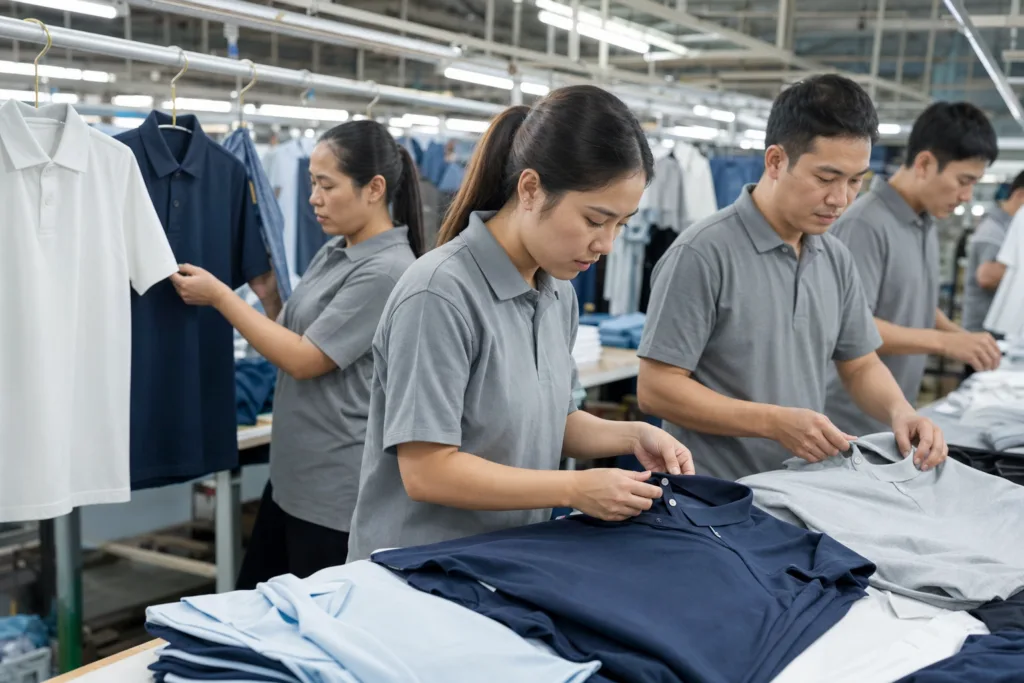
If the target market values classic appearance, natural hand feel, and a more traditional polo identity, cotton pique is often the stronger choice. If the project needs moisture management, easy care, shape retention, and active-use practicality, polyester usually provides a better fit.
The smartest decision is often segment-specific rather than universal. Corporate and retail casual lines may lean toward cotton pique. Golf, teamwear, events, and many work-focused programs may lean toward polyester. Between those two ends, cotton-poly blends and engineered performance cotton can offer a practical compromise.
When buyers compare pique cotton vs polyester polo shirts carefully, they usually get better outcomes in cost-performance balance, branding consistency, and customer satisfaction. The goal is not to find a winner in every case, but to build the polo that fits the market it is meant to serve.
FAQs
Is cotton pique better than polyester for all polo shirts?
No, cotton pique is not better for every polo shirt. It is often better for classic appearance, natural hand feel, and premium casual positioning, while polyester is often better for moisture management, easy care, and repeated active use.
Which fabric is better for corporate uniform polos?
Corporate uniform polos often work well in cotton pique or cotton-rich blends when the goal is a polished and traditional look. Polyester can still be the better choice when staff need easier care, faster drying, or more consistent appearance across heavy wash use.
Are polyester polo shirts too cheap for premium markets?
No, polyester polo shirts are not automatically low-end. Premium polyester polos can feel refined and perform very well, but the yarn quality, knit structure, GSM, and finishing must support the market position instead of looking overly shiny or basic.
What is the best fabric for golf polo shirts?
Polyester or performance blends are usually the best fabric for golf polo shirts. They generally offer faster drying, lighter active comfort, and better moisture management, which aligns with how golf polos are worn in warm and movement-heavy conditions.
Should buyers sample both cotton and polyester before placing a bulk order?
Yes, sampling both can be very helpful when the market position is still being decided. Side-by-side samples reveal differences in drape, logo effect, shrinkage, wash appearance, and wearer comfort that are hard to judge from swatches alone.
When should a brand choose a cotton-poly blend instead of 100% cotton or 100% polyester?
A cotton-poly blend is a practical choice when the brand wants a balance of softer hand feel, improved care performance, and more stable bulk results. Blends can be especially useful for corporate, retail, and crossover programs that need both comfort and easier maintenance.