






Finding the right factory is less about searching for the cheapest quote and more about matching your product, order plan, and quality expectations with a manufacturer that can actually deliver consistently. If you are learning how to find a clothing manufacturer, the most useful approach is to evaluate fabric capability, sample quality, communication speed, MOQ logic, production control, and whether the supplier understands your category, not just whether they say yes to every request.
If you are focused on choosing the right clothing manufacturing partner, it helps to look beyond price sheets and ask how the factory will support fabric selection, fit refinement, logo application, private label details, sample correction, and bulk order consistency. At Ninghow, we help B2B buyers turn early concepts into workable production plans by reviewing specifications, advising on practical materials, arranging sampling, and preparing orders for smoother bulk execution.
What matters most when you compare clothing manufacturers?
The short answer is production fit. A good manufacturer for your project is one that can make your type of garment well, communicate clearly, and control quality from sampling through packing.
Many buyers start with broad searches, then quickly face the same problem: too many suppliers look similar online. From our manufacturing perspective, the real differences usually appear in the details of fabric sourcing, pattern execution, trim coordination, and how a supplier handles revisions when a sample is not right the first time.
Before sending inquiries, define a few basics internally:
- Your product category: T-shirts, polos, hoodies, sportswear, uniforms, golf apparel, outerwear, or mixed programs
- Your target price range and expected quality level
- Your likely MOQ and launch volume
- Your customization needs, such as embroidery, screen printing, sublimation, labels, hangtags, or custom packaging
- Your timeline for sampling and bulk production
- Your fit direction, size range, and target customer
Key takeaway: The clearer your product brief is, the easier it becomes to filter out manufacturers that are not a practical match.
How to find a clothing manufacturer that fits your product type
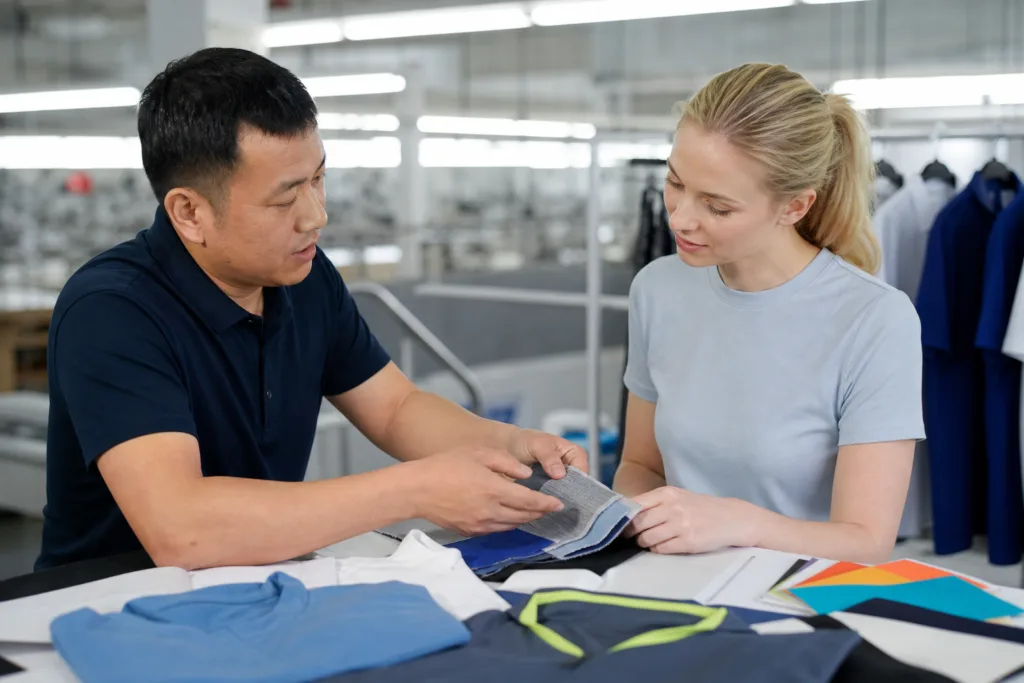
Not every apparel factory is built for the same work. Some are efficient for simple cotton basics, while others are stronger in stretch sportswear, team uniforms, or detail-heavy private label collections.
When buyers ask us how to find a clothing manufacturer, we usually suggest starting with category alignment first. A supplier that regularly produces your garment type is more likely to understand the right fabric behavior, construction methods, finishing standards, and production risks.
| Product Type | What to Check | Why It Matters |
|---|---|---|
| T-shirts and polos | Jersey or pique sourcing, GSM consistency, collar and placket quality | These details affect shrinkage, shape retention, and bulk consistency |
| Hoodies and sweatshirts | Fleece weight, rib quality, seam durability, print stability | Heavy styles expose construction and finishing weaknesses |
| Sportswear and gym clothing | Stretch fabric handling, panel accuracy, moisture-management fabric options | Technical garments need better pattern control and sewing precision |
| Teamwear and uniforms | Color consistency, repeat ordering capability, logo placement control | Programs often require stable replenishment and size consistency |
| Golf apparel | Performance fabrics, refined fit, embroidery quality, neat finishing | Buyers usually expect a more polished hand feel and appearance |
Ask for relevant examples, but do not stop at product photos. Ask what fabrics were used, what decoration methods were applied, what the usual MOQ was, and how long production took. Those answers reveal real operating capability.
What information should you prepare before contacting factories?
The better your inquiry, the better the responses you receive. Factories can estimate more accurately when they know your garment type, fabric preference, customization needs, quantity, and target market.
A strong first inquiry usually includes sketches or reference images, fabric ideas, size range, logo method, estimated order quantity, and expected delivery timing. If you already have artwork, measurements, or brand label requirements, share them early.
Many delays happen because buyers ask for quotations before the product is defined. A supplier may still give a number, but it will often change once fabric, trims, or construction details become clear.
- Style description and intended use
- Fabric composition or similar reference fabric
- Estimated GSM or weight preference
- Color count and dyeing expectations
- Logo size, placement, and method
- Target quantity by color and size
- Packaging needs such as polybags, stickers, barcodes, or cartons
- Required market labeling or care information
When buyers are unsure how to organize their design package, our recommended starting point is understanding how to submit clothing designs to a manufacturer so the factory can evaluate the request without guessing.
How fabric choice affects supplier selection
Fabric is one of the biggest decision points because it affects price, hand feel, fit, durability, and MOQ. A manufacturer may be capable of making your style, but if they cannot source the right fabric consistently, bulk production can still become unstable.
For example, a 100% cotton T-shirt in 180 GSM single jersey behaves differently from a 95/5 cotton-spandex jersey. The second option may offer more recovery and a closer fit, but it also changes pattern allowances, sewing handling, and fabric cost.
In our production work, we encourage buyers to ask not only which fabric is available, but whether it is stocked or made to order, whether the color needs custom dyeing, and whether the finish changes lead time. These points affect both MOQ and repeatability.
| Fabric Decision | Buyer Benefit | Possible Trade-Off |
|---|---|---|
| Stock fabric | Lower risk and faster sampling | Limited color or composition choices |
| Custom-dyed fabric | Better brand color control | Higher MOQ and longer lead time |
| Higher GSM fabric | Heavier hand feel and stronger coverage | Higher cost and warmer wear experience |
| Blended performance fabric | Stretch, recovery, or moisture management | More technical sourcing and testing needs |
If labeling and product information are part of your launch plan, it is wise to align with recognized guidance for standards and consistency. Buyers who want a broader understanding can learn more about international standards and quality benchmarks when building internal evaluation criteria for suppliers and materials.
Why sampling tells you more than quotations
Samples are where a manufacturer’s strengths and weaknesses become visible. A quotation can look competitive, but the sample reveals whether the factory can interpret your design, control measurements, match color direction, and execute logos cleanly.
This is why we treat the apparel sampling process and prototype review as a critical decision stage rather than a formality. A good sample review helps buyers check fit, drape, stitching, trim quality, logo clarity, and wash expectations before committing to bulk production.
During sample evaluation, look closely at:
- Overall silhouette and fit balance
- Measurement accuracy against size specs
- Fabric hand feel and whether the GSM matches expectations
- Print, embroidery, or transfer execution
- Label placement and finish quality
- Seam neatness, thread trimming, and inside construction
- Color matching across body fabric and trims
Key takeaway: A supplier that handles sample corrections clearly and efficiently is usually easier to work with in bulk production too.
How to evaluate MOQ without misunderstanding it
MOQ is rarely just one number. It depends on fabric sourcing, color count, trim customization, and whether the factory can use existing materials or must develop new ones.
Buyers often assume low MOQ means easy production. In reality, very low volumes can increase unit cost, limit fabric choices, or reduce the practicality of custom trims. A factory may agree to a low quantity, but compromises may be required in color options, packaging, or logo method.
Ask these questions when discussing MOQ:
- Is the MOQ based on total order, per style, or per color?
- Does custom fabric dyeing change the minimum?
- Are custom labels, hangtags, or bags included in the MOQ calculation?
- Can sizes be mixed freely within one color?
- Is there a surcharge for small runs?
From our manufacturer perspective, transparent MOQ discussions early in the project reduce later friction. If your order is still being finalized, discussing the likely apparel order process for new projects can help align realistic quantities, milestones, and approval steps before fabric or trims are committed.
What lead time really depends on
Lead time is not just sewing time. It includes material sourcing, lab dips or color confirmation, sample approval, trim preparation, cutting, sewing, finishing, packing, and shipping readiness.
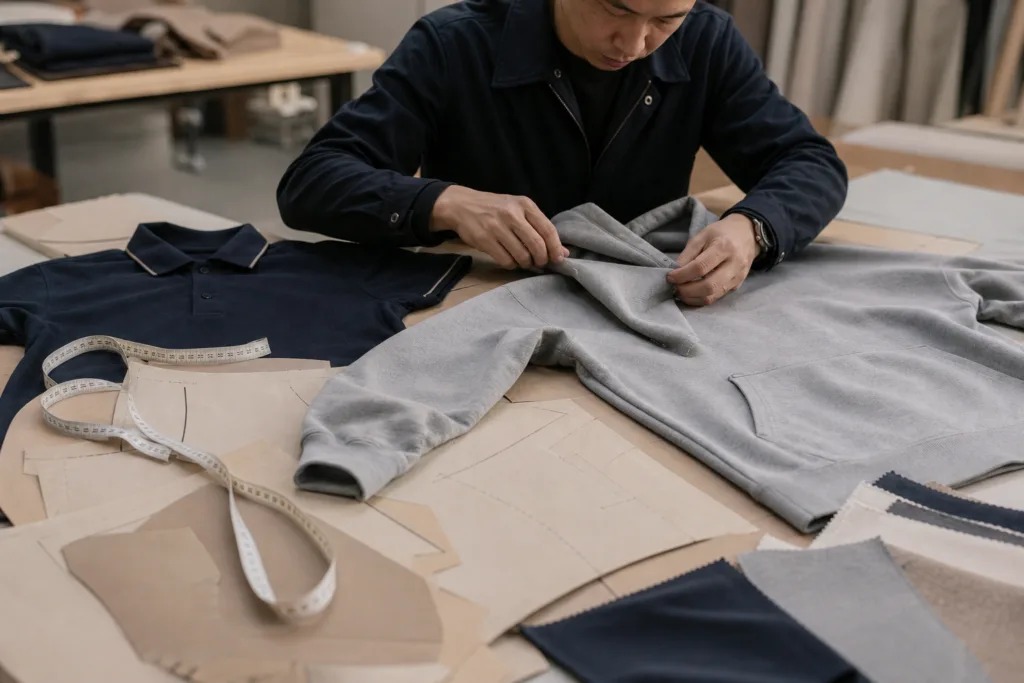
That means two factories quoting the same delivery window may not actually be equally reliable. One may already understand the production path, while another may simply be giving a general estimate.
Ask manufacturers to explain what drives their schedule. An overview of the clothing manufacturing process helps buyers understand where delays usually occur and why approvals at the right stage matter so much.
| Lead Time Factor | What Can Slow It Down | Buyer Action |
|---|---|---|
| Fabric sourcing | Custom knitting, dyeing, or finishing | Confirm availability early |
| Sampling | Multiple fit or detail revisions | Give clear comments with measurements |
| Trims | Custom labels, zippers, packaging, or badges | Approve artwork and specs quickly |
| Bulk production | Capacity congestion or style complexity | Book production after sample approval |
| Final packing | Special folding, assortments, barcode work | Provide packing instructions in advance |
How logo application and private label details affect factory fit
Customization can make or break a supplier match. A basic blank garment is one thing; a private label collection with custom embroidery, woven labels, branded hangtags, and retail-ready packaging is another.
When comparing factories, ask which decoration methods they handle regularly and which ones are outsourced. This matters because embroidery setup, screen print registration, heat transfer adhesion, or sublimation alignment all influence quality control and delivery planning.
Typical customization areas include:
- Embroidery for polos, caps, golf apparel, and uniforms
- Screen printing for cotton T-shirts, hoodies, and promotional apparel
- Heat transfer for sportswear names, numbers, or small logos
- Sublimation for polyester teamwear and all-over graphics
- Woven labels, printed neck labels, hangtags, size stickers, and branded polybags
At Ninghow, we often help buyers simplify early private label development by separating must-have custom elements from launch-stage extras. That usually makes sampling faster and bulk execution more stable.
What quality control questions buyers should ask
The right quality questions are practical, not abstract. Instead of asking whether a factory has quality control, ask how and when quality is checked during production.
A reliable manufacturer should be able to explain inspection points before cutting, during sewing, after finishing, and before packing. The exact process can vary by product type, but the logic should be clear and consistent.
Useful buyer questions include:
- How is fabric checked before cutting?
- How are measurements controlled during production?
- How is logo placement verified?
- How are color and trim issues handled if mismatches appear?
- Are random final inspections done before packing?
- How are defects recorded and corrected?
For buyers working with teamwear, uniforms, or repeat programs, size consistency and shade consistency matter especially strongly. Quality is not only about whether a garment looks good individually; it is about whether the full order is consistent across sizes, colors, and cartons.
If your market has specific technical, testing, or conformity requirements, it is useful to consult an official standards and conformity-assessment resource before finalizing supplier expectations and product documentation.
Common mistakes that make supplier selection harder
The biggest mistake is comparing factories with incomplete information. If each supplier receives a different version of the product request, pricing and lead time cannot be compared fairly.
Another common issue is approving a sample visually without checking measurements, construction details, and labeling requirements. Bulk production problems often begin when sample approval is rushed.
- Choosing based only on the lowest quote
- Ignoring fabric composition and GSM differences between suppliers
- Assuming MOQ includes all trims and packaging
- Sending logo files without placement sizes or method details
- Skipping pre-production confirmation for labels and packaging
- Changing colors or details after materials are already booked
Key takeaway: The more stable your product brief becomes before bulk production, the fewer avoidable delays and cost changes you will face.
How to compare manufacturers in a practical way
A structured comparison is usually better than relying on instinct. We recommend scoring suppliers on a few operational factors that directly affect production success.
| Evaluation Area | What Good Looks Like | Warning Sign |
|---|---|---|
| Communication | Clear answers, realistic timing, detail awareness | Vague replies or frequent contradictions |
| Sampling | Accurate prototype, useful revision handling | Repeated errors without explanation |
| Fabric capability | Relevant options with sourcing transparency | Unclear fabric origin or unstable availability |
| Customization | Strong control of logos, labels, and packaging | Decoration quality varies or is poorly explained |
| MOQ logic | Clear breakdown by style, color, and trim | One vague minimum for everything |
| Production planning | Reasoned lead time and process visibility | Unusually fast promises without detail |
This type of comparison helps both startups and experienced sourcing teams. It also makes internal approval easier when multiple stakeholders are involved in vendor selection.
When a manufacturer relationship is likely to work well
The relationship is usually strongest when both sides have realistic expectations. Buyers provide clear product direction, and the manufacturer provides honest guidance on feasibility, cost drivers, and production risk.
In good projects, communication improves after the first sample rather than becoming more confusing. Questions become more specific, approvals become faster, and the path to bulk production becomes clearer.
This is also where practical manufacturer support matters. A factory should not only quote your design; it should help identify where fabric substitutions, fit refinements, label choices, or packaging simplifications may improve cost-performance without losing your product intent.
Conclusion
If you want to know how to find a clothing manufacturer, start by matching your product category and business needs with a supplier’s real operating strengths. The right choice is usually the factory that can explain fabric options clearly, produce a reliable sample, manage customization properly, and guide you through MOQ, lead time, and quality control with transparency.
For apparel brands, sourcing teams, clubs, schools, and private label buyers, the best results usually come from organized preparation rather than broad outreach alone. When product details, sample expectations, and bulk requirements are clearly aligned, manufacturer selection becomes much more practical and much less risky.
FAQs
How many clothing manufacturers should I compare before choosing one?
You should usually compare three to five manufacturers seriously rather than contacting dozens superficially. That gives you enough range to compare communication, sampling quality, MOQ logic, and pricing structure without creating too much confusion or slowing your decision-making.
What is the most important thing to ask a clothing manufacturer first?
The most important first question is whether the manufacturer regularly produces your type of garment with your required customization level. This quickly shows whether the supplier is actually suited to your project, which is more useful than discussing price before fabric, construction, and quantity are clear.
Can I find a clothing manufacturer if I only have a design idea and no tech pack?
Yes, but the process will be slower unless you organize your idea into clear references, measurements, fabric direction, and logo details. Many manufacturers can help develop the product, but better starting information leads to more accurate samples, quotations, and production planning.
How do I know if a manufacturer’s MOQ is realistic?
A realistic MOQ is one the factory can explain clearly by style, color, fabric, and trims rather than presenting as a vague fixed number. If the supplier can show how fabric sourcing, custom labels, packaging, and decoration methods affect the minimum, the MOQ discussion is usually more trustworthy.
Should I choose a manufacturer based on the lowest price?
No, because the lowest price can hide weaker fabric quality, inconsistent workmanship, missing trim costs, or unrealistic lead times. A better decision is to compare total value, including sample execution, communication, quality control, customization capability, and the likelihood of smooth bulk production.
What should I approve before bulk clothing production starts?
Before bulk production begins, you should approve the sample, measurements, fabric choice, colors, logo method, labels, packaging details, and order breakdown by size and color. Final confirmation at this stage reduces mistakes in cutting, decoration, packing, and shipment preparation.