








Small batch clothing manufacturing makes sense when your apparel project needs flexibility, controlled risk, and room to refine the product before scaling. For many brands, startups, teams, and product developers, a smaller production run is not just about ordering fewer pieces. It is a strategy for testing fit, confirming demand, managing cash flow, and learning what should be improved before committing to larger bulk orders.
If you are trying to evaluate low MOQ clothing manufacturing options, it helps to look beyond the order quantity alone. In practical production terms, the right solution depends on fabric sourcing, logo method, labeling, size breakdown, and whether the project needs private label development, sample revision, or a clean path to repeat orders. At Ninghow, we often help buyers compare these factors early so the production model fits the project goal instead of creating avoidable cost or delay.
What small batch clothing manufacturing means in practice
In practice, small batch clothing manufacturing means producing a limited run of garments in quantities that are lower than standard bulk production, while still following a real factory workflow. This usually includes approved samples, fabric and trim confirmation, cutting, sewing, decoration, finishing, and packing.
The exact quantity varies by product type. A simple cotton T-shirt with stock fabric may be realistic at a much lower quantity than a fully customized jacket with special zippers, contrast panels, and custom-dyed rib. That is why buyers should treat small batch as a production model, not a fixed piece count.
From our manufacturing perspective, small batch projects work best when the style is defined clearly and the buyer understands that lower quantity does not always mean lower complexity. The factory still needs time for pattern handling, marker planning, line setup, logo placement control, and quality checks.
Key takeaway: Small batch production is useful when you want lower inventory risk and more flexibility, but it still requires proper factory planning and realistic expectations about cost and setup.
Small batch vs. low MOQ: are they the same thing?
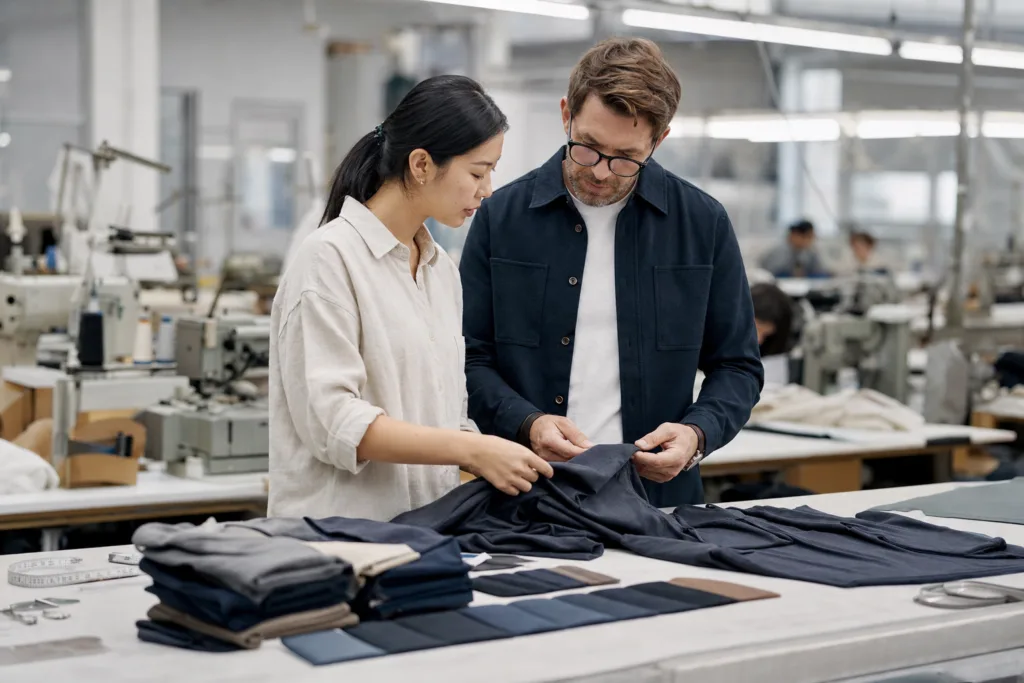
No, they are related but not identical. Small batch clothing manufacturing describes the scale and strategy of production, while low MOQ refers to the minimum order threshold a manufacturer can accept under certain conditions.
A low MOQ project may still involve a relatively efficient style if the fabric is in stock, trims are standard, and the print method is simple. A small batch project can become difficult if it asks for too many custom elements across too many sizes or colors. Buyers often confuse these two ideas and assume any small order is automatically easy to produce.
That is why it helps to understand what MOQ is realistic for a startup clothing brand before requesting quotes. MOQ depends on fabric mill minimums, trim sourcing, color matching, decoration setup, and the number of SKUs being developed.
| Factor | Small Batch Manufacturing | Low MOQ Production |
|---|---|---|
| Main purpose | Control risk, test product, launch limited runs | Allow production at lower minimum quantity |
| Focus | Production strategy | Order threshold |
| Best fit | New launches, capsule drops, validation | Simple styles, limited customization, stock-supported programs |
| Common risk | Too much complexity for the quantity | Assuming low quantity will also mean low cost per piece |
Why brands choose small run apparel production
Brands choose small runs because they reduce inventory exposure and create more room to learn. If a fit issue appears, color sells slowly, or a logo placement needs refinement, the financial impact is smaller than it would be in a large first order.
This is especially valuable for newer labels and seasonal programs. Rather than producing a large quantity based on assumptions, the buyer can gather real feedback from retail sell-through, end users, teams, or distributors.
Small runs also help when the product concept is strong but the reorder forecast is still uncertain. In that case, the first run acts as a controlled validation stage before larger production planning begins.
- Lower stock risk for new or unproven products
- More flexibility to adjust fit, color, or branding after launch
- Better cash-flow control for small and mid-stage businesses
- Useful for testing niche demand or regional programs
- Helpful for private label development before scale
The types of projects that fit small batch manufacturing best
Startups and new brand launches
Startups are often strong candidates because they need product proof before making a bigger commitment. A first launch usually involves uncertainty around size ratio, color preference, and expected reorder volume.
In these cases, buyers should focus on a manageable SKU count and a style that is not overloaded with customization. It is often smarter to start with one or two core styles done well than to spread the budget across many versions.
We often suggest that startups first review how to plan a first small clothing order so they can align style quantity, size range, labels, and packaging with the actual development budget.
Limited drops, capsule collections, and market testing
Small batch works very well for limited drops. These projects usually prioritize speed, uniqueness, and brand storytelling over the lowest possible unit cost.
If the product uses a stable base fabric and controlled decoration method, a small run can help the brand test which graphics, colors, or fits deserve a second release. This is also a practical model for online-first brands that need actual customer response before placing a larger reorder.
Custom teamwear, niche sportswear, and seasonal programs
Teamwear and niche sportswear programs often fit this model when the order volume is tied to a school, club, event, or local organization. The buyer may need custom logos, names, seasonal colorways, or a specific delivery window, but not national-scale volume.
At Ninghow, we see this often with polos, hoodies, warm-up gear, training tops, and shorts. The project is usually viable when the style count is limited, the artwork is production-ready, and the buyer can confirm a realistic size breakdown early.
Private label product validation before scaling
Private label development is another strong use case. When a buyer wants to test branded labels, hangtags, packaging, and a refined fit before a broader launch, small batch production can provide a market-ready version without forcing immediate high inventory.
Still, the buyer should understand the boundaries of low MOQ private label clothing feasibility and limits. Custom neck labels, woven labels, polybags, cartons, and color-specific accessories can push the economics in different directions, especially when each style has multiple variants.
Projects that usually do not fit small batch production
Very low unit cost targets and high price-sensitive orders
If the main goal is the lowest possible unit cost, small batch is usually not the best answer. Factory setup, sampling time, decoration preparation, and trim handling are spread over fewer units, so cost per piece tends to be higher.
This matters a lot for promotional orders, distributor programs, or price-driven retail projects where margins are already narrow. In those cases, buyers may need larger volume or simpler specifications to reach the target price.
Highly complex styles requiring heavy setup costs
Some garments are technically possible in small quantity but commercially inefficient. Examples include multi-panel outerwear, bonded constructions, specialized padding, high-count embroidery, or garments requiring many custom trims from separate suppliers.
When setup costs are heavy, a small run may carry too much development cost per unit. The buyer might be better served by simplifying the style first or moving directly to a larger commitment if demand is already proven.
Large uniform programs or mass retail replenishment needs
Projects with ongoing replenishment needs usually require more stable bulk planning. If a uniform program must be restocked regularly across full size ranges and consistent shades, larger-scale production is often more efficient.
The same is true for retail programs that depend on continuous inventory. Small batch can support pilot testing, but it is usually not the long-term solution when the business needs price efficiency and repeat consistency at scale.
Key factors that decide whether small batch makes sense
MOQ, sample cost, and total development budget
The most important question is not only whether you can place a small order. It is whether the total project budget still makes sense after samples, pattern adjustments, logo setup, labels, packaging, and shipping are included.
Small batch production often works well when the buyer values learning, speed to market, and lower stock risk. It works less well when the buyer expects bulk-level pricing on a very customized order.
A practical way to assess this is through the apparel sampling process for early-stage production. The sample stage reveals whether the style is stable enough for production, whether the fit needs more revision, and whether the final specification is still too complex for the order quantity.
Fabric availability, color matching, and trim requirements
Fabric is often the biggest driver of whether a small batch project is realistic. If the style can use available stock fabric or a mill-supported base, MOQ becomes easier. If the buyer needs a custom knit, exact dye-to-match shade, special texture, or unusual composition, minimums usually rise.
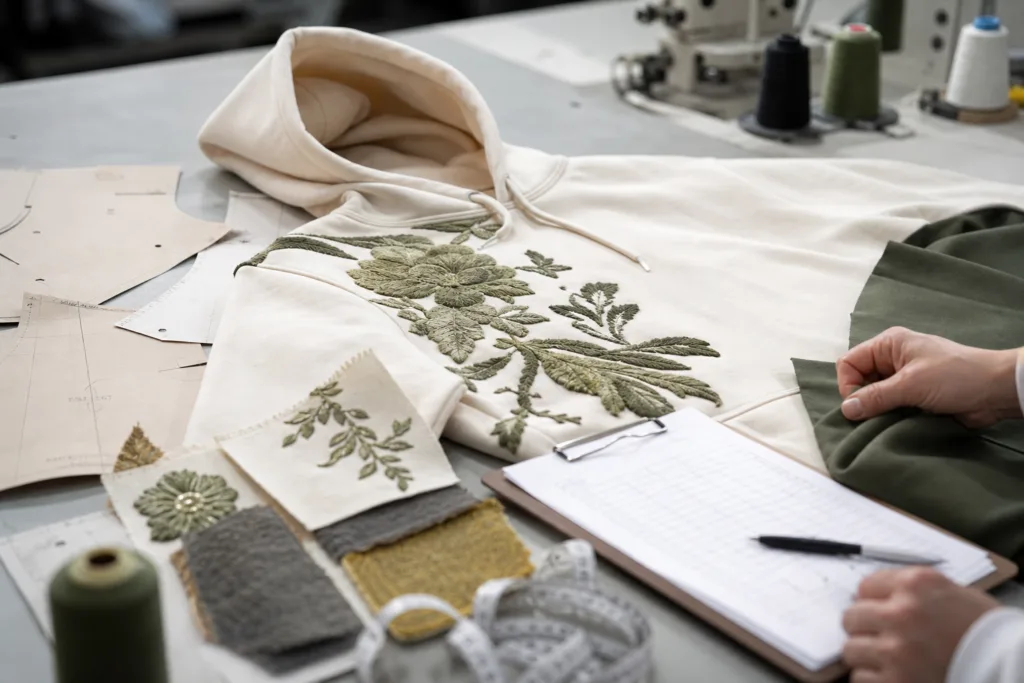
Trim complexity matters in the same way. Standard drawcords, stock zippers, common buttons, and generic care labels are much easier to manage than custom-molded hardware, branded cords, printed elastic, or special packaging inserts.
| Production Element | More Small-Batch Friendly | Less Small-Batch Friendly |
|---|---|---|
| Fabric | Stock fabric, proven base materials | Custom-developed or mill-minimum fabrics |
| Color | Core stock shades or limited palette | Exact custom dye matching across many colors |
| Trims | Standard trims and labels | Multiple custom trims and packaging items |
| SKU count | Focused style and color range | Many style-color-size combinations |
Print, embroidery, and customization method impact
Customization method changes both cost structure and production flow. Screen printing can be efficient, but setup costs rise with color count and placement complexity. Embroidery gives a premium look, but stitch count, backing, and placement affect both speed and price.
Heat transfer and digital methods may help for certain smaller programs, especially when artwork varies or quantity is limited. However, the best method still depends on fabric type, logo detail, hand feel, durability requirements, and the garment’s end use.
Key takeaway: In small batch orders, the simplest decoration method that still meets brand and performance goals is often the most efficient choice.
Fit consistency, grading, and size range planning
Fit can make or break a small run. Buyers sometimes assume quantity is the main issue, but poor grading or a weak size spec creates bigger problems than MOQ itself.
If the garment has a broad size range, the pattern and grading need to be checked carefully before bulk cutting. This is especially important for sportswear, fitted tops, kidswear, and gender-specific team apparel, where balance and movement matter more.
From a manufacturer viewpoint, fewer styles with clearer size specs usually produce better consistency than many styles with unclear fit direction. If you are still deciding between relaxed, regular, or athletic fit, resolve that during development rather than after bulk production starts.
Lead time, production capacity, and reorder strategy
Small batch production is not always faster by default. If custom fabric, labels, or embroidery files are not ready, a small order can still move slowly. Lead time depends on material readiness, sample approval speed, factory scheduling, and how many changes occur after confirmation.
The best small batch projects also include a reorder plan. If the style performs well, can the same fabric be reordered? Will the trim still be available? Can the color be matched closely enough in the second run? These questions matter because a successful test run often creates urgency for repeat production.
- Confirm whether the base fabric is repeatable
- Lock logo files and print dimensions before bulk
- Approve size spec and tolerance clearly
- Keep packaging simple for the first run when possible
- Plan how a reorder would scale if demand is strong
How to evaluate a supplier for small batch clothing manufacturing
The right supplier for small batch clothing manufacturing should be able to explain trade-offs clearly, not just say yes to any quantity. Buyers need a factory partner that can discuss material sourcing, MOQ logic, sample control, and repeat-order planning in practical terms.
Ask how the supplier handles small runs with custom labels, multiple sizes, and logo applications. Also ask whether they can keep records on patterns, artwork placement, approved trims, and packing requirements so future reorders are more stable.
Questions to ask about MOQ, sampling, and repeat orders
- What is the MOQ by style, color, and fabric type?
- Can stock fabric reduce the minimum quantity?
- Which trims are standard and which require custom sourcing?
- How many sample rounds are usually needed for this type of garment?
- How will repeat orders be handled if the first batch sells well?
- Will the same fabric and color be available for reorders?
Quality control expectations for smaller runs
Quality control should not be lighter just because the order is smaller. In fact, smaller runs need disciplined checks because the cost of an error is concentrated across fewer units.
We recommend checking fabric shade, panel symmetry, logo position, measurements, stitch quality, thread trimming, finishing, labeling, and packing accuracy. For decorated garments, the approved sample should remain the visual reference during production.
At Ninghow, we find that smaller orders run more smoothly when the buyer confirms tolerances and appearance priorities in writing. That makes it easier to resolve borderline issues before bulk packing instead of after shipment.
Common mistakes buyers make when choosing small batch production
The most common mistake is asking for too much customization in too few units. A buyer may request custom fabric, multiple colors, woven labels, embroidered badges, premium packaging, and broad size coverage, then expect a simple low-MOQ quote. The result is often delay, cost pressure, or a need to redesign the specification.
Another mistake is treating the sample as optional. If the style has a new fit, performance fabric, or exact branding requirement, skipping development increases bulk risk. A good sample process is usually cheaper than correcting a full run that misses the target.
Buyers also underestimate the effect of SKU count. One style in two colors and five sizes already creates ten combinations before packaging details are added. That complexity matters even when the total quantity looks small.
- Expecting bulk pricing on a heavily customized small run
- Using too many colors or size options in the first order
- Approving artwork late or changing logo placement mid-process
- Ignoring fabric repeatability for future reorders
- Not defining fit expectations clearly before sample approval
A simple decision framework: choose small batch, low MOQ, or full-scale production
If your main goal is to test the market, validate fit, or launch with lower inventory risk, small batch is usually the right starting point. If your style is simple and materials are readily available, low MOQ production may give you that flexibility with less complexity.
If your demand is proven, price sensitivity is high, and repeat volume is expected, full-scale production is usually more efficient. The best choice depends on the project objective, not just the quantity you prefer to order.
| Project Goal | Best Model | Why |
|---|---|---|
| Test a new design or fit | Small batch | Reduces inventory risk and allows learning |
| Launch a simple product with limited budget | Low MOQ | Works if materials and trims are straightforward |
| Supply ongoing retail or uniform demand | Full-scale production | Improves unit economics and replenishment stability |
| Validate private label presentation | Small batch | Lets you test labels, packaging, and market response |
When to start small and when to scale up
Start small when product demand, fit confidence, or reorder timing is still uncertain. This is the safer route for startups, capsule programs, event-driven apparel, and niche sportswear launches.
Scale up when the sample is approved, the first run performs well, and the supply side is stable enough to support repeat production. That means the fabric can be reordered, the trim package is confirmed, and the style has a clear size ratio and quality standard.
In real manufacturing, scaling is easiest when the first run was designed with repeatability in mind. A controlled small batch is not separate from future bulk production. It should be the foundation for it.
Conclusion: matching the production model to the project goal
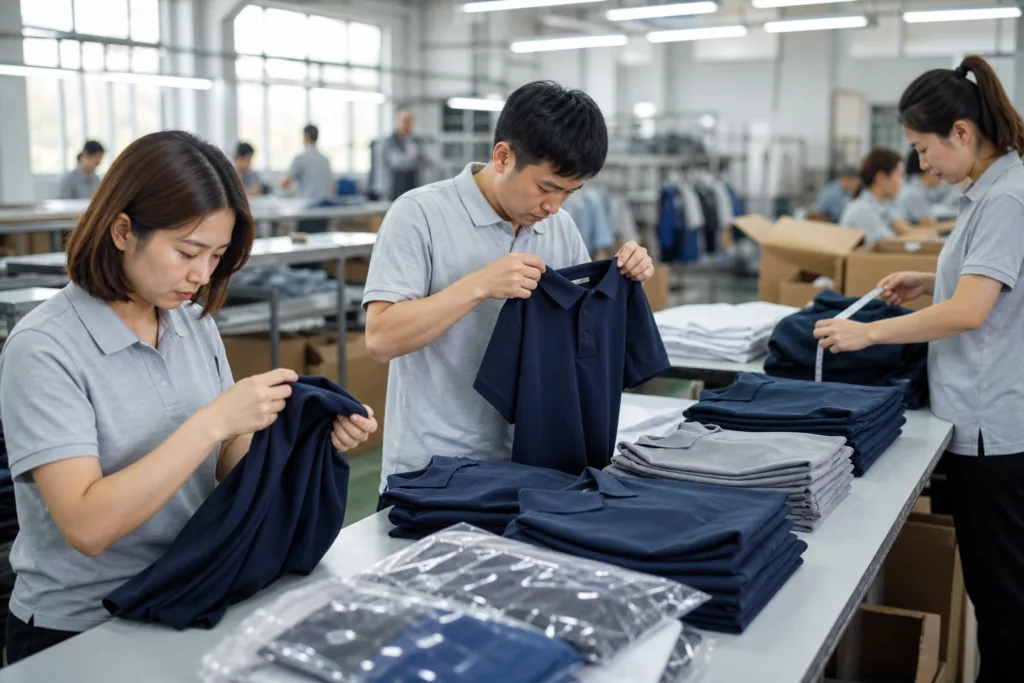
Small batch clothing manufacturing is a smart choice when your project needs flexibility, lower inventory exposure, and a chance to improve the product through real market feedback. It is not automatically the cheapest option, and it is not ideal for every garment program. But when the style, materials, and customization plan are aligned, it can be one of the most practical ways to launch or validate an apparel idea.
The best results come from matching the production model to the purpose of the order. If the goal is testing, learning, and refining, small batch often fits. If the goal is scale, low unit cost, and repeat efficiency, a larger production model may be the better path.
For buyers who are still deciding, the most useful next step is to define the style complexity, target quantity, size range, fabric direction, and branding requirements before requesting production terms. That gives the factory enough context to advise whether small batch, low MOQ, or standard bulk production is the most realistic fit.
Frequently asked questions
What quantity counts as small batch clothing manufacturing?
There is no single quantity that defines it because the answer depends on the garment, fabric, trims, and customization level. A simple T-shirt program may be considered small batch at a much lower quantity than a fully customized jacket or teamwear set.
Is small batch clothing manufacturing always low MOQ?
No, small batch clothing manufacturing and low MOQ are connected but not the same. Small batch refers to the production approach, while low MOQ refers to the minimum order threshold a factory can accept based on materials, setup, and style complexity.
Why is the unit price higher on small batch orders?
The unit price is usually higher because development, setup, cutting, decoration preparation, and quality control are spread across fewer units. Even when the order is small, the factory still has to complete many of the same steps required for bulk production.
What types of garments work best for small batch production?
Simple or moderately customized products usually work best, especially T-shirts, polos, hoodies, sweatshirts, shorts, and selected teamwear or sportswear programs. Projects are more practical when they use available fabrics, standard trims, and a focused number of colors and sizes.
Should I sample before placing a small batch order?
Yes, sampling is strongly recommended when the style is new, the fit matters, or the branding details must be controlled closely. An approved sample helps confirm measurements, fabric hand feel, logo placement, construction details, and finishing expectations before bulk production begins.
When should a brand move from small batch to larger production?
A brand should scale up when the product has proven demand, the fit and construction are stable, and the material supply is reliable enough for repeat orders. Moving to larger production usually makes more sense once the buyer wants better unit economics and more predictable replenishment.