








If you plan to import clothing from China to New Zealand for the first time, the safest approach is to prepare the order before you pay the deposit, not after the goods are finished. First-time buyers usually focus on price and design first, but import success depends just as much on classification, documents, labeling, shipping method, taxes, and whether the supplier can deliver production-ready goods that match your commercial invoice and packing list.
If your project is still at the planning stage, our import planning for apparel buyers support helps connect product development with export preparation. That matters when you need to confirm fabric details, logo method, carton setup, sample approval, and documentation expectations before bulk production starts, especially if you are launching a new clothing brand, importing teamwear, or buying stock for retail resale in New Zealand.
What first-time buyers need to know before importing clothing from China to New Zealand
The main point is simple: importing clothing is not only a shipping task. It is a combined product, production, and customs process. If one part is unclear, such as fiber content, HS code, labeling, or carton count, it can slow down clearance or create avoidable cost.
From our manufacturing perspective, buyers make better decisions when they define the product clearly before the order is placed. A manufacturer can produce the garments, but the buyer still needs a usable import plan that covers landed cost, timeline, and receiving requirements in New Zealand.
This guide is written for clothing brands, startups, retailers, teamwear buyers, and bulk purchasers who want a practical first overview. It will help you move from idea stage to shipment stage with fewer surprises.
Who this guide is for

This article is especially useful if you are ordering apparel for resale, promotion, uniforms, clubs, schools, or private label development. It is also relevant if you already know the garment you want, but have never handled import documents or New Zealand customs clearance.
In our apparel production work, we often see first-time buyers fall into two groups:
- Buyers with a clear design idea but limited understanding of import steps
- Buyers who know they want to source from China but have not finalized fabrics, sizing, labels, packaging, or shipment terms
Key takeaway: The earlier you connect sourcing decisions with import requirements, the easier it is to control cost, compliance, and delivery timing.
Step 1: Confirm the product type, order quantity, and import readiness
Before you ask for final pricing, confirm exactly what you are buying. “Clothing” is too broad for production planning and also too broad for import paperwork. You should know whether the order is T-shirts, polo shirts, hoodies, jackets, shorts, uniforms, or mixed styles, because classification, packaging, and shipping cost can vary.
Order quantity matters for both manufacturing and freight planning. A small test order may be suitable for courier or air freight, while a larger bulk order may work better by sea. Quantity also affects whether custom fabric dyeing, special trims, and private label packaging are realistic.
Import readiness means you can answer these questions before production begins:
- What garment category are you importing?
- What is the estimated total quantity per style and color?
- Is the order for resale, uniforms, events, or brand launch?
- Do you know your target landed cost, not just ex-factory price?
- Do you have a realistic delivery deadline with buffer time?
This stage is also where buyers should start choosing the right clothing HS code. Classification affects duty assessment, product descriptions, and customs accuracy, so it should not be treated as a last-minute paperwork step.
Step 2: Choose the right supplier and clarify whether the order is OEM, ODM, or private label
The right supplier is the one that fits your product type, order size, and development needs. For first-time buyers, that usually means checking whether the manufacturer can handle fabric sourcing, sample development, size grading, labeling, and export documents in a coordinated way.
OEM usually means you provide the design or clear product specification and the factory manufactures it. ODM usually means the supplier already has a base product or style that can be modified. Private label normally focuses on branding the garment with your logo, labels, hangtags, and packaging.
At Ninghow, we advise buyers to define this production model early because it affects sampling time, pattern work, MOQ, and communication. A private label polo shirt order from an existing block is very different from a custom-developed performance jacket with new fabric, custom trims, and branded packaging.
When comparing suppliers, ask practical questions rather than only chasing the lowest quote:
- Can they produce your garment category consistently?
- Can they support fabric testing or at least clear fabric specification confirmation?
- Can they provide stable sizing and grading for your target market?
- Can they prepare export-friendly invoices and packing lists accurately?
- Do they understand carton marking, barcode, labeling, and packaging requirements?
Step 3: Prepare product details before production starts
The most common import problem starts earlier in production: unclear product details. If the factory receives incomplete instructions, the sample may still look acceptable, but the bulk order may create receiving problems, relabeling work, or product description mismatches on documents.
Before bulk production, buyers should lock down the following details:
- Fabric composition, weight, and hand feel
- Color references and tolerance expectations
- Size chart and fit comments
- Logo method such as embroidery, screen print, heat transfer, or sublimation
- Main label, size label, care label, and country of origin presentation
- Hangtags, polybags, carton ratios, and outer carton markings
Label content deserves extra attention because imported garments often need fiber, care, size, and origin details presented clearly. Buyers who are unsure should review practical guidance on imported clothing labeling requirements before approving bulk packaging.
Why fabric and sizing decisions affect importing
Fabric details are not only a quality issue. They also affect classification descriptions, invoice wording, unit value, and buyer expectations at receiving. For example, a 100% cotton T-shirt and a polyester performance tee may look similar in silhouette, but they can differ in customs description, use case, and retail position.
Size consistency also matters more than many first-time importers expect. If sample measurements are not approved carefully, the shipment can arrive on time but still fail commercially because the fit is inconsistent across sizes. That problem is expensive because it is hard to correct after import.
| Product Detail | Why It Matters Before Import | Common First-Time Buyer Risk |
|---|---|---|
| Fabric composition | Affects description, hand feel, use, and classification | Approving a sample without confirming actual fiber content |
| GSM or weight | Affects cost, drape, opacity, and freight weight | Choosing only by photo or price |
| Size chart | Improves bulk consistency and customer satisfaction | Using generic sizing without market fit check |
| Logo method | Affects production lead time and unit cost | Changing logo method after sample approval |
| Labels and packaging | Affects compliance and receiving efficiency | Leaving details to be decided after production |
Step 4: Understand the main shipment documents
For most first-time buyers, the core documents are straightforward, but they must be accurate. The usual set includes a commercial invoice, packing list, and transport document such as a bill of lading for sea freight or an air waybill for air freight. Depending on the shipment and entry process, other certificate-related or broker-requested paperwork may also be needed.
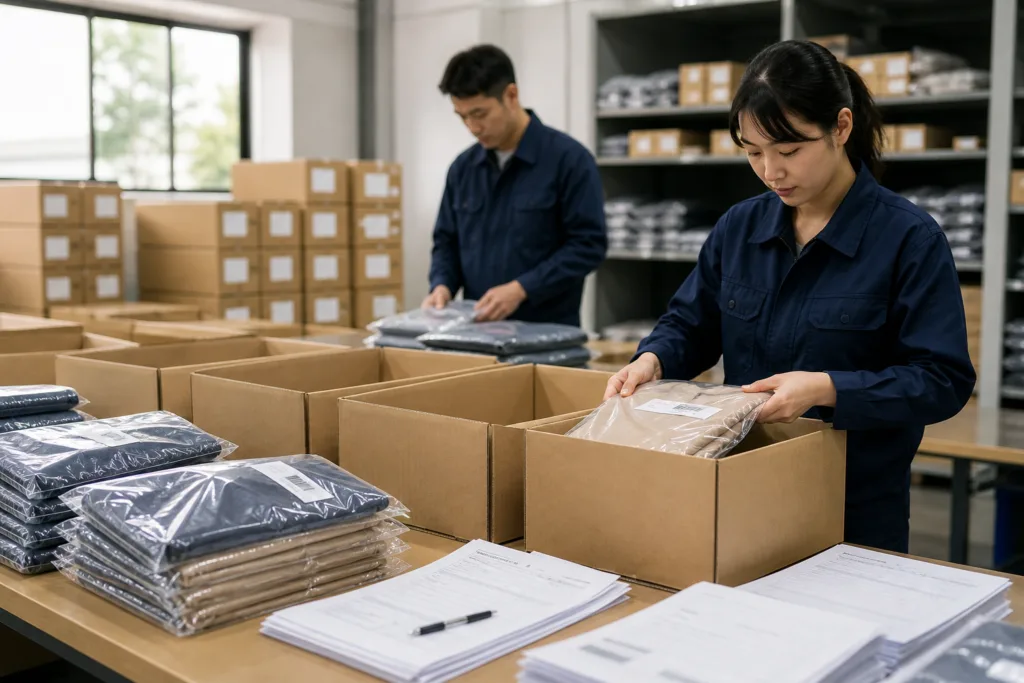
The commercial invoice should describe the goods clearly, show seller and buyer information, list quantities and values, and match the shipment. The packing list should show carton counts, net and gross weights, and packing breakdown. If those documents do not align with the actual goods, customs or delivery handling can become slower.
Buyers should check these points before shipment:
- Product descriptions match the garments actually packed
- Style quantities match the approved order summary
- Carton count and carton marks match the packing list
- Declared value and currency are correct
- Consignee details are accurate and complete
From a manufacturer side, document accuracy depends on product clarity. If the buyer changes styles, quantities, or packaging late in production, shipping paperwork often becomes more error-prone.
Step 5: Check New Zealand customs clearance basics for apparel imports
Customs clearance is the stage where the shipment is declared for entry into New Zealand and reviewed using the shipment data and supporting documents. In practice, many first-time buyers use a freight forwarder or customs broker to handle the import entry because the process is easier when an experienced party checks the information before submission.
New Zealand Customs explains the customs clearance process for imported clothing and other commercial goods through the Trade Single Window lodgement process. For first-time buyers, the practical lesson is that clearance is not just about the goods arriving. It also depends on who lodges the information, whether the data is complete, and whether Customs or MPI need anything further before release.
This is where supplier coordination matters. If your invoice description is vague, your packaging is inconsistent, or the consignee details are incomplete, your broker may need corrections before the shipment clears.
Key takeaway: Customs clearance gets easier when production documents, shipping documents, and product descriptions are aligned before the goods depart China.
Step 6: Learn the difference between customs duty, GST, and other possible charges
Many first-time buyers assume duty and GST are the same thing. They are not. Duty is a tariff-based charge that may apply depending on the product classification and applicable tariff treatment, while GST is a separate tax that can apply to imports based on New Zealand rules.
New Zealand Customs provides practical guidance on duty and GST on clothing imports, including value thresholds, Customs treatment, and common questions importers have. Buyers should review current official rules rather than relying on old advice from suppliers or social media groups.
You should also understand the broader clothing import duty basics for buyers before finalizing landed cost. This helps you compare manufacturer pricing with freight, taxes, brokerage, inspection, storage, and local delivery costs instead of judging the order only by FOB or ex-factory price.
| Cost Item | What It Covers | Why Buyers Miss It |
|---|---|---|
| Customs duty | Tariff-based import charge depending on classification | Assuming all clothing has the same rate |
| GST | Import tax applied under New Zealand rules | Confusing it with duty |
| Freight | International transport cost | Quote compared without shipment size context |
| Broker or clearance fee | Entry handling and documentation support | Not included in factory quote |
| Local delivery | Final movement from port or depot to your address | Overlooked during landed-cost planning |
Step 7: Decide on shipping method: air freight, sea freight, or courier
The right shipping method depends on urgency, order volume, carton count, and cost sensitivity. Small urgent orders often move by courier or air, while larger repeat orders usually become more economical by sea.
Buyers should compare transit speed with total landed cost, not speed alone. A delayed product launch is costly, but overpaying for freight on a low-margin order can also damage the commercial result.
Our recommendation is to review shipping methods for clothing orders based on quantity and delivery target. The best method for 300 branded polo shirts is not automatically the best method for 8,000 mixed cartons of private label knitwear.
- Courier suits very small shipments, urgent samples, or replacement items
- Air freight suits medium orders with deadline pressure
- Sea freight suits larger bulk orders where freight efficiency matters more than speed
Step 8: Work out lead time, shipping timeline, and buffer time
Lead time is not only factory sewing time. It includes sampling, material booking, production scheduling, finishing, inspection, packing, document preparation, shipping, clearance, and local delivery. First-time buyers often underestimate this because they ask only, “How many days for production?”
For a simple repeat style using available fabric, production can move faster. For a private label order with custom labels, custom colors, size set approval, and branded packaging, the timeline is longer. This is normal and should be planned before you announce a launch date or sales campaign.
Buffer time is especially important for seasonal goods, school uniforms, events, and golf or teamwear programs. If the goods must arrive for a fixed use date, you should not plan around the fastest possible case.
Where delays usually happen
- Late sample comments from the buyer
- Fabric or trim approval taking longer than expected
- Logo strike-off or embroidery file issues
- Packing changes after production starts
- Incomplete shipping instructions
- Customs or delivery handling after arrival
At this stage, buyers often benefit from reviewing production flow and milestone timing with the manufacturer before deposit payment. That conversation is usually more useful than negotiating one more small price reduction.
Step 9: Quality control checks before shipment reduce receiving and customs issues
Quality control before shipment is one of the easiest ways to reduce import risk. A garment that is late is a problem, but a garment that arrives on time with wrong labels, wrong sizes, or wrong carton ratios is often worse because the import costs have already been spent.
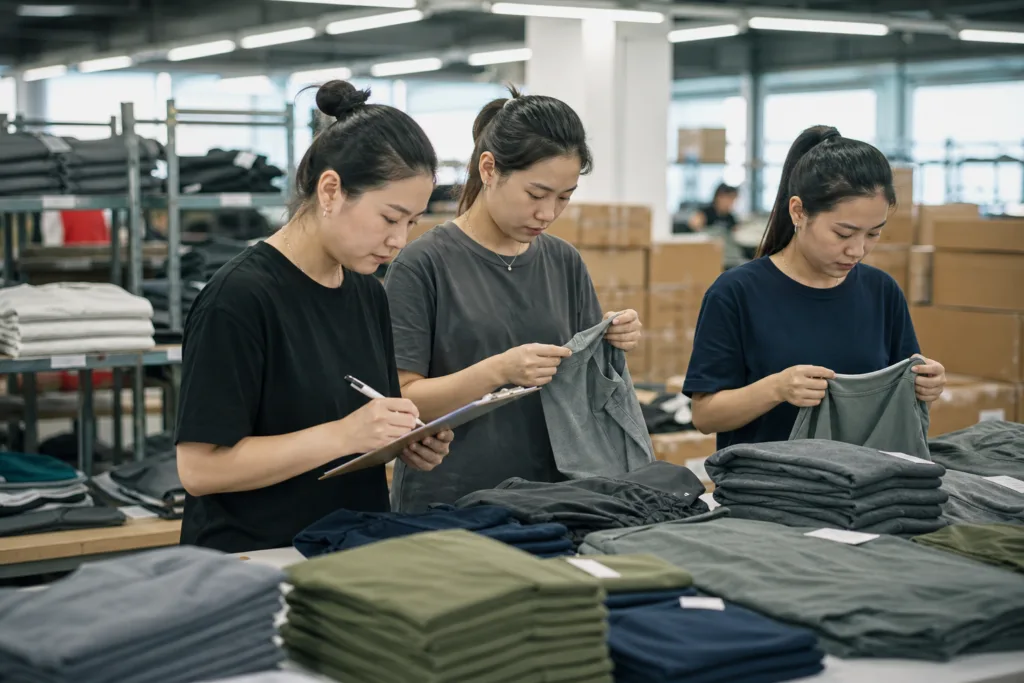
In our production process, pre-shipment review should cover both garment quality and shipment accuracy. This means checking workmanship, measurements, color consistency, logo application, labeling, folding, polybag details, carton count, and carton markings.
A practical pre-shipment QC checklist includes:
- Random measurement checks against approved size chart
- Fabric and color consistency checks across cartons
- Print, embroidery, or transfer placement confirmation
- Care label, size label, and origin label review
- Assortment ratio verification by style, size, and color
- Outer carton count and shipping mark confirmation
Key takeaway: A clean shipment is not only well sewn. It is correctly labeled, correctly packed, and correctly documented.
Step 10: Common mistakes first-time buyers make when importing clothing from China
The biggest mistakes usually happen before freight is booked. Buyers who rush into production without clear specifications often create avoidable cost in sampling, shipping, clearance, or local rework.
- Ordering before confirming full product specifications
- Comparing suppliers only by unit price
- Ignoring classification and duty planning
- Approving samples without checking labels and packaging
- Leaving shipping method decisions too late
- Using unrealistic launch dates without buffer time
- Assuming the supplier will handle every customs detail automatically
Another common issue is mixing too many styles, colors, and packaging variations into a small first order. That can be possible, but complexity increases the risk of document errors, carton confusion, and delayed approvals.
Step 11: A simple pre-order checklist for clothing buyers importing to New Zealand
Before you place the order, make sure these basics are already clear:
- Final garment type, fabric, color, and quantity
- OEM, ODM, or private label production model
- Approved size chart and fit comments
- Confirmed logo application method
- Confirmed labels, care content, and packaging details
- Preliminary HS classification and landed-cost estimate
- Planned shipping method and delivery window
- Broker, freight forwarder, or importer contact details
- Required commercial invoice and packing list details
- QC checkpoints before shipment release
This checklist is simple by design. For first-time importers, clarity beats complexity. A shorter but complete product brief is more useful than a long, inconsistent one.
Step 12: When to ask a freight forwarder, customs broker, or manufacturer for support
You should ask for support when the order is commercially important, time-sensitive, or unclear on documentation. First-time buyers do not need to know every technical detail themselves, but they do need to know which party is responsible for what.
A freight forwarder is useful when you need help planning shipment mode, booking, and delivery flow. A customs broker is useful when you need entry support, tax handling clarity, and document review for New Zealand clearance. A manufacturer is useful when the risk sits upstream in product specs, labels, carton setup, export packing, or production consistency.
From our side, the best results happen when buyers involve the manufacturer early enough to align production details with export requirements. If the order includes private label development, we can usually help structure the brief so that sample approval, labeling, packing, and bulk documentation are easier to manage later.
| Support Partner | Best Time to Involve Them | Main Value |
|---|---|---|
| Manufacturer | Before sampling and before deposit | Product specs, labels, packaging, QC planning |
| Freight forwarder | Before shipment booking | Route, transit mode, freight timing, booking advice |
| Customs broker | Before arrival and during clearance prep | Import entry, tax handling, document checking |
How Ninghow supports production-ready and export-ready apparel orders
For first-time buyers, the real challenge is often not finding a factory. It is getting a complete order prepared well enough that production and importing run smoothly together. That means clear specifications, practical MOQ decisions, consistent sizing, workable labels, and shipping documents that reflect the goods accurately.
At Ninghow, we support buyers by connecting garment development with bulk production preparation. If a project needs help with fabric selection, sample refinement, private label setup, packaging details, or pre-shipment checking, those decisions are easier to manage before the goods are finished than after they are already on the way to New Zealand.
Conclusion
To import clothing from China to New Zealand successfully, first-time buyers should think beyond price and start with order readiness. Product clarity, correct documents, duty and GST awareness, the right shipping method, and pre-shipment QC all work together to protect the order.
If you prepare the product properly and involve the right support at the right time, importing becomes much more manageable. A good first order usually comes from careful planning, realistic timelines, and a manufacturer that can align production details with export requirements.
FAQs
What documents do I usually need to import clothing from China to New Zealand?
You usually need a commercial invoice, packing list, and a transport document such as a bill of lading or air waybill. Depending on the shipment and how the entry is handled, your broker or freight forwarder may also request additional paperwork or supporting information, so it is important that the supplier prepares accurate descriptions, quantities, values, and consignee details.
Do I always pay duty and GST when importing clothing into New Zealand?
Not always, but you should assume taxes may apply until you confirm the current rules for your shipment value and classification. Clothing buyers should check the likely duty treatment, GST position, and any broker-related costs before placing the order so the landed cost is realistic rather than based only on the factory quote.
Can I import a small clothing order first before placing a larger bulk order?
Yes, a smaller trial order can be a practical way to test sizing, workmanship, packaging, and supplier communication before scaling up. The key is to remember that a small shipment still needs correct product details, labels, documents, and a suitable shipping method, so it should be treated as a structured test rather than an informal purchase.
Should I use air freight or sea freight for my first clothing order?
The right method depends on order size, delivery deadline, and margin. Air freight is usually better for urgent or moderate-size orders, while sea freight usually makes more sense for larger bulk shipments where freight efficiency matters more than speed.
Why do labels and packaging matter so much for imported clothing?
Labels and packaging matter because they affect compliance, customer-facing presentation, warehouse receiving, and document accuracy. If garments arrive with incorrect fiber details, missing origin information, or the wrong carton breakdown, the shipment may still clear but create expensive problems after arrival.
When should I ask a manufacturer for help instead of only relying on a freight forwarder?
You should ask the manufacturer for help when the issue involves the product itself, such as fabric details, measurement tolerances, logo method, labels, polybags, carton marks, or packing ratios. Freight forwarders and brokers help with shipment movement and clearance, but many import problems start earlier in production, which is why manufacturer input is valuable before bulk goods are packed.