


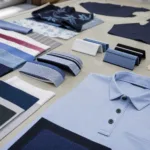
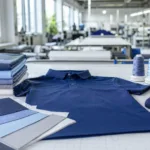




Choosing a custom clothing manufacturer is a commercial decision that affects product quality, landed cost, launch timing, and the consistency of every future reorder. The right supplier should do more than quote a unit price. It should understand your garment specifications, help resolve development issues, document approvals, and scale production without losing control of fit or workmanship.
If your project includes uniform polos, teamwear, golf apparel, or other performance garments, reviewing polo shirt manufacturing options for bulk performance orders can help you compare fabric, decoration, fit, and production requirements before approaching suppliers. Ninghow supports buyers with development planning, sampling, private label details, and bulk production coordination when those needs match the product.
What a Custom Clothing Manufacturer Actually Provides
A custom clothing manufacturer converts a product idea or technical specification into a physical garment and then produces approved quantities. Depending on the supplier, this may include OEM production from your designs, ODM adaptation of an existing product concept, private label development, or standardized bulk manufacturing with selected customization.
OEM is appropriate when your brand owns the design and needs the factory to manufacture it accurately. ODM is useful when you need a starting product that can be adjusted in fabric, color, fit, branding, or construction. Private label production usually combines a garment design with branded labels, packaging, and decoration. A bulk production partner may also offer repeat manufacturing for an established style.
These services are not interchangeable. A supplier that is efficient at basic T-shirts may not have the pattern capability, equipment, or quality controls needed for structured jackets, technical sportswear, embroidered polos, or complex washed garments.
Key takeaway: Evaluate the manufacturer against the product you actually plan to sell, not only against a general catalog or a low introductory quote.
Who Should Use a Custom Clothing Manufacturer?

Custom manufacturing is suitable for clothing brands, startups, retailers, distributors, sports organizations, golf businesses, schools, clubs, corporate buyers, and procurement teams that need more control than a ready-made wholesale product allows. It is especially useful when the buyer needs a specific fit, fabric weight, color system, logo placement, label package, or repeatable size range.
For a small brand, the manufacturer may help turn a sketch into a workable sample. For an established buyer, the main requirement may be reliable replenishment, consistent grading, and documented inspection. Organizations ordering uniforms may prioritize durability, color continuity, decoration quality, and delivery coordination over fashion-led development.
Before contacting factories, define whether you need one development sample, a small launch run, a recurring core product, or a large seasonal order. The correct supplier profile and commercial terms can differ substantially between these scenarios.
Define the Product Before Contacting Suppliers
The more clearly you define the product, the more useful supplier quotations will be. A manufacturer cannot reliably price or schedule a garment when the request only says “premium hoodie” or “custom sports shirt.” Start with the garment category, intended use, target customer, estimated quantity, sales channel, and price positioning.
For each style, prepare a short product brief covering the following points:
- Garment type, such as T-shirt, polo, hoodie, sweatshirt, jacket, short, pant, or performance top.
- End use, including everyday wear, workwear, golf, training, competition, outdoor use, school, or promotional distribution.
- Target fabric composition, preferred GSM, stretch requirement, breathability, durability, and care expectations.
- Target size range, fit direction, measurement chart, and whether the garment should be fitted, regular, relaxed, or oversized.
- Estimated quantity by style, color, and size, including a realistic reorder expectation.
- Branding requirements for labels, embroidery, printing, packaging, hangtags, and retail presentation.
- Target cost range and delivery window, with a distinction between factory price and total landed cost.
A tech pack is valuable because it gives the factory one reference for measurements, construction, artwork, fabric, trims, and packing. It does not need to be visually perfect, but it should identify decisions that affect production. If a detail is undecided, mark it as open instead of allowing the supplier to make an assumption that later changes the cost.
How to Evaluate Product and Development Capability
Fabric, composition, GSM, and performance
Fabric selection affects appearance, hand feel, drape, shrinkage, sewing behavior, decoration, and final cost. Cotton jersey may suit casual T-shirts, while a cotton-polyester blend can improve recovery, drying behavior, and durability for uniforms or active use. A heavier GSM does not automatically mean better quality; it must match the intended silhouette, climate, construction, and customer expectation.
Ask the manufacturer to identify composition, fabric width, usable yield, finishing, shrinkage expectations, color availability, and stock status. For performance garments, also discuss stretch recovery, moisture management, pilling resistance, colorfastness, and seam performance. These characteristics should be confirmed through samples or agreed testing rather than inferred from a fabric name.
Fabric weight should be measured consistently and included in the technical specification with a reasonable tolerance. Buyers who need a repeatable GSM requirement can refer to standardized fabric weight or GSM testing when establishing a shared measurement method with a supplier. The purpose is not to make every order academic; it is to prevent a garment from becoming noticeably lighter, heavier, or different in hand feel between development and bulk production.
Pattern making, grading, and fit consistency
A capable custom clothing manufacturer should be able to develop or interpret patterns, adjust balance and ease, grade across sizes, and explain how changes affect consumption and construction. A garment can measure correctly at one size and still fit poorly across the range if grading is rushed or proportions are not reviewed.
Request a measurement chart with points of measure, tolerances, and a clear sample size. Check chest, body length, shoulder, sleeve, armhole, waist, inseam, rise, and opening measurements according to the garment type. For stretch fabrics, evaluate the garment on a body or dress form as well as on a flat table because recovery and tension affect the worn fit.
Tech pack interpretation and revision control
Ask how the supplier records revisions. A professional process should identify the sample version, date, measurement changes, artwork version, fabric approval, and outstanding comments. Without version control, a factory may use an earlier pattern or decoration file even when the buyer believes the specification has been updated.
We recommend separating design preference from production instruction. “Make the sleeve cleaner” is open to interpretation, while a revised sleeve opening, seam allowance, or reference image gives the pattern team something measurable to follow.
Private Label and Customization Options to Confirm
Private label development involves more than sewing a logo onto a garment. Confirm whether the supplier can provide woven main labels, printed care labels, size tabs, hangtags, barcode stickers, branded buttons, zipper pulls, polybags, cartons, and other packaging components. Each item may have its own minimum quantity, artwork requirement, approval stage, and sourcing lead time.
Decoration should be selected according to the fabric and expected use. Embroidery creates a durable, dimensional finish but can add weight and puckering to lightweight fabrics. Screen printing suits many cotton and cotton-blend surfaces, while heat transfer can support detailed artwork and smaller placement quantities. Sublimation is generally associated with suitable synthetic fabrics and all-over or performance decoration requirements. The best method depends on artwork, fabric, color, wash exposure, order quantity, and desired appearance.
For logo-heavy uniform or golf projects, review custom embroidered polo shirt options to understand how embroidery scale, placement, backing, and garment construction influence the result. We also check whether the decoration file is production-ready, whether thread or ink colors need matching, and whether the selected application changes the garment’s hand feel.
Ask about color matching using physical standards where accuracy matters. A digital screen color is not a reliable substitute for a physical swatch or approved lab dip. Also confirm garment washing, brushing, enzyme treatment, special seams, reflective details, contrast panels, and other finishing requirements before pricing, since these choices can affect both capacity and quality risk.
The Sample Development Process
A sample should answer production questions, not simply create a visual mock-up. A useful request includes the garment sketch or reference, tech pack, fabric target, color, size, logo artwork, label information, packaging expectations, and the specific points you want the factory to test.
At Ninghow, we treat sample review as a decision stage. We compare the physical garment with the measurement chart, inspect the fabric hand feel, check seam construction, assess decoration, and record changes for the next version. A sample that looks attractive but has an incorrect shoulder balance, unstable rib, poor print adhesion, or inconsistent measurements is not ready for bulk approval.
Use a written sample comment sheet rather than sending scattered messages. Separate critical corrections from optional refinements, identify the responsible party, and request confirmation that each revision has been understood. Buyers who want a deeper reference for this stage can review apparel sampling for testing fabric hand feel and construction.
Before bulk production, approve a pre-production sample or an agreed sealed reference. It should represent the final fabric, color, trims, labels, decoration, measurements, and finishing. If a substitute fabric or late artwork revision is used after approval, the change should be documented and reapproved.
MOQ, Pricing, and Cost-Performance Trade-Offs
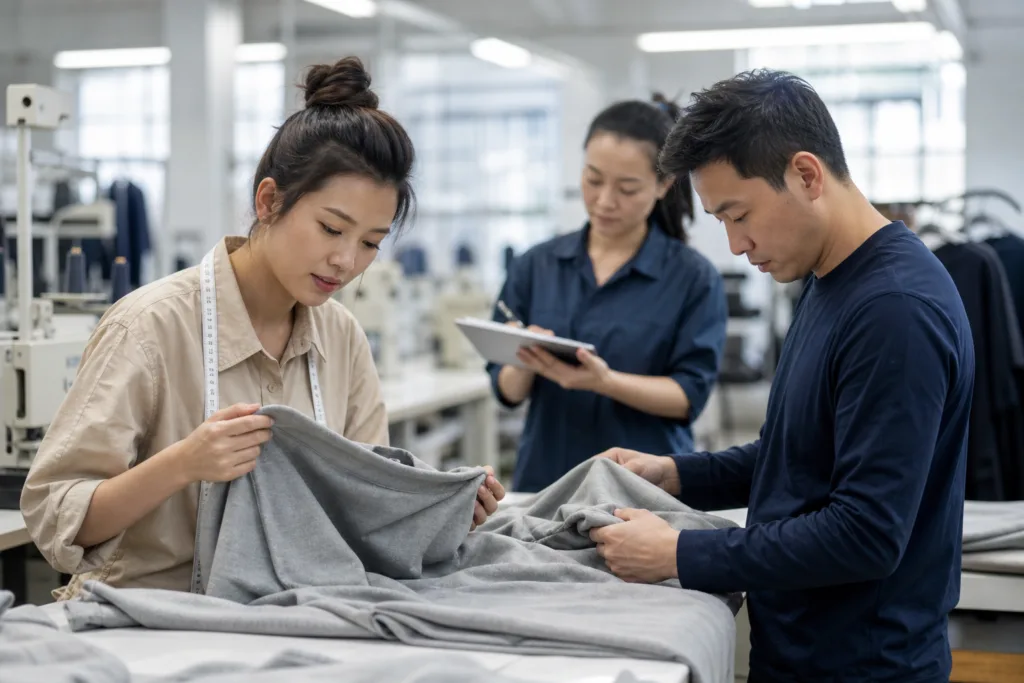
Minimum order quantity is usually shaped by fabric purchasing, dyeing, color count, trims, production setup, and factory efficiency. A supplier may accept a modest quantity for an available stock fabric but require a higher quantity for a custom color, special finish, or newly developed trim. MOQ should therefore be discussed by style, color, and material rather than as one universal number.
| Cost element | What to clarify | Why it matters |
|---|---|---|
| Development and sampling | Sample fee, pattern fee, revisions, and courier cost | Shows the true cost before bulk production |
| Unit price | Quantity breaks, fabric assumptions, decoration, and packing | Prevents comparison of incomplete quotations |
| Custom materials | Labels, trims, fabric dyeing, buttons, zippers, and cartons | May create separate MOQs or setup charges |
| Tooling and artwork | Embroidery digitizing, screens, molds, or special files | Some charges apply once; others may repeat |
| Freight and duties | Shipping term, destination, carton count, and insurance | Determines landed cost rather than factory price |
The cheapest unit quote can become expensive if it causes rework, late delivery, inconsistent sizing, or excess inspection. Compare suppliers using total cost, approval effort, expected defect risk, reorder reliability, and the financial impact of a missed launch. A slightly higher price may be rational when it buys better documentation, more stable materials, or stronger quality controls.
Production Lead Time and Bulk Order Planning
A realistic production plan separates material confirmation, sample approval, fabric and trim preparation, cutting, sewing, decoration, finishing, inspection, packing, and shipment. The clock should not start from the first inquiry if the fabric, artwork, measurements, or purchase order are still changing.
Lead time can extend when a fabric must be knitted or dyed, when custom trims are imported, when construction is complex, when several sample revisions are required, or when seasonal capacity is tight. Size and color assortment also affects cutting and packing complexity. Confirm whether the quoted time is working days, calendar days, or an estimate dependent on approval.
Build the launch schedule backward from the required delivery date. Include time for internal review, courier transit, testing, artwork approval, payment milestones, inspection, freight booking, and possible corrective action. A reorder plan should also record fabric availability and whether the same color or trim can be reproduced later.
When you are comparing production stages in more detail, apparel production timeline planning can help organize approvals and dependencies. We also recommend asking which milestones trigger a new commitment, because a supplier cannot responsibly reserve capacity when the specification remains open.
Quality Control Questions to Ask Before Ordering
Quality control should begin before sewing. Ask how incoming fabric and trims are checked, how shade lots are separated, how measurements are recorded, and who approves materials. Fabric inspection should consider width, weight, shade, holes, contamination, skew, stretch, and visible defects where relevant.
During production, in-line checks can identify measurement drift, seam problems, skipped stitches, puckering, needle damage, panel mismatch, and incorrect construction before the entire quantity is completed. Decoration requires separate checks for placement, size, thread or ink color, adhesion, registration, density, and damage to the base fabric.
Final inspection should review workmanship, measurements, color, labels, packing, stains, loose threads, count accuracy, and carton identification. Agree how defects are classified and what happens if an issue exceeds the accepted standard. Corrective action should identify the cause, not merely repair visible pieces.
For buyers comparing inspection priorities, Ninghow’s approach to apparel quality control for colorfastness and pilling illustrates why appearance checks and performance checks should be considered together. A garment may look acceptable at packing but still fail the customer if it pills quickly, bleeds during care, or loses shape.
Our manufacturing perspective is that quality is easier to protect when specifications are measurable. The Ninghow team uses the approved sample, measurement chart, material approvals, artwork, and packing instructions as connected production references rather than treating inspection as a final rescue step.
How to Compare Custom Clothing Manufacturers
First determine whether you are speaking with a manufacturer, a trading company, or a mixed sourcing operation. A trading company may still be suitable, but you should understand who controls pattern making, material purchasing, sewing, decoration, inspection, and corrective action. Ask for a clear explanation of the production route instead of assuming that a factory photo proves direct manufacturing capability.
| Evaluation area | Questions to ask | Evidence to review |
|---|---|---|
| Product capability | Have you produced comparable garments and fabrics? | Relevant samples, construction details, and references where available |
| Development | Who handles patterns, grading, samples, and revisions? | Sample comments, measurement charts, and revision records |
| Customization | Can you manage labels, trims, decoration, and packaging? | Approved artwork, decoration samples, and packing examples |
| Capacity | Can you support the first order and future reorders? | Capacity explanation, material planning, and schedule assumptions |
| Quality | What is checked before, during, and after production? | Inspection reports, defect procedure, and corrective action method |
| Communication | Who owns updates and approval records? | Clear quotation, timeline, and written responses |
Communication quality is a production capability. A supplier that asks precise questions about GSM, size tolerance, logo placement, packing, and delivery terms is often reducing risk before production begins. Conversely, immediate certainty on an incomplete brief may indicate that assumptions are being hidden inside the quote.
Check whether the supplier can support your likely growth path. A low MOQ development partner may not be equipped for recurring bulk orders, while a large factory may not prioritize a small first run. The best fit is the supplier whose process can handle your current order without blocking a sensible next stage.
Common Mistakes When Selecting a Clothing Manufacturer
- Choosing only on unit price without comparing fabric, decoration, packing, inspection, freight, and rework exposure.
- Sending incomplete specifications and expecting the factory to infer fit, construction, tolerances, or artwork requirements.
- Ignoring size grading and approving one sample without reviewing the full measurement range.
- Assuming fabrics, colors, printing methods, and embroidery settings are interchangeable.
- Changing the fabric, trim, label, or artwork after approval without resetting the sample and production schedule.
- Failing to confirm ownership of designs, confidentiality expectations, packaging details, and delivery terms.
- Accepting a lead time that excludes material preparation, approvals, inspection, or freight.
- Using a production reference that was not made with the final fabric and decoration.
These mistakes are avoidable when the buyer treats the supplier relationship as a documented product-development process. The goal is not to eliminate every uncertainty at the inquiry stage; it is to identify uncertainty early, assign responsibility, and close it before bulk cutting.
A Practical Supplier Evaluation Checklist
During the first inquiry, ask concise questions that reveal process maturity:
- What comparable garments and fabric types do you produce?
- Can you develop patterns, grade sizes, and revise samples from a tech pack?
- What fabric compositions, GSM ranges, colors, and performance finishes are available?
- How do MOQ and pricing change by style, color, fabric, trim, and decoration?
- Which private label components can you source and pack?
- What are the sample stages, approval requirements, and revision charges?
- What are the production milestones and what starts the lead-time clock?
- What quality checks are performed and how are defects handled?
- Can you support both a controlled launch quantity and future bulk reorders?
Request a written quotation, material details, sample timeline, measurement chart, packaging assumptions, payment terms, shipping terms, and a clear list of exclusions. If relevant, request physical fabric swatches and decoration samples rather than relying only on photographs.
Warning signs include vague answers about who makes the garments, unexplained substitutions, pressure to approve before sampling, pricing that excludes major components, refusal to document revisions, and promises that ignore fabric availability or capacity. One warning may be explainable; a pattern of unclear communication deserves caution.
When to Choose OEM, ODM, Private Label, or a Standardized Route
Choose OEM when your design, measurements, construction, and brand direction are defined and you need accurate execution. Choose ODM when you want to begin with a supplier’s existing product foundation and customize it efficiently. Choose private label when branded labels, packaging, and a recognizable product identity are central to the launch.
A more standardized route may be suitable when speed, lower development effort, and predictable availability matter more than a unique pattern. It can reduce risk for promotional orders or basic uniforms, but it may limit differentiation and fit control. The decision should reflect product strategy, not simply the smallest quoted MOQ.
Final Decision Framework for Selecting the Right Manufacturer
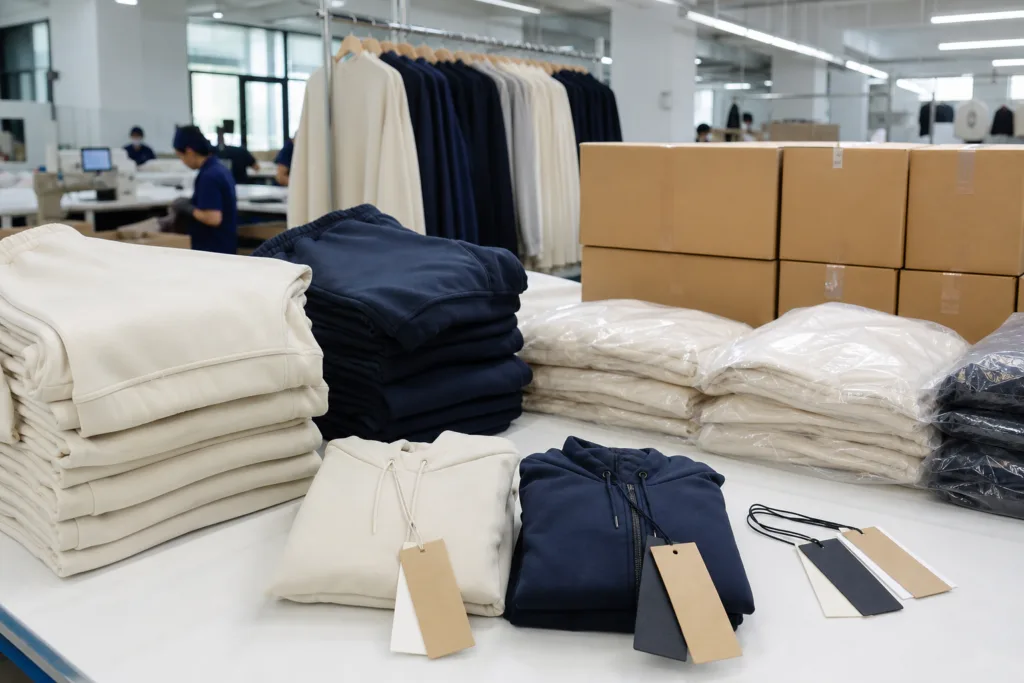
Score each candidate against product capability, fabric knowledge, development process, customization, MOQ fit, price transparency, lead time, quality control, communication, and scalability. Weight the criteria according to your business: a technical sportswear brand may prioritize performance testing and decoration durability, while a startup may place greater weight on sampling support and manageable development quantities.
Then compare the complete production path from brief to reorder. Ask whether the supplier can preserve the approved fit, source consistent materials, reproduce decoration, communicate changes, and respond when a problem appears. A custom clothing manufacturer should make your product more controllable, not merely more customized.
At Ninghow, we believe the strongest manufacturing decisions come from matching a buyer’s product, quantity, budget, and growth plan with a practical production process. When fabric, specifications, sampling, private label details, inspection, and delivery expectations are aligned before bulk production, the buyer has a much better basis for quality and commercial reliability.
Key takeaway: Select the manufacturer that can explain how your garment will be developed, approved, produced, inspected, packed, and repeated—not simply the supplier that offers the lowest first quotation.
Frequently Asked Questions
What should I send a custom clothing manufacturer for an accurate quote?
Send the garment category, sketches or reference images, tech pack, fabric target, GSM, size range, colors, artwork, label and packaging requirements, estimated quantity, delivery destination, and desired delivery date. The more clearly you separate confirmed specifications from open decisions, the more comparable the quotation will be.
How do I know whether a manufacturer can handle private label production?
Ask for examples of labels, hangtags, branded trims, packaging, and decoration they have managed, then confirm who sources each component and how approvals are recorded. Private label capability should include coordination of the full brand package, not just attachment of a neck label.
Why does MOQ vary between clothing manufacturers?
MOQ varies because fabric production, dyeing, custom colors, trims, labels, decoration setup, and production efficiency may require different minimum quantities. Always ask whether the MOQ applies per style, color, fabric, or total order, and whether available stock materials can support a smaller development run.
How many samples should I approve before bulk production?
The number depends on the complexity of the garment, but you should approve a sample that represents the final fabric, color, trims, decoration, measurements, and finishing. Additional fit or wash revisions may be necessary when the first sample exposes construction or performance issues.
What quality documents should I request from a clothing manufacturer?
Request the approved measurement chart, material specifications, sample comments, inspection criteria, packing instructions, and any relevant test or inspection reports available for the product. The exact documents depend on the garment and market, but written references are more useful than informal promises.
Can one supplier support both low MOQ development and large bulk production?
Some manufacturers can support both, but this must be confirmed through material availability, production planning, and capacity discussions. Ask how the supplier will handle the first smaller order, what changes at higher quantities, and whether the same approved specifications can be maintained for reorders.
Related Reading
- custom polo shirt manufacturing guidance on fabric, fit, MOQ, and QC
- MOQ, lead time, and cost factors in sportswear production
- cotton-polyester blend fabric properties and performance considerations
- apparel production timeline planning
- the clothing manufacturing process from development to production