








Importing clothing from China to the EU involves more than confirming a style, price, and ship date. If you want to import clothing from China to EU markets smoothly, you need accurate product classification, a defensible customs value, clear origin information, and complete shipping documents before the goods leave the factory. In our manufacturing work, we see that many clearance delays start long before arrival because the importer, supplier, and forwarder were not aligned on product details, labeling, or document accuracy.
If your project involves private label apparel, teamwear, sportswear, or general bulk garments headed to Europe, our import clothing support for EU-bound orders helps connect manufacturing preparation with import readiness. We support buyers with practical product data, composition details, labeling coordination, packing accuracy, sampling confirmation, and bulk shipment planning so the information used for customs and downstream EU market entry is more consistent from the start.
Why importing clothing from China to the EU requires more than just a purchase order
The short answer is that customs decisions are based on declared facts, not only on your commercial agreement. EU customs authorities and customs brokers need to know what the product is, what it is made of, where it comes from, what it costs, and how it is shipped. A simple invoice with a generic line such as “garments” is rarely enough.
For clothing buyers, this matters because apparel is not classified as one single product group. A cotton T-shirt, a polyester hoodie, a woven work jacket, and a knitted sports short can all have different classification outcomes, duty rates, document needs, and labeling implications. Small description mistakes can lead to the wrong tariff code, wrong duty estimate, or requests for additional evidence.
Key takeaway: A clothing shipment clears more smoothly when product data, composition, origin, and invoice details are prepared as part of sourcing and production, not added at the last minute.
Who this guide is for

This guide is written for clothing brands, sourcing teams, distributors, retailers, and private label buyers sending EU-bound apparel orders from China. It is especially useful for teams that already understand garment development but want a clearer import compliance workflow.
It is also relevant for first-time importers who need to understand where customs, VAT, origin rules, and shipping documents fit into the buying process. From our perspective as a manufacturer, the most effective projects are the ones where import planning starts before bulk production is finalized.
- Brand founders planning their first EU import order
- Sourcing managers comparing landed cost across garment categories
- Private label buyers preparing invoices, labels, and packaging specs
- Retailers and distributors coordinating with customs brokers
- Product developers needing accurate composition and construction data
The EU import process in simple terms
At a practical level, the process usually follows five steps: order confirmation, shipment booking, customs declaration, payment of duty and VAT, and cargo release. The exact workflow can differ by Incoterm, destination country, and whether the importer works through a customs broker, but the core sequence is similar.
First, the goods are produced and packed. Next, shipping documents are prepared and the transport is arranged. Then customs data is submitted using the product classification, origin, customs value, and commercial documents. After that, duty and import VAT are assessed, and if the declaration is accepted, the shipment is released.
The most important point is timing. If classification, origin, or invoice data is unclear only after the vessel or flight departs, fixing errors becomes slower and more expensive.
How clothing is classified for customs
Clothing is classified according to the product’s objective characteristics. In practice, that means customs does not classify garments based on your marketing name alone. The garment type, knit or woven construction, fiber composition, gender or age category where applicable, and use-specific features can all affect the code.
Buyers who want a deeper breakdown can review our guide on how to choose the right clothing HS code. The key lesson is that classification should be built from measurable product facts, not assumptions carried over from an older style.
For example, two garments both described as “hoodies” may classify differently if one is a knitted cotton pull-on sweatshirt and the other is a woven insulated outerwear jacket with a front opening. Similar commercial names do not guarantee the same customs treatment.
What product details usually matter most
- Garment category, such as T-shirt, jacket, pants, shorts, polo, or sweatshirt
- Knit or woven construction
- Main fiber content and percentage breakdown
- Adult or children’s garment where relevant
- Functional features such as lining, padding, water resistance, or workwear design
- Whether the item is clothing or an accessory
Typical clothing categories and classification considerations
Apparel importers often underestimate how much composition and construction affect customs treatment. The more technical or hybrid the garment, the more important precise description becomes.
| Product type | Classification factors to check | Common risk |
|---|---|---|
| T-shirts | Knit structure, fiber composition, adult or children’s sizing | Using a generic “tops” description |
| Hoodies and sweatshirts | Knit fabric, brushed fleece, front opening or pull-on style | Confusing sweatshirt and jacket categories |
| Jackets | Woven or knit shell, lining, padding, weather protection features | Misclassifying outerwear as simple tops |
| Pants and shorts | Knit or woven, fiber content, sportswear construction | Incomplete description of fabric type |
| Sportswear sets | Whether imported as sets or separate items, performance fabric details | Declaring all pieces under one vague line |
| Accessories | Product function, material, and whether it is apparel or accessory | Mixing accessories into clothing lines on invoices |
In our production work, we encourage buyers to lock composition, style naming, and carton packing logic before invoice preparation. That reduces the chance that the commercial invoice and actual goods tell different stories.
How customs value is calculated for apparel imports
For most clothing imports, customs value starts with the transaction value, then customs authorities assess what should be included under the applicable rules. This is why the invoice amount alone is not always the final basis for duty calculation. Freight, insurance, and other cost elements may affect the calculation depending on the transaction structure and point of import.
The European Commission provides a useful explanation of how EU import duties are calculated, including why tariff classification, customs value, and origin work together. From a buyer perspective, this means landed cost planning should never rely only on the factory price.
Common cost elements that may matter include the product price, transport charges, insurance, and in some cases assists or other additions linked to the sale for export. If your sourcing model includes buyer-supplied trims, design inputs, or separate freight billing, align that structure with your broker early.
Why landed cost estimates often go wrong
- The buyer calculates duty on ex-factory price only and ignores other customs value elements
- The freight term changes, but the landed cost sheet is not updated
- The wrong tariff code is used for pre-costing
- Mixed-product shipments are costed as if all garments share one duty rate
Import duty on clothing from China to the EU
Duty rates vary because different garment categories fall under different tariff lines. Fiber composition, construction, and garment type can all change the result. A buyer importing cotton knit tees should not assume the same duty outcome for polyester outerwear or woven trousers.
If you are building cost models, our article on import duty basics for clothing buyers can help frame the issue from a sourcing perspective. The practical point is simple: even small classification differences can materially change the landed cost on large-volume apparel orders.
Duty also interacts with origin. Even when the goods are physically shipped from China, the applicable origin analysis still matters because customs treatment depends on the product’s origin status, not only the port of loading.
Key takeaway: Do not treat “apparel duty” as one fixed percentage. Confirm the correct classification and origin basis for each product group in the shipment.
VAT on EU clothing imports and why it matters for planning
Import VAT is generally charged when goods enter the EU, and it is separate from customs duty. The exact handling depends on the importer’s setup, destination member state, and tax arrangements, but from a cash-flow standpoint it can significantly affect the real cost of an order.
Buyers often focus heavily on FOB or CIF price negotiations and forget that VAT can be a major landed cost and financing factor. If you are comparing suppliers or shipment splits, include the timing of VAT payment and recovery in your planning, not just the headline factory price.
For procurement teams, the key question is not only “what is the VAT rate?” but also “who is the importer of record, when is VAT due, and how does that affect working capital?” Those decisions should be aligned with your finance and customs teams before shipping.
Country of origin basics for clothing imports
For customs purposes, country of origin is not simply the place where goods were shipped from or where the seller is based. It refers to the country determined under origin rules. In many apparel cases, that may be China, but the conclusion should come from the actual production facts.
Buyers sometimes confuse supplier nationality, port of export, and country of origin. Those are not the same thing. If the goods are marked or declared incorrectly, customs may question origin, valuation, and supporting documents at the same time.
To reduce confusion between product labeling and customs declarations, buyers can review our guide on how to verify country of origin labels. In our experience, origin should be checked against the manufacturing process, labeling plan, and invoice wording before bulk shipment documents are issued.
Preferential origin vs non-preferential origin
Non-preferential origin identifies the origin of goods for general customs purposes, while preferential origin can affect whether reduced or zero duty treatment is available under specific trade arrangements. That difference is important because the words “origin” and “Made in” are often used casually in sourcing discussions, even though customs treatment can depend on the exact legal context.
The European Commission’s overview of EU rules of origin for imported goods is a useful reference when buyers need to understand why origin is determined by rules, not by assumption. For most standard clothing imports from China to the EU, buyers should still verify what origin basis applies instead of relying on shorthand descriptions.
Origin can become more complicated when materials, cutting, sewing, finishing, or assembly are spread across multiple countries. In those cases, you need a clear record of the manufacturing steps to evaluate origin properly.
Common origin mistakes buyers make
- Assuming the shipping country is automatically the country of origin
- Using supplier letterhead as proof of origin without checking production facts
- Mixing goods from different origins in one shipment without document clarity
- Ignoring origin when cost planning duty exposure
- Failing to align sewn-in labels with customs declarations
Essential import documents for clothing shipments
At minimum, most clothing shipments need a commercial invoice, packing list, and transport document, plus the data required for customs declaration. The exact document package can vary by shipment mode, importer setup, and broker requests, but these core records are the starting point.

Buyers wanting a practical checklist can review our page on documents required to import clothing from China. From the factory side, we find that document quality improves when the shipment file is prepared from approved style data, final carton counts, and confirmed composition records rather than rebuilt in a hurry after packing.
| Document | What it should show | Why it matters |
|---|---|---|
| Commercial invoice | Seller, buyer, item details, quantity, unit price, total value, Incoterm | Supports customs value and product identification |
| Packing list | Carton count, weights, dimensions, item packing breakdown | Helps customs and logistics verify shipment contents |
| Transport document | Shipment route and carrier details | Supports movement and release procedures |
| Customs data set | Tariff code, origin, value, importer details | Forms the basis of declaration accuracy |
When supporting documents may also be needed
Some shipments need more than the basic document set. Depending on the product, origin claim, broker requirement, or customs question, you may also need additional product descriptions, composition breakdowns, declarations, or compliance-related evidence.
This happens often with technical sportswear, mixed-fiber garments, or goods with unusual construction. A customs broker may ask for clearer fiber percentages, fabric type, or garment function if the invoice description is too broad.
- Detailed material composition sheets
- Style photos or technical descriptions
- Origin-related declarations or supporting records
- Labeling and packaging details
- Compliance records for downstream EU market requirements where relevant
How composition and garment construction affect document accuracy
For apparel, composition is not a minor specification. It influences classification, labeling, landed cost, and sometimes even the wording used on invoices and packing lists. If the approved bulk fabric is 60% cotton and 40% polyester, but the invoice shows a generic “cotton top,” the mismatch can create avoidable questions.
Construction details matter too. Whether the product is knitted or woven, lined or unlined, padded or unpadded, pull-on or full-zip can affect how customs understands the product. This is one reason we recommend that buyers use approved tech packs and sample records as the basis for shipment documentation.
At Ninghow, we see fewer documentation issues when style specs, care labels, composition labels, and invoice descriptions are checked together before final shipping files are released.
Customs declaration workflow and why accuracy is critical
The customs declaration is normally submitted by the importer or its customs representative using data taken from your commercial documents and product records. If that data is incomplete or inconsistent, the broker may need clarification, or customs may stop the shipment for review.
Accuracy matters because customs issues often connect. A wrong HS code can affect duty. A questionable invoice can affect customs value. An unclear origin statement can trigger document requests. When several fields are weak at once, clearance risk rises quickly.
From a manufacturing perspective, the best support we can provide is structured product information before shipment: style breakdowns, composition confirmation, packing details, and label consistency. That helps the importer and broker submit a cleaner declaration.
Incoterms and landed cost
The shipping term changes who pays for what and when costs transfer. That means Incoterms can change both your landed cost calculation and your operational responsibility during shipment. Buyers should confirm this early because customs value planning, transport booking, and document flow often depend on the chosen term.
For example, the information needed under EXW, FOB, CIF, or DDP discussions may look similar on the surface, but the commercial and customs implications are not the same. If your landed cost sheet is built on one term and the supplier invoice is issued under another, your import cost model may be wrong before the cargo even departs.
Questions buyers should align before shipment
- Who is the importer of record?
- Which party books and pays the main transport?
- Which costs are included in the invoice and which are billed separately?
- Who provides the customs broker with final classification and origin data?
- Who checks that invoice, packing list, and labels match the goods?
Compliance issues beyond customs
Customs clearance is only one part of getting garments ready for the EU market. Buyers also need to consider textile labeling, fiber content accuracy, care information, and product compliance requirements that apply after import and sale. These topics may not always change the customs duty itself, but they still affect commercial readiness and risk.
The EU’s guidance on EU textile label requirements is useful when reviewing fiber composition declarations for products sold in Europe. In practice, the composition on the sewn label, product specification, and shipment records should align as closely as possible so the same garment is described consistently from factory to customs to retail.
For private label projects, buyers should confirm label language expectations, fiber naming, care instructions, and packaging details during sampling. Trying to correct these only after production can delay shipping or create relabeling costs.
Practical checklist before shipping clothing from China to the EU
Before shipment, the importer should be able to explain exactly what each product is, how it is classified, what it is made of, what origin applies, and how the customs value will be supported. If any of these answers is still uncertain, shipment readiness is not complete.
- Confirm final style descriptions for every SKU
- Verify fiber composition and knit or woven construction
- Check the tariff code logic with your broker or trade advisor
- Review invoice, packing list, and carton breakdown for consistency
- Make sure origin data matches production facts and labels
- Confirm the agreed Incoterm and included cost elements
- Prepare supporting records for any non-standard garment features
- Check labeling and packaging for EU market use
Common clearance problems and how to avoid them
The most common clothing clearance problems are not dramatic legal issues. They are routine data problems: wrong HS code, incomplete invoice descriptions, missing composition details, unclear origin, undervalued goods, or cartons that do not match the packing list.
These issues are preventable when the sourcing file is built carefully. In our experience, the risk rises when teams separate product development, purchasing, shipping, and customs into disconnected handoffs with no final document review.
| Problem | Typical cause | Prevention step |
|---|---|---|
| Wrong HS code | Generic style naming | Classify using composition and construction details |
| Incomplete invoice | Rushed document preparation | Use approved style data and clear item descriptions |
| Unclear origin | Assumptions about shipping country | Verify origin from actual production steps |
| Missing composition data | No final fabric confirmation | Lock composition before bulk and share with broker |
| Undervalued goods | Incomplete cost basis | Review customs value method before shipment |
Key takeaway: Most import delays begin with preventable information gaps, not with the transport itself.
How to work with your supplier and freight forwarder to reduce customs delays
The best approach is to treat import compliance as a shared preparation task. The supplier provides accurate product and packing data. The buyer confirms commercial structure and importer details. The forwarder and customs broker validate shipping and declaration requirements.
From our side as a manufacturer, we recommend one final pre-shipment review covering composition, carton quantities, labels, invoice wording, and any unusual garment features. This review is especially important for mixed orders containing several apparel categories with different tariff classifications.
Communication also matters. If your broker asks whether the item is knitted or woven, whether the shell and lining have different compositions, or whether the goods are adult or children’s wear, answer with product facts from the approved records, not assumptions from a sales description.
When to involve a customs broker or trade advisor
Involve a broker early if you are importing for the first time, using mixed-product shipments, dealing with origin complexity, or building a new landed cost model. It is much easier to confirm classification and document expectations before production is finished than after the goods are in transit.
A trade advisor can also be useful when you have multi-country production, uncertain origin treatment, or questions about how a specific garment should be classified. For many apparel businesses, broker input is a cost-control step because it helps prevent rework, storage charges, and delayed delivery to customers.
Final checklist for first-time EU clothing importers
If this is your first order, keep the process simple and evidence-based. Use approved product specifications, align documents early, and ask your customs contacts to review any uncertain areas before shipment.
- Do not use generic descriptions like “garments” or “fashion wear”
- Keep composition percentages consistent across specs, labels, and invoices
- Separate different product categories clearly on commercial documents
- Make sure origin and labeling logic are aligned
- Include duty and VAT in landed cost planning from the start
- Confirm who files the declaration and who pays import charges
- Retain product records and shipping documents in an organized file
Prepare accurate product details before placing the bulk order
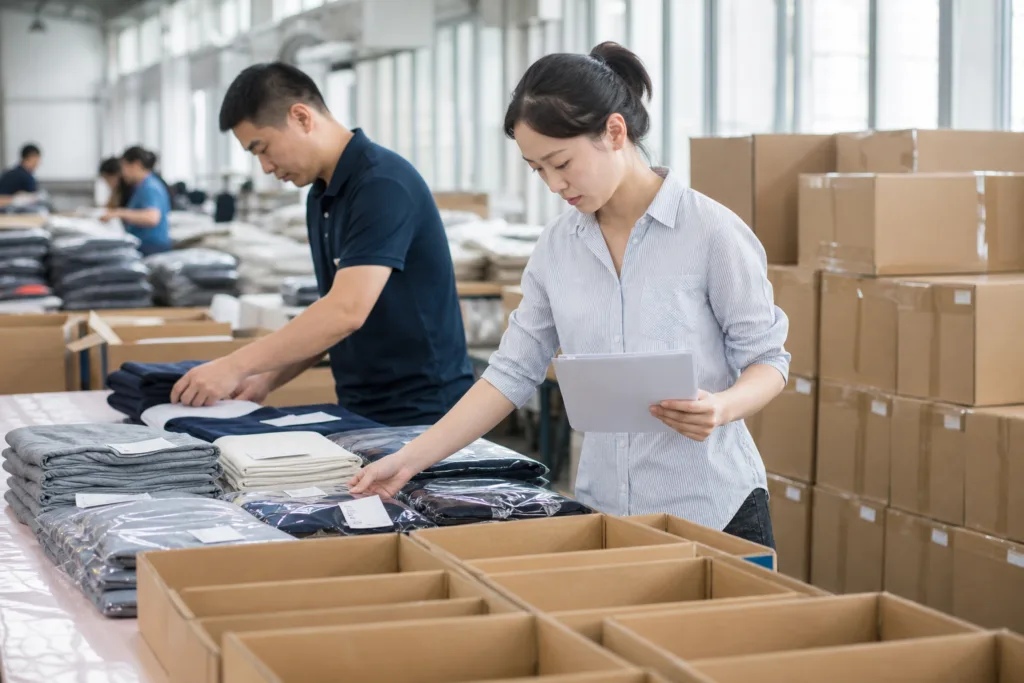
The safest time to prevent customs trouble is before bulk production starts. Once a shipment is packed, many errors become expensive to fix. That is why we encourage buyers to treat classification, composition, labeling, and document structure as part of the sourcing brief, not as a final shipping admin task.
If you plan to import clothing from China to EU destinations regularly, build one repeatable process: clear tech packs, confirmed fabric composition, aligned country-of-origin labeling, accurate invoices, and broker-reviewed customs data. That process reduces surprises and makes future shipments more predictable.
For brands, distributors, and sourcing teams, the real goal is not only customs release. It is total import readiness: products made correctly, documents prepared correctly, and landed cost understood before the order ships.
FAQs
What is the biggest mistake when importing clothing from China to the EU?
The biggest mistake is using incomplete or vague product information. Generic descriptions such as “garments” or “sportswear” can lead to the wrong classification, duty estimate, or customs questions, so buyers should prepare clear style descriptions, fiber composition, and construction details before shipping.
Do all clothing products from China have the same EU duty rate?
No, clothing products do not all share one duty rate. Duty depends on the tariff classification, and that can vary by garment type, knit or woven construction, fiber content, and sometimes other product features, which is why each apparel category should be reviewed separately during landed cost planning.
Why does country of origin matter if the goods are shipped from China?
Country of origin matters because customs treatment is based on origin rules, not just the port of export. Even when goods leave China, the importer still needs the correct origin basis supported by production facts, labels, and documents so the declaration is consistent and defensible.
Which documents are usually required for an EU clothing import shipment?
Most shipments need a commercial invoice, packing list, transport document, and the customs declaration data set. Depending on the product and shipment structure, buyers may also need composition details, clearer product descriptions, origin-related records, or other supporting evidence requested by the broker or customs authority.
Should I involve a customs broker before the goods ship?
Yes, involving a customs broker before shipment is usually a smart step, especially for first-time importers or mixed apparel orders. Early review helps confirm classification, customs value assumptions, origin questions, and document requirements before mistakes become expensive to correct.
How can a clothing manufacturer help reduce EU import risk?
A clothing manufacturer can reduce import risk by preparing accurate product data at the source. When composition, construction details, labels, packing lists, and invoice descriptions are aligned during production and pre-shipment review, the importer has a much stronger base for customs clearance and compliance planning.