








To import clothing from China to Australia successfully, apparel buyers need to prepare more than a purchase order and a freight booking. Product specifications, labeling, export documents, tariff classification, GST, packaging, inspection, and delivery timing all affect whether goods clear smoothly and arrive at the expected cost. A factory may complete production correctly, yet a shipment can still face delays or unexpected charges when the commercial information is incomplete.
If you are comparing factories, developing private label garments, or preparing a first wholesale shipment, import clothing support for Australian buyers can help connect product development with export preparation. We can support fabric and specification review, sampling, label placement, packing requirements, production coordination, and pre-shipment planning so the garment is considered as a complete import project rather than only a factory order.
Why importing clothing from China to Australia requires preparation
The central rule is simple: confirm the product, paperwork, and landed cost before the goods leave the factory. Australian buyers are responsible for knowing what they are importing and for ensuring that the shipment information matches the physical garments, cartons, and sales requirements.
For a clothing brand, this means checking details such as fiber composition, garment type, knitted or woven construction, intended use, sizes, colors, quantities, country of origin, and packaging. These details influence manufacturing, labeling, customs classification, duty assessment, inventory receiving, and sometimes retail compliance.
We recommend treating import preparation as part of product development. The earlier the buyer shares requirements with the manufacturer and logistics partners, the easier it is to correct a missing label, revise carton information, or confirm a classification before production is finished.
Key takeaway: A shipment is ready only when the garments, documents, labels, cartons, and commercial calculations all tell the same story.
Who should use this clothing import guide?

This guide is designed for Australian apparel brands, startups, wholesalers, retailers, distributors, sportswear companies, clubs, schools, and procurement teams sourcing from Chinese clothing manufacturers. It is especially useful for buyers moving from samples to a repeatable bulk-order process.
First-time importers often focus on the factory price because it is easy to compare. Experienced buyers know that the final cost also includes sampling, labels, packaging, inspection, freight, insurance where applicable, customs-related fees, duty, GST, storage, and domestic delivery. A lower unit price is not necessarily lower total cost if the order requires rework or creates clearance problems.
What to confirm before clothing production starts
Before confirming bulk production, create one approved product file for each style. It should contain the information that the factory, quality inspector, freight forwarder, customs broker, and receiving team need to use consistently.
Product and construction details
- Garment category and intended use, such as T-shirt, polo, hoodie, jacket, shorts, or uniform.
- Fiber composition and any blended-fabric percentages.
- Fabric construction, GSM, finish, stretch direction, and performance expectations.
- Approved measurements, tolerances, grading rules, and size range.
- Color standards, artwork, embroidery files, print method, and placement measurements.
- Labels, hangtags, packaging, barcode requirements, and carton marking instructions.
- Quantity by style, color, and size, including acceptable substitutions or overage rules.
Our manufacturing perspective is that fabric composition and garment construction should be finalized before tariff and labeling discussions. A cotton jersey T-shirt, a polyester woven jacket, and a fleece sweatshirt may look similar in a product photograph but can be treated differently for classification and consumer information.
Commercial terms and responsibilities
Confirm the purchase price, currency, payment schedule, Incoterm, shipping responsibility, insurance expectations, and destination charges in writing. The buyer should also identify who will book freight, who will provide export documents, who will communicate with the customs broker, and who pays for corrections if documents do not match the shipment.
Do not assume that a supplier’s quotation includes every cost needed to deliver goods to your warehouse. Ask for a written scope of included and excluded charges, then build an internal landed-cost estimate before approving the order.
Shipping preparation checklist for clothing imports
Clothing is usually shipped in polybags, cartons, or a combination of both. The packing method should protect the garments while also making quantity checking and warehouse receiving efficient.
Before packing begins, confirm whether each garment needs an individual barcode, size sticker, color sticker, or SKU label. A retailer may require a specific barcode format or carton configuration even when customs does not. These requirements should be supplied to the factory before the final sample is approved.
- Confirm the number of garments per inner pack and master carton.
- Record carton dimensions, gross weight, net weight, and carton count.
- Specify carton marks, purchase order number, style number, size range, and destination.
- Use moisture-resistant packaging where the freight plan and product type justify it.
- Check whether cartons can be safely stacked and handled by the selected carrier.
- Confirm whether the forwarder needs carton data before booking space.
Carton data should be measured from the final packed goods rather than estimated from an early sample. Small differences in carton dimensions or weight can affect freight quotations and may create discrepancies between the packing list and the physical shipment.
Essential import documents Australian buyers should prepare
The exact document set depends on the shipment, transport mode, commercial terms, and broker requirements, but most apparel imports require a consistent core file. Buyers should request draft documents before shipment so errors can be corrected while the goods are still at the factory.
A useful working reference is this guide to documents required to import clothing from China. The important point is not simply collecting files; it is checking that product names, quantities, values, weights, carton counts, and parties are consistent across every document.
Commercial invoice
The commercial invoice supports customs valuation and identifies the seller, buyer, goods, quantity, unit price, total value, currency, and agreed trade terms. Clothing descriptions should be specific enough to explain what is being imported. Descriptions such as “apparel” or “samples” may be too vague for a commercial shipment.
Packing list
The packing list shows how the goods are arranged. It should normally identify carton numbers, style or product references, quantities, size and color breakdowns where useful, net and gross weights, and carton dimensions. The receiving team can also use it to reconcile delivery against the purchase order.
Bill of lading or airway bill
A bill of lading is commonly used for ocean freight, while an airway bill is used for air freight. These transport documents connect the shipment to the carrier and provide information such as shipper, consignee, origin, destination, package count, and transport reference.
Certificate of origin and supporting records
A certificate of origin may be relevant depending on the goods, trade arrangements, customs treatment, and broker request. It should not be ordered automatically without confirming whether it is needed for the particular shipment. Other supporting records may include purchase orders, inspection reports, insurance documents, permits for unusual materials, or evidence supporting a claimed customs value.
Request draft copies of the invoice, packing list, and transport document before dispatch. This gives the buyer and broker time to identify inconsistent style names, incorrect weights, wrong consignee information, or missing product descriptions.
How customs duties and HS classification affect clothing cost
Australian customs treatment depends partly on the correct classification of each product. Clothing commonly falls within textile and apparel sections of the tariff, but the correct code can depend on factors such as garment type, material, gender or wearer category where relevant, knitted or woven construction, and product details.
Use the Australian Border Force resource for HS code and tariff classification for clothing as an official starting point, then confirm the classification with your customs broker or another qualified adviser. A supplier may suggest a code based on export experience, but the Australian import treatment still needs to be checked for the destination market.
Choosing the wrong code can cause more than a duty difference. It may lead to document questions, reassessment, delayed release, inaccurate costing, or problems when the same style is reordered. Keep a classification record for each product family and update it when composition or construction changes.
Buyers should provide the broker with a clear description rather than relying only on a product photograph. Include garment type, fabric composition, construction, intended use, and any information the broker requests for classification.
For a broader costing discussion, review import duties on clothing from China. The practical lesson is to estimate duty at the product level and avoid applying one assumed rate to every style in a mixed shipment.
GST and landed-cost planning for imported apparel
GST should be included in the landed-cost model before the purchase order is approved. The amount and treatment can depend on the customs value, international transport and insurance components, duty, and other applicable charges. The Australian Border Force explains GST and border charges on imported clothing, which buyers can use when discussing the shipment with their broker or accountant.
A useful internal formula is to estimate the total delivered cost as product value plus origin charges, freight, insurance where applicable, duty, GST, customs or broker charges, destination handling, and domestic transport. The exact accounting treatment of GST depends on the buyer’s tax position, so businesses should obtain advice suited to their structure.
| Cost area | What to confirm | Why it matters |
|---|---|---|
| Product cost | Unit price, quantity, currency, and Incoterm | Establishes the commercial base of the order |
| Freight | Mode, chargeable weight, route, and booking terms | Can change significantly by shipment size and timing |
| Duty | Classification and applicable rate | Incorrect assumptions distort margin calculations |
| GST | Taxable import basis and recovery treatment | Creates a cash-flow requirement at import |
| Destination charges | Broker, handling, delivery, storage, and inspection fees | Often excluded from factory quotations |
For repeat orders, compare the estimate with the actual import statement and update the model. This creates a more reliable benchmark for future pricing and helps identify whether a change in carton configuration, shipping method, or order quantity is improving the total economics.
Product labeling requirements for clothing sold in Australia
Labels should be planned during product development, not added after production. Australian buyers generally need to consider fiber content, country of origin, size information, care instructions, and any retailer-specific product or barcode requirements. The exact legal obligations can vary by product and sales channel, so buyers should verify the current requirements for their garments.
For practical guidance, see these apparel labeling requirements for imported clothing. The manufacturer should receive approved label artwork, dimensions, language, placement, attachment method, and sewing instructions before bulk cutting or sewing begins.
Permanent labels and care information
A sewn-in label is usually more durable than a temporary sticker and is less likely to disappear before the consumer uses the garment. Buyers should decide whether fiber information and care instructions will be combined or separated, then confirm that the label remains readable after washing and normal wear.
Care information should be based on the actual fabric, dye, trims, print, and construction. A care instruction copied from another style may be unsuitable if the new garment contains a different blend, coating, transfer print, or delicate accessory. We recommend approving the physical label sample together with the garment sample.
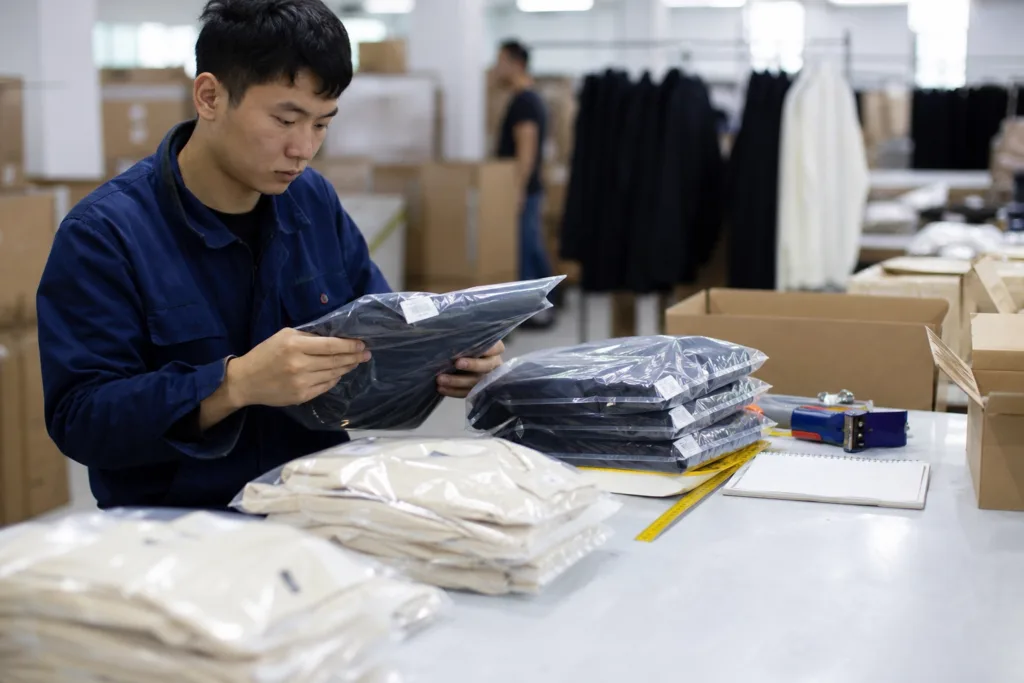
Country of origin, size, and packaging
Country-of-origin information should be handled consistently across the garment, hangtag, packaging, and commercial documents where required. Size labels should match the approved size chart and the carton breakdown. A common operational problem is a correct garment with an incorrect size sticker, which can disrupt warehouse receiving and retail fulfillment.
Keep a final label approval record containing artwork, dimensions, material, placement photographs, and version date. This helps prevent an outdated label file from being used on a repeat order.
Compliance risks that deserve attention before shipment
The most common risks are mismatched information and late decisions. Buyers should inspect not only the garment appearance but also the details that connect the product to Australian sale and import requirements.
- Fiber percentages on the label do not match the approved fabric composition.
- Care instructions do not reflect the actual garment or decoration method.
- Country-of-origin information is missing, inconsistent, or placed on an unapproved component.
- Size labels, hangtags, barcodes, and carton markings do not match the purchase order.
- The customs description is too generic to support classification.
- Invoice quantities or values differ from the packing list.
- Packaging uses materials or formats that the retailer did not approve.
- Bulk garments vary from the approved sample in measurements, color, or logo placement.
These problems are easier to fix before shipment than after arrival. A pre-shipment inspection should include measurement checks, workmanship, color, labels, decoration, packing quantity, carton marks, and document comparison.
How to coordinate the supplier, forwarder, and customs broker
Assign one person to own import readiness, even when several companies are involved. The factory controls production and export-side information, the freight forwarder manages transport coordination, and the customs broker supports destination clearance. The Australian buyer remains the party that must ensure the overall information is complete and commercially understood.
Share the following information early:
- Approved product descriptions and composition details.
- Purchase order, commercial terms, and consignee details.
- Expected ready date and preferred shipping window.
- Carton count, dimensions, weights, and packing method.
- Requested HS classification information for broker review.
- Label, barcode, and retail packaging specifications.
- Inspection requirements and release conditions.
At Ninghow, we treat export documentation and packing information as part of production communication. This approach helps buyers compare the approved product against the final shipment and gives the logistics team usable information before cargo handover.
Set a document deadline before the cargo-ready date. The factory should provide drafts, the buyer should review them, and the broker or forwarder should flag missing information before the shipment is collected.
Packaging and shipping methods that reduce avoidable delays
The best shipping method depends on order volume, urgency, carton dimensions, budget, and inventory risk. Air freight can suit urgent samples or small replenishment quantities, while ocean freight is often considered for larger, less time-sensitive orders. Consolidation may be useful when the shipment is too small for a dedicated container, but it can introduce additional coordination and handling points.
Packaging should balance protection, freight efficiency, and warehouse usability. Overly large cartons increase volume, while overly compressed garments may arrive creased or lose presentation quality. Ask the factory to confirm whether folding, polybagging, carton size, and carton weight are suitable for the chosen route and receiving process.
Before booking, compare:
- Estimated transit time and sailing or flight frequency.
- Cutoff dates and cargo-ready requirements.
- Chargeable volume or weight.
- Transshipment and consolidation arrangements.
- Destination handling, delivery, and storage terms.
- Whether the shipment can be tracked from factory pickup to Australian delivery.
Lead time planning for Chinese clothing imports
Plan lead time as a chain of separate stages rather than one factory promise. A practical schedule includes product confirmation, fabric and trim sourcing, sampling, sample approval, bulk production, inspection, document preparation, freight booking, export handling, transit, customs clearance, and final delivery.
| Stage | Buyer decision | Typical risk to manage |
|---|---|---|
| Development | Approve specifications and fit | Repeated sample changes |
| Materials | Confirm fabric and trims | Availability or color delays |
| Production | Release bulk order | Capacity and quality variation |
| Inspection | Approve shipment condition | Late rework or missing quantities |
| Shipping | Book freight and provide documents | Cutoff, routing, or document errors |
| Clearance | Respond to broker questions | Classification or valuation delays |
Allow a buffer for public holidays, port congestion, weather, inspection rework, and customs questions. Do not set a retail launch date using the factory’s production completion date alone.
How Australian buyers can evaluate supplier export readiness
A capable apparel supplier should be able to explain how it manages product data, labels, packing, export paperwork, and inspection coordination. Export experience is not only about having shipped before; it is about maintaining accurate information from sampling through final dispatch.
Ask the supplier to confirm:
- Whether it can provide consistent commercial invoice and packing list data.
- How it records fabric composition and style information.
- Who checks labels and carton markings before packing.
- How it handles buyer-approved samples and measurement tolerances.
- When draft documents will be shared for review.
- How changes to quantity, packing, or shipping dates are communicated.
- Whether it can support inspection and corrective action before release.
During supplier evaluation, look for clear answers and documented processes. Vague promises about “standard export documents” are less useful than a sample document set, a defined approval workflow, and a named person responsible for shipment information.
For private label projects, prepare logo files, label artwork, packaging references, size specifications, and carton requirements before sampling. Early clarity reduces the chance that a factory develops a garment correctly but finishes it with the wrong branding or packing format.
Common mistakes when importing clothing from China
Using the factory price as the total cost
Factory price is only one part of the financial decision. Freight, duty, GST, brokerage, inspection, storage, and domestic delivery should be estimated before the order is accepted.
Leaving labels until the end
Late label decisions can require extra sampling, relabeling, or production interruption. Approve label content and placement with the garment sample.
Accepting an assumed HS code
A supplier’s classification suggestion may not reflect the Australian import position. Give the broker complete product information and retain the classification rationale.
Booking freight before carton data is final
Estimated cartons can result in inaccurate freight costs and booking changes. Use final packed measurements when possible.
Skipping pre-shipment inspection
Inspection is especially valuable when the order includes several colors, sizes, decoration methods, or private label components. A small issue found before dispatch is usually easier to address than a mixed shipment received into a warehouse.
Pre-shipment checklist for Australian apparel buyers
Use this checklist before authorizing cargo collection:
- Product specifications match the approved tech pack and sample.
- Fabric composition and care instructions have been confirmed.
- Size labels, country-of-origin details, hangtags, and barcodes are approved.
- Decoration, trims, packaging, and carton marks match the purchase order.
- Commercial invoice and packing list drafts have been reviewed.
- Carton count, dimensions, net weight, and gross weight are final.
- HS classification and expected duty treatment have been reviewed with the broker.
- GST and other import charges are included in the landed-cost calculation.
- Inspection results are acceptable and corrective actions are closed.
- Freight booking, cargo cutoff, consignee, and delivery address are confirmed.
- All parties know who will respond to customs or document questions.
This checklist should become a repeatable control point for every purchase order. A standard process reduces reliance on memory and makes it easier to compare performance between suppliers and shipments.
How to make repeat imports more predictable
The first shipment should produce useful records for the next one. Save the final invoice, packing list, classification information, freight quote, actual charges, inspection report, label approvals, and delivery results in one style or supplier file.
After arrival, compare planned and actual landed cost. Review whether the selected shipping method, carton configuration, order quantity, and production schedule supported the business objective. If a shipment generated avoidable fees, identify the process change that will prevent the same issue on the next order.
We also recommend separating product approval from shipment approval. A garment can pass a fit review but still fail a carton, label, or document review. Treating these as separate gates gives Australian buyers a clearer view of both product quality and import readiness.
Final advice for importing clothing from China to Australia

To import clothing from China to Australia with better cost control, begin with a complete product file and finish with a documented pre-shipment review. Confirm fabric, construction, measurements, labels, packaging, quantities, classification, documents, freight, duty, GST, inspection, and delivery responsibilities before the goods leave the factory.
Chinese clothing manufacturers can support efficient production, but the buyer and supplier must communicate the destination-market requirements early. When product development, quality control, and logistics planning are connected, Australian apparel businesses can reduce avoidable delays and build a more reliable repeat-order process.
From our manufacturer perspective, the strongest import workflow is practical and transparent: approve the garment, approve the labels, verify the packed goods, review the documents, then release the shipment. That sequence protects margin, customer experience, and future sourcing decisions.
Frequently Asked Questions
What documents are needed to import clothing from China to Australia?
Most clothing shipments require a commercial invoice, packing list, and bill of lading or airway bill, with additional documents depending on the goods and shipment terms. Buyers should also prepare the purchase order, product descriptions, classification information, and any supporting records requested by the customs broker.
Do imported clothes from China attract GST in Australia?
Imported clothing may attract GST and other border charges, so buyers should include them in landed-cost and cash-flow planning. The applicable calculation and whether GST can later be managed through the buyer’s tax arrangements should be confirmed with the Australian Border Force guidance, customs broker, or accountant.
How do I choose the correct HS code for clothing?
Choose the HS classification using the garment type, fiber composition, knitted or woven construction, and other product characteristics, then have the classification checked for Australian import treatment. Do not rely only on a generic supplier code or product photograph because an incorrect classification can affect duty, documents, and clearance.
Should clothing labels be attached before shipping from China?
Yes, labels should normally be approved and attached during production before shipping, especially for private label garments. Confirm fiber content, care information, country of origin, size, placement, barcode, and retailer requirements with the manufacturer before bulk production begins.
When should an apparel buyer arrange a pre-shipment inspection?
A pre-shipment inspection should be arranged when bulk goods are substantially complete and before the shipment is released, allowing enough time for corrective action. The inspection should cover measurements, workmanship, color, decoration, labels, quantities, packing, carton marks, and visible agreement with the approved sample.
How much lead time should Australian buyers allow for imported apparel?
Allow time for product development, material sourcing, sampling, bulk production, inspection, document review, freight, customs clearance, and domestic delivery rather than relying only on the factory completion date. A buffer is also prudent for rework, transport disruption, public holidays, and customs questions.