







Polo shirts for employees work well when the program is designed as a system, not as a one-time order. For enterprise buyers, HR teams, admin departments, and brand managers, the real challenge is not choosing a shirt once. It is building a repeatable uniform standard that keeps color, fit, logo presentation, and restocking consistent across new hires, department changes, and future reorder cycles.
If your company is comparing suppliers or standardizing a multi-location uniform plan, it helps to review polo shirt manufacturing options before locking fabric, trims, and logo methods. At Ninghow, we support this kind of program by helping buyers align fabric selection, color continuity, embroidery or printing decisions, sample approval, and replenishment planning so the uniform system stays stable long after the first delivery.
Why polo shirts work as a long-term employee uniform system
Polo shirts are practical because they sit between formal and casual dress. They are structured enough for customer-facing teams, comfortable enough for daily use, and flexible enough to adapt across office, retail, hospitality, service, and light industrial settings.
From our manufacturing perspective, polos also scale better than many other uniform categories. Collar construction, placket styling, sleeve length, fabric weight, and logo methods can be standardized without making every team member wear an identical-looking garment if role variation is needed.
A well-run polo uniform program usually gives buyers four advantages:
- Clear brand presentation across locations and teams
- Comfortable daily wear that supports employee acceptance
- Simpler onboarding for new hires through ready size and color standards
- More predictable replenishment planning and supplier communication
Key takeaway: The value of employee polos comes from repeatability. A consistent program reduces confusion, protects brand image, and makes reordering much easier.
What goals should define your uniform program first?

Before selecting fabric or logo placement, define what the uniform must achieve. Most problems in corporate apparel start when buyers move too quickly into colors or pricing before setting clear use requirements.
We usually advise buyers to document four decision categories first: brand image, comfort, role clarity, and reorder logic. These become the foundation for supplier specs and internal approval.
| Program goal | What it affects | What buyers should define early |
|---|---|---|
| Brand image | Color, fit, logo look | Main brand colors, logo size, desired appearance level |
| Comfort | Fabric, GSM, breathability | Climate, wear hours, job movement, wash frequency |
| Role clarity | Color coding, trims, embroidery | Department differences, management distinction, field visibility |
| Repeat ordering | MOQ, stock planning, continuity | Forecast quantities, new hire needs, refill cycle |
For some companies, the program goal is polished customer presentation. For others, it is operational durability and easy weekly laundry. Those are not always the same thing, so your polo specification should reflect the real work environment.
How to choose the right fabric for polo shirts for employees
The right fabric depends on wear intensity, climate, and the image your company wants to project. For daily uniforms, the best choice is usually the one that balances comfort, shape retention, wash durability, and replenishment stability.
In practice, buyers should compare fiber content, knit structure, GSM, and finishing. A soft hand feel may look attractive in a showroom sample, but if the shirt loses collar shape, pills quickly, or shrinks after several washes, it becomes a poor uniform program choice.
What to check in fabric selection
- Fiber composition, such as cotton, polyester, or blends
- Fabric weight in GSM for opacity and structure
- Breathability and moisture management
- Shrinkage risk after washing
- Pilling tendency in repeated wear areas
- Colorfastness for dark or saturated brand colors
- Collar and cuff compatibility with the body fabric
For many corporate orders, work polo shirts for daily uniform use perform best when the fabric is selected around wash frequency and role demands, not just first-touch softness. Front desk staff may prioritize cleaner drape and refined surface appearance, while service teams may need better moisture release and abrasion tolerance.
Comparing common polo fabric options
| Fabric type | Main strengths | Trade-offs | Best use case |
|---|---|---|---|
| 100% cotton pique | Natural hand feel, breathable, classic look | Higher shrink risk, slower drying, may fade faster | Office, hospitality, premium casual branding |
| 100% polyester | Durable, color stable, quick drying | Less natural feel, heat sensitivity in some logo methods | Field teams, sports-inspired uniforms, active roles |
| Cotton-poly blend | Balanced comfort and durability, easier care | Exact hand feel varies by ratio and knit | Most general employee uniform programs |
| Moisture-wicking performance knit | Lightweight, fast drying, functional for movement | Can feel more technical than corporate if styling is basic | Outdoor staff, event teams, active service roles |
When laundering performance matters, test-based review is smarter than assumptions. Standards related to appearance retention after repeated washing help buyers think beyond fabric composition and focus on what the garment still looks like after regular domestic care.
We also recommend asking suppliers how the chosen fabric behaves with your logo method. Embroidery, chest prints, and heat-applied branding can all interact differently with pique, jersey, or performance knits.
What GSM and hand feel work best for daily corporate uniforms?
For most employee polos, midweight fabrics are the safest choice. They usually deliver better opacity, a more stable silhouette, and less cling than very light fabrics, without becoming too heavy for indoor use.
As a practical starting point, many buyers prefer roughly 180 to 240 GSM depending on knit structure and role. A lightweight performance polo may sit lower, while a more substantial cotton-rich pique may perform well at the higher end.
| GSM range | General feel | Program impact |
|---|---|---|
| Below 170 GSM | Light, airy, often sportier | Can be comfortable, but may show wear sooner or feel too casual for some brands |
| 180 to 210 GSM | Balanced, versatile | Good for many office, retail, and mixed-role programs |
| 220 to 240 GSM | More substantial, structured | Supports a premium look and better opacity, but may feel warmer |
| Above 240 GSM | Heavy, durable | Useful in some rugged settings, but often too warm for all-day indoor wear |
Key takeaway: Do not choose GSM by number alone. The right weight depends on knit type, climate, role, and the level of structure your brand expects.
How to build a stable color system for easy replenishment
Color consistency is one of the biggest long-term risks in an employee uniform program. Even a good polo style can fail operationally if refill orders arrive in visibly different shades.
The safest approach is to limit the palette and define exact standards early. Most buyers do better with one primary company color, one neutral backup, and a controlled approach to role differentiation.
Color planning rules that reduce reorder problems
- Use approved color references before sampling
- Keep department color coding simple
- Avoid too many seasonal color changes for core roles
- Confirm color consistency across fabric lots during bulk production
- Check trim color match for collars, plackets, thread, and buttons
Dark navy, black, charcoal, and white are common choices because they fit many industries, but each comes with technical considerations. White needs opacity and stain management. Dark shades need stronger control on dye consistency and transfer risk. That is why some buyers request testing related to colour fastness to rubbing when color durability is especially important.
If your program serves different functions, color should clarify roles without making procurement difficult. In many cases, subtle distinction through trim, embroidery thread, or one secondary department color works better than building several separate garment programs.
How should logo placement and branding standards be planned?
Logo planning should be documented before sampling, not adjusted casually after prototypes arrive. The main decisions are placement, size, method, thread or ink colors, and whether the logo standard changes by department or garment color.
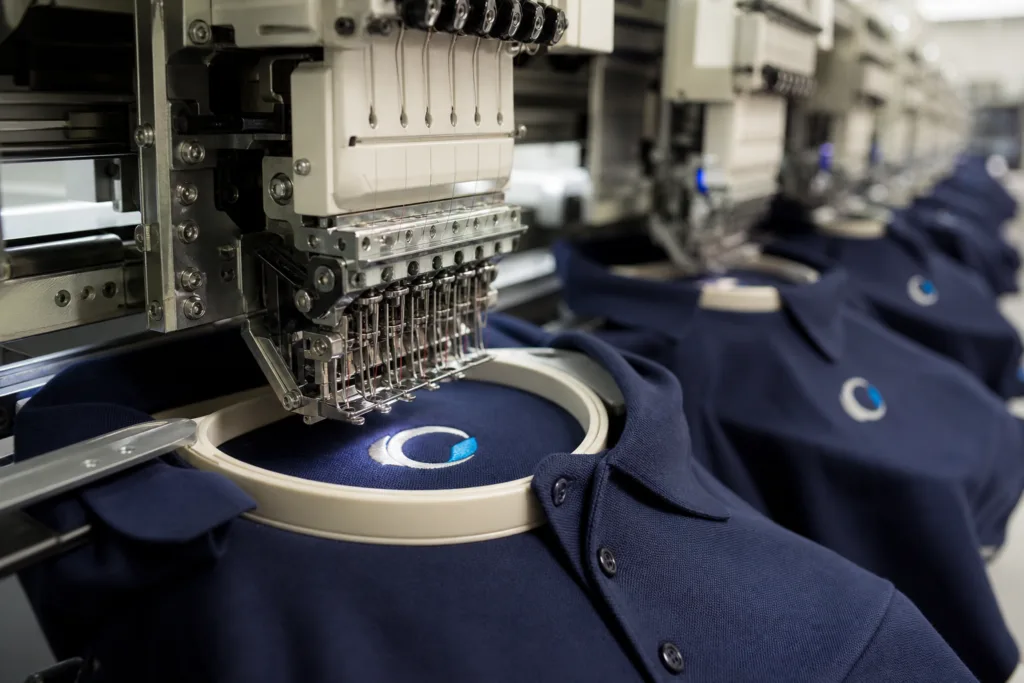
For long-term consistency, embroidery is often the most reliable solution for corporate uniforms. It creates a stable branded appearance across repeated orders and generally handles frequent washing better than some print methods, especially for left-chest logos on pique polos.
When buyers compare embroidered polo shirt logo applications, we suggest they review more than visual appearance. They should also consider stitch density, backing material, logo complexity, placement tolerance, and whether the embroidery distorts lighter fabrics.
| Logo method | Best for | Strengths | Limitations |
|---|---|---|---|
| Embroidery | Corporate identity, left chest logos | Professional, durable, premium look | Can add weight on light fabrics; small detail limits |
| Screen printing | Larger graphics, event use | Good color impact, scalable | Less common for refined corporate polos |
| Heat transfer | Small runs, names, variable data | Flexible, useful for personalization | Durability depends on material and care conditions |
| Sublimation | Polyester-based all-over decoration | Strong for performance styles and vivid color | Requires suitable fabric; less typical for classic corporate pique |
Buyers often benefit from creating one brand standards sheet for uniforms. That sheet can specify left chest position, maximum logo width, approved thread colors, approved garment colors, and any department-specific variation rules.
What sizing strategy prevents employee complaints and exchange waste?
A strong sizing strategy starts with real wearer diversity, not a generic S to 3XL list. If your workforce includes office staff, warehouse teams, service technicians, and managers, body shape and movement requirements may differ significantly.
We recommend approving a specific size chart for the polo program and using it consistently for all repeat orders. This is especially important when buyers compare suppliers, because a size label alone does not guarantee the same garment measurements.
Useful sizing controls for a uniform program
- Approve a master size spec with chest, length, shoulder, and sleeve measurements
- Decide whether men’s, women’s, unisex, or mixed fit blocks are needed
- Check grading consistency between adjacent sizes
- Use wear trials on actual staff if the order is large or multi-site
- Create a new-hire reorder process using the same approved spec
For companies with different work functions, it may make sense to build team polo shirts for different departments while keeping the core fit architecture aligned. That means the office team, field team, and management team may not wear identical colors or trims, but the size system remains stable across the program.
At Ninghow, we often see exchange rates drop when buyers spend more time on sample fitting and size communication before mass ordering. A small improvement in spec clarity can save significant replacement cost later.
When should you create role-based variations instead of one polo for everyone?
You should create role-based variations when job conditions are genuinely different. If some employees work indoors with customers and others work outside, travel between sites, or perform active tasks, one fabric and one styling approach may not serve all users well.
However, variation should be controlled. Too many styles create inventory complexity, inconsistent branding, and slower replenishment.
| Role group | Recommended variation approach | What to keep consistent |
|---|---|---|
| Front office | Refined fit, smoother appearance, stable collar | Core logo placement and main brand color family |
| Operations | Durable blend fabric, easier-care finish | Shared size system and brand identity |
| Field staff | Moisture-wicking, higher mobility, possible long sleeve option | Logo standard and approved trim colors |
| Management | Premium hand feel or subtle distinction | Program-level consistency, not separate branding |
If the project needs structured differentiation without losing unity, buyers often start by reviewing custom corporate polo shirt solutions and then narrowing the program into one core style plus one or two role-specific options.
Which quality standards should be defined before bulk production?
The most important quality standards for employee polos are collar stability, stitching consistency, colorfastness, shrinkage control, placket symmetry, and pilling resistance. These points affect both day-one appearance and the uniform’s wear life.
From a manufacturer perspective, buyers should not rely on a broad phrase like “good quality.” They should define what that means in measurable or reviewable terms before production begins.
Core quality checkpoints to specify
- Fabric composition tolerance
- GSM tolerance
- Shrinkage expectation after washing
- Color approval standard
- Collar and cuff shape retention
- Embroidery appearance and placement tolerance
- Seam quality and stitch density
- Pilling resistance expectation for frequent-use uniforms
Durability is especially important when polos are washed often. That is why some enterprise buyers review internal or third-party methods related to pilling resistance testing before approving the final material for repeat uniform orders.
For larger organizations, governance also matters. Procurement teams may find it useful to align garment specifications and documentation with broader apparel compliance requirements for uniform programs, especially when multiple stakeholders are involved in labeling, fiber declaration, and vendor documentation review.
Why sample approval is the most important risk-control step
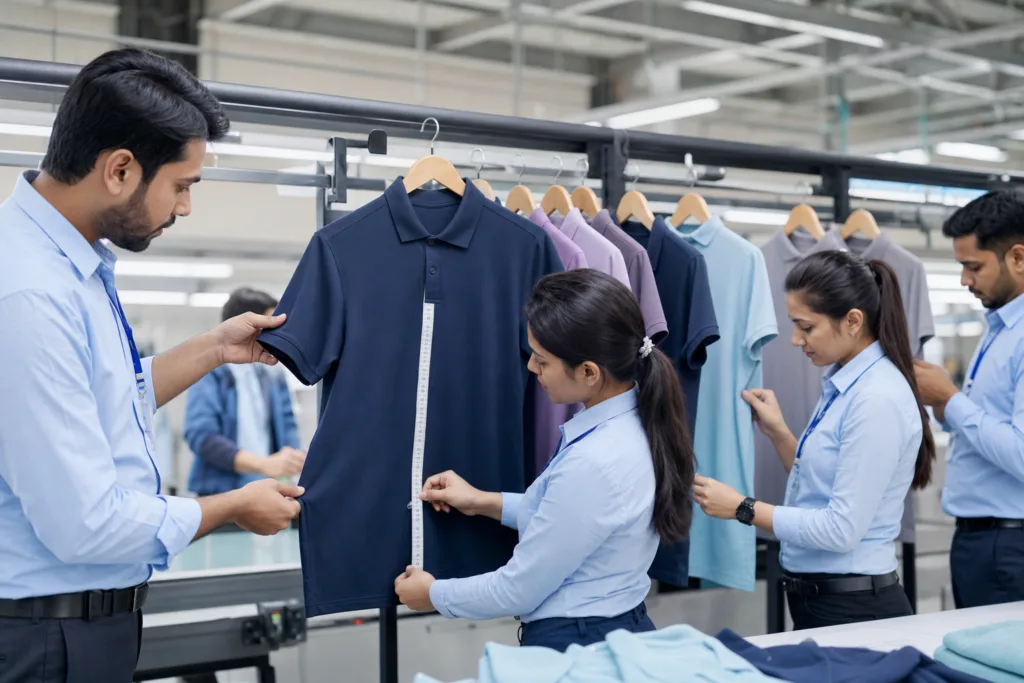
Sample approval is where you verify the whole uniform system in physical form. It is not only about confirming whether the polo looks good. It is where buyers validate fit, fabric feel, logo execution, color accuracy, construction, and role suitability before committing to bulk quantities.
We recommend that the approval stage include at least these checks:
- Fabric hand feel and thickness match the intended work environment
- Logo size and position are consistent with the brand standard
- Collar shape stays neat after handling and try-on
- Size measurements match the approved chart
- Department colors are clearly differentiated if needed
- Wash test feedback is reviewed before mass production
Key takeaway: A sample should answer operational questions, not just aesthetic ones. If you skip this step or approve too quickly, repeat-order consistency becomes much harder to maintain.
How to plan MOQ, lead time, and replenishment without supply gaps
MOQ should be discussed as a program issue, not just an opening-order issue. Some buyers focus on the first order quantity but forget that the uniform system must also support future staff additions, size exchanges, and seasonal top-ups.
In our production work, MOQ often depends on fabric availability, color customization, logo method, label requirements, and whether the program uses stock-supported materials or developed materials. A standard color in a common blend may be easier to replenish than a custom-dyed branded shade with special trims.
Questions buyers should ask before confirming production
- Can the supplier support refill orders in the same fabric and color?
- Will future reorders use the same approved size chart and pattern?
- What is the realistic lead time for peak season production?
- Are labels, buttons, and packaging custom or stock-based?
- Is a buffer quantity or forecast plan recommended for new hires?
For many companies, a practical model is one main bulk order supported by quarterly or scheduled replenishment planning. This reduces urgent small-batch sourcing, which often creates inconsistency in color, fit, or trims.
How should seasonal stock and layering options be managed?
Seasonal planning matters if employees work across changing temperatures or mixed indoor-outdoor settings. A good uniform system is not only a short-sleeve polo in one color. It may include long-sleeve polos, lightweight layering pieces, or role-specific alternatives for colder months.
The key is to keep the visual identity connected. If the base polo is navy with a left chest logo, the long-sleeve version and layering garment should follow the same brand logic unless there is a strong reason to change it.
We usually suggest planning seasonal categories like this:
- Short-sleeve core polo for year-round standard use
- Long-sleeve version for cooler conditions or formal presentation
- Lightweight outer layer for commuting or field movement
- Optional performance fabric variant for hot-weather teams
Seasonal inventory works best when historical reorder data is tracked by department, region, and size. Without that visibility, companies often overbuy one variation and run short on another.
What common mistakes weaken employee polo programs?
The most common mistakes are inconsistent fabric lots, unapproved size changes, weak color controls, and no refill strategy. These problems usually appear after the first delivery, when a second or third order reveals that the program was never properly standardized.
Another frequent issue is treating different departments as separate projects handled by different suppliers. That often creates visible differences in shade, fit, collar construction, and embroidery quality.
Mistakes to avoid
- Approving a sample without wash or wear review
- Choosing fabric only by first-touch softness
- Using too many department colors or style variations
- Skipping a master size specification
- Allowing logo placement to shift between orders
- Ignoring replenishment planning until urgent reorders are needed
- Changing suppliers without transferring full technical specifications
Most of these issues are preventable if the buyer treats the uniform as an ongoing apparel program with controlled specs, not as a one-off purchase.
How to choose a manufacturer for long-term corporate polo orders
The right manufacturer should be able to do more than quote a price. For a long-term employee program, the supplier needs to support consistency in fabric sourcing, color control, logo execution, pattern stability, and production documentation.
We suggest evaluating suppliers on operational fit as much as on costing. A manufacturer that understands repeat orders, spec discipline, and private label detail is usually a better long-term partner than one that only focuses on the first bulk run.
| Evaluation area | What to ask | Why it matters |
|---|---|---|
| Fabric continuity | Can the same material be sourced again? | Supports consistent replenishment |
| Sampling process | How are fit, color, and logo approved? | Reduces bulk-order risk |
| Customization control | How are labels, trims, and embroidery standardized? | Protects brand consistency |
| QC checkpoints | What is checked before, during, and after production? | Improves delivery reliability |
| Communication | Can the supplier manage repeat program documentation? | Makes reorders faster and clearer |
At Ninghow, we find that the strongest uniform programs come from clear technical communication on the buyer side and disciplined process control on the factory side. That combination is what keeps polos consistent across departments and future reorder cycles.
A practical checklist for launching or upgrading your polo uniform program
If you are building a new program or replacing an inconsistent one, use a documented checklist before placing the first bulk order.
- Define the brand image and role requirements for the uniform
- Select fabric based on wear, wash durability, and climate
- Approve color standards and keep the palette controlled
- Document logo placement, size, and method
- Approve a master size chart and fit direction
- Decide whether role-based variations are necessary
- Set clear quality requirements for shrinkage, pilling, and construction
- Review and approve production samples carefully
- Plan MOQ, lead time, and future refill cycles
- Align seasonal options and inventory logic
A consistent employee polo system is built through specification, testing, and planning. When those three areas are clear, the uniform becomes easier to manage, easier to replenish, and more reliable for both the business and the people wearing it.
Conclusion
Building a strong polo program is less about buying shirts and more about creating a repeatable standard. The best employee uniform systems define fabric, color, logo execution, fit, quality checkpoints, and replenishment logic before bulk production starts.
For companies sourcing polo shirts for employees, that planning discipline is what protects brand presentation and operational efficiency over time. If the project involves multi-role use, custom branding, or long-term refill needs, a manufacturer-led approach to sampling, specification, and QC will usually deliver better consistency than ad hoc ordering.
FAQs
What fabric is best for polo shirts for employees?
The best fabric is usually a cotton-poly blend or a well-chosen performance knit, depending on the job environment. Blends often give the most balanced result for comfort, durability, easier care, and repeat uniform use, while performance fabrics can be better for active or outdoor roles.
Should employee polo logos be embroidered or printed?
Embroidery is usually the safer choice for long-term corporate uniform programs. It gives a professional appearance, holds up well in repeated washing, and creates more consistent branding on left chest logos, while printing is more suitable for larger graphics or shorter-term event use.
How many polo styles should a company uniform program include?
Most companies should keep the program simple with one core polo and only one or two role-based variations if needed. Too many styles make sizing, inventory, replenishment, and visual consistency harder to control across departments and future orders.
How can buyers reduce sizing problems in bulk polo orders?
Buyers reduce sizing problems by approving a master size chart, reviewing fit samples, and keeping the same graded pattern for future reorders. Relying only on generic size labels is risky because different suppliers can use very different garment measurements for the same marked size.
What should be approved before bulk production starts?
Before bulk production starts, buyers should approve fabric, color, size specifications, logo placement, construction details, labels, and a physical sample. This approval stage is the main control point for preventing problems with appearance, fit, and consistency in the final shipment.
How should a company plan replenishment for employee polos?
Replenishment should be planned as part of the original uniform program, not left until urgent reorders appear. Buyers should confirm fabric continuity, expected lead times, refill MOQ conditions, and likely new-hire demand so future top-up orders can match the original garments as closely as possible.