


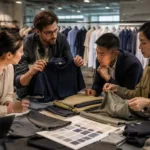





Choosing a supplier for private label production is not only about price or product photos. The real risk is committing your budget, launch timeline, and brand reputation to a manufacturer that cannot deliver consistent fabric, fit, labeling, packaging, or communication. When buyers search for private label clothing manufacturer red flags, they are usually trying to avoid expensive lessons that appear only after sampling delays, bulk inconsistencies, or missing compliance details.
If your project includes custom labels, branded packaging, fit development, or bulk apparel planning, it helps to review private label apparel development options before comparing suppliers. That gives you a clearer view of what should be discussed early, including fabric selection, sampling expectations, private label trims, MOQ logic, and the production steps a real manufacturer should be able to explain with confidence.
What buyers should expect from a private label clothing manufacturer
A capable private label manufacturer should be able to do more than sew garments. From our manufacturing perspective, buyers should expect clear discussion around fabric composition, GSM, fit, label placement, logo application, packaging details, sampling, bulk planning, and quality checkpoints.
The supplier does not need to promise everything instantly, but they should be able to explain what is possible, what needs development, and where trade-offs exist. That transparency matters more than polished sales language.
Key takeaway: A good private label partner is clear about process, limitations, and production details before you pay for bulk.
Private label clothing manufacturer red flags that buyers should not ignore

The supplier only talks about low price and avoids total cost discussion
Low price by itself is not a red flag. The red flag is when price becomes the only topic and the supplier avoids talking about fabric quality, shrinkage, print durability, trim standards, size tolerance, or packaging requirements.
In apparel production, a lower quote usually comes from specific decisions. The supplier may be using lighter fabric, simpler construction, looser tolerances, lower-grade trims, or less finishing work. If they cannot explain those choices, the quote is not really transparent.
- Ask what fabric composition and GSM the quote is based on.
- Ask whether labels, hangtags, polybags, and carton packing are included.
- Ask whether logo application cost changes by size, color count, or position.
- Ask what quality standard is assumed for bulk inspection.
Buyers comparing quotes should focus on landed decision quality, not only on unit price. This is one reason finding a reliable clothing manufacturer requires side-by-side technical comparison, not just RFQ collection.
The manufacturer is unclear about labels, country of origin, and compliance requirements
A private label supplier should understand that brand presentation also includes legal and technical labeling. If a manufacturer gives vague answers about care labels, fiber content labeling, size labels, or country-of-origin marking, that is a serious warning sign.
Different markets have different requirements, and some product categories carry extra obligations. For example, U.S. buyers should understand apparel flammability rules and safety compliance when evaluating certain garment categories and fabric choices. A supplier does not need to act as your legal counsel, but they should know when compliance needs checking rather than dismissing it casually.
This issue becomes more important for kidswear, sleep-related apparel, brushed fabrics, and any order entering tightly regulated markets. If the supplier treats care labeling and compliance as an afterthought, there is a high chance they will also be careless with private label execution.
We usually advise buyers to clarify these points before sampling approval:
- Required brand label content
- Care label language and symbol expectations
- Country-of-origin marking location
- Fiber content disclosure format
- Any buyer-specific testing or compliance documents
When manufacturers can explain these items clearly, it is easier to move into sampling and bulk planning with fewer surprises. This is also where apparel manufacturing compliance should be discussed early instead of after production starts.
Packaging is treated casually instead of as part of the product
Many buyers focus on the garment and forget that packaging is part of private label delivery. A risky supplier often treats packaging as a simple add-on, even when your retail, e-commerce, distributor, or club order needs specific folding, bagging, barcode, sticker, size sorting, or carton marking rules.
Poor packaging planning can create avoidable costs. Garments may arrive wrinkled, mislabeled, mixed by size, or packed in the wrong ratios. That does not always show up in the first sample, but it becomes a serious issue during bulk fulfillment.
| Packaging Item | What a Good Supplier Clarifies | Red Flag Behavior |
|---|---|---|
| Polybags | Size, thickness, warning requirements, sticker details | Says standard bag will be fine without checking buyer needs |
| Hangtags | Attachment method, string type, placement, barcode details | Quotes vaguely without print or assembly details |
| Cartons | Carton size, ratio pack, shipping marks, weight limits | No carton plan until goods are already packed |
| Folding | Folding board method, tissue use, insert requirements | No confirmation of presentation standard |
Key takeaway: In private label orders, packaging mistakes are not small operational issues. They affect presentation, warehouse efficiency, and retail readiness.
Samples and bulk production do not match in fabric, fit, construction, or finishing
This is one of the most damaging risks in apparel sourcing. A supplier may produce an acceptable sample, then change fabric source, sewing method, finishing standard, or measurement tolerance in bulk without proper control.
Buyers should never assume that a sample alone guarantees bulk consistency. What matters is whether the supplier has a repeatable process for locking approved specs before production.
At Ninghow, we see this issue most often in garments where hand feel, stretch recovery, fit balance, or decoration placement matter a lot. Hoodies, T-shirts, polos, leggings, teamwear, and activewear can all look similar in photos while performing very differently in wear and wash.
What should be locked before bulk:
- Fabric composition and GSM tolerance
- Color standard or approved swatch
- Measurement chart and size tolerances
- Logo method, size, and position
- Construction details such as seam type and rib quality
- Washing, finishing, and packing standard
Buyers should also understand the apparel sampling process well enough to know whether they are reviewing a proto sample, fit sample, salesman sample, or pre-production sample. Those stages are not interchangeable, and confusion here often causes sample-to-bulk mismatch.
The quotation is vague or hides important charges
A risky supplier often sends a unit price that sounds competitive but leaves out the cost drivers that actually shape your order. This can include sampling fees, custom dyeing, embroidery punch files, print screens, woven labels, hangtags, packaging assembly, export cartons, or pre-shipment preparation.
The problem is not only extra cost. The larger problem is planning uncertainty. If the quote is incomplete, your margin model and delivery timeline are incomplete too.
| Quote Area | Clear Supplier Response | Warning Sign |
|---|---|---|
| Sample fees | Explains whether refundable and what is included | Changes fee logic later |
| Fabric basis | States composition, GSM, and sourcing assumption | No fabric detail in quote |
| Customization | Separates print, embroidery, labels, packaging | Uses one bundled number with no breakdown |
| MOQ | Clarifies by style, color, and fabric availability | Gives one number without context |
| Lead time | Explains sample, material, and bulk timeline steps | Promises fast delivery without process detail |
A good quote helps buyers compare manufacturers fairly. A vague quote forces buyers to discover the real cost later, usually after they are already invested in development.
Communication is slow, inconsistent, or evasive on technical questions
Not every delayed reply is a red flag. Production teams are busy, and some questions need internal checking. The real warning sign is a pattern of unclear, shifting, or evasive answers when you ask technical questions about fabric, sizing, trims, or process.
If a supplier answers simple commercial questions quickly but avoids detailed production questions, that usually means either weak technical control or weak communication between sales and factory teams. Neither is good for private label work.
Questions that should receive clear answers include:
- What fabric is being quoted exactly?
- What is the realistic MOQ by color and size set?
- How is color matching approved?
- What are the measurement tolerances in bulk?
- What decoration methods are suitable for this fabric?
- What happens if sample comments require pattern changes?
From our manufacturing perspective, fast answers are helpful, but accurate answers are more important. A supplier who says, “We need to confirm with production,” is often safer than one who answers everything immediately but inconsistently.
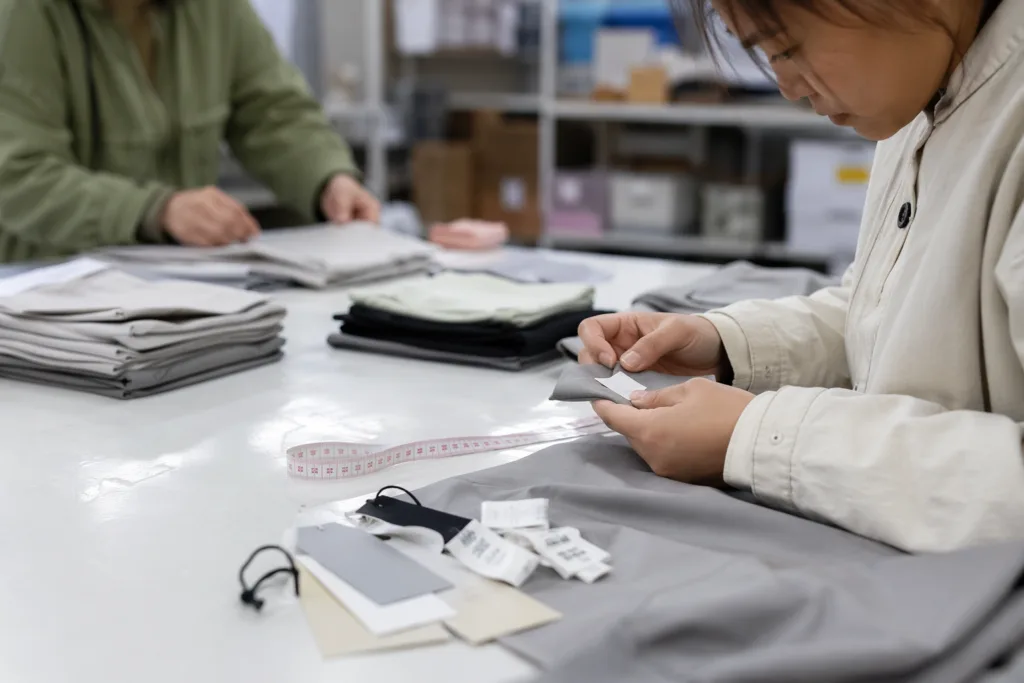
The supplier cannot explain MOQ, lead time, production flow, or quality control
MOQ should never sound like a random number. In real production, MOQ depends on fabric availability, dyeing minimums, trim sourcing, decoration setup, and line efficiency. If a supplier cannot explain why the MOQ is what it is, buyers should be careful.
The same applies to lead time. A credible manufacturer should be able to break lead time into development, material booking, pre-production approval, sewing, finishing, inspection, and packing. Generic promises such as “15 days for everything” often ignore real constraints.
Quality control is another area where vague language is risky. Buyers should ask what checkpoints exist before, during, and after sewing. Strong suppliers can explain inspection logic in practical terms, including fabric inspection, inline checks, measurement checks, logo placement review, finishing inspection, and final packing review.
For buyers who want a better benchmark, structured apparel quality control checks are useful because they show whether the supplier is thinking in process terms or only in shipment terms.
We also recommend using the manufacturer conversation to see whether they think like a production team. If they can explain how pattern approval, marker efficiency, trim readiness, and line balancing affect output, they are usually closer to real manufacturing control.
One good place to assess this broader capability is by reviewing how Ninghow approaches apparel development, customization, and bulk planning as connected steps rather than isolated transactions.
Product photos and factory claims look strong, but proof of capability is weak
Impressive photos are easy to collect. Real manufacturing capability is harder to prove. One of the most common bad apparel supplier signs is a polished presentation combined with weak evidence when buyers ask follow-up questions.
For example, a supplier may show many garment categories but struggle to explain pattern development, fabric sourcing routes, print method limitations, or how they maintain size consistency across a run. That usually suggests a trading-style operation, inconsistent subcontracting, or limited control over production details.
Useful proof points include:
- Clear sample process and revision handling
- Ability to discuss fabric options by end use
- Production photos matched to the garment type being quoted
- Consistent answers about equipment, decoration, and finishing methods
- Realistic explanation of what they do in-house and what is outsourced
Key takeaway: Buyers should trust process evidence more than portfolio volume.
How to verify a private label clothing manufacturer before you place an order
The safest way to verify a supplier is to test them in stages. Do not rely on one good call, one attractive quote, or one sample photo. Verification should happen through document review, technical questioning, sample evaluation, and pre-production confirmation.
- Start with an RFQ that includes fabric, sizing, logo, label, and packaging details.
- Check whether the supplier asks smart follow-up questions.
- Request sample comments to be confirmed in writing.
- Compare revised samples against approved specs, not memory.
- Confirm what changes are allowed after sample approval.
- Lock packaging and carton details before bulk starts.
We usually tell buyers to watch the supplier’s behavior as much as the sample itself. A supplier who handles comments carefully, confirms changes clearly, and highlights risks early is often safer than a supplier who says yes to everything.
Questions to ask during RFQ, sampling, and pre-production communication
Good questions expose weak suppliers quickly. They also help good manufacturers build the right production plan for your order.
| Stage | Question | Why It Matters |
|---|---|---|
| RFQ | What exact fabric composition and GSM is this quote based on? | Prevents hidden quality downgrades |
| RFQ | What is included and excluded in the unit price? | Reveals hidden charges |
| Sampling | Is this sample using the intended bulk fabric and trims? | Checks sample-to-bulk alignment |
| Sampling | What measurements are expected to vary in bulk? | Clarifies tolerance realism |
| Pre-production | What approvals must be locked before cutting starts? | Reduces bulk mistakes |
| Pre-production | How will logos, labels, and packaging be checked? | Protects private label execution |
If the supplier answers these questions with specifics, that is a positive sign. If they stay vague, defensive, or contradictory, it is usually wise to slow down the project and review alternatives.
A practical checklist for comparing stronger suppliers against risky ones
- Fabric clarity: stronger suppliers state composition, GSM, and sourcing assumptions; risky suppliers stay general.
- Fit control: stronger suppliers discuss grading and tolerances; risky suppliers only mention standard sizing.
- Label knowledge: stronger suppliers ask about market requirements; risky suppliers say labels can be added later.
- Packaging detail: stronger suppliers confirm bagging, hangtags, and carton marks; risky suppliers improvise near shipment.
- MOQ logic: stronger suppliers explain minimums by material and process; risky suppliers give unsupported numbers.
- Lead time realism: stronger suppliers break down stages; risky suppliers promise speed without structure.
- QC process: stronger suppliers explain checkpoints; risky suppliers only promise inspection at the end.
- Communication quality: stronger suppliers answer technically; risky suppliers avoid specifics.
Common mistakes buyers make when they ignore warning signs
The biggest mistake is assuming that one acceptable sample means the supplier is production-ready. Another common mistake is approving a quote before confirming what is excluded.
Buyers also get into trouble when they send incomplete tech packs, unclear packaging instructions, or logo files without application details. A weak supplier may not challenge these gaps, and that silence later turns into inconsistency.
We also see problems when buyers rush into bulk to save time after a delayed sample phase. In reality, skipping pre-production clarity usually creates bigger delays later through remake requests, relabeling, or repacking.
When to walk away and look for a better manufacturing partner
You should seriously consider walking away when multiple red flags appear together. For example, the quote is vague, the sample comments are not followed carefully, and the supplier cannot explain lead time or labeling requirements with confidence.
Walking away is often cheaper than trying to manage avoidable chaos through bulk production. This is especially true for startups, small brands, and lean sourcing teams that cannot absorb shipment errors easily.
The right partner does not need to be perfect. They do need to be transparent, technically capable, and consistent in how they communicate from inquiry to production planning.
Conclusion
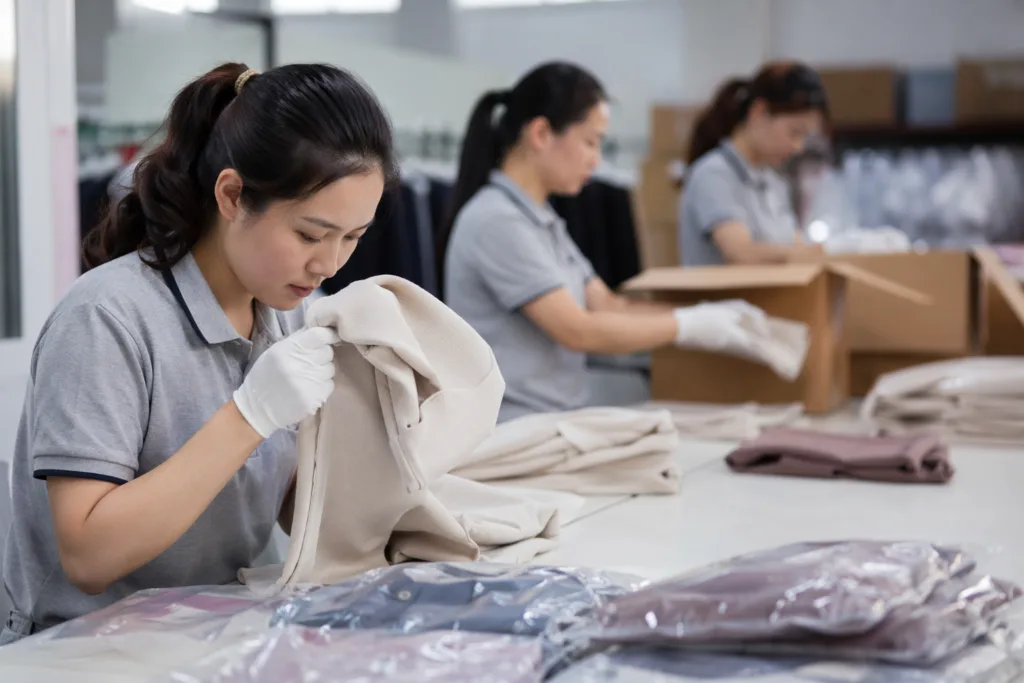
The most useful way to read private label clothing manufacturer red flags is not as a list of dramatic warnings, but as a decision framework. Buyers should look for proof of process, clarity of quotation, consistency of technical answers, and control from sample approval to bulk shipment.
At Ninghow, we believe the safest private label projects start with realistic questions and clear production planning. If a supplier can explain trade-offs, confirm standards, and stay consistent through development, the chance of a smooth order improves significantly. If they cannot, it is better to find out before your deposit is tied to a risky production path.
FAQs
What is the biggest warning sign when choosing a private label clothing manufacturer?
The biggest warning sign is a supplier that sounds confident commercially but stays vague on technical details. If they cannot clearly explain fabric, sizing, labeling, MOQ, lead time, and quality control, buyers should assume there may be weak production control behind the sales conversation.
How can I tell whether a low quote is actually risky?
A low quote becomes risky when the supplier does not explain what quality level and inclusions support that price. Buyers should check whether fabric GSM, trims, labels, packaging, logo application, sample fees, and inspection standards are clearly defined before comparing quotes.
Why do some samples look good but bulk production turns out different?
Samples and bulk usually differ when the approved sample was not properly locked into a production standard. Fabric substitutions, looser tolerances, different trim sourcing, and weak pre-production control can all cause the final order to look or fit different from the approved sample.
Should a private label clothing manufacturer help with labels and packaging details?
Yes, a capable manufacturer should be able to discuss label placement, care label content, country-of-origin marking, hangtags, polybags, and carton marking as part of the production plan. Buyers still need to confirm their market requirements, but the supplier should not treat these details as minor or optional.
How many questions should I ask before approving bulk production?
You should ask enough questions to confirm fabric, fit, trims, logo method, labels, packaging, MOQ, lead time, and inspection checkpoints without ambiguity. If a supplier becomes evasive when these topics are raised, that reaction itself is useful information and may be a reason to delay approval.
When should I stop working with a supplier and look elsewhere?
You should consider stopping when red flags repeat across quotation, sampling, and communication rather than appearing as one isolated issue. If the supplier gives inconsistent answers, ignores sample comments, or cannot support basic private label requirements with clear process control, moving forward usually creates more risk than value.