







Your first bulk order gives you proof of concept, but it does not give you a finished product system. If you want to scale private label clothing brand operations in a controlled way, the most important work often starts after launch: reviewing what sold, what stalled, what customers said about fit, and what needs to change before the next production cycle.
If your next step depends on stronger product consistency, better fit control, or smarter reorder planning, our private label clothing production support helps brands move from a first run to a more stable second order. We support fabric and trim review, fit updates, label and packaging adjustments, sampling, bulk planning, and production coordination so the next order is based on real market response rather than assumptions.
Why the first private label order is only the starting point
The first order tests more than demand. It also tests your size chart, your chosen fabric, your print or embroidery placement, your packaging practicality, and your ability to forecast size and color ratios.
From our manufacturing perspective, many first orders are intentionally conservative. Brands may use a simpler trim package, a narrower size run, or fewer colorways to keep risk under control. That is sensible, but it also means the first order rarely represents the most optimized version of the product.
Key takeaway: Treat the first order as a market and production learning phase, not as the final standard for future scale.
What brands should measure after launch

After the launch window, review performance quickly. Waiting too long can blur the reasons behind returns, low sell-through, or unexpected demand spikes.
The most useful post-launch review combines commercial data with product data. Sales alone do not tell you whether a style deserves repeat production.
Sales and inventory signals that matter most
- Sales speed in the first 2 to 6 weeks
- Sell-through rate by style, color, and size
- Markdown dependency
- Stockout timing for core sizes
- Slow-moving variants that tie up cash
Fast sales can be a positive sign, but they can also reflect underbuying. Slow sales can indicate weak styling, poor timing, wrong pricing, unclear branding, or a fit problem.
Customer response signals that deserve equal attention
- Return reasons by style and size
- Fit comments such as too tight in chest, short body length, or narrow sleeves
- Fabric comments such as too thin, too heavy, too stiff, or too warm
- Quality comments related to shrinkage, pilling, twisting, seam puckering, or print feel
- Packaging feedback such as damaged presentation, creasing, or inconsistent branding
At this stage, a brand should not only ask what sold. It should ask why customers kept or returned the garment, and whether the product experience matched the intended price point.
How to decide whether a style is ready for repeat private label production
A style is ready for repeat production when demand is real, the product problems are understood, and the revision list is manageable. It does not need to be perfect, but the next order should be more controlled than the first.
We usually suggest dividing styles into three buckets: repeat with minor edits, pause for redesign, or discontinue. This is more useful than simply calling a style good or bad.
| Decision | When It Makes Sense | Recommended Action |
|---|---|---|
| Repeat with minor edits | Good sell-through, acceptable returns, clear improvement points | Adjust size specs, trim details, or packaging and reorder |
| Pause for redevelopment | Strong customer interest but repeated complaints about fit or quality | Revise pattern, fabric, or construction before bulk |
| Discontinue | Weak demand and no clear path to improvement | Do not reorder; redirect budget to stronger SKUs |
A brand trying to scale private label clothing brand growth should avoid emotional reorders. Repeat production should be based on measurable demand and fixable production variables.
How to optimize SKUs after the first order
The second order should usually be simpler and sharper, not broader by default. Many brands add too many colors and variations too early, which increases inventory risk and complicates production planning.
Instead, use first-order data to narrow the assortment around proven winners.
Which variants to keep, reduce, or remove
| SKU Element | Keep or Expand When | Reduce or Remove When |
|---|---|---|
| Colors | Core colors sell evenly and support brand identity | Fashion colors move slowly or create leftover stock |
| Sizes | Size demand is consistent and replenishment is predictable | Extreme sizes rarely move and create imbalance |
| Styles | The style attracts repeat buyers and low return rates | The style requires heavy discounting to sell |
| Logo variants | One decoration option clearly performs better | Too many logo versions dilute MOQ and brand clarity |
In our factory work, SKU discipline often improves both margin and consistency. Fewer weak variants mean better fabric utilization, clearer trim planning, and less confusion in packing and labeling.
Brands that want tighter control over repeat consistency should pay close attention to apparel quality control for repeat orders, especially when styles remain the same but materials, color lots, or production timing change.
How real customer feedback should change fit and sizing
Fit issues are one of the biggest reasons first orders fail to convert into stable repeat business. A product can have strong branding and acceptable fabric, but repeated size complaints will eventually slow reorders.
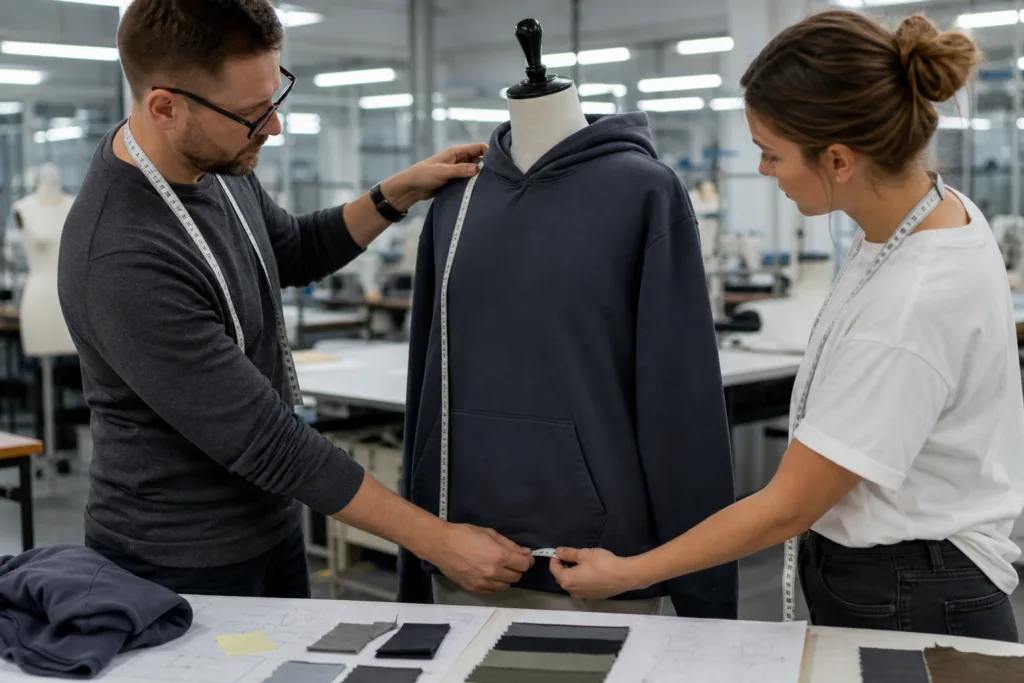
The right response is not to guess. Review return comments, fit notes from customer service, and actual garment measurements from remaining stock and returned units.
Fit questions to answer before the next order
- Are customers saying the garment runs small, or only specific areas such as shoulder or hip?
- Are complaints concentrated in one size or across the full range?
- Did the approved sample match the bulk garments?
- Did washing change the fit more than expected?
- Does the target customer body shape match the original size chart?
Using body measurements and sizing data to improve fit consistency is important when size complaints repeat across multiple orders. For technical sizing guidance, brands can review body measurement references for apparel fit and compare that thinking with their own target customer profile before revising the next size set.
At Ninghow, we often recommend confirming whether the issue is pattern shape, grading, fabric stretch behavior, or washing shrinkage. Those are different problems and should not be solved with the same size-chart change.
If the style has reorder potential but fit feedback is mixed, the safest path is refining fit through sampling and revisions before confirming bulk quantities. A revised pre-production sample can prevent a second large batch of avoidable returns.
What to improve in the second production round
The second order is usually where brands begin turning a product into a repeatable standard. Not every change needs to happen at once, but the update list should be specific.
Construction improvements worth reviewing
- Stitch density on stress points
- Reinforcement at neck seams, crotch seams, or side vents
- Elastic recovery in waistbands or cuffs
- Pocket placement and symmetry
- Seam allowance consistency for better durability
Fabric and hand feel adjustments
If customers like the style but dislike the feel, review GSM, composition, and finishing. A small fabric change can alter drape, opacity, warmth, and perceived value.
| Fabric Issue | Possible Cause | Second-Order Adjustment |
|---|---|---|
| Too thin | Low GSM or open knit structure | Increase GSM or change knit density |
| Too stiff | Fiber blend or finishing choice | Review enzyme wash, peaching, or blend change |
| Too warm | High weight or low breathability | Use lighter fabric or higher cotton ratio |
| Poor recovery | Insufficient elastane or weak knit stability | Adjust blend or improve fabric specification |
Second-round improvement can also involve labels, drawcords, zippers, hangtags, polybags, folding methods, and carton setup. These details affect customer perception and warehouse efficiency more than many early-stage brands expect.
How packaging should evolve after the first order
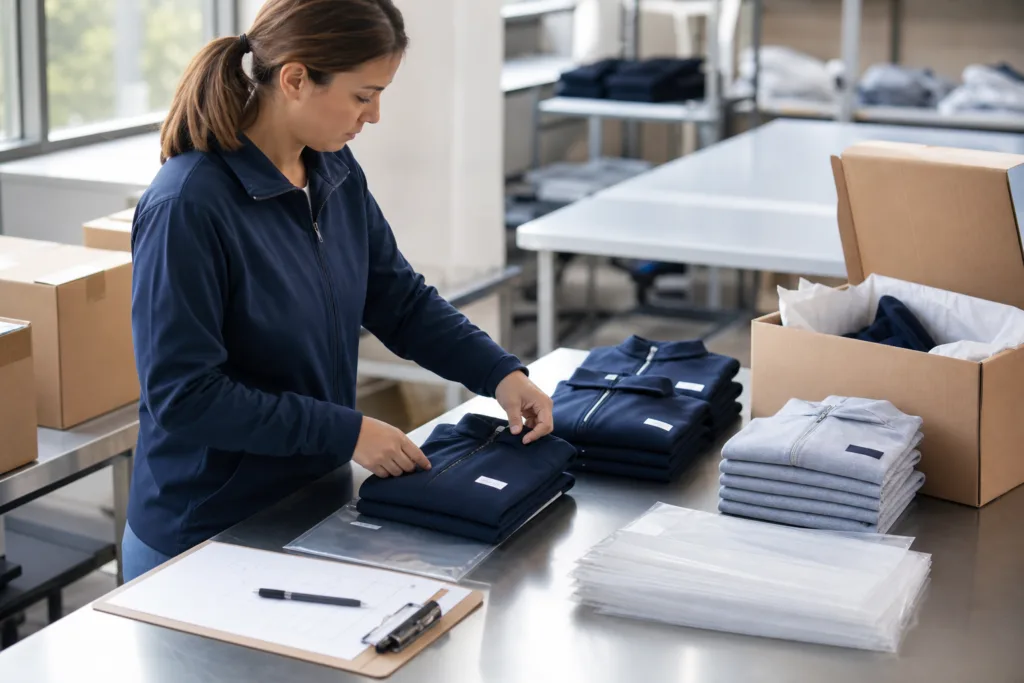
Packaging should protect the garment, support brand presentation, and stay commercially sensible. If the first order used very basic packing, the second order is the right time to decide whether better presentation will improve retention, gifting value, or retailer acceptance.
We usually advise brands to separate packaging into three functions: protection, branding, and operational efficiency. If one function improves while the others become worse, the packaging system may still be failing.
Packaging areas to review
- Whether garments arrived creased, damp-affected, or dusty
- Whether labels, stickers, or barcodes were easy for warehouse teams to process
- Whether unboxing matched the brand price point
- Whether packaging cost was too high relative to reorder volume
- Whether retail or e-commerce channels need different pack formats
Key takeaway: Better packaging is not always more expensive packaging. Often the best upgrade is more consistent folding, clearer barcode placement, stronger polybag quality, or cleaner branded trim presentation.
How to plan reorder quantities and MOQ using real sales data
Reorders should be built from demand signals, not optimism. The first order gives you the first real evidence for quantity planning, and that evidence should drive the second order mix.
Start with the rate of sale by week, then adjust for seasonality, promotion periods, and stockout distortion. If a size sold out early, its low total units may actually hide stronger demand.
A practical reorder planning approach
- Estimate average weekly sales for each style-size-color combination
- Remove one-off spikes caused by launch discounts or influencer activity
- Add expected demand for the selling period you want to cover
- Include a buffer for core sizes that historically stock out early
- Check whether the reorder still aligns with fabric and trim MOQ realities
MOQ should not be treated as a fixed obstacle without context. Sometimes a reorder can stay efficient because the same fabric, color, and trims remain available. In other cases, even a style that sold well may become harder to repeat if a custom trim, yarn-dyed fabric, or special packaging element has a higher minimum requirement.
How to time repeat production without creating stock risk
The best reorder timing is earlier than many brands expect. If you wait until inventory is nearly gone, you may be forced into rushed decisions on quantities, color repeats, or substitutions.
Good repeat planning combines current stock cover, sales rate, factory lead time, raw material lead time, and inbound shipping time. This is especially important for seasonal programs, teamwear, or promotional calendars.
For brands building a more predictable calendar, planning repeat production lead times helps align sales forecasts with sampling, material booking, bulk sewing, finishing, and shipping windows.
What to include in your production buffer
- Sample approval time if revisions are needed
- Fabric booking or dyeing time for custom colors
- Trim sourcing for labels, hangtags, and packaging
- Bulk production time
- Final inspection and shipping time
Brands often underestimate how much time is lost between decision-making and actual production start. Delays usually come from incomplete approvals, unclear revision notes, or late artwork and packaging confirmation.
Why long-term manufacturer communication improves repeatability
Working with the same manufacturer can improve consistency if revision control is handled well. Repeat production should not rely on memory or verbal instructions. It should rely on documented standards.
That includes approved measurements, pattern version control, fabric references, print or embroidery position, label placement, packing method, and carton ratio. A consistent supplier relationship becomes more valuable when each order leaves a clearer technical record than the last.
From our production perspective, clear communication reduces hidden variation. This is one reason many growing brands centralize development and bulk execution with Ninghow or another qualified manufacturer that can track approved changes across multiple production cycles.
It also helps to formalize who approves what. If design, merchandising, and sourcing teams send separate revisions without one final version, repeat production becomes unstable very quickly.
Common mistakes brands make after the first order
The biggest mistake is reordering too quickly without reviewing what the market actually told you. The second biggest is overcorrecting based on a few opinions instead of full pattern-level evidence.
- Reordering the same size curve even though returns show a clear imbalance
- Adding more SKUs before the core bestsellers are stable
- Changing fabric and fit at the same time, making root-cause analysis difficult
- Ignoring packaging failures because the garment itself sold
- Failing to record approved revisions for the next production cycle
- Assuming a good first order means every style deserves expansion
Another common issue is weak handover between sales data and production planning. A brand may know which style sold, but not which construction or packaging details caused complaints. That gap slows improvement.
A practical repeat-production checklist for the next bulk order
Before confirming the next PO, brands should review the full product system rather than only reorder quantity. The goal is not just to restock. It is to reduce friction in the next selling cycle.
- Confirm best-selling styles, sizes, and colors
- Review return reasons and prioritize the top product issues
- Update size specs and pattern notes if fit changes are needed
- Confirm whether fabric, GSM, or finish should stay the same
- Review trim, label, and packaging updates
- Lock revised artwork, logo size, and placement details
- Approve a new sample if technical changes are material
- Set reorder quantities based on weekly sales and stock cover
- Align lead times with launch or replenishment timing
- Document final approvals for future repeatability
When order complexity increases, brands also benefit from managing reorder steps for growing brands through a clearer process for approvals, timelines, and production handoffs.
When to scale, when to pause, and when to redevelop
Scale when a style has repeat demand, stable fit, manageable returns, and clear production specifications. Pause when demand exists but the product still creates too much post-sale friction. Redevelop when the concept is strong but the current execution is not commercially reliable.
This decision is especially important if you want to scale private label clothing brand operations without letting complexity outrun control. Growth should come from better repeatability, not from a growing number of unresolved product issues.
In many cases, the strongest next move is not doubling style count. It is improving two or three proven styles until they become dependable revenue drivers.
How we support repeat private label production and ongoing product improvement
As a clothing manufacturer, we see the biggest long-term gains when brands connect commercial feedback with technical revision control. The second and third orders are where fit refinement, clearer specs, better packaging, and stronger production discipline start to compound.
At Ninghow, we support brands by reviewing what changed after launch, identifying which adjustments need new samples, checking MOQ feasibility against fabrics and trims, and preparing bulk production with clearer standards. That helps reduce repeated mistakes and gives growing brands a more stable path from first order to repeat production.
Frequently Asked Questions
How soon should a brand review the first private label order after launch?
A brand should review the first order as soon as enough early sales and customer feedback are available, usually within the first few weeks. That timing helps separate real product signals from assumptions and allows fit, packaging, or SKU issues to be corrected before the next production window closes.
What is the best way to decide if a style should be reordered?
The best way is to combine sales performance with return reasons, fit feedback, and margin reality. A style should usually be reordered only when demand is proven, the main product issues are understood, and the next order can be improved with clear technical changes instead of guesswork.
Should brands change fabric and fit in the same repeat order?
Brands should avoid changing both at the same time unless the product clearly needs full redevelopment. If you change fabric and fit together, it becomes harder to identify whether the next result improved because of the pattern, the material, or both, which makes future production decisions less reliable.
How can small brands handle MOQ when planning reorders?
Small brands should base reorder plans on proven winners and check MOQ against the actual fabric, color, and trim setup before confirming quantities. Sometimes repeating the same material package keeps MOQ manageable, while new colors, new labels, or upgraded packaging can increase minimum requirements even if the garment style stays the same.
Do brands need a new sample before every repeat production?
Brands do not always need a new sample if nothing technical has changed, but they usually should request one when fit, fabric, trim, artwork, or packaging is revised. A new sample is especially valuable when the first order revealed customer complaints that need to be corrected before another bulk run.
What should be documented to keep repeat production consistent?
Brands should document approved measurements, pattern version, fabric specifications, color standards, logo application details, label placement, packaging method, and any revision notes from the previous order. Clear documentation helps the manufacturer reproduce the product more accurately and reduces the risk of untracked changes between orders.