







Business polo shirts are one of the most practical choices for corporate uniform programs because they combine a clean appearance with comfort, repeat-wear value, and easier size acceptance than many formal alternatives. The real sourcing challenge is not deciding to use polos; it is defining the fabric, fit, decoration method, and replenishment plan so the shirt works for office staff, front-line teams, and multi-location brands.
For buyers who want to review polo shirt manufacturing options before they lock a program, review polo shirt manufacturing options for corporate programs can be a useful starting point. We use that same planning logic at Ninghow when we help brands compare fabric weights, sampling approaches, logo placement, and bulk production risk before they place a uniform order.
Why business polo shirts work well in corporate uniform programs
The best business polo shirts do three jobs at once: they keep staff looking consistent, they stay comfortable through long shifts, and they reduce the friction that often comes with dress shirts or very casual tees. That is why they work especially well for reception teams, sales staff, retail associates, trade show crews, and service teams that need a neat but approachable look.
- They are easier to size than tailored shirts, which helps HR and procurement manage larger employee groups.
- They can be branded in a subtle way, so the company identity is visible without overwhelming the garment.
- They usually wash and re-wear well, which matters when uniform pieces are issued to employees and replaced over time.
- They bridge office and field use, so one program can often cover different roles with the same core style.
When polos work better than other uniform options
A polo usually beats a dress shirt when the workplace needs more movement, simpler maintenance, or a less formal dress code. It usually beats a T-shirt when the brand wants a sharper first impression or a more professional neckline and collar. Jackets solve weather needs, but they are not always practical as the main uniform piece because they add cost and limit year-round wear.
| Option | Best strength | Main limitation | Typical use case |
|---|---|---|---|
| Business polo shirts | Balanced look and comfort | Less formal than dress shirts | Corporate teams, retail, trade shows |
| Dress shirts | Formal appearance | More demanding fit and care | Client-facing or executive settings |
| T-shirts | Casual comfort | Less structured brand image | Back-of-house or event support |
| Jackets | Weather protection | Higher cost, seasonal use | Outdoor or layered uniform programs |
What companies should define before they source
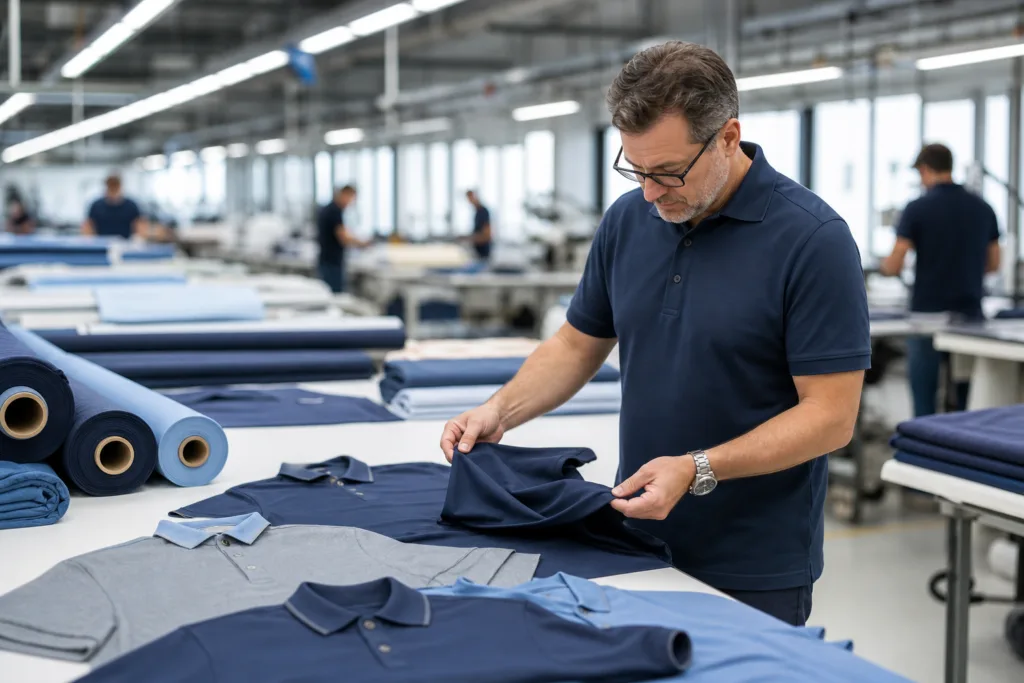
Before requesting samples, buyers should define the work scenario, the brand image, the budget range, and the expected order volume. Those four inputs decide almost everything else, including fabric selection, trim choices, logo size, and whether the program can support future reorders without redesigning the whole garment.
If the program serves office staff and front-line teams together, start by mapping the use case clearly and then custom business polo shirts for office and front-line teams around those daily requirements. A shirt that looks polished in a reception area may need different fabric recovery or stain resistance for warehouse, retail, or field service staff.
- Workplace use case: indoor, outdoor, customer-facing, or physically active.
- Brand image: conservative, modern, premium, sporty, or relaxed.
- Budget: the target cost should include logo application, labels, and packaging.
- Order volume: the first issue may be small, but replenishment volume often matters more.
How to choose the right fabric for business polo shirts
Fabric choice is the biggest driver of comfort, cost-performance balance, and long-term satisfaction. In corporate uniform work, we usually see buyers choose between cotton, polyester, and blends, with the final decision driven by the work setting and how often the garment will be washed.
Pure cotton gives a softer hand feel and a familiar premium feel, but it can wrinkle more and may shrink if the construction and finishing are not controlled well. Polyester usually improves durability, color stability, and drying speed. Blends often give the best balance because they combine comfort with better shape retention and more manageable care.
| Fabric type | Hand feel | Strengths | Watch-outs | Best use |
|---|---|---|---|---|
| Cotton | Soft and natural | Comfortable, familiar, breathable | Can wrinkle and shrink more easily | Office teams, lighter use, premium feel |
| Polyester | Smoother and lighter | Good color retention, quick drying | Can feel less natural if quality is low | Active teams, frequent washing, budget control |
| Cotton-poly blend | Balanced | Comfort plus shape retention | Needs the right ratio for the role | Most corporate uniform programs |
| Performance knit | Technical and airy | Moisture management, stretch, durability | May look too sporty for some brands | Service teams, trade shows, hybrid workwear |
When buyers ask us for business polo shirts that need repeat-wash durability, we also look at testing discipline. For a practical reference point, the fabric testing standards used in textile labs help teams think more clearly about colorfastness, shrinkage, and appearance after laundering. That does not replace sample approval, but it gives procurement a better basis for comparison.
Why fabric weight matters more than many buyers expect
Fabric weight affects drape, opacity, warmth, and how refined the shirt feels on the body. A very light polo may breathe well, but it can also feel flimsy if the fabric is too thin for a corporate setting. A heavier polo can feel more structured, but it may be too warm for teams that wear the shirt all day in active or humid conditions.
| Approximate GSM range | Typical feel | Buyer impression | Notes |
|---|---|---|---|
| 160 to 180 GSM | Light and airy | Casual and warm-weather friendly | Useful when breathability matters most |
| 180 to 220 GSM | Balanced | Most versatile for corporate use | A common range for business polo shirts |
| 220 GSM and above | Substantial | More structured and durable | Can feel warmer, but often looks more substantial |
Key takeaway: the right GSM is the one that supports the job, climate, and branding goal at the same time, not simply the heaviest fabric available.
Fit, sizing, and grading for mixed employee teams
Fit is where many uniform programs succeed or fail. A good polo should give enough room to move, keep the collar neat, and avoid pulling across the chest or ballooning at the waist. If the garment feels comfortable but looks sloppy, the brand loses polish; if it looks sharp but restricts movement, employees stop wearing it well.
For mixed teams, do not assume one generic size chart will work across all departments and regions. A corporate program should either collect employee measurements or confirm a fit matrix through sample sets. Clear body measurement planning helps teams think in practical sizing terms instead of guessing from S, M, and L alone.
- Choose men’s, women’s, or unisex blocks based on the actual workforce mix.
- Check shoulder width, chest ease, body length, and sleeve opening on real wearers.
- Ask for graded samples so you can see how the shirt behaves in multiple sizes.
- Plan extra stock for the sizes that move fastest during onboarding and replacement cycles.
Color selection and brand consistency across locations
Color is one of the fastest ways to make a uniform program feel controlled, or inconsistent. The safest approach is to define one master shade, approve a physical sample, and keep the same fabric recipe, trim spec, and logo placement for every reorder. Digital screens are not enough; they can hide small but meaningful shifts in tone.
If your company needs a single look across branches or departments, custom corporate polo shirts for brand-consistent uniforms are usually easier to manage when the color standard is locked early. This matters most for buyers who need to match shirts across multiple locations while still allowing a little variation for role-based dress codes.
In practice, the best result comes from a simple rule: approve one sample, document the shade, and reuse that reference for every future lot. That helps protect brand consistency even when the program grows over time.
Logo customization options and where each fits
Logo method changes the look of the shirt, the production schedule, and the long-term wear performance. Embroidery is usually the most durable and polished choice for small chest logos or name marks. Screen printing is useful when the graphic is larger or the budget needs more control. Heat transfer can work for flexible applications, but it should be matched carefully to fabric type and wash expectations.
| Method | Best for | Strengths | Watch-outs |
|---|---|---|---|
| Embroidery | Small logos and premium branding | Durable, polished, classic | Can feel heavy on very light fabrics |
| Screen printing | Simple graphics and larger marks | Cost-efficient in volume | Less textured and may crack if poorly matched |
| Heat transfer | Short runs and complex details | Flexible, sharp detail | Needs correct film and wash testing |
| Sublimation | Performance polyester garments | Integrated color and design | Not suitable for every fabric or corporate style |
When the logo must stay crisp and professional after repeated wear, embroidered polo shirts for logo-focused uniform branding are often the most reliable choice. The key is to keep stitch density, logo size, and placement in line with fabric weight so the decoration does not distort the garment.
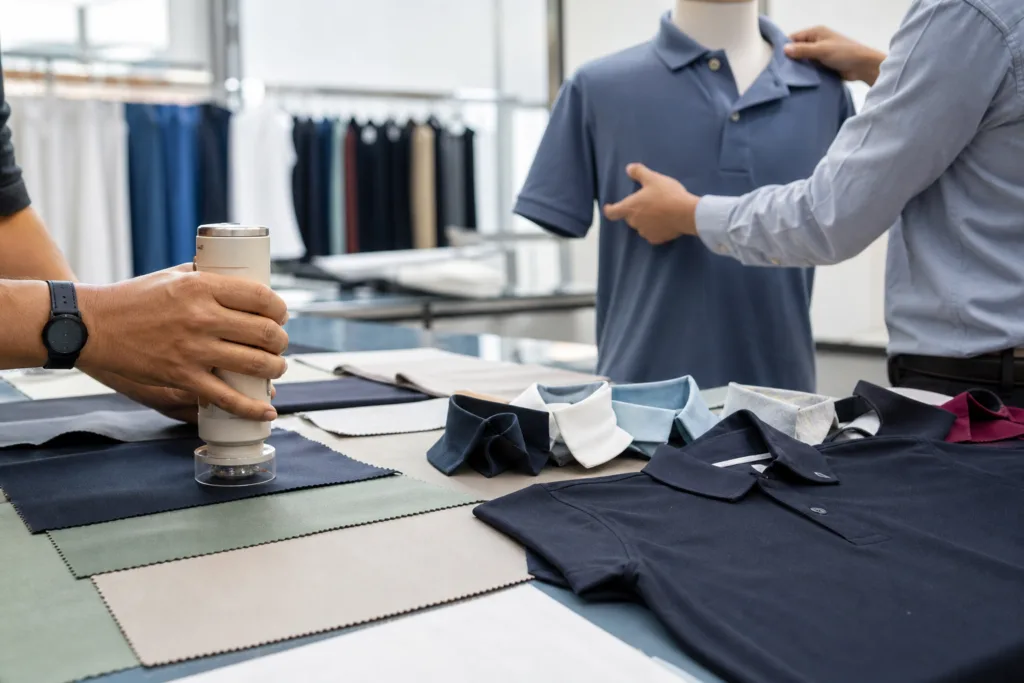
How to balance a professional look with employee comfort
The best business polo shirts look structured enough for a customer-facing role but easy enough for people to wear all day. That balance comes from small details: collar stability, placket shape, side slits, sleeve opening, and the amount of stretch in the fabric. If any one of those elements is off, the shirt can look wrong even if the fabric itself is good.
From our manufacturing perspective, the most successful programs are the ones that treat the polo as a working garment, not just a branded item. At Ninghow, we typically help buyers align fabric, fit, and decoration so the final shirt can handle a sales floor, an office setting, and repeated laundering without losing its shape.
- Choose stretch where movement matters, but avoid overcomplicating the fabric if the role is low-activity.
- Check collar recovery so the shirt still looks neat after a long shift.
- Confirm that the hem and side seams stay flat after wash testing.
- Make sure the logo position does not interfere with comfort or drape.
MOQ, lead time, and replenishment strategy
MOQ is usually influenced by fabric availability, color, trim sourcing, and the decoration method. A buyer may think they are ordering a simple polo, but one custom collar detail, a special thread color, or a rare shade can change the production plan quickly. That is why we encourage buyers to define the core spec before they ask for pricing.
Lead time is also easier to manage when the program is planned as a repeat order instead of a one-off purchase. If the company expects turnover, seasonal hires, or expansion, it is better to keep an approved sample, a clear size run, and a replenishment plan ready before the first issue is complete.
- Ask which items are stocked and which must be developed from scratch.
- Confirm whether the same fabric and trim can be reordered later.
- Build a small buffer for size reorders and replacement stock.
- Keep art files, size specs, and approved colors in one controlled file set.
What to ask a manufacturer before bulk approval
Bulk approval should never come before sample review. The sample is where you confirm the real hand feel, the fit on actual wearers, the logo placement, and the way the fabric behaves after washing. If the first sample is close but not perfect, a second round of changes is often cheaper than correcting dozens or hundreds of finished garments later.
Corporate buyers should also ask for documentation on fiber content, care instructions, and labeling before release. A procurement checklist based on the apparel compliance checklist can help teams review product descriptions, labeling expectations, and supplier responsibilities before committing to a uniform run.
- Confirm the approved fabric composition and GSM.
- Review size set samples, not only one base size.
- Approve logo size, thread color, and placement with clear reference points.
- Check wash care labeling, packaging, and carton marking requirements.
- Ask how the factory handles shade variation, replacement units, and reorders.
Quality control checkpoints for branded polo shirts for companies
Quality control should be simple enough to repeat and strict enough to catch the mistakes that matter. For corporate uniform programs, the usual pain points are shade inconsistency, poor collar shape, logo misplacement, uneven stitching, and shrinkage after the first wash cycle. A clear inspection plan prevents these issues from slipping into bulk delivery.
| Checkpoint | Why it matters | What to confirm |
|---|---|---|
| Fabric shade | Brand consistency across cartons | Match against the approved sample |
| Stitch quality | Appearance and durability | Even seams, no loose threads, clean finishing |
| Logo placement | Professional presentation | Correct height, size, and alignment |
| Size tolerance | Wearer comfort and reorder reliability | Consistent measurements across the size run |
| Wash behavior | Long-term uniform use | Low shrinkage, stable collar, stable color |
Before production starts, we usually recommend checking decorated samples and production-ready fabric in the same lighting conditions. That makes subtle issues easier to spot and reduces the risk of a surprise when the order reaches the warehouse.
Common sourcing mistakes to avoid
Most sourcing mistakes happen when the buyer moves too quickly from idea to order. The polo may look simple, but the project can still fail if the team skips measurement review, ignores fabric performance, or approves a logo without checking how it behaves on the chosen knit.
- Choosing the cheapest fabric without checking hand feel or wash performance.
- Approving a sample without testing it on real employees.
- Ignoring the difference between screen display color and physical shade.
- Forgetting to plan replenishment for new hires and replacements.
- Ordering a decoration method that does not match the fabric or the brand image.
- Not documenting the final approved spec for future reorders.
How to compare suppliers for a long-term uniform program
A supplier should be able to do more than quote a unit price. For a corporate uniform program, the real test is whether the factory can support sampling, clarification, consistent production, and repeat orders without losing the approved standard. That is why we look at communication speed, sample quality, trim control, and the ability to hold a spec over time.
If your sourcing team needs a partner that can keep the garment plan stable across reorders, compare vendors on the full program, not only on the first shipment. In our view, the strongest suppliers are the ones that can explain why a fabric choice works, how a logo will hold up, and what happens if the company needs a second round of sizes or colors later.
- Ask how they handle pre-production samples and approval notes.
- Review whether they can explain fabric, fit, and decoration trade-offs clearly.
- Check if they understand corporate uniform logistics, not just fashion production.
- Look for a clear QC process and a documented order file for reorders.
A practical checklist for choosing the right business polo shirts
- Define the workplace setting and the daily wear conditions.
- Pick a fabric that balances comfort, durability, and maintenance.
- Approve fit on real employees, not only on a size chart.
- Lock the color standard and keep one master reference sample.
- Match the logo method to the fabric, budget, and brand image.
- Confirm care labeling, packaging, and replenishment needs before bulk.
- Document the final spec so future reorders stay consistent.
Conclusion

Business polo shirts are a strong uniform choice when companies need a professional look without the stiffness or maintenance burden of dress shirts. The best results come from disciplined sourcing: choose the right fabric, size the garment properly, match the decoration method to the use case, and make sure every reorder follows the same approved spec.
When buyers treat the polo as part of a long-term uniform system, the shirt does more than carry a logo. It supports comfort, brand consistency, and smoother operations across the whole team.
Frequently Asked Questions
What fabric is best for business polo shirts?
The best fabric depends on the work setting, but most corporate buyers choose a cotton-poly blend or a performance polyester knit because it balances comfort, shape retention, and repeat-wash durability. If the team faces heat or movement, add moisture management and test the hand feel before approving bulk.
Should a company choose embroidery or printing for polos?
Embroidery is the usual choice for a polished, durable logo on collars, chests, or sleeves, while printing works better for larger graphics, softer budgets, or lighter-weight polos. The right method depends on logo size, fabric stretch, wash frequency, and the brand image you want to maintain.
How many sizes should a corporate uniform program order?
A practical range usually covers the most common body types in each location, but the exact size run should come from employee data, not guesswork. We recommend collecting size preferences early, confirming grading with samples, and keeping a replenishment plan for new hires and replacements.
What MOQ should buyers expect for custom polos?
MOQ depends on fabric availability, color, logo method, and trim sourcing, so there is no single universal number. Buyers can usually reduce risk by choosing stocked fabrics, simple trims, and a decoration method that does not require too many production variables.
How can companies keep polo colors consistent across locations?
They can keep colors consistent by approving a master shade, requesting lab dips or fabric swatches, and locking the same fabric, trim, and logo placement for every reorder. It also helps to store approved samples and share one clear specification sheet across all sites.
What should buyers check before approving bulk production?
Buyers should confirm fabric, fit, logo placement, care instructions, label details, and packaging before releasing bulk. A final size set, color approval, and pre-production sample reduce avoidable errors and make it easier to keep the program consistent.