




If you need to vet clothing manufacturer remotely, the goal is not to replace a factory visit with trust alone. The goal is to replace it with enough structured evidence that you can make a responsible sourcing decision. For overseas apparel buyers, that means checking business identity, product specialization, workshop reality, sample quality, compliance documents, communication habits, and trial-order performance before you commit to bulk production.
If you are researching how to evaluate a clothing manufacturer before placing an order, remote vetting should focus on proof you can compare and document. At Ninghow, we support this process with sample development, live video review, technical communication, private label planning, production documentation, and phased bulk preparation so buyers can reduce risk even when they cannot visit the factory in person.
Why remote factory vetting matters for overseas apparel buyers
Remote sourcing can work well, but only when buyers verify facts instead of relying on polished photos or fast quotes. A supplier may look capable online while lacking the production control, category experience, or communication discipline required for a consistent bulk order.
From our manufacturing perspective, the biggest remote sourcing mistakes happen when buyers judge a factory by price alone. A low quote does not tell you whether the supplier can control shrinkage, match Pantone colors, repeat a fit across sizes, or keep embroidery placement consistent in bulk.
Key takeaway: Remote vetting is not one check. It is a layered review of identity, capability, process, quality evidence, and small-scale performance before scale-up.
What you must verify before trusting a clothing manufacturer
Before you move forward, you should verify six core areas. If one of them is weak, the project may still be possible, but your risk goes up and your production plan should become more cautious.
- Business legitimacy: legal entity, export ability, and stable operating details.
- Product fit: real experience in your garment category, fabric type, and customization method.
- Production reality: workshop setup, equipment, workflow, and staffing support.
- Quality consistency: sample workmanship, measurement control, and revision accuracy.
- Compliance readiness: test reports, labeling understanding, and document transparency.
- Communication discipline: timely replies, technical accuracy, and problem-solving ability.
This is especially important for private label, sportswear, teamwear, and uniform projects. Those categories often involve more size control, branding details, repeat orders, and fabric-performance expectations than basic promotional apparel.
How to vet clothing manufacturer remotely with a structured process
The best approach is step-by-step. Instead of asking one broad question like “Are you a real factory?”, ask for evidence that answers smaller operational questions. That makes it easier to compare suppliers and harder for weak factories to hide behind general claims.
Step 1: Check business identity, legal registration, and export capability
Start with the company itself, not the product photos. Ask for the legal business name, business license, registered address, export history, and the main person responsible for your order.
A serious apparel manufacturer should be able to provide clear company documentation and explain how orders are handled for overseas buyers. If the company name on documents, payment details, and communications does not match, treat that as a warning sign.
- Confirm the legal company name used for contracts and invoices.
- Check whether the registered business scope matches apparel manufacturing or garment export activity.
- Ask who handles sampling, merchandiser communication, and bulk production follow-up.
- Verify whether the supplier exports directly or works through another trading entity.
If a supplier cannot explain its export process clearly, delays often appear later in paperwork, labeling, packaging approval, or shipment coordination.
Step 2: Review product focus, category experience, and production scope
Do not assume that a factory making T-shirts can also make technical outerwear, golf polos, or size-critical team uniforms at the same standard. Category match matters.
Ask what product lines the factory produces most often and what percentage of business each category represents. A supplier that mainly produces casual cotton tees may not be the right partner for compression wear, bonded jackets, or school uniforms with complex trim standards.
| What to Check | Why It Matters | Buyer Question |
|---|---|---|
| Main garment categories | Shows real specialization | What styles do you produce regularly in bulk? |
| Fabric familiarity | Affects hand feel, shrinkage, and performance | Which knit or woven fabrics do you source most often? |
| Logo application methods | Changes setup and quality risk | Do you handle embroidery, screen print, heat transfer, or sublimation in-house or with managed partners? |
| Private label components | Important for branding consistency | Can you develop labels, hangtags, polybags, and custom packaging? |
| MOQ range | Indicates production flexibility | What changes the MOQ for fabric, trims, and colorways? |
At this stage, compare their answers to your actual product needs. If your project involves custom sizing, branded trims, and performance fabric, you need evidence that the factory manages those details in normal production, not only in a single sample.
Buyers who need product development support should also review the supplier’s apparel sampling process because sampling discipline often reveals whether the factory can convert ideas into repeatable production standards.
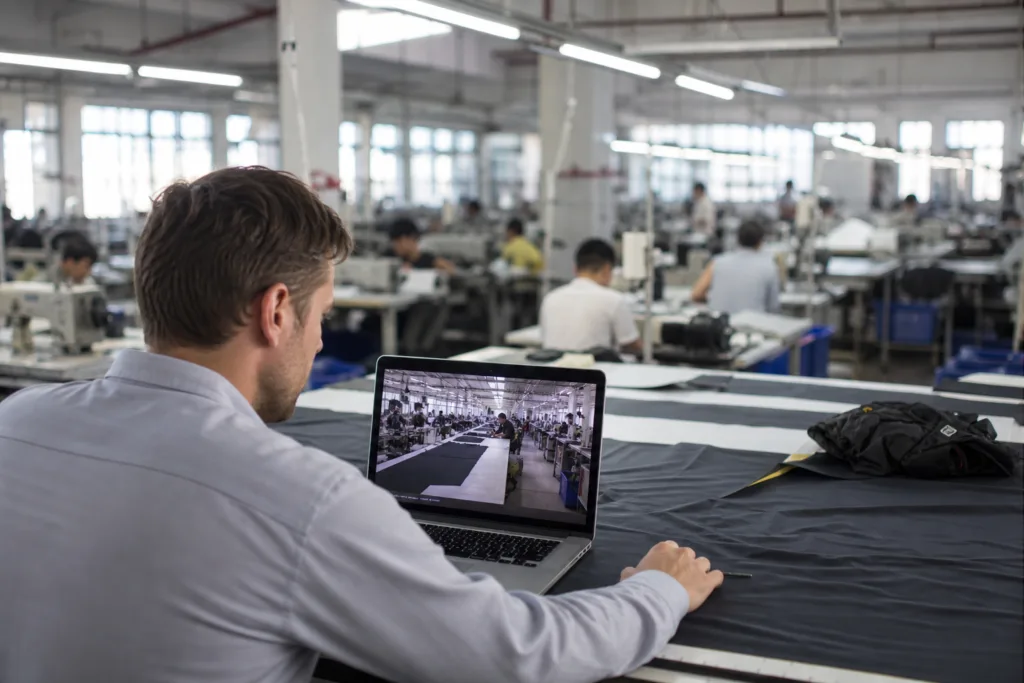
Step 3: Use live video calls to inspect the workshop, equipment, workflow, and staff coverage
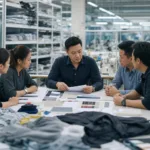
A live video call is one of the strongest remote vetting tools because it is harder to stage than edited photos. Ask for a real-time walk-through of the cutting area, sewing lines, printing or embroidery area if relevant, finishing section, packing area, and sample room.
The purpose is not to judge whether the factory looks luxurious. The purpose is to confirm whether the production setup matches the supplier’s claims about scale, organization, and category capability.
- Ask to see fabric storage and how rolls are identified.
- Check whether cutting tables, sewing lines, and finishing areas appear active and organized.
- Ask to see machines relevant to your product, such as coverstitch, flatlock, bartack, or heat-press equipment.
- Look for work-in-progress bundles, size tickets, inspection tables, and packing flow.
- Request introductions to the merchandiser, pattern team, or QC staff, not only the salesperson.
One useful tactic is to ask spontaneous follow-up questions during the call. For example, ask how measurements are checked during sewing or where embroidery panels are inspected before assembly. Real factories can usually answer operational questions with confidence and specific examples.
Key takeaway: A live video audit should show process, not just premises. You are evaluating whether the supplier understands production control in practice.
Step 4: Evaluate sample quality, workmanship consistency, and revision handling
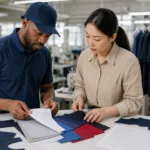
Samples are one of the most reliable ways to vet a supplier remotely because they reveal both physical quality and communication quality. A sample is not only a product. It is evidence of how the factory interprets your tech pack, size chart, artwork, fabric request, and revision comments.
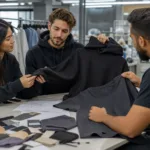
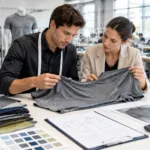
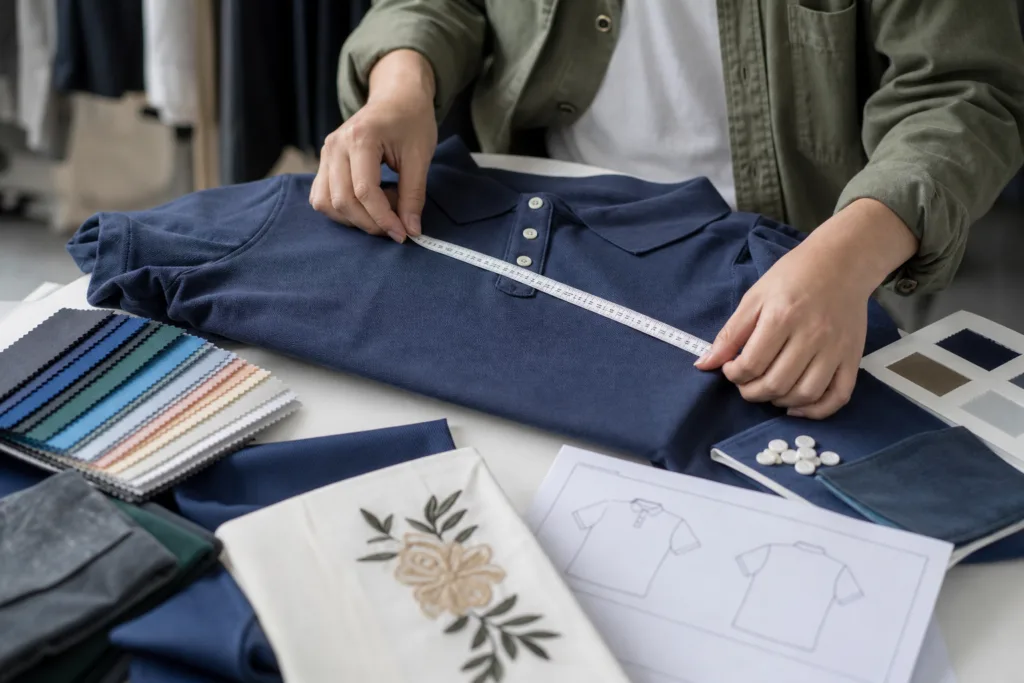
When reviewing a sample, check more than overall appearance. Measure key points, test stretch recovery where relevant, inspect stitch density, compare logo placement, review inside finishing, and note whether labels and packaging were executed correctly.
| Sample Checkpoint | What to Look For | Why It Predicts Bulk Risk |
|---|---|---|
| Measurements | Matches approved spec within tolerance | Poor control here often scales into size inconsistency |
| Fabric and GSM | Close to requested hand feel and weight | Wrong base fabric changes fit, drape, and cost |
| Construction | Clean seams, stable stitching, balanced shape | Shows sewing line capability |
| Logo execution | Sharp print or neat embroidery placement | Branding errors become expensive in bulk |
| Revision response | Factory updates issues accurately | Shows technical understanding and accountability |
Ask the supplier to explain any deviation instead of ignoring it. A trustworthy manufacturer may still make sample mistakes, but should identify the cause, suggest correction, and update the spec clearly.
We often tell buyers that the best sample feedback is precise. Instead of “make it better,” note issues like chest width tolerance, collar height, placket shape, coverstitch tension, print hand feel, or hangtag attachment. Clear comments shorten the next revision cycle and show whether the supplier can follow technical language.
Step 5: Request essential documents, certifications, and compliance proof
Do not rely on verbal assurances for compliance-sensitive products. Ask what documents are available for your garment type, market, and fabric composition, and ask the supplier to explain which requirements apply to your order.
This does not mean every project needs the same certification package. It means the supplier should understand how product type, fabric, market destination, and buyer standards affect documentation. For many projects, that includes labeling accuracy, fiber content confirmation, colorfastness expectations, and any product-specific safety or testing concerns.
For example, buyers shipping to the United States should understand basic product-safety expectations, including when apparel flammability testing may matter. In remote vetting, this is exactly why you should ask for test history or product classification details instead of accepting “it is fine” as an answer.
You should also ask how the supplier handles labeling and documentation under relevant apparel manufacturing compliance standards. A capable manufacturer should be able to discuss care labels, fiber content declarations, country-of-origin labeling, and packaging or carton mark requirements in a practical way.
- Business license and company identity documents
- Any available factory audit or social/compliance audit records if relevant to your program
- Fabric test reports when the product category requires them
- Trim and packaging specifications for private label projects
- Labeling and market-specific compliance understanding
If the supplier avoids document questions, sends incomplete screenshots, or cannot explain what a report means, slow down before placing a deposit.
Step 6: Assess communication quality, response speed, and technical understanding
Strong communication is one of the clearest signs that remote production may succeed. You are not just measuring friendliness. You are measuring whether the supplier can handle technical detail, maintain records, and keep decisions aligned across departments.
Useful remote suppliers usually do three things well. They answer directly, they summarize decisions clearly, and they flag risks before the buyer discovers them later.
- Do they reply with specifics instead of generic reassurance?
- Do they confirm fabric, trim, logo, and sizing details in writing?
- Do they ask useful clarification questions about your tech pack?
- Do they acknowledge lead time risks honestly?
- Do they track revisions and approvals in an organized way?
From our experience, buyers should pay close attention to how a supplier handles ambiguous instructions. If your request is incomplete, a good manufacturer will ask for the missing artwork file, measurement tolerance, wash standard, or packaging detail before proceeding.
This is also where a manufacturer perspective matters. On the Ninghow side, we find that many preventable production errors come from unconfirmed assumptions, not from sewing skill alone. A supplier that documents decisions carefully is usually safer than one that replies quickly but vaguely.
Step 7: Analyze past client cases, order history, and product photos critically
Past work can be useful, but only if you review it critically. Nice images alone do not prove manufacturing capability. Ask what was actually produced, what order sizes were involved, what customization methods were used, and what parts of the process were managed by the factory.
Look for consistency across examples. If every photo shows a different style with no clear product focus, the supplier may be broad but shallow. If the case history matches your category, ask follow-up questions about fabric composition, fit challenges, logo application, and repeat-order control.
- Ask for close-up photos, not only campaign-style images.
- Request inside-out photos for seam and finishing review.
- Ask whether the shown styles were sample-only or bulk-produced.
- Check whether packaging, labels, and branding were part of the order.
- Ask what problems came up and how they were corrected.
Be careful with unsupported claims such as “we make everything” or “we work with many famous brands” without documentation. A serious supplier should be able to talk about process and product specifics even when client names are confidential.
Step 8: Start with a phased trial order before scaling up
The safest way to reduce risk is to move in stages. Even if remote checks look strong, your first order should be structured as a learning order, not a full-scale commitment.
A phased trial order lets you test fabric booking, trim confirmation, pre-production approval, production communication, inspection discipline, and shipment readiness under real conditions. This gives you stronger evidence than a sample alone.
| Phase | Purpose | What You Learn |
|---|---|---|
| Sample stage | Validate fit, workmanship, and interpretation | Can the factory understand and execute your requirements? |
| Pilot order | Test small bulk workflow | Can the factory maintain consistency beyond one piece? |
| Inspection stage | Check defect level and packing accuracy | Does the lot meet agreed quality expectations? |
| Scale-up order | Expand volume after evidence is proven | Is the supplier reliable enough for a larger commitment? |
Before the trial order begins, align the timeline and decision points through the apparel order process for overseas buyers. That helps both sides confirm approvals, production milestones, and shipment expectations before volume increases.
For inspections, some buyers also define an AQL sampling plan so that pass or fail decisions are based on an agreed defect tolerance instead of subjective last-minute debate.
Common red flags when verifying an apparel supplier online
Some warning signs appear early if you know where to look. None of them automatically proves the factory is unreliable, but several together should make you more cautious.
- Company documents, bank details, and communication signatures do not match.
- Factory videos are always edited and never shown live.
- The supplier avoids technical questions about fabric, fit, or construction.
- Sample revisions are acknowledged but not actually corrected.
- Lead times sound unrealistically short for custom trims or dyeing.
- MOQ answers change repeatedly without explanation.
- Every product photo looks different, with no clear category depth.
- Compliance questions are answered with generic promises instead of documents.
Key takeaway: One weak point can be manageable. A pattern of unclear answers, missing evidence, and inconsistent execution usually signals a higher-risk supplier.
A remote vetting checklist for clothing brands, sourcing teams, and bulk buyers
If you need a quick working checklist, use this before placing a deposit or confirming bulk materials.
- Verified legal company identity and export setup
- Confirmed category match for your garment type
- Completed live video workshop review
- Reviewed sample measurements and workmanship in detail
- Checked revision handling and spec accuracy
- Requested compliance and testing evidence relevant to the product
- Assessed written communication quality and technical clarity
- Reviewed real production examples and order context
- Structured a phased trial order before scale-up
- Defined inspection criteria, packing requirements, and approval checkpoints
This checklist is useful for startups, growing brands, procurement teams, schools, clubs, and distributors. The exact depth may vary, but the logic stays the same: trust documented process more than marketing presentation.
How to reduce risk when placing the first order with a new manufacturer
Your first order should be simple enough to control and detailed enough to reveal weaknesses. Avoid launching with too many colors, too many fabric substitutions, or too many packaging variations if the relationship is still untested.
We usually recommend reducing variables in the first run. Keep the size range realistic, finalize logo method early, approve fabric and trims before cutting, and lock packaging details before finishing starts.
- Use an approved tech pack and measurement chart.
- Confirm fabric composition, GSM target, and color standard in writing.
- Approve pre-production sample or PPS before bulk starts.
- Define carton marks, folding method, barcode, and polybag details.
- Schedule in-line and final apparel quality control checks.
For performance garments or repeat-program uniforms, ask how the supplier controls size grading, shade variation, and logo placement consistency between batches. Those are common failure points in growing accounts.
When a remote-vetted supplier is reliable enough to move forward
A remote-vetted supplier is usually reliable enough to proceed when the evidence forms a consistent picture. That means the business identity is clear, the category experience is relevant, the live workshop review matches the claims, the sample shows control, the documents are reasonable, and communication remains organized through revisions.
You do not need perfection in every area before a first order. You need enough transparency and process control to make risk manageable. If a supplier is honest about limitations, responsive to corrections, and strong in your actual product category, that is often a better sign than polished marketing with little operational detail.
Final takeaway: combine evidence, samples, and trial orders into one sourcing decision
The smartest way to vet clothing manufacturer remotely is to combine three things: verified information, physical product evidence, and controlled trial production. Any one of those alone is incomplete. Together, they give you a realistic view of whether the supplier can support your brand, order volume, and quality expectations.
At Ninghow, we believe remote buyer confidence is built through transparency. That includes clear communication, realistic sampling, document sharing, video-based review, and careful bulk planning rather than oversized promises.
If you use a structured process, remote vetting can be practical and dependable. The key is to move from claims to proof, from proof to sample, and from sample to phased production with clear standards at each step.
FAQs
Can I trust a clothing manufacturer without visiting the factory?
Yes, you can move forward without a factory visit if you verify the supplier through layered evidence. A trustworthy remote process should include legal identity checks, live video review, sample evaluation, compliance documentation, written communication records, and a phased trial order before larger production.
What is the most important thing to check when vetting a manufacturer remotely?
The most important thing is consistency between what the supplier says and what the evidence shows. If company documents, workshop video, sample quality, communication quality, and order planning all align, the supplier is usually much safer than one that only offers good pricing or attractive photos.
How many samples should I request before placing a bulk order?
There is no single number, but most buyers should expect at least one development sample and one corrected approval stage when the product is customized. More sample rounds may be necessary if the project includes new patterns, performance fabric, special logo applications, or private label packaging details.
What documents should I ask for from an overseas apparel supplier?
You should ask for the business license, company identity details, export-related information, and any product-relevant testing or compliance documents. Depending on the garment and destination market, you may also need fabric test reports, labeling confirmation, audit records, or documentation related to safety and product claims.
Is a small trial order really necessary if the sample looks good?
Yes, a small trial order is still valuable because a good sample does not prove full production consistency. Trial production shows whether the supplier can manage materials, maintain measurements, control workmanship across multiple units, communicate during production, and pack the order correctly.
How do I know when a remote-vetted supplier is ready for larger orders?
You can scale up when the supplier has passed the core checks and performed reliably in a pilot order. That usually means clear documents, relevant category capability, accurate sampling, strong communication, acceptable inspection results, and stable execution of packaging, labeling, and delivery milestones.