






If you need to choose private label clothing manufacturer partners for a new launch or a scaling brand, the hard part is rarely finding factories. The real challenge is separating suppliers that look capable on paper from manufacturers that can actually execute your product, branding, quality, and delivery requirements with consistency. From our manufacturing perspective, the right decision comes from a structured review of technical fit, sample capability, branding support, quality systems, communication discipline, and realistic production planning rather than from price alone.
For teams that are comparing suppliers and trying to evaluate private label clothing support, it helps to look beyond a simple product catalog. A useful review should include fabric and trim options, fit development, labels and packaging, sample revisions, MOQ flexibility, bulk planning, and the quality controls that protect your brand once orders start repeating. That is where practical manufacturing support becomes more valuable than a broad but shallow offering.
Start with your sourcing goals before contacting factories
Before you shortlist any supplier, define what you are actually buying. Many brand founders start with a vague request such as “premium hoodie” or “custom polo,” but a manufacturer cannot price or plan accurately without commercial and technical context.
We recommend clarifying these points first:
- Product category: T-shirts, polos, fleece, jackets, uniforms, teamwear, or performance apparel
- Fabric direction: cotton, cotton-poly, French terry, pique, interlock, woven stretch, recycled blends, or performance knits
- Target retail price: this determines acceptable fabric cost, trim level, and garment construction
- Order frequency: one seasonal drop, monthly replenishment, or year-round core styles
- Launch timeline: sample window, approval cycles, and shipping deadline
- Brand identity: minimal branding, streetwear details, teamwear function, or retail-ready presentation
- Customization depth: neck labels, size labels, care labels, hangtags, barcodes, zipper pulls, custom bags, and cartons
If these basics are not defined, supplier comparisons become misleading. One factory may price a standard blank with a printed neck label, while another may assume a fully custom garment with dyed-to-match drawcords, woven labels, and branded packaging. The quote difference looks dramatic, but the scope is not the same.
Core criteria to use when you choose private label clothing manufacturer options
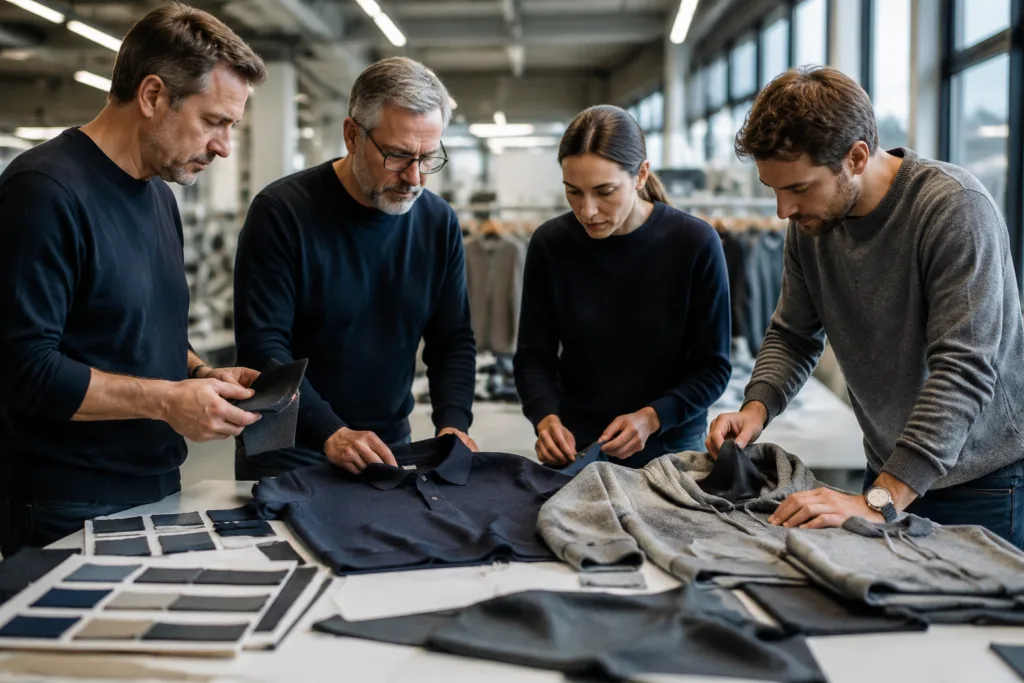
A practical review can fit on one page. We often suggest that buyers score each supplier against the same criteria so the decision stays objective.
| Criterion | Why it matters | What to verify |
|---|---|---|
| Product and technical fit | The factory must understand your garment type and construction risks | Past styles, fabric familiarity, process capability, workmanship photos |
| Sample and prototyping ability | Early development quality predicts bulk execution | Pattern skill, grading accuracy, revision speed, approval process |
| Private-label support | Branding details affect setup cost, MOQ, and retail presentation | Labels, hangtags, packaging, barcode handling, trim minimums |
| Quality systems | Good QC reduces return risk and repeat-order problems | Inspection points, measurement control, test reports, corrective action |
| Communication | Delays often come from unclear decisions, not only production issues | Single point of contact, response time, update format, escalation path |
| Capacity and scalability | A supplier may handle a trial but struggle with growth | Line capacity, seasonal loading, repeat-order planning, backups |
| Cost structure | Low quoted price can hide weak materials or unstable processes | Fabric basis, trim scope, setup fees, MOQ breakpoints, lead-time impact |
This kind of scorecard is especially useful when multiple stakeholders are involved, such as a founder, merchandiser, and sourcing manager with different priorities.
Evaluate product range and technical expertise, not just style photos
Not every clothing manufacturer is equally suitable for every category. A supplier that produces large runs of basic jersey T-shirts may not be the right fit for waterproof outerwear, sublimated team uniforms, or structured golf polos with strict color matching and collar performance requirements.
Ask whether the factory has real experience with your product type:
- Knitwear: T-shirts, polos, hoodies, sweatshirts, joggers
- Woven styles: jackets, shirts, shorts, workwear, lightweight outerwear
- Performance apparel: moisture management, elastane recovery, mesh panel construction, compression considerations
- Teamwear or schoolwear: repeatability, logo placement consistency, and size-set completeness
You should also understand process depth. Some manufacturers cut and sew in-house but outsource printing, embroidery, washing, or packaging. Outsourced processes are not automatically a problem, but you should know who controls timing, quality standards, and rework responsibility.
In our production work, technical fit usually comes down to a few practical questions: Can the supplier source the right fabric at your target hand feel and GSM? Can they maintain sizing consistency across runs? Can they manage the decoration method your design requires without distorting the garment? A strong answer is more valuable than a broad promise.
Questions to ask about technical fit
- Which similar garments have you made in the last 12 months?
- Do you work more often with knits, wovens, or both?
- Which fabric mills or sourcing channels do you typically use for this category?
- Which processes are in-house, and which are subcontracted?
- What construction risks do you see in this design?
Sample and prototyping capability tells you how the bulk order will behave
A supplier’s sample stage is one of the clearest predictors of future performance. If measurements drift, details are missed, or revisions are poorly tracked during development, those issues rarely disappear during bulk production.
Buyers should understand the full apparel sampling process for prototypes and pre-production samples before placing a first order. A disciplined sample path usually includes pattern review, first prototype, fit corrections, salesman or confirmation sample where needed, and a pre-production sample that becomes the reference for bulk.
What to evaluate during sampling:
- Pattern making skill: Are balance, shape, and proportions correct?
- Grading: Does the supplier understand your size range and tolerance expectations?
- Revision control: Are comments logged clearly, or handled informally by chat?
- Remote approval support: Can they provide measurement sheets, close-up photos, and videos?
- Turnaround discipline: Are promised dates realistic and consistently met?
A useful sample policy should also explain when you pay for new development, when a revision is included, and what triggers extra cost such as a new fabric, a major pattern change, or custom trim remaking. If a supplier cannot explain this clearly, planning becomes difficult for both sides.
Private-label branding support should match your real brand stage
Private label means more than attaching a neck label. The scope can range from a printed main label and stock polybag to a fully branded system with woven labels, care labels, hangtags, barcodes, size stickers, folding instructions, carton marks, and e-commerce-ready packaging.
Ask manufacturers what they offer as standard and what requires separate setup:
- Woven main labels
- Printed neck labels
- Care labels with country-specific content
- Hangtags and stringing
- Custom polybags or recyclable packaging
- Barcode or UPC application
- Retail folding and assortment packing
Early-stage brands often underestimate trim minimums. Garments may have a low piece MOQ, but custom woven labels, branded zipper pulls, or printed mailer bags can require much higher minimums. That is why branding support must be reviewed as a total system, not one trim at a time.
At Ninghow, we often help buyers simplify this stage by separating launch-critical branding elements from features that can wait until reorder volumes improve. That approach protects brand presentation without creating unnecessary MOQ pressure in the first run.
Quality control and testing systems should be visible, not vague
When buyers ask about quality, many suppliers answer with general statements such as “we check everything before shipment.” That is not enough. You need to know where quality is checked, how it is recorded, and what happens when something fails.
A basic but credible system should include:
- Raw material inspection: fabric shade, hand feel, width, defects, and trim verification
- Pre-production review: approved sample, artwork, labels, measurements, and packing method
- In-line inspection: measurement checks, seam quality, print position, embroidery quality, and workmanship at the sewing stage
- Final inspection: assortment, appearance, measurements, labels, packaging, and carton count
For brands that make safety or compliance claims, ask what testing is available before bulk approval. Depending on market and product, this can include colorfastness, shrinkage, pilling, fiber-content confirmation, print adhesion, and chemical-safety review. If a supplier references STANDARD 100 by OEKO-TEX or similar material-safety standards, ask whether the certification applies to the specific material or component you are buying, not just to an unrelated past order.
It is also useful to ask whether the factory works within a documented quality framework such as the ISO 9001 quality management standard. Certification alone does not guarantee a good product, but a process-based quality system can indicate stronger document control, corrective action discipline, and repeat-order consistency.
If you want a more detailed review of checkpoints and reporting, our guide to apparel quality control and inspection procedures shows how measurement, workmanship, and packing controls should connect across production.
Communication and project management reduce more risk than many buyers expect
Many production failures are actually information failures. A good manufacturer should not only respond quickly, but also translate buyer intent into actionable factory instructions.
Ask each supplier how project communication is managed:
- Will you have one point of contact?
- How are comments and approvals logged?
- How often will bulk updates be sent?
- What photos can be provided during cutting, sewing, finishing, and packing?
- How are urgent issues escalated?
We recommend a simple update rhythm for first orders: sample tracker during development, pre-production meeting before bulk, then milestone updates at fabric arrival, cutting start, sewing start, finishing, and packing. Buyers who need a clearer picture of that workflow can review a typical apparel order process and production communication structure before comparing suppliers.
The point is not to create bureaucracy. It is to avoid hidden assumptions. A short, disciplined communication process is usually far more efficient than dozens of scattered chat messages.
Capacity, lead time, MOQ, and pricing need to be judged together
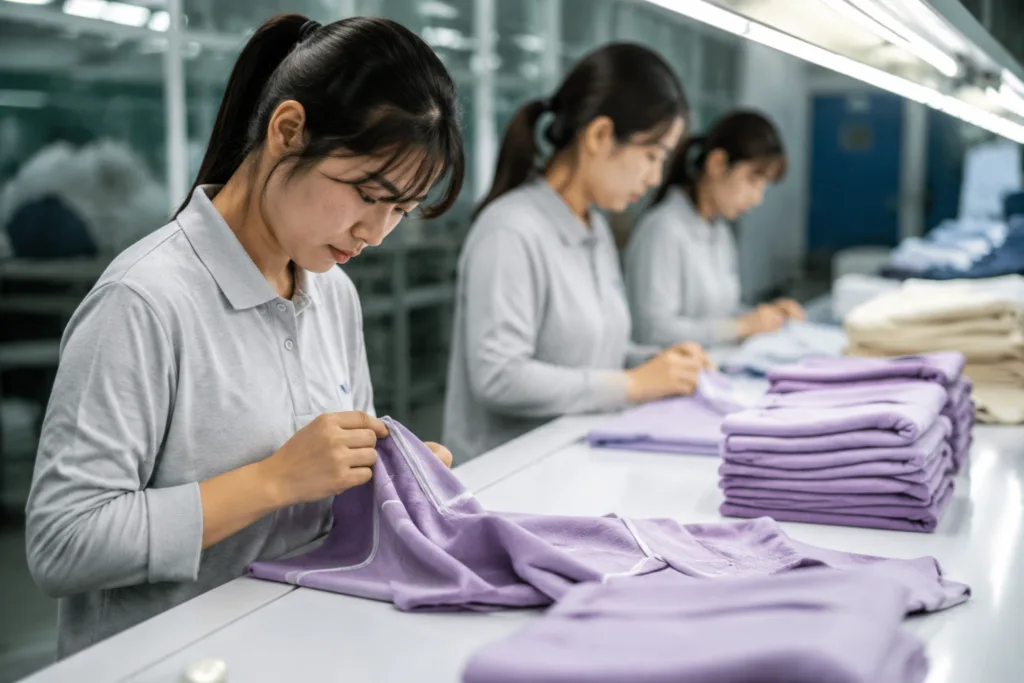
Lead time claims mean little unless they are tied to actual capacity and order size. A factory may promise a fast first run because your order fits into a gap, but repeat runs may face seasonal congestion or fabric delays.
When reviewing capacity, ask:
- What is the realistic sample lead time and bulk lead time for this category?
- How does lead time change during peak seasons?
- Can orders be split into pilot and balance quantities?
- What happens if a key process partner is overloaded?
- How are repeat orders prioritized?
MOQ should also be interpreted carefully. The garment MOQ is only one layer. Fabric color minimums, custom trim minimums, print setup, embroidery setup, and packaging minimums can all change the commercial reality of a supposedly small order.
For emerging brands, it is worth exploring low MOQ clothing manufacturing options for small batches, but with realistic expectations. Lower MOQ often increases unit cost because fabric utilization is less efficient, setup cost is spread over fewer pieces, and some trims still require larger commitments. A low MOQ program is most useful when product architecture is simplified and branding choices are prioritized intelligently.
Typical cost drivers to compare
| Cost area | What changes price most | Buyer takeaway |
|---|---|---|
| Fabric | Composition, GSM, dye method, finish, mill source | Fabric usually has the biggest impact on cost and hand feel |
| Trims | Custom labels, zippers, cords, packaging | Small branding details can raise MOQ or setup cost |
| Decoration | Embroidery count, print colors, placement, special effects | Decoration affects both cost and production speed |
| Labor | Construction complexity, seam count, handling time | Simple silhouettes are easier to launch at small volume |
| Washing/finishing | Special washes, softeners, garment dye, pressing standards | Finishing choices influence appearance consistency and lead time |
Tech pack readiness makes supplier evaluation more accurate
A manufacturer can only quote and sample as well as the information provided. Incomplete tech packs create avoidable delays, re-quotes, and disagreements about what was expected.
A practical tech pack should include:
- Flat sketches and construction details
- Fabric composition and target GSM
- Color references
- Point-of-measure chart with tolerances
- Grading rules or expected size range
- Seam and stitch notes
- Artwork files for print or embroidery
- Label and packaging requirements
- Special comments on fit, hand feel, or use case
Common missing items include neck drop notes, cuff and rib specifications, fold-and-pack instructions, print dimensions by size, and approved color references. These gaps may sound small, but they often cause repeated sample corrections.
Run samples and a pilot order before committing to scale
For a new supplier, we recommend a staged validation process rather than jumping from a first sample to a large bulk order. Start with fit and construction approval, then move to a pilot run or small launch quantity if the business model allows.
A practical sequence looks like this:
- Initial sample to assess pattern and construction direction
- Revised fit sample after comments
- Pre-production sample in bulk fabric and trims
- Small pilot production to confirm consistency
- Full bulk order after pilot acceptance
Acceptance criteria should be written down. That includes measurement tolerances, allowed print variation, shade expectations, packing rules, and defect thresholds. If these are only discussed verbally, disputes are much more likely.
For bulk production, your quality assurance plan should include pre-production sign-off, in-line measurement checks, final inspection, and a clear remedy if lots fail. Remedies may include sorting, rework, replacement production, partial acceptance with discount, or delayed shipment by mutual agreement.
Contract terms, IP protection, logistics, and red flags
Commercial terms deserve the same attention as the garment itself. Even a technically good factory can become a risky partner if payment terms, ownership rights, or defect handling are unclear.
Points worth negotiating early
- Payment structure: deposit, balance timing, and inspection condition before final payment
- Lead-time commitment: agreed production window and what happens if delays occur
- Rework terms: who pays for corrections if goods miss approved standards
- Pattern and artwork ownership: especially for custom developments
- NDA or confidentiality terms: useful for original graphics, prints, and product concepts
- Shipping terms: clarify FOB, EXW, DDP, or other agreed Incoterms
Logistics details also matter earlier than many brands expect. Retail customers may need barcode labels, carton marks, exact fold methods, or country-specific care-label content. E-commerce projects may need individual bagging, size stickers, and fulfillment-friendly carton packing. These details should be confirmed before the pre-production sample stage, not after bulk is cut.
Common red flags
- Prices that change sharply once labels, packaging, or correct fabric are added
- Very fast promises with no sample calendar or capacity explanation
- No clear answer on who manages outsourced printing or embroidery
- Reluctance to share production photos or measurement reports
- Over-reliance on verbal promises instead of approved documents
- Strong style photo portfolio but weak technical questioning
Use a supplier scorecard and a structured RFI to compare options
When several suppliers seem acceptable, a weighted scorecard helps you avoid the trap of choosing whoever answered first or quoted lowest.
| Area | Suggested weight | Scoring note |
|---|---|---|
| Technical fit | 25% | Past category experience, fabric understanding, process match |
| Sample capability | 20% | Accuracy, revision control, speed, communication quality |
| Branding support | 10% | Labels, tags, packaging, retail readiness |
| Quality control | 20% | Inspection system, reports, corrective action, testing access |
| Communication | 10% | Responsiveness, clarity, single point of contact |
| Capacity and lead time | 10% | Scheduling realism, repeat-order readiness |
| Cost structure | 5% | Transparency and fit with your product strategy |
A shortlist threshold can be simple: any supplier below 75 out of 100 requires caution, and any supplier with a weak score in technical fit or quality control should not advance only because the quote is attractive.
Your RFI or RFQ should ask targeted questions such as:
- Which similar programs do you currently produce?
- What is your actual MOQ by style, color, and size set?
- How long do first samples and repeat samples take?
- How are revisions recorded and approved?
- What inspections do you run during bulk?
- Can you provide recent production photos for similar items?
- What branded trims can be customized, and what minimums apply?
- How do you handle defects found after final inspection?
Decision pathways for different brand stages
Not every buyer should prioritize the same things.
Early-stage brand with small launches
Prioritize sample speed, flexible MOQ structure, clear branding support, and a supplier willing to simplify trims and packaging without damaging presentation. Avoid overbuilding the first collection.
Growing brand scaling repeat volumes
Prioritize capacity, measurement consistency, stable quality systems, and a cost structure that improves with volume without changing fabric or workmanship standards.
Seasonal or fast-turn capsule
Prioritize scheduling reliability, quick approvals, fabric availability, and a communication process that makes issues visible early enough to act.
What the first 30-60-90 days should look like after selection

Once you choose private label clothing manufacturer support, the onboarding phase should be structured. We recommend this sequence:
- First 30 days: NDA if needed, onboarding documents, tech pack handoff, sample calendar, material confirmation
- By 60 days: sample approvals, packaging confirmation, price confirmation, pre-production meeting agenda
- By 90 days: first bulk run, in-line reporting, final inspection plan, KPI review for delivery, defects, and communication quality
The goal is not only to place an order. It is to build a repeatable system. A supplier relationship becomes stronger when decisions, approvals, measurements, and corrective actions are documented from the beginning.
Frequently Asked Questions
What is the most important factor when choosing a private label clothing manufacturer?
The most important factor is technical and commercial fit with your specific product, not the lowest quoted price. A supplier should be able to make your garment category well, support your branding needs, communicate clearly, and maintain quality consistently within your target MOQ and timeline.
How many samples should I expect before bulk production?
Most projects need at least an initial prototype, one fit revision, and a pre-production sample in the correct fabric and trims. More complex products or brands with strict fit standards may need additional rounds, and that is usually cheaper than discovering avoidable issues in bulk production.
Can a low MOQ supplier still be a good long-term private label partner?
Yes, if the supplier is transparent about what parts of the order can stay low MOQ and which trims or fabrics still require higher minimums. A good long-term partner helps you launch efficiently at small volume while creating a path toward better costing, fuller customization, and smoother repeat production as your brand grows.
What should be included in a private label tech pack?
A useful private label tech pack should include flat sketches, fabric details, color references, point-of-measure specifications, grading information, construction notes, decoration artwork, label instructions, and packaging requirements. The more complete the pack is, the more accurate the quote, sample, and bulk execution will be.
How do I verify a manufacturer’s quality control claims?
Ask for a clear explanation of raw material inspection, in-line checks, final inspection, measurement reporting, and corrective action procedures. You can also request sample test results, recent production photos, and independent inspection support for the first bulk orders to confirm that the factory’s process matches its claims.
When should I switch from one supplier to another?
You should consider switching when repeated problems show a process issue rather than a one-time mistake, especially if communication becomes unclear, quality drift is not corrected, or lead times become unreliable. Before moving, document the failures, compare improvement efforts, and make sure your next supplier is stronger in the exact areas that caused the original problems.