








Choosing between low MOQ vs bulk clothing production is not just a pricing decision. It affects your cash flow, inventory exposure, lead time flexibility, supplier coordination, and how confidently you can reorder the same SKU later. From our manufacturing perspective, the right order model depends less on what seems cheaper today and more on where your brand is now, how stable your styles are, and how often you expect to replenish.
If you are trying to evaluate low MOQ clothing manufacturing options, the key is to look beyond the first order quantity. Many brands need a production setup that supports fabric choice, sample refinement, logo application, size consistency, and a realistic path from test runs into repeat orders. At Ninghow, we help buyers connect those early-stage decisions with later production realities, so the order model fits both current risk tolerance and future growth plans.
What low MOQ apparel production really means in practice
Low MOQ usually means producing smaller quantities per style, color, or size breakdown than a standard bulk program. It is commonly used by startups, new collections, test launches, niche teamwear projects, limited drops, or brands that want to validate demand before tying up too much inventory.
That said, low MOQ does not mean no production constraints. Factories still need to source fabric, arrange trims, prepare patterns, cut efficiently, schedule sewing lines, and manage printing or embroidery setup. Smaller runs can be flexible, but they often come with tighter choices around available fabrics, color options, or decoration complexity.
Key takeaway: Low MOQ is usually best when demand is uncertain, SKU life is short, or preserving cash is more important than reaching the lowest possible unit cost.
When brands usually choose low MOQ
- New brand launch with limited sales history
- Testing fit, fabric, or logo placement before scaling
- Seasonal or trend-sensitive styles with uncertain reorder demand
- Club, school, or team programs with smaller confirmed quantities
- Private label development where branding details are still being refined
In these cases, a smaller first run can act as both market validation and a production learning stage. It allows buyers to identify fit comments, packaging issues, or decoration adjustments before committing to a large inventory position.
What bulk clothing production means and why factories often prefer it
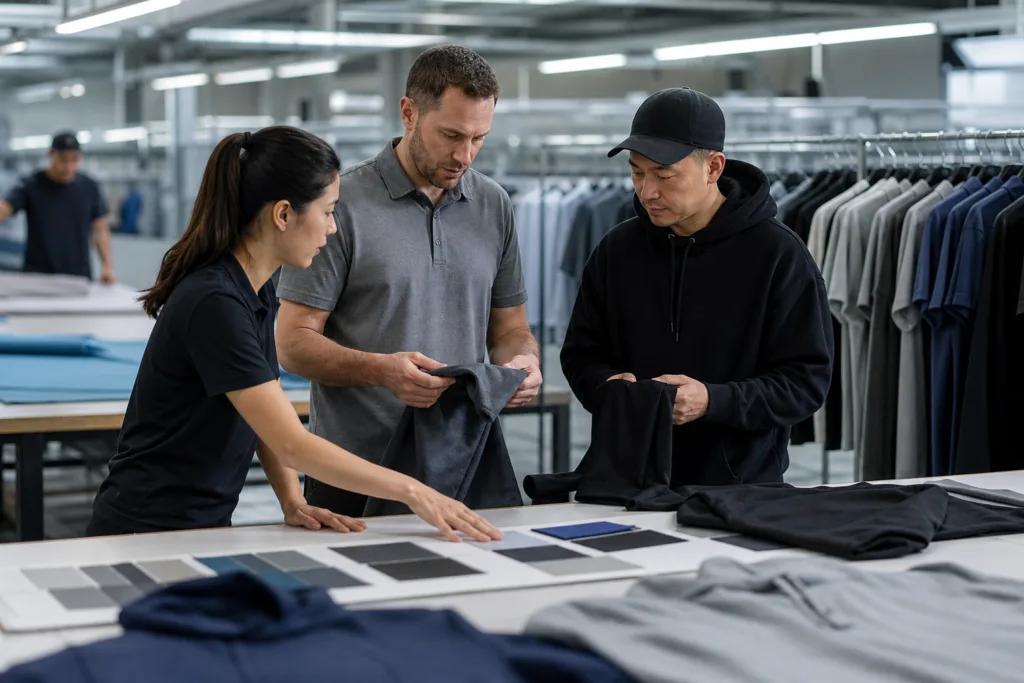
Bulk production means larger confirmed order quantities that improve line efficiency and purchasing leverage. For manufacturers, larger runs make it easier to optimize marker efficiency, fabric usage, production planning, and trim procurement. That usually leads to lower unit cost and more stable workflow.
Factories often favor scale because setup time is spread across more units. Pattern preparation, grading checks, cutting, sewing line balancing, printing screens, embroidery programming, washing, finishing, and packing all become more cost-efficient when the order is large enough.
However, bulk is only efficient if the product is stable enough to justify it. Large runs of unstable SKUs can create dead stock, color imbalance, or size ratio problems that are harder to correct later.
Why bulk works well for the right product
- Core basics with predictable demand
- Uniform and repeat teamwear programs
- Established best sellers with stable size curves
- Retail replenishment styles that move consistently
- Private label essentials where trims and packaging are already standardized
Bulk production is not automatically the smarter option. It becomes the better option when reorder confidence is high and the business can carry the inventory without creating pressure elsewhere.
Low MOQ vs bulk clothing production: what buyers should compare first
The simplest way to compare low MOQ vs bulk clothing production is to look at four factors together: unit cost, inventory risk, flexibility, and operational efficiency. Buyers often focus only on unit price, but the more important question is total business risk per order.
| Factor | Low MOQ | Bulk Production |
|---|---|---|
| Unit cost | Usually higher per piece | Usually lower per piece |
| Cash required upfront | Lower initial commitment | Higher initial commitment |
| Inventory risk | Lower if demand is uncertain | Higher if sell-through is unclear |
| Customization freedom | Can be limited by sourcing practicality | Better for developed and standardized programs |
| Production efficiency | Lower line efficiency | Higher line efficiency |
| Reorder responsiveness | Good for testing and short cycles | Good when demand planning is strong |
| Best use case | Validation, launches, limited runs | Stable repeat styles and scale growth |
In real sourcing decisions, the winning model is usually the one that protects margin after sell-through, not just before production. A lower unit cost means less if half the inventory moves slowly or needs discounting.
Which order model fits your brand stage
Brand stage is one of the clearest decision filters. Early-stage brands usually need learning, flexibility, and lower exposure. More mature brands usually need scale, cost control, and dependable replenishment.
Startups and new labels
Startups are usually better served by smaller runs unless they already have strong preorders, wholesale commitments, or confirmed demand. Early in a brand journey, fit comments, sales feedback, and size distribution patterns are still forming. A low MOQ strategy keeps mistakes smaller and easier to correct.
Growing DTC brands
Growing brands often sit between the two models. A common path is low MOQ for new styles and bulk for proven best sellers. If you are assessing when a brand is ready to move from small batches to bulk runs, look at repeat sell-through, return reasons, and whether the same specifications can now be reordered with confidence.
Established labels and mature collections
Established brands often benefit from bulk production because the tech packs, fit blocks, trim standards, and reorder history are already in place. At that stage, the savings from scale are more likely to convert into real margin improvement instead of extra inventory risk.
Seasonal collections and fashion-led drops
For seasonal programs, lower quantities can still be the safer model even for bigger brands. Trend risk, short lifecycle selling windows, and unpredictable color demand often justify more cautious first orders.
How cash flow changes under each model
Cash flow is where many brands feel the difference most strongly. Low MOQ reduces upfront payment pressure because fewer units are purchased at once. Bulk can reduce per-unit cost, but it usually increases deposit size, material commitment, freight planning complexity, and inventory carrying cost.
From our production experience, brands sometimes underestimate what happens after goods arrive. Bulk inventory occupies warehouse space, locks working capital, and can delay the next collection if too much money is tied up in slow-moving stock.
| Cash Flow Area | Low MOQ Impact | Bulk Impact |
|---|---|---|
| Deposit amount | More manageable | Higher |
| Inventory carrying cost | Lower | Higher |
| Pressure to sell quickly | Moderate | High |
| Ability to fund new development | Better preserved | Can be restricted |
| Freight efficiency | Potentially less efficient | Often more efficient per unit |
Key takeaway: A higher unit cost can still be the healthier financial choice if it protects cash, shortens inventory exposure, and keeps room for faster product decisions.
For brands using lean inventory systems, supply chain resilience also matters. The operational balance between lead time reduction, supplier coordination, and inventory discipline is well aligned with guidance from NIST on supply chain management, especially when buyers are comparing flexibility against buffer stock needs.
How SKU stability should influence your production quantity
SKU stability means how confident you are that the same style, fit, fabric, color, and size mix will continue selling without major changes. Stable SKUs are better candidates for bulk. Unstable SKUs usually belong in smaller runs.
We often advise buyers to ask a simple question: if this style performs well, will you reorder it exactly as approved, or are you likely to change fabric, shape, logo size, packaging, or color assortment? If changes are likely, a large order may create leftovers that no longer match your next version.
Signals that a SKU is stable enough for bulk
- Fit has already been tested and approved in market
- Returns are not driven by size inconsistency
- Fabric and trim sourcing are repeatable
- Branding details are finalized
- Demand is proven across sizes and colors
Signals that a SKU should stay low MOQ first
- New silhouette or untested block
- Experimental fabric or wash
- Unclear size ratio demand
- Trend-led graphic or seasonal concept
- Brand packaging or labeling still evolving
This is especially important in private label projects. Labels, hangtags, care labels, barcode stickers, and bagging standards all seem small, but changes after production can make existing inventory less usable.
Why reorder rhythm can matter more than first-order price
If your brand expects regular replenishment, the best strategy may not be the largest first order. It may be the order model that supports healthy reorder rhythm. Fast-moving basics can justify a bulk base order plus planned replenishment. Fashion-driven styles often benefit from smaller, more frequent decisions.
For product teams focused on building a repeat production plan from sales data and reorders, the goal is to align order quantity with actual sales velocity, not hopeful projections. Reorder strategy works best when early sales results directly shape later purchase volume.
In fashion products with short life cycles, replenishment decisions are closely linked to stockout and obsolescence risk. Research on fashion replenishment and short lifecycle products is useful here because it highlights why one large buy is not always the most profitable path when demand is uncertain and timing matters.
How product type changes the right order model
Different garment categories behave differently in production and in the market. The same quantity strategy should not be applied to every product type.
| Product Type | Usually Better for Low MOQ | Usually Better for Bulk |
|---|---|---|
| Graphic T-shirts | Yes, if artwork is trend-led or campaign-based | Yes, if design is evergreen and demand is proven |
| Basic polos | Good for early testing | Strong choice once fit and fabric are stable |
| Uniforms | Useful for pilot programs | Very suitable for repeat programs |
| Sportswear sets | Good for new collections and fit validation | Good when fabric and grading are locked |
| Fashion hoodies | Safer for limited drops | Works for proven winners only |
| Private label essentials | Useful during development | Efficient after approval and standardization |
At Ninghow, we see this clearly in sportswear, teamwear, and private label basics. A stable polo or uniform program can often move to larger production smoothly, while a fashion hoodie with evolving washes, trims, and graphics may need tighter first runs.
How sampling and development differ between low MOQ and bulk
Sampling matters in both models, but its role changes. With low MOQ, sampling is often part of market validation. With bulk, sampling is about locking specifications tightly enough to protect consistency across a larger run.
In smaller programs, buyers may tolerate some flexibility in fabric availability or trim substitution if the goal is speed and testing. In bulk, that tolerance drops. Every approved detail needs to translate clearly into repeatable manufacturing instructions.
What should be locked before bulk production
- Final graded size chart
- Approved base fit and measurement tolerances
- Fabric composition, GSM, and color standard
- Print or embroidery placement and size
- Labels, hangtags, polybags, and carton requirements
- Packing ratio by size and color
When details are still moving, bulk production becomes risky. This is one reason why smaller pilot runs can be valuable before scaling.
What changes in quality control as volume increases
Quality control becomes more structured as quantity grows. A 100-piece order and a 5,000-piece order do not carry the same risk profile. Larger orders require more formal checkpoints because a single issue can affect many more units.
From our manufacturing side, QC at higher volume usually needs fabric inspection, pre-production confirmation, in-line checks, measurement verification, logo placement control, finishing review, and final packing inspection. The bigger the run, the more discipline is required to maintain consistency from first carton to last carton.
QC points buyers should ask about
- Fabric shade consistency between rolls
- Shrinkage and hand feel after finishing
- Measurement tolerance control across sizes
- Print adhesion or embroidery stability
- Needle, stitching, and seam appearance checks
- Packing accuracy by SKU and carton
Key takeaway: Bulk production lowers unit cost only if the factory can keep quality stable across the entire run. Without solid QC checkpoints, larger volume can magnify defects instead of reducing cost.
MOQ, lead time, and scheduling trade-offs buyers should understand
MOQ and lead time are connected to factory scheduling more than many buyers expect. Small orders can sometimes move quickly if materials are available and line capacity can absorb them. In other cases, small runs take longer because fabric or trims still need to meet minimum purchase levels.
Large orders often get better production efficiency, but they also need more planning time. Material booking, lab dips, trim approval, line allocation, and packing preparation all become more important as volume rises. Buyers should therefore think in terms of total calendar time, not just sewing days.
For practical scheduling, it helps to review planning lead times for sampling, production, and delivery before confirming a launch date. The production model must fit not only your target quantity, but also your development timeline, shipping window, and sales calendar.
What details often increase MOQ more than buyers expect
Order quantity is not driven by style count alone. Fabric customization, dye-to-match trims, specialty labels, unique packaging, multiple print placements, and wide color assortments can all raise the practical MOQ even if the garment itself is simple.
That is why buyers should understand what product details can push order quantities higher before finalizing a sourcing plan. Sometimes the easiest way to keep MOQ low is to simplify one or two custom elements rather than reducing the garment quantity itself.
Common mistakes brands make when choosing only by unit price
The most common mistake is assuming that the cheapest per-piece option is the cheapest business decision. Bulk can look attractive on a quote sheet while quietly increasing inventory risk, markdown risk, and cash pressure.
Another mistake is placing a large order before the fit block is truly stable. If grading issues, size returns, or print placement comments appear after launch, the brand may be stuck with too much imperfect inventory.
We also see buyers overlook reorder speed. If the supplier cannot replenish fast enough, a low first unit cost may still result in missed sales or long out-of-stock periods.
- Do not choose bulk only because the unit price is lower
- Do not choose low MOQ if your style is already proven and repeatedly reordered
- Do not ignore trim and packaging complexity when discussing MOQ
- Do not skip sample approval details just to save time
- Do not assume every supplier can support both models equally well
How to choose the right model for the next 6 to 12 months
A practical decision starts with your next planning horizon, not just your next PO. Ask what your brand needs over the next 6 to 12 months: testing, stability, margin improvement, faster replenishment, or broader assortment control. The right order model is the one that supports that next stage with acceptable risk.
Low MOQ is usually stronger when your near-term priority is learning. Bulk is usually stronger when your near-term priority is margin and repeatability. Many brands will benefit from a mixed strategy, using low MOQ for new development and bulk for proven carryover styles.
A simple decision framework
- Choose low MOQ if demand is uncertain and your product is still evolving
- Choose bulk if demand is proven and specifications are stable
- Use mixed planning if your range includes both test styles and core repeats
- Review cash position before chasing lower unit cost
- Match order size to expected reorder rhythm, not optimism alone
This is often the most commercially sound path for growing apparel brands. It reduces overbuying while still creating room to scale the winners.
Decision checklist before placing your order
Before confirming either model, buyers should pressure-test the decision with a few operational questions. This step often reveals whether the quantity choice is based on strategy or just quote comparison.
- Is this style already proven in the market?
- Are fit, grading, and fabric details fully approved?
- Can your current cash flow support the inventory without slowing future development?
- How fast can the supplier repeat the same SKU if it sells through?
- Will labels, trims, and packaging stay the same for the next reorder?
- Is the style seasonal, trend-sensitive, or likely to be revised soon?
- Are you optimizing for margin, flexibility, or risk control?
If several of these answers are still uncertain, a smaller initial run is often safer. If most answers are already stable, bulk becomes easier to justify.
Choosing the model that supports growth instead of creating pressure

Low MOQ vs bulk clothing production should be evaluated as a business system, not a price debate. The best choice depends on your brand stage, inventory tolerance, cash position, style confidence, and reorder discipline. Smaller runs help control uncertainty. Larger runs reward stability.
From our perspective as a clothing manufacturer, the strongest results usually come from matching quantity to product maturity. When buyers align order size with real demand signals, approved specifications, and realistic replenishment timing, production becomes easier to manage and growth becomes more sustainable.
If your project includes private label setup, sampling, logo application, fabric selection, or future bulk planning, it helps to discuss those steps before confirming quantity. That way, the order model supports not just this launch, but the next one as well.
FAQs
Is low MOQ always better for startup clothing brands?
Low MOQ is often better for startups, but not always. It works well when demand is still uncertain, fit is still being validated, and cash needs to be protected, but a startup with strong preorder volume or confirmed wholesale demand may be ready for larger production on selected SKUs.
When does bulk clothing production make more sense?
Bulk clothing production makes more sense when a style is proven, specifications are stable, and the brand can carry the inventory without cash strain. It is especially effective for repeat basics, uniforms, and best sellers where reorder confidence is already supported by actual sales data.
Does low MOQ mean faster production every time?
No, low MOQ does not always mean faster production. Small runs can move quickly when fabric and trims are available, but they can also slow down if custom materials still require minimum purchases or if the factory must fit a small order around existing production schedules.
How should brands split styles between low MOQ and bulk orders?
Brands should usually place new, trend-led, or uncertain styles in low MOQ and reserve bulk orders for stable carryover products. This mixed approach helps reduce overstock risk while still improving cost efficiency on the SKUs that have already earned larger commitments.
What is the biggest risk of choosing bulk only for a lower unit price?
The biggest risk is tying up too much cash in inventory that sells slower than expected or needs markdowns. A lower manufacturing cost per piece can quickly lose value if the order creates storage pressure, blocks future development budgets, or leaves the brand with outdated stock.
Can a manufacturer support both low MOQ development and later bulk production?
Yes, many manufacturers can support both, but the transition works best when the product is developed with future scale in mind. Buyers should align sampling, fabric selection, measurement control, logo application, and packaging standards early so the same style can move into bulk production with fewer surprises.