






If you need smaller production runs, the right supplier is not simply the one offering the lowest minimum. To choose low MOQ clothing manufacturer options wisely, you need to look at transparency, sampling discipline, material reality, communication quality, and the supplier’s ability to repeat your product consistently after the first order. Small-batch production can be a smart way to test demand, launch a new collection, supply a niche market, or reduce inventory risk, but only if the manufacturing partner treats low MOQ projects with the same technical care as larger orders.
For buyers comparing low MOQ clothing manufacturing options, the most useful starting point is to ask how the supplier handles fabric sourcing, sample revisions, logo application, labels, packaging, and re-order planning at lower volumes. At Ninghow, we support brands and organizations that need practical low-volume development with clear MOQ logic, sample coordination, private label details, and realistic bulk planning rather than vague promises.
Why low MOQ matters for small-batch apparel production
Low MOQ matters because it reduces commitment before you know whether a style will sell or perform. Startups use it to test brand direction, sportswear labels use it to validate fit and fabric, and clubs or organizations use it to place manageable first orders without carrying excess stock.
From our manufacturing perspective, small-batch production also changes the risk profile of a project. Fabric availability becomes more important, trim choices need to be controlled, and production efficiency can be harder to maintain if the product has too many variations for too few units.
Key takeaway: A low MOQ is valuable when it helps you test the market, but it only works well if the supplier is honest about what can be produced efficiently at that quantity.
What makes a low MOQ clothing manufacturer reliable, not just affordable

A reliable low MOQ supplier does more than say yes to a small order. The supplier should explain what the MOQ applies to, whether it is per style, per color, per fabric, or per size ratio, and how customization choices affect feasibility.
Price alone is a weak screening tool. Very cheap quotations often hide problems such as unstable fabric sourcing, poor size consistency, rushed sampling, outsourced printing without control, or future re-order issues when the original material is no longer available.
When buyers evaluate a manufacturer, we suggest looking at five core areas:
- MOQ transparency and cost logic
- Sample development quality and revision control
- Fabric and trim sourcing flexibility
- Communication speed and technical accuracy
- Repeat order support and bulk consistency
These points are more useful than broad claims about being flexible or experienced. A supplier becomes dependable when the process is understandable and repeatable.
How to choose low MOQ clothing manufacturer partners without misunderstanding the MOQ
The first thing to confirm is what the MOQ really covers. Some suppliers advertise a very low number, but that quantity may only apply to a stock fabric, one color, simple construction, and no custom trims. Once you add branded labels, special dye colors, embroidery, or packaging, the real minimum may change.
Ask for the MOQ breakdown in writing. You should know whether minimums apply separately to fabric purchase, logo process, label production, packaging, and each SKU combination.
| MOQ Item | What Buyers Should Ask | Why It Matters |
|---|---|---|
| Garment MOQ | Is the minimum per style, per color, or total order? | Prevents confusion on order structure |
| Fabric MOQ | Is custom fabric required or can stock fabric be used? | Strongly affects low-volume feasibility |
| Logo MOQ | Does embroidery, print, or transfer have separate minimums? | Customization often changes cost and lead time |
| Label MOQ | Are woven labels, care labels, and hangtags counted separately? | Private label details may create hidden commitments |
| Packaging MOQ | Can custom bags, boxes, or stickers be produced at low volume? | Packaging can become an unexpected constraint |
Clear MOQ language is especially important for private label projects. If your product includes a custom neck label, branded hangtag, size sticker, and printed polybag, each item may involve its own supply chain minimum.
A reliable supplier should also tell you when low MOQ is realistic and when it is not. For example, small runs are usually easier with stock or readily available fabrics than with custom-knitted fabrics, garment dyeing, or uncommon trim development.
Review the sample development process before placing a bulk order
Before you commit to bulk production, review how the supplier manages development. A dependable partner should explain the sequence from tech pack review to material approval, pattern making, first sample, revision round, and pre-production confirmation.
This is where many buyers discover whether a factory truly understands product development or is only quoting from photos. Our advice is to inspect the supplier’s apparel sampling process before you compare unit prices, because good sampling reduces later delays, quality disputes, and fit problems.
What should you check in sample development?
- Whether the supplier works from a tech pack, reference sample, or both
- How size specs and tolerances are confirmed
- How fabric substitutions are communicated if exact material is unavailable
- Whether logo size, placement, and application method are approved clearly
- How revision rounds are tracked
- Whether a pre-production sample is used before bulk cutting
Sampling is not only about appearance. It is also the stage where you verify hand feel, GSM, fit balance, construction quality, seam behavior, shrinkage risk, and decoration suitability.
Key takeaway: If the sample process is vague, the bulk order will usually be harder to control.
Confirm material feasibility and fabric sourcing flexibility
Low MOQ projects succeed when the material plan matches the order size. That means choosing fabrics and trims that are commercially feasible in smaller quantities without compromising the product concept too much.
A reliable manufacturer should tell you whether your requested fabric can be sourced as stock, whether a mill requires its own minimum, and what alternatives are available if your original composition or color is unrealistic for a test order.
In practice, material feasibility often decides whether a low MOQ project moves smoothly or stalls. A cotton-spandex jersey for active tops, a standard fleece range for hoodies, or a common polyester interlock for teamwear may be manageable in lower volumes. A highly specialized recycled blend in a custom shade with matching rib and custom drawcord tips may not be.
| Material Situation | Low MOQ Feasibility | Buyer Advice |
|---|---|---|
| Stock fabric in common colors | High | Best for test orders and faster launches |
| Mill-supported standard dyed fabric | Medium | Confirm dye lot consistency and lead time |
| Custom-developed fabric | Low | Better for larger confirmed programs |
| Special trims with branding | Medium to low | Check trim minimums early |
| Mixed decoration methods | Medium | Review production complexity before approval |
Buyers should also ask how the supplier handles fabric testing and quality checks. A serious manufacturer should understand standards-based thinking around textile performance, sewing quality, and process control, not just cutting and sewing. Broader technical awareness of fabric testing and process standards helps explain why capable suppliers ask detailed questions about shrinkage, colorfastness, pilling, or dimensional stability when developing a garment.
If you are unsure between two fabric choices, ask the supplier to explain the trade-off in hand feel, stretch recovery, opacity, breathability, and cost. We often see buyers choose a fabric by composition alone, but in production the GSM, knitting structure, finish, and dye behavior are equally important.
Evaluate communication speed, clarity, and technical understanding
Good communication is one of the strongest signs of supplier reliability. You are not only looking for fast replies. You are looking for replies that answer the actual question, identify missing information, and flag production issues early.
A useful way to test this is during the quotation and sample stage. Ask for construction comments, possible MOQ conflicts, fabric alternatives, and likely lead time risks. If the supplier gives generic answers or avoids specifics, that pattern usually continues later.
Strong supplier communication usually looks like this:
- Questions are answered clearly and directly
- Missing tech pack details are highlighted early
- Fit, fabric, and logo concerns are explained in simple language
- Changes are confirmed in writing
- Lead time is broken down by development, material preparation, and production
- Potential problems are raised before they become delays
This is also where buyers should assess technical understanding. A reliable team should know the difference between print methods, explain why embroidery may distort a lightweight knit, and understand why grading a unisex hoodie differs from grading fitted sportswear.
For projects involving overseas sourcing, it also helps to review practical questions to ask before placing an order so you can compare communication quality across multiple suppliers using the same criteria.
Verify whether the supplier supports repeat orders and production consistency
Many low MOQ suppliers can produce a first test run. Fewer can support repeat orders with stable quality, sizing, and branding details. If your style performs well, re-order capability quickly becomes more important than the initial minimum.
Ask how the supplier records approved specifications. A reliable manufacturer should keep pattern files, size specs, approved artwork, decoration position references, fabric information, and packaging details so the next order does not start from zero.
Repeat production depends on process discipline. If a supplier changes fabric sources, stitch settings, or decoration placement without a clear approval process, your second order may not match the first. That creates problems for retail presentation, team uniform continuity, and customer satisfaction.
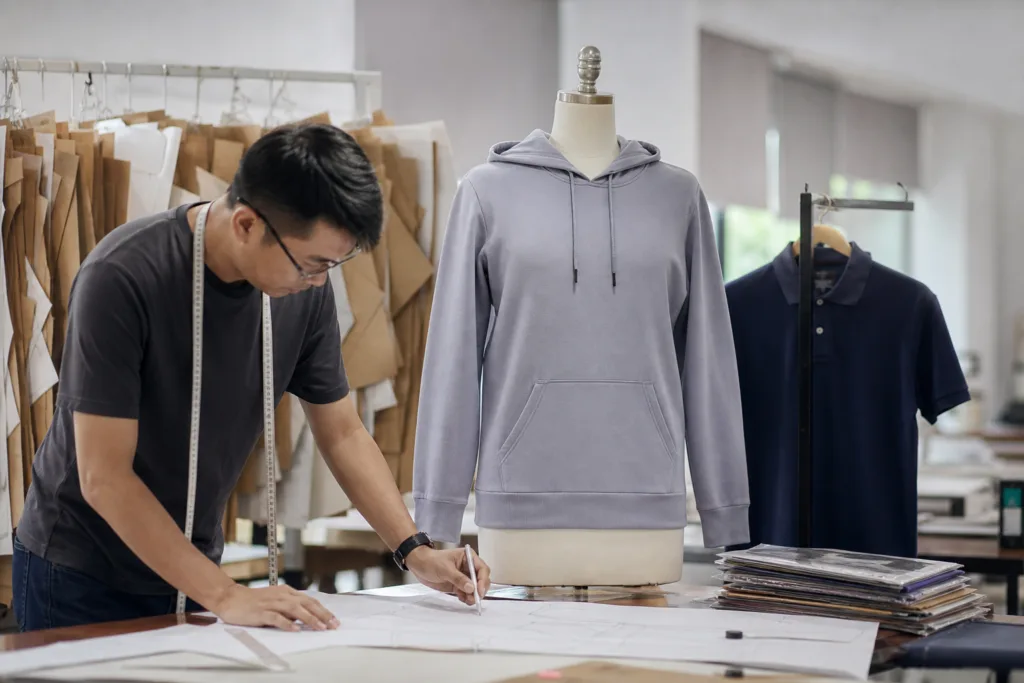
From our production experience, repeat consistency improves when buyers confirm these points before the first bulk order:
- Approved measurement chart with tolerances
- Locked fabric composition and target GSM range
- Color standard or reference swatch
- Approved logo file and size placement
- Label and packaging specification
- Pre-production sample sign-off method
If your project may scale, work with a supplier that can explain how re-orders are handled when original stock fabric is no longer available. That is a much more useful conversation than hearing a simple yes to low MOQ.
Other screening points buyers should not ignore
Lead time realism
Lead time should be explained in stages, not given as one optimistic number. Development, fabric sourcing, sample revision, trim preparation, cutting, sewing, finishing, and shipment each affect the final schedule.
We recommend reviewing apparel production timeline planning before confirming your order calendar, especially if your launch depends on packaging, private labels, or multiple colorways.
Quality control checkpoints
Quality control should begin before sewing. Fabric inspection, pattern confirmation, size spec verification, decoration approval, inline checks, and final random inspection all matter, even on small runs.
At Ninghow, we find that low-volume orders still benefit from structured QC because small quantities do not remove the risk of measurement error, logo inconsistency, or finishing defects. In some cases, low-volume custom work needs even closer review because the product is less standardized.
Labeling, trims, and packaging
Labeling and packaging are common sources of hidden delay. Buyers should ask when care labels, woven labels, hangtags, and custom polybags are approved and whether those items affect the production start date.
For small-batch private label programs, keeping the first order simpler can help. Standard packaging with branded labels may be more realistic than fully custom box packaging for an early test order.
Customization options and production fit
Not every customization method suits every fabric or quantity. Screen printing may be efficient for some runs, while heat transfer is more practical for lower units or names and numbers. Embroidery gives a premium look, but it can pull lightweight fabric or add bulk in certain positions.
A dependable supplier should recommend the right process for your garment instead of agreeing to every request without comment.
Red flags that suggest a low MOQ supplier may not be dependable
Some warning signs appear early if you know what to watch for. These do not always mean the supplier cannot produce, but they do suggest higher risk.
- MOQ is advertised broadly but not broken down by style, color, fabric, and trims
- Quotations are given without reviewing specs, fabrics, or logo methods
- Sample revisions are informal and not documented
- Fabric substitutions are made without clear approval
- Lead times sound too short for the requested customization
- Communication is fast but vague
- The supplier avoids discussing tolerance, shrinkage, or QC checkpoints
- Re-order questions are answered with assumptions instead of process details
Buyers should also be cautious when a supplier promises almost any MOQ on almost any product. In manufacturing, flexibility is real, but it is always shaped by fabric availability, trim sourcing, and process efficiency.
Questions to ask before choosing a small-batch clothing supplier
The fastest way to compare factories is to ask the same practical questions to each one. This turns supplier evaluation into a structured review instead of a subjective impression.
- What is the real MOQ by style, color, and fabric?
- Can you use stock fabric for this project, or is a mill minimum required?
- What is included in sample development and how many revision rounds are normal?
- What decoration method do you recommend for this fabric and why?
- How do you confirm measurements, tolerances, and fit approval?
- What QC checkpoints do you use before and during production?
- How are labels, hangtags, and packaging handled for low-volume orders?
- How do you support repeat orders if the style sells well?
- What could delay this project based on my current specs?
- What information do you need from me before final quotation?
These questions also help you understand how to reduce risk in custom clothing orders by forcing more technical clarity before money is committed.
How to compare multiple manufacturers and avoid hidden sourcing risks
The best comparison method is a scorecard, not a price list. If you compare only by unit cost, you may choose the supplier with the weakest sample control or least stable fabric plan.
| Evaluation Factor | What Good Looks Like | Risk If Weak |
|---|---|---|
| MOQ transparency | Written breakdown by style, color, fabric, and trims | Unexpected cost or quantity changes |
| Sampling process | Clear stages, revision control, technical comments | Fit errors and bulk mismatch |
| Fabric sourcing | Realistic alternatives and stock options | Delays or unavailable materials |
| Communication | Clear, technical, responsive replies | Frequent misunderstandings |
| Repeat order support | Documentation and stable specifications | Inconsistent future production |
| QC system | Inspection points before and during production | More defects reaching shipment |
When we speak with buyers, we often recommend weighting these factors according to business stage. A startup may care most about low-risk development and manageable MOQ. An established brand may care more about repeat consistency and scaling potential.
Key takeaway: The right supplier is not the cheapest one on the first order. It is the one that gives you the highest chance of a successful sample, smooth bulk run, and repeatable product.
Best practices for moving from sampling to repeat production
Once your sample is approved, do not assume the project is fully locked. You still need to convert the sample into a production-ready standard that the factory can follow repeatedly.
Buyers should prepare a final approval package that includes measurement specs, artwork, fabric confirmation, trim list, label placement, packaging requirements, and any important comments from sample revisions. This reduces dependence on memory and messaging history.
Good transition practices include:
- Approving one final sample or pre-production sample
- Confirming any acceptable tolerances in writing
- Locking color references before cutting
- Rechecking decoration placement on all sizes if needed
- Confirming carton and individual packaging requirements
- Planning re-order options for the same style in advance
If your first order is a test run, ask the supplier what changes would improve efficiency on the second run. Sometimes simplifying a trim, reducing color splits, or standardizing packaging can improve price and speed without changing the core product.
Final checklist for selecting a reliable low MOQ clothing manufacturer
Before you choose a supplier, make sure the answers below are clear enough that another team member could review the project and understand it quickly.
- The MOQ is broken down clearly and matches your actual SKU plan
- The sample process is structured and includes technical review
- The fabric and trims are feasible for your quantity
- The supplier communicates clearly and flags issues early
- The decoration method suits the fabric and order size
- Lead time is realistic and broken into stages
- QC checkpoints are explained
- Private label details are understood and documented
- Repeat order support is possible if the style performs well
- The supplier feels process-driven, not promise-driven
If you are at the evaluation stage, sending a complete tech pack, target quantity, color count, fabric preference, logo method, and packaging requirement will usually lead to better answers. It also helps the factory judge whether a low MOQ plan is commercially realistic from the start.
Conclusion
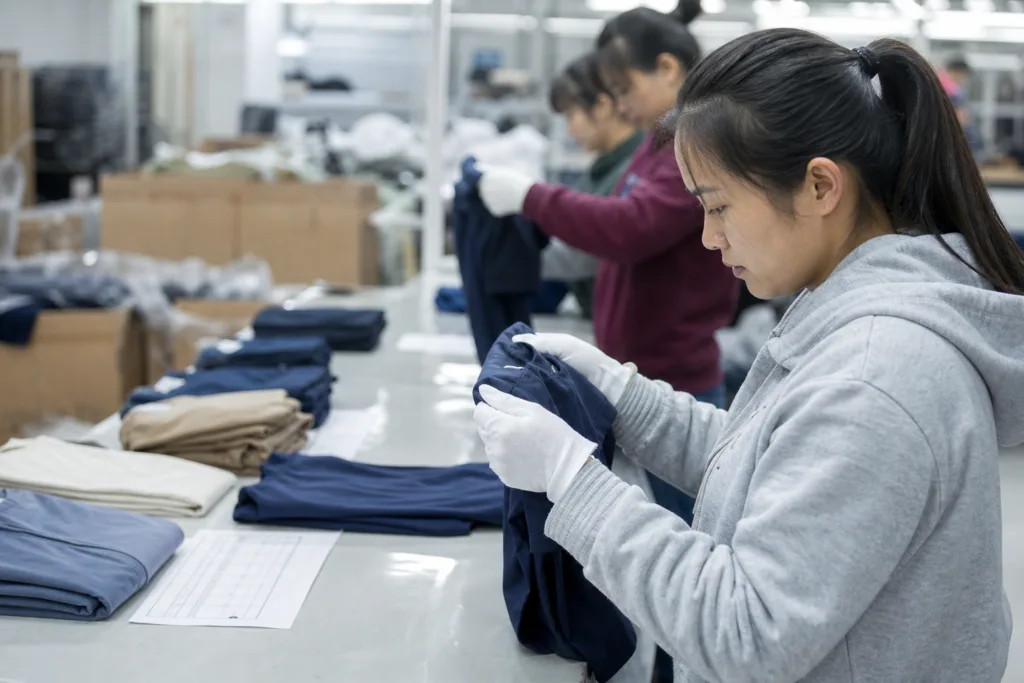
To choose low MOQ clothing manufacturer partners well, focus less on headline minimums and more on how the supplier thinks through your product. A reliable small-batch manufacturer should explain what the MOQ means, guide you through sample development, confirm material feasibility, communicate clearly, and support repeat production with consistent standards.
For brands, teams, retailers, and sourcing managers, that approach reduces wasted time and protects product quality. If your project needs small-batch development, private label setup, or sample evaluation, a manufacturer-led review of fabric options, customization methods, and production constraints will usually reveal much more than a simple quote comparison.
FAQs
What is a realistic low MOQ for custom clothing?
A realistic low MOQ depends on the garment, fabric, and customization method. Simple products using stock fabric and standard trims may be feasible at relatively low quantities, while custom-dyed fabrics, branded trims, and complex decoration usually increase the true minimum required for efficient production.
Why do some suppliers advertise low MOQ but later increase the minimum?
This usually happens because the advertised number only applies to a basic production setup. Once custom labels, special colors, embroidery, printing, or specific fabric sourcing are added, the supplier must account for separate material and trim minimums that were not explained clearly at the start.
How important is sampling before a small-batch order?
Sampling is very important because it reveals fit issues, fabric hand feel, construction problems, and decoration risks before bulk production begins. Even for a small run, a controlled sample process reduces the chance of receiving a finished order that does not match your product expectations.
Can a low MOQ manufacturer also support repeat orders later?
Yes, but only if the supplier keeps proper records and can maintain material and specification consistency. Buyers should confirm how patterns, measurement charts, approved fabrics, logo placements, and packaging details are stored so future re-orders can follow the same standard.
What documents should I prepare before contacting a manufacturer?
The most helpful documents are a tech pack or product reference, target quantity, size breakdown, color plan, logo files, trim requirements, and packaging expectations. Clear information allows the supplier to judge feasibility, quote more accurately, and identify development risks earlier.
How can I compare two low MOQ clothing manufacturers fairly?
Compare them using the same checklist for MOQ transparency, sample control, fabric sourcing, communication quality, lead time realism, and re-order support. A supplier with a slightly higher price may still be the better choice if the process is clearer and the production risk is lower.