







Custom clothing manufacturing turns an apparel idea into a repeatable product that can be sampled, approved, produced, inspected, and delivered at the required quality. It is relevant to clothing brands, startups, retailers, sports teams, schools, distributors, and procurement teams that need more control than ready-made wholesale can provide. The strongest projects begin with a clear product brief, realistic fabric and quantity decisions, and a manufacturer that can communicate production risks before bulk cutting begins.
For a training, gym, or sportswear project, custom gym clothing manufacturing support can connect garment selection with performance fabrics, fit development, logo application, sampling, and bulk planning. This is especially useful when a buyer needs coordinated tops and bottoms, branded labels, practical packaging, and a production plan that matches the intended use and order volume.
How Custom Clothing Manufacturing Works for Different Buyers
Custom clothing manufacturing is a development and production process rather than a single product purchase. The buyer defines the garment, materials, measurements, branding, and delivery requirements; the manufacturer then converts those requirements into patterns, samples, production specifications, and quality checkpoints.
It is important to distinguish custom production from related sourcing models. The right model depends on how much control the buyer needs over design, materials, branding, fit, and production quantities.
| Production model | Buyer control | Typical use |
|---|---|---|
| Ready-made wholesale | Limited to available styles, colors, sizes, and branding options | Fast resale of existing garments with minimal development |
| Private label | Usually based on an existing garment with custom labels, packaging, and selected details | Brands that need a faster route to a branded product |
| OEM production | High control over the buyer’s specifications, materials, construction, and branding | Brands with defined designs, tech packs, or product requirements |
| ODM production | Shared development, with the manufacturer contributing existing designs or product knowledge | Buyers that want a customized product without developing every detail from zero |
| Fully custom cut-and-sew | High control over pattern, fabric, trims, decoration, and finishing | Distinctive products, uniforms, activewear, teamwear, and private label collections |
From our manufacturing perspective, a buyer does not always need the most complex model. A startup may be better served by adapting a proven base pattern and investing in labels and packaging, while an established brand may need a new block, custom fabric, specialized construction, and a complete pre-production approval process.
Define the Product Brief Before Requesting a Quote
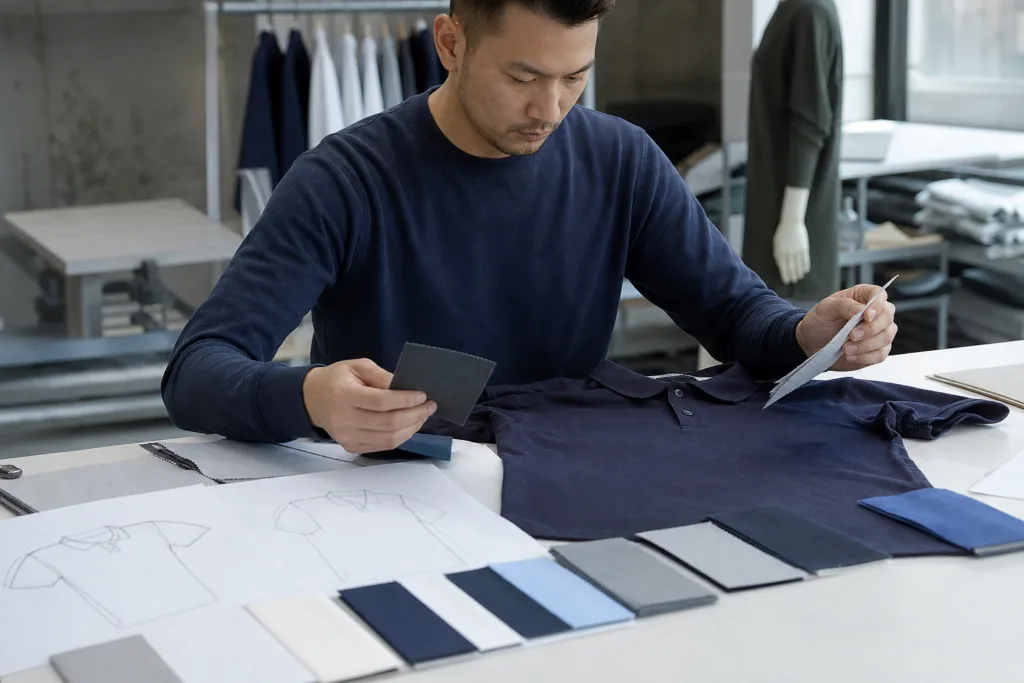
A manufacturer can give a more useful quotation when the product brief explains the commercial and technical purpose of the garment. A request that only says custom hoodie or branded polo leaves too many variables open, so the first price may not represent the final product.
- Garment category, such as T-shirt, polo, hoodie, sweatshirt, jacket, shorts, leggings, joggers, or uniform
- Target customer and intended use, including training, golf, workwear, school, retail, lifestyle, or outdoor activity
- Target retail or purchase price and the required balance between appearance, durability, and performance
- Expected order quantity, number of colors, size range, and whether the order will be repeated
- Brand positioning, including basic, mid-market, premium, technical, sustainable, or promotional use
- Decoration requirements, labels, packaging, delivery market, and target launch date
Use case should influence the product from the beginning. A lightweight training shirt may need moisture management, stretch, fast drying, and flat or smooth seams. A retail sweatshirt may place more emphasis on weight, softness, brushed interior, silhouette, and color depth. A school or team order may prioritize size coverage, easy care, logo durability, and dependable replenishment.
Key takeaway: Define the garment’s purpose and commercial position before comparing factory prices. Otherwise, two quotations may describe different products even when they use the same product name.
Choose the Garment Type and Construction Details
Garment type affects fabric consumption, sewing operations, fit, decoration placement, production speed, and cost. A simple T-shirt may require fewer operations than a panelled performance top, but the simplest option is not always the best choice for the customer or end use.
For cut-and-sew products, the manufacturer should review the pattern pieces, seam construction, stitch type, reinforcement points, cuff or waistband structure, pocket details, and finishing method. Our cut-and-sew activewear production work, for example, requires close coordination between fabric stretch, panel direction, seam allowance, sewing sequence, and the intended movement of the wearer.
| Garment type | Construction decisions to review | Common production risk |
|---|---|---|
| T-shirt | Neck rib, shoulder tape, sleeve shape, hem finish, side seams | Neck opening, twisting side seams, or inconsistent length |
| Polo shirt | Collar, placket, button position, cuff, reinforcement, hem shape | Collar mismatch, placket distortion, or poor button alignment |
| Hoodie | Hood construction, drawcord, kangaroo pocket, cuff, waistband, lining | Hood imbalance, bulky seams, or inconsistent rib tension |
| Performance top | Panel layout, stretch direction, seam profile, reflective or printed details | Restricted movement, seam irritation, or decoration failure |
| Shorts or joggers | Rise, waistband, drawcord, pockets, gusset, leg opening | Poor mobility, waistband rolling, or pocket placement variation |
Ask the manufacturer to identify which details are essential and which can be simplified if the target quantity or budget is limited. Reducing unnecessary panels, unusual trims, or decorative operations can improve repeatability without making the garment look basic.
How to Select Fabric, GSM, and Performance Requirements
Fabric selection should be based on composition, construction, GSM, stretch, recovery, breathability, surface appearance, shrinkage, colorfastness, and the way the garment will be used. GSM is a useful reference for weight, but it does not tell the whole story. Two fabrics with the same GSM can feel very different because of yarn, knit structure, finishing, fiber blend, and dyeing.
| Product direction | Useful fabric considerations | Indicative GSM discussion |
|---|---|---|
| Lightweight T-shirt | Soft hand feel, opacity, drape, shrinkage control, and print surface | Often discussed around 140–180 GSM, depending on composition and use |
| Structured polo | Pique or smooth knit texture, collar stability, breathability, and color retention | Often discussed around 180–240 GSM |
| Midweight sweatshirt | Loopback or brushed interior, warmth, recovery, and rib compatibility | Often discussed around 280–360 GSM |
| Performance activewear | Moisture management, stretch, recovery, pilling resistance, and drying behavior | Often discussed around 130–220 GSM |
| Heavy hoodie or outer layer | Body, warmth, structure, seam strength, and trim durability | May exceed 360 GSM depending on design |
These ranges are starting points rather than fixed specifications. A lightweight cotton jersey can be opaque and durable if it is well constructed, while a heavier polyester fabric may still feel cool if its knit structure and finishing support airflow. A manufacturer should assess the actual fabric swatch and test sample, not rely only on a GSM number.
Composition also affects the production plan. Cotton can provide a natural hand feel but may require shrinkage control and careful color matching. Polyester is widely used for performance and sublimation applications, while elastane can improve fit but requires attention to recovery, heat exposure, and cutting direction. Blends can balance comfort and durability, but they may change the appearance and behavior of printing or dyeing.
If the brand needs a specific shade or coordinated color system, custom fabric dyeing for branded activewear may be considered after confirming fabric composition, minimum dyeing quantity, lab dip approval, and color tolerance. Color should be evaluated under consistent lighting, and the approved standard should be retained for future production whenever repeat orders are expected.
- Check shrinkage after washing, especially for cotton and cotton-rich fabrics.
- Check pilling, snagging, opacity, and surface change after realistic use or laundering.
- Confirm stretch and recovery in the direction required by the pattern.
- Compare fabric hand feel on the finished garment rather than only on a loose swatch.
- Discuss colorfastness for washing, perspiration, rubbing, and exposure relevant to the product.
Key takeaway: Choose fabric by matching fiber, construction, GSM, finish, and performance to the use case. Increasing GSM alone is not a reliable way to make a garment feel more premium.
Manage Fit, Sizing, Grading, and Pattern Development
Fit consistency begins with a clear measurement chart and a defined fit intention. Regular, relaxed, oversized, slim, athletic, and unisex fits require different blocks and grading logic. A manufacturer cannot correct an unclear fit preference by simply adjusting one length measurement.
Provide a base size with finished garment measurements, not only body measurements. Include chest or bust, body length, shoulder width, sleeve length, hem width, neck opening, rise, inseam, and any measurement that affects the silhouette. For stretch garments, also identify the intended negative ease or close-to-body relationship.
Pattern development should consider fabric behavior. A pattern created for stable cotton jersey may not work for a highly elastic performance knit. Likewise, a heavy fleece hoodie may need different seam allowances, pocket proportions, and rib dimensions than a lightweight sweatshirt.
- Approve the base size before grading the full size range.
- Measure samples on a flat surface using the same points each time.
- Set tolerances for each measurement instead of treating every difference as equally important.
- Review fit on representative wearers when movement, modesty, or sports performance matters.
- Keep approved patterns and measurement revisions clearly identified for repeat production.
Inconsistent grading can create a product that fits one size well but feels unbalanced in larger or smaller sizes. This is why size-set review is more valuable than approving only one attractive sample.
Prepare a Tech Pack That a Manufacturer Can Produce
A tech pack is the working reference that connects design intent with production execution. It does not need to be complicated, but it must remove ambiguity from the areas that affect fit, materials, construction, decoration, and inspection.
- Flat sketches or clear product images showing front, back, inside, and detail views
- Measurement chart with points of measure, base size, grading rules, and tolerances
- Bill of materials covering main fabric, contrast fabric, rib, thread, buttons, zippers, cords, labels, and packaging
- Fabric composition, GSM target, color standard, finish, and performance expectations
- Construction notes for seams, stitch types, reinforcement, bartacks, pockets, hems, and closures
- Artwork files with dimensions, placement, colors, application method, and acceptable tolerance
- Label, hangtag, folding, polybag, carton, barcode, and shipping-mark requirements
- Sample comments and revision history so the latest approved version is clear
Reference measurements should be written in a way that different people can interpret consistently. For example, specify whether body length is measured from the high shoulder point or from the neck seam. If a buyer has a physical reference garment, identify which features should be copied and which should not.
Compare Customization Methods for the Intended Garment
Branding method should be selected according to fabric, artwork, order quantity, expected wear, color count, and the desired appearance. A decoration that looks suitable on a cotton T-shirt may not perform well on a stretch sports top or fleece hoodie.
| Method | Best suited to | Important considerations |
|---|---|---|
| Embroidery | Polos, caps, jackets, uniforms, and structured garments | Thread density, backing, stitch count, needle marks, and fabric distortion |
| Screen printing | Cotton and cotton-blend garments with bold artwork | Color count, ink hand feel, curing, registration, and wash durability |
| Heat transfer | Short runs, names and numbers, detailed graphics, and selected performance fabrics | Film quality, application temperature, pressure, stretch, and peeling risk |
| Sublimation | Polyester performance garments with all-over or detailed graphics | Polyester content, color appearance, white base, and artwork scaling |
| Woven or printed labels | Neck branding, care information, size identification, and private label presentation | Label softness, attachment position, legal information, and minimum quantities |
| Washing and finishing | Vintage effects, soft hand feel, shade variation, or specialized surface appearance | Color consistency, dimensional change, environmental controls, and repeatability |
Private label development usually involves more than adding a logo. The buyer may need a branded neck label, size pip, care label, hangtag, barcode, tissue, polybag, carton marking, and retail-ready folding. These details should be confirmed before sampling because label dimensions and attachment positions can affect the pattern and sewing sequence.
Artwork should be supplied in usable formats with clear dimensions and color references. Confirm whether the final price includes screens, embroidery digitizing, transfer setup, sublimation preparation, or other one-time charges. Separating setup costs from per-piece decoration helps buyers compare quotations fairly.
Use Samples to Reduce Bulk Production Risk
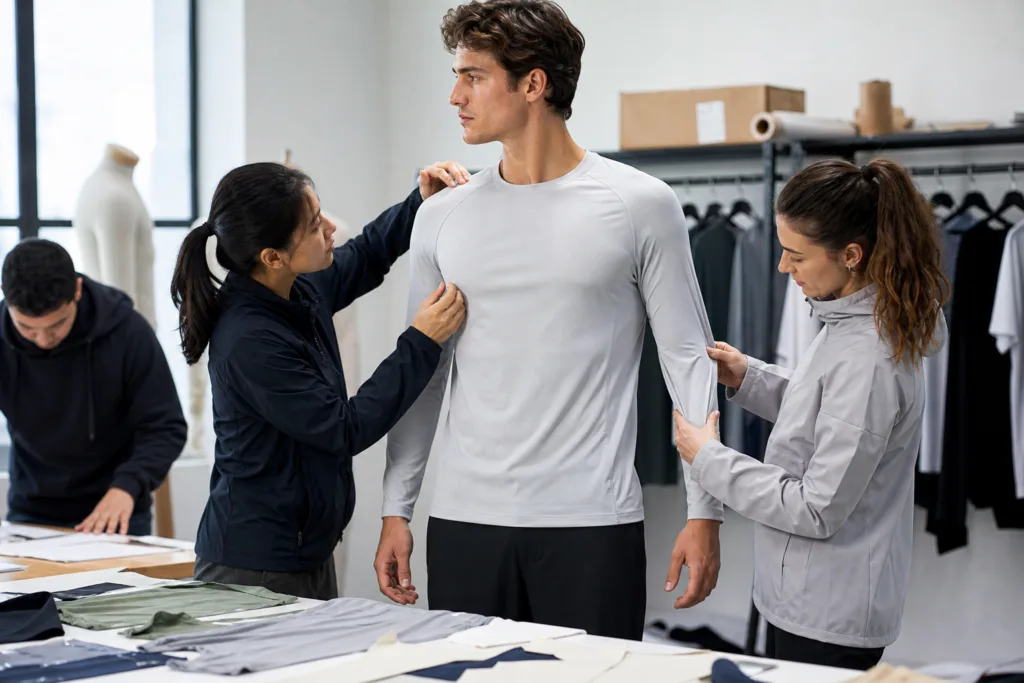
Sampling is the stage where the buyer and manufacturer discover whether the design works as a physical garment. A sketch can look correct while the neckline, pocket, sleeve balance, fabric weight, or decoration placement feels wrong in production.
The apparel sampling and fit development process should be treated as a sequence of decisions rather than a single sample shipment. Each revision should identify the issue, the requested change, the responsible party, and the version that replaces the previous approval.
| Sample stage | Purpose | Buyer approval focus |
|---|---|---|
| Proto sample | Check whether the basic design and construction can be made | Overall concept, proportions, operations, and material direction |
| Fit sample | Refine pattern, measurements, and comfort | Fit, mobility, balance, length, openings, and size chart |
| Size set | Check grading across the required size range | Consistency between sizes and tolerance compliance |
| Print or decoration sample | Confirm artwork, method, scale, color, and hand feel | Placement, clarity, adhesion, stretch, and durability |
| Pre-production sample | Represent the approved bulk materials and methods | Fabric, color, trims, labels, packaging, construction, and final appearance |
Do not approve bulk production from a sample made with substitute fabric unless the differences are understood and recorded. A substitute fabric can change shrinkage, drape, color, sewing behavior, and print performance. Keep the approved sample, measurement chart, artwork, and comments together so the factory team and buyer are working from the same reference.
When Low MOQ Is Realistic
MOQ is influenced by more than the number of finished garments. Fabric availability, dyeing quantity, number of colors, custom trims, packaging components, artwork setup, and production efficiency all affect the minimum practical order.
| MOQ driver | Why it affects quantity | Possible planning response |
|---|---|---|
| Custom fabric color | Dyeing and lab approval may require a material minimum | Reduce colorways, use stock colors, or consolidate demand |
| Special fabric or finish | Technical or reserved materials may not be stocked | Confirm availability before finalizing the product brief |
| Custom labels and trims | Suppliers may require minimum quantities for woven labels, buttons, zippers, or packaging | Use standard components or plan trim usage across several styles |
| Many size and color combinations | Small quantities per combination increase cutting and production inefficiency | Prioritize core colors and forecast the size curve carefully |
| Complex construction | More operations require setup time and make very small runs less efficient | Simplify nonessential details or consolidate styles |
A low MOQ is most realistic when the design uses available fabric, standard trims, a manageable number of colorways, and a construction method that the factory already handles efficiently. It is less realistic when a small order also requires custom dyeing, many sizes, multiple decorations, special packaging, and a unique fabric.
Ask whether MOQ applies per style, color, fabric color, or total order. Also ask whether a repeat order can use the same fabric and trims without restarting every minimum. Clear answers prevent a low initial quantity from becoming unexpectedly expensive.
Build a Complete Cost Plan Instead of Comparing Unit Price Alone
The quoted garment price is only one part of the landed cost. A useful comparison separates development, materials, manufacturing, decoration, packaging, logistics, and potential compliance or testing expenses.
- Main fabric, contrast fabric, lining, rib, insulation, and specialty finishes
- Cutting, sewing, pressing, thread, labels, buttons, zippers, cords, and other trims
- Embroidery, printing, heat transfer, sublimation, washing, and finishing
- Pattern, sample, lab dip, testing, digitizing, screen, or setup charges
- Individual packaging, cartons, barcodes, hangtags, and shipping marks
- Freight, insurance, duties, inspection, and destination handling where applicable
- Rework, replacement, or delay risk if specifications and approvals are incomplete
Ask the manufacturer to identify assumptions behind the quote. The price may change if the final GSM, color quantity, artwork size, packaging method, or order split changes. Volume pricing should be reviewed together with quality, lead time, and the cost of holding excess inventory; the lowest unit price is not always the lowest commercial risk.
Plan Lead Time from Approval to Delivery
Production lead time begins after the necessary approvals and materials are available, not when the first inquiry is sent. A realistic plan separates development time from bulk production time and includes room for buyer decisions, material approvals, and inspection.
| Stage | Typical activities | Buyer action needed |
|---|---|---|
| Product review | Specification review, quotation, feasibility check, and material discussion | Confirm brief, target quantity, delivery market, and priorities |
| Development | Pattern, fabric sourcing, artwork preparation, trims, and first sample | Return consolidated comments and approve revisions promptly |
| Pre-production | Lab dips, size set, decoration approval, final tech pack, and PPS | Approve the exact standard for bulk production |
| Bulk production | Material inspection, cutting, sewing, decoration, finishing, and packing | Remain available for questions and agree inspection timing |
| Delivery | Final inspection, carton confirmation, freight, and destination handling | Verify shipping documents, labels, and receiving requirements |
Delays often come from decisions that were left open: an unapproved color, incomplete artwork, unclear size grading, unavailable labels, or a change to packaging after cutting. Build a decision calendar with dates for sample comments, material approvals, purchase order confirmation, final inspection, and shipment readiness.
When the launch date is fixed, tell the manufacturer early. The team can then assess whether to simplify construction, use available fabric, reduce colorways, approve standard trims, or split the collection into phases.
Use Quality Control Checkpoints Before and During Bulk Production
Quality control works best as a series of checkpoints rather than a final inspection only. A final check can identify defects, but it may not recover the cost of fabric already cut or decoration already applied.
- Fabric inspection: Check shade, GSM, width, stretch, defects, hand feel, shrinkage, and roll consistency against the approved standard.
- Pre-production review: Compare the PPS with the tech pack, approved sample, artwork, labels, trims, and packaging instructions.
- Cutting control: Confirm marker accuracy, panel direction, size separation, and fabric spreading consistency.
- Inline sewing checks: Review seam strength, skipped stitches, puckering, measurement points, component matching, and workmanship.
- Decoration testing: Check placement, color, adhesion, stretch, embroidery density, print registration, and wash performance when relevant.
- Final inspection: Check measurements, appearance, stains, loose threads, labels, folding, quantity, cartons, and shipping marks.
Acceptance criteria should be agreed before production. Define measurement tolerances, acceptable minor defects, critical defects, decoration placement tolerance, and the sample size or inspection method. If the garments are for children or a regulated destination market, confirm the applicable product safety and labeling responsibilities before materials are approved. The U.S. apparel flammability requirements are one example of why fabric selection, testing, documentation, and importer responsibilities may need review before production.
Our performance apparel quality control approach treats fabric, fit, construction, decoration, and packing as connected checks. A garment can pass a sewing review but still fail commercially if the logo is misplaced, the size chart is inconsistent, or the final packaging does not match the retail requirement.
How to Evaluate a Custom Clothing Manufacturer
Supplier evaluation should focus on production fit rather than photographs or a low opening price. Ask whether the manufacturer has the equipment, material access, technical communication, and quality process needed for your specific garment category.
- Can the manufacturer explain fabric composition, GSM, stretch, shrinkage, and finishing trade-offs?
- Can the team review or build patterns and provide clear measurement comments?
- Will the supplier identify which details affect MOQ, cost, lead time, or repeatability?
- Can the manufacturer support your decoration method and test it on the selected fabric?
- How are samples versioned, approved, and transferred into bulk production instructions?
- What are the in-process and final quality checkpoints?
- How are defects, changes, shortages, and delays communicated?
- Can the supplier manage labels, packaging, carton marks, and other private label requirements?
- What information is required before a quotation can be considered reliable?
As a manufacturer, Ninghow views supplier fit as a combination of product understanding, communication, sampling discipline, and production control. Buyers should look for a partner that can explain limitations early, not one that agrees to every request without discussing the consequences.
Common Ordering Mistakes That Create Delays or Inconsistent Garments
Many production problems are created before the purchase order is issued. They usually come from incomplete specifications, late changes, or assumptions that were never recorded in writing.
- Requesting a quote without stating fabric composition, GSM, color quantity, size range, or decoration requirements
- Approving a sample without checking it on the intended body type or reviewing a complete size set
- Changing fabric, artwork, labels, or packaging after the pre-production sample has been approved
- Using a reference garment without explaining which measurements and construction details must be retained
- Comparing suppliers on unit price while ignoring sample charges, setup costs, freight, inspection, and rework risk
- Assuming low MOQ applies equally to custom fabric, custom trims, every color, and every size
- Sending separate or conflicting comments from several stakeholders instead of one consolidated approval
- Failing to keep the final tech pack, sample, artwork, and measurement chart under version control
One practical improvement is to create a change-control rule. After PPS approval, every requested change should identify its effect on cost, lead time, sample approval, and bulk quality. This helps the buyer make a deliberate decision instead of treating a late change as free or riskless.
Bulk Production Readiness Checklist
Before authorizing bulk production, the buyer and manufacturer should be able to answer yes to the following points:
- The garment category, use case, fit intention, and target customer are documented.
- The final fabric composition, GSM target, color, finish, and testing expectations are approved.
- The measurement chart, grading, tolerances, and construction details are complete.
- The artwork, decoration method, placement, color, and durability expectations are approved.
- Labels, hangtags, packaging, barcodes, folding, polybags, and cartons are confirmed.
- The quantity is clear by style, color, and size, with any MOQ assumptions recorded.
- The pre-production sample represents the intended bulk fabric, trims, decoration, and workmanship.
- Quality checkpoints and acceptance criteria are agreed before cutting.
- Delivery dates, inspection timing, shipping documents, and communication contacts are confirmed.
If several answers are no, the project is not necessarily impossible, but bulk production is premature. Resolve the open decisions or deliberately accept the associated risk before materials are committed.
Key Questions to Ask Before Selecting a Production Partner
Use supplier discussions to test how clearly the manufacturer thinks, not just how quickly the team responds. A useful conversation should cover the product, materials, development, production, and after-production stages.
- Which parts of this design are most likely to affect fit, cost, MOQ, or lead time?
- What fabric alternatives could achieve a similar hand feel or performance at a different cost?
- Which sample stages do you recommend for this product and order size?
- How will the approved sample and tech pack be controlled during bulk production?
- What tolerances and inspection checkpoints should be included in the purchase order?
- Which trims or packaging components require advance ordering?
- What information would allow you to provide a more accurate quotation?
- What happens if the fabric shade, measurement, or decoration does not meet the approved standard?
The quality of these answers is often more revealing than a general capability statement. A production partner should be able to explain trade-offs in plain language and show how decisions will be checked at each stage.
How to Move from Apparel Concept to Reliable Production
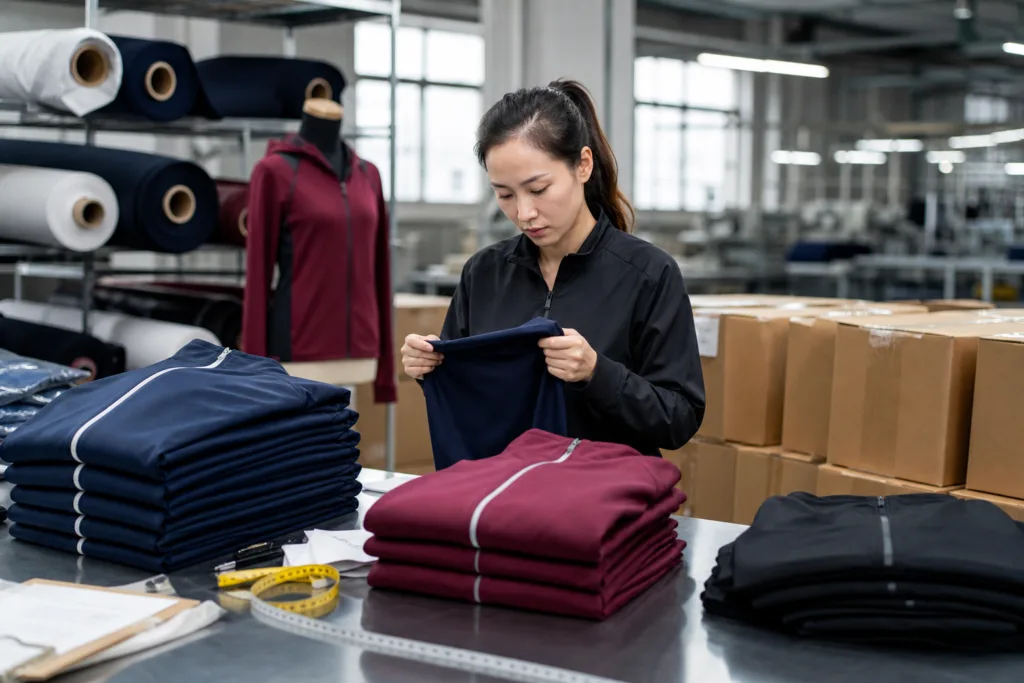
A reliable custom clothing manufacturing project follows a practical sequence: define the use case, choose the garment and fabric, build a clear tech pack, develop and approve samples, confirm MOQ and cost assumptions, and establish quality checkpoints before bulk cutting. This sequence protects both product quality and commercial planning.
For brands and sourcing teams, the goal is not maximum complexity. The goal is a garment that meets its intended use, fits consistently, carries the required branding, can be produced within the available quantity and budget, and can be repeated with controlled variation. When buyers provide clear information and manufacturers raise risks early, sampling becomes more productive and bulk production becomes easier to manage.
Choose a production partner based on technical understanding, communication, sampling discipline, and quality control rather than price alone. A well-defined product brief and a documented approval standard give every later decision a stronger foundation.
Frequently Asked Questions
How does custom clothing manufacturing differ from private label apparel?
Custom clothing manufacturing can include new patterns, fabrics, construction, decoration, and packaging, while private label apparel often starts with an existing base garment and adds the buyer’s branding. The best choice depends on how much control the buyer needs over fit, materials, product identity, quantity, and development time.
What should a buyer include in a tech pack?
A buyer should include sketches, measurements, grading, tolerances, fabric and trim details, construction notes, artwork placement, labels, packaging, and revision history. The tech pack should explain how the garment is expected to look, fit, function, and be inspected so the manufacturer can identify risks before sampling.
What MOQ should a new apparel brand expect?
There is no single MOQ because the practical minimum depends on fabric availability, dyeing, colorways, trims, packaging, garment complexity, and production efficiency. A smaller order is more realistic when the buyer uses available materials and standard components, while custom fabrics and many variations usually require higher quantities.
How many samples are needed before bulk production?
Most projects need at least a development or proto sample, a fit sample, and a pre-production sample, while products with several sizes or complex decoration may also need a size set and decoration test. The correct number depends on garment complexity, but bulk should not begin until the fabric, fit, construction, branding, and packaging standard are approved.
How can a buyer control quality during bulk production?
A buyer can control quality by approving a clear PPS, setting measurement and defect tolerances, inspecting fabric before cutting, checking sewing and decoration during production, and completing a final inspection before shipment. Quality expectations should be documented in the tech pack or purchase order rather than discussed only informally.
What causes apparel production delays?
Common causes include incomplete specifications, late artwork or label approval, unavailable fabric, custom dyeing, unclear size grading, late packaging changes, and slow consolidated feedback. A decision calendar, version-controlled tech pack, early material confirmation, and realistic approval deadlines reduce the likelihood of these delays.