


Understanding MOQ in Gym Clothing Manufacturing
Minimum Order Quantity, or MOQ, is a central concept for brands sourcing gym clothing. Knowing why MOQs vary by product type helps buyers plan realistic launches and scale efficiently. At Ninghow, we guide clients through the drivers behind order sizes for everything from leggings to hoodies—because MOQ isn’t set on a whim. It’s shaped by practical realities in textile and trim sourcing, equipment setup, sizing range, and production workflow.
For readers seriously comparing gym clothing manufacturing options, a useful next step is to explore gym clothing manufacturers. That resource provides a focused view of category-specific production capabilities, customization scope, and how factories define MOQs for gym clothing—a helpful reference before making final sourcing decisions.
What Is MOQ and Why Does It Matter?
MOQ stands for Minimum Order Quantity—the smallest number of units a manufacturer will accept for production. MOQs protect factories from losses and ensure efficient use of resources. For buyers, understanding MOQ is critical to budgeting, brand launches, and inventory management.
Key Factors That Drive MOQ
- Raw materials: fabrics, trims, and accessories ordered in bulk
- Customization: logo methods, dyes, specialty processes
- Sizing: each size is a separate production run
- Style complexity: more panels, pockets, and colors increase setup costs
- Packing and packaging: custom polybags or boxes add minimums
Fabric Dyeing: Not All Yards Are Equal
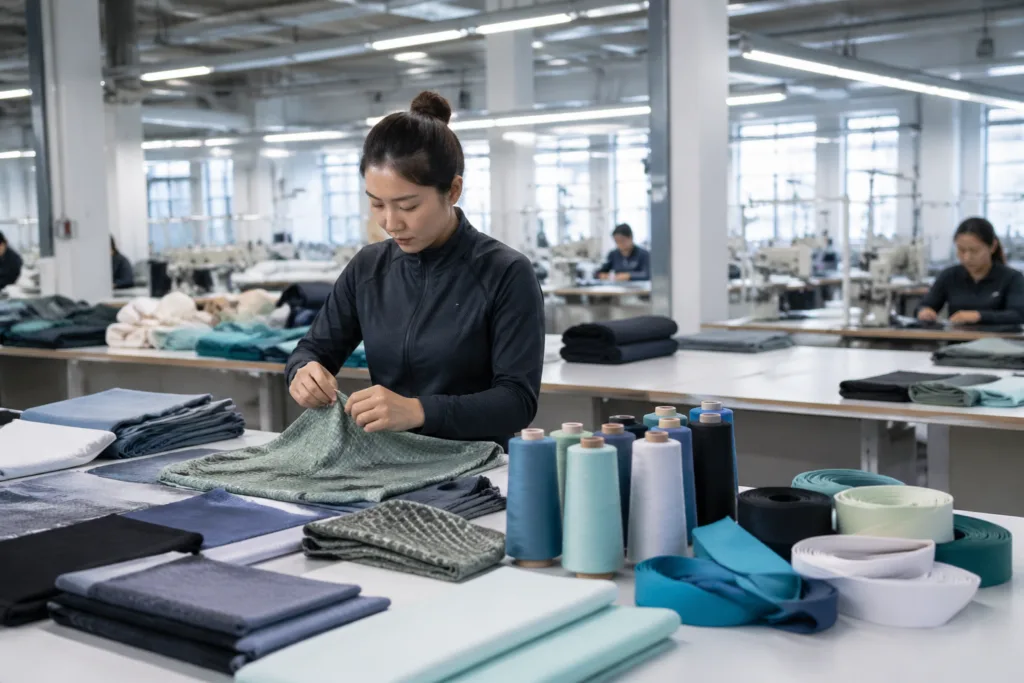
Many gym clothing pieces use performance fabrics—like nylon spandex blends or recycled polyester. Mills have minimums for dyeing these textiles, often tied to the dye machine’s capacity. For instance, a mill may require at least 600 meters of one color to run a dye lot. If your custom gym shorts use a unique blue, you must order enough units to consume that fabric length.
Solid Dyed vs. Yarn Dyed
- Solid dyed: Lower MOQ for basic colors, higher for custom Pantones
- Yarn dyed: Used for stripes or jacquards (like branded elastic bands), MOQs are significantly higher due to intricate setups
Trims and Accessories: Small Parts, Big Impact
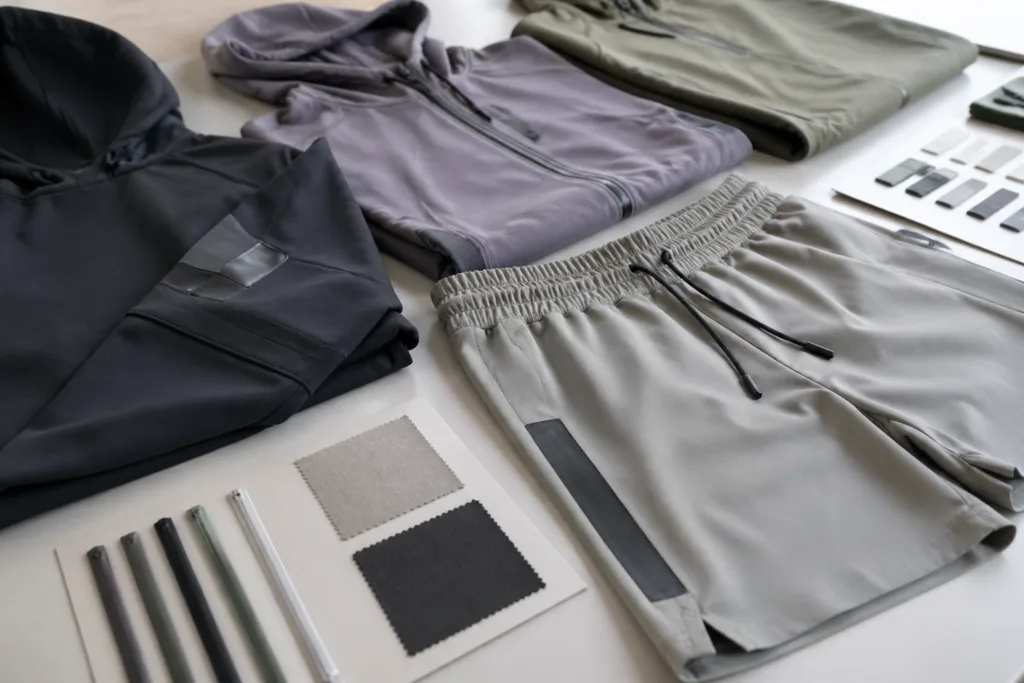
Elastic waistbands, reflective tapes, metal eyelets, and custom zippers may each have separate MOQ from their suppliers. Sourcing branded drawcords for hoodies? The trim supplier could request 1,000 units minimum—regardless of your garment order.
Logo Applications
- Screen printing: Lower MOQ but setup fees per design and color
- Embroidery: Higher setup cost, best for bulk runs
- Silicone patches: Custom molds mean high MOQs (500+ typical)
Real-World Example
Your new performance tee uses reflective vinyl logos (higher MOQ) and recycled polyester fabric (mid-level MOQ), while your designer hoodies require chenille patches (often >500 pcs MOQ from patch supplier) and heavy French terry (high fabric MOQ).
Sizing Range: Why XS-3XL Isn’t “Free”
Every additional size requires its own pattern, markers, and cut bundles. Once you split a small MOQ across five sizes, each size batch may not meet the fabric or trim minimum—potentially pushing up the overall MOQ or per-unit cost. In gym wear, where fit accuracy is key, brands must balance offering an inclusive range with production realities.
Size Set Examples
- Leggings: Typically sold XS-XL, six sizes mean smaller runs per size
- Oversized hoodies: Fewer sizes (S, M, L, XL), so MOQ is easier to meet across sizes
Style Complexity: Panels, Pockets, and More
Simple t-shirts require fewer operations and standard trims—factories are more inclined to accept lower MOQs. Technical gym shorts with mesh linings, side zips, and multiple pockets need extra setup, QC checks, and specialized labor. That complexity raises the baseline MOQ, as the overhead is only worth it for larger runs.
Packaging Requirements and Their Role in MOQ
Some buyers specify branded polybags, hang tags, or gift boxes. Packaging vendors have their own MOQs, often in the 1000+ range—even if the garment order is small. This can force buyers to adapt packaging needs or accept costlier unit prices for smaller orders.
How Different Gym Apparel Categories Compare
Let’s break down typical MOQ ranges and drivers by product:
| Product Type | Main MOQ Drivers | Typical MOQ Range |
|---|---|---|
| Performance Leggings | Custom dye fabric, multiple sizes, specialty elasticity | 200-500 pairs |
| Private Label Hoodies | Heavy fabric, custom dye, branded trims, bulk patch/logos | 300-600 units |
| Technical Gym Shorts | Mesh lining, color trims, logo process setup | 200-400 units |
| Compression Tees | Sizing range, lightweight fabric, basic trims | 150-300 pieces |
Why “Low MOQ” Differs by Category
A “low MOQ clothing manufacturer” may advertise 50-100 pieces per design. In reality, true minimums depend on fabric and trim supply chains, not just cutting and sewing. Stock fabric and generic trims allow the lowest MOQs, but custom options require hitting higher supplier benchmarks throughout the process. Understand low MOQ options to balance brand goals and production logic.
Custom vs Private Label MOQ Logic
Private label lines often use the manufacturer’s existing fabrics and trims, allowing lower MOQs. Full custom gymwear (e.g., sponsor club kits or influencer collabs) means custom-dyed fabrics, labels, and finishes—each with their own higher threshold.
How Logo Process Impacts MOQ
Choosing between transfer printing, embroidery, or rubber badges affects not just unit price but total MOQ. Methods requiring custom tools or molds (like rubber or silicone badges) push MOQs higher, while screen print or heat transfer allow more flexibility for small runs—provided colors and positions are limited. Learn about private label gym clothing MOQs for different logo applications and product strategies.
MOQ and Lead Time: Two Sides of the Coin
Bigger MOQs may mean better unit cost but can extend lead times if fabric or trims are made-to-order. For gym apparel, balancing MOQ and delivery is a strategic decision based on launch date, inventory risk, and capital flow.
Negotiating MOQ with a Manufacturer
Open discussions on substitutions, shared fabrics across styles, or revising packaging can help brands reach reasonable MOQs. Factories respond best when buyers prioritize a few colorways or standard trims, rather than maximum customization across every style in a small order.
MOQ Myths: What Buyers Should Watch Out For
- Myth: Any “factory” can deliver 50 units of any custom design
- Fact: True custom items with source-level requirements (fabric, trims) need higher order volume to be economically feasible
MOQ Is a Supplier Ecosystem Issue
Apparel factories depend on external partners—textile mills, trim suppliers, print shops—each with their distinct minimums. Changing a small detail, like a woven hem label, can shift the entire MOQ equation. Experienced manufacturers address this in sampling discussions, so there are no surprises when mass production is planned.
Case Study: Comparing Leggings and Hoodies
Consider two categories:
- Leggings use technical blends, often with several prints or dye colors per size set, and require performance QC (stretch, hold, opacity). The baseline MOQ thus rises to meet fabric supplier batch minimums.
- Hoodies use heavier, more generic fabric (like cotton/poly fleece). If stock colors are permitted, MOQ can be lower; custom color increases the threshold. Branded trims (cords, patches) add separate MOQs.
MOQ and Sizing Logic: Brand Perspective vs. Factory Constraint
- Brands prefer wide sizing for inclusivity.
- Factories must manage overproduction risk if small sizes (e.g., XXS/XXL) have unpredictable sales. That’s why mixing multiple colors and sizes in a low-volume order is challenging for the supply chain—yet planning groupings at the start makes a big difference.
Reducing MOQ: Practical Strategies
- Use stock fabrics/colors offered by the manufacturer
- Limit number of sizes and colorways for the first order
- Share labels/trims across styles
- Standardize logos/print positions
- Negotiate partial use of branded packaging or phase it in later
MOQ and Cost Per Unit: The Trade-Off
Lower quantities usually mean a higher per-unit cost, because fixed charges (fabric dye, pattern making, logo setup) are spread over fewer pieces. For start-up brands, it’s critical to balance exclusivity with budget and inventory safety.
MOQ and Sampling: Test Runs vs. Production Reality
Sample runs (1-3 units per size) allow you to verify fit and make changes before bulk is committed. However, MOQs only apply to production, not samples. When launching new gym clothing, use samples to perfect patterns and then plan your first bulk run within realistic supplier MOQ thresholds.
Product Launch Tips: Managing MOQ Risks
- Order run matching market test level—avoid overcommitting up front
- Stagger style launches if budgets are tight
- Communicate openly about changes in sizing or trims for future reorders
- Ninghow tip: Early in development, share total line goals so we can bundle fabric orders when possible, helping you get closer to supplier minimums
MOQ in Sustainable and Tech Fabrics
Eco-friendly or technical gym apparel almost always has higher MOQs. Mills producing recycled yarns, for example, require larger dye runs for QC consistency. If organic cotton or specialty moisture-wick fabrics are chosen, buyers must prepare for increased order minimums to cover mill production planning.
MOQ and Supplier Type: Manufacturer vs Trading Company
Direct manufacturers can sometimes group several buyers’ orders for one fabric or trim batch, helping reach minimums. Trading companies often quote lower MOQs but may be reselling from stock inventory—limiting customization versus a factory with fabric sourcing capability.
Communication, Forecasting, and MOQ Success
The best MOQ results stem from open communication between brand and manufacturer. Share launch calendars, color forecasts, and reorder expectations; factories like Ninghow can often help coordinate shared manufacturing runs. This supports both smaller first orders and agile growth over time.
Gym Clothing MOQ Explained: Why Order Quantity Changes by Product Type
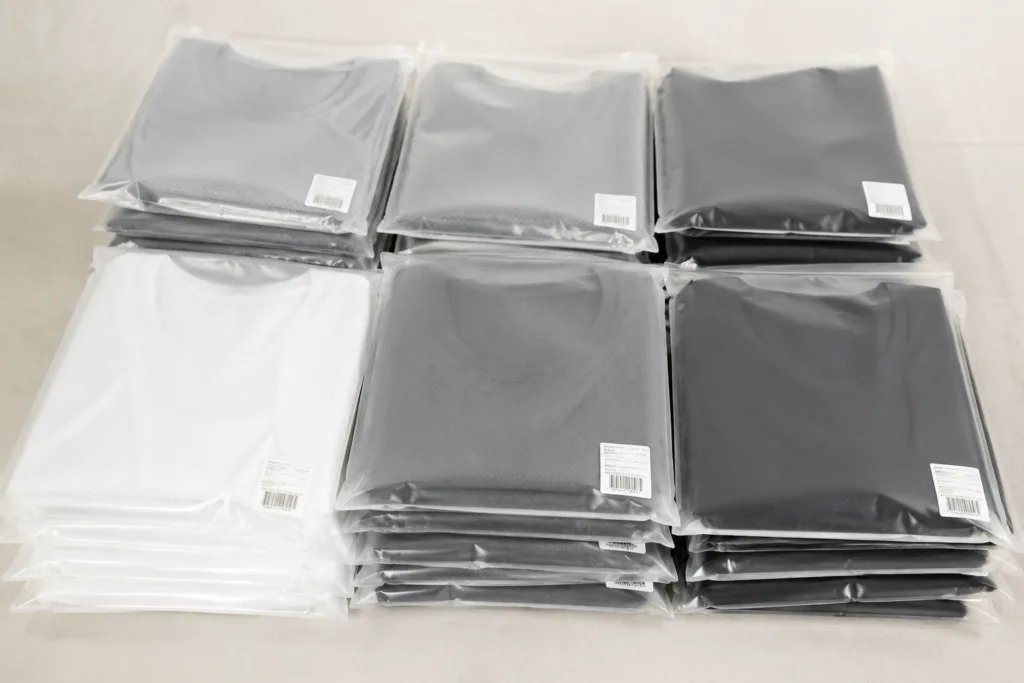
Order quantity is never random—it’s a careful balance of raw material supply, factory process realities, and brand ambitions. Whether you’re sourcing private label gym clothes, custom gym shorts, hoodies, or activewear, understanding these MOQ drivers helps you build a sustainable, well-managed supply chain partnership. Planning ahead, asking informed questions, and staying flexible on fabric/trims/color will put your production on the right track every time.
Frequently Asked Questions
What does MOQ mean in gym clothing manufacturing?
MOQ stands for Minimum Order Quantity, which is the smallest number of pieces a factory will make per style or color. It balances factory setup costs and resource use.
Why is the MOQ higher for custom colors and trims?
Custom colors and unique trims require suppliers to run special batches. Their setup costs and minimums get passed on, raising the overall MOQ for the finished garment.
Can I mix sizes and colors within one MOQ?
Factories allow mixing sizes, but every new color or size splits the minimum further. The more variations, the more total pieces needed to satisfy all supply chain minimums.
How can a start-up brand reduce initial MOQ risks?
Choose stock fabrics and trims, keep the style and color count low, and focus on core sizes for the first production run. This streamlines sourcing and lowers upfront costs.
Do custom gym hoodies and leggings have the same MOQ?
No, different products have different MOQ logic due to fabric, trim, and process complexity. Hoodies may have lower MOQs if using stock knits, but prints and custom features push up the minimum.
How does working with a direct manufacturer like Ninghow affect MOQ?
Manufacturers with sourcing experience can sometimes group orders, suggest shared trims, and advise on practical ways to meet minimums—delivering better value and fit for custom activewear brands.