




Custom polo shirt manufacturing is most successful when buyers define the end use before selecting fabric, fit, decoration, and price targets. A polo for corporate uniforms needs a different balance of durability and logo visibility than a golf polo, retail private-label style, or team garment. Clear specifications early help protect sample timing, size consistency, and bulk production quality.
If your project involves uniforms, promotional programs, golf events, or branded workwear, explore custom polo shirt manufacturing options for professional programs. We can help buyers translate an intended use into fabric selection, collar and placket details, logo application, private-label components, sampling priorities, and a practical bulk production plan.
How to Plan Custom Polo Shirt Manufacturing Before Requesting Quotes
The first decision is not the logo; it is the product brief. A manufacturer can quote more accurately when the buyer states who will wear the polo, where it will be worn, how often it will be washed, and what visual standard the garment must meet. “Premium polo” alone is not enough to establish a usable fabric, construction, or finishing specification.
Start with a short brief that separates essential requirements from preferences. This makes cost-performance discussions more productive and reduces revisions after sampling starts.
- Use scenario: office uniform, hospitality, golf, teamwear, retail, school, or event merchandise.
- Target wearer: gender mix, size range, fit preference, and climate.
- Fabric direction: cotton pique, polyester performance knit, cotton-poly blend, or another approved option.
- Branding: logo size, placement, decoration method, and color count.
- Private-label needs: neck label, size label, care content, hangtag, polybag, and carton marking.
- Order plan: estimated quantity by color and size, delivery window, and target cost range.
Key takeaway: The more clearly a polo’s job is defined, the easier it is to choose specifications that perform well without paying for features the program does not need.
Choose Fabric by Wear Conditions, Not by Weight Alone
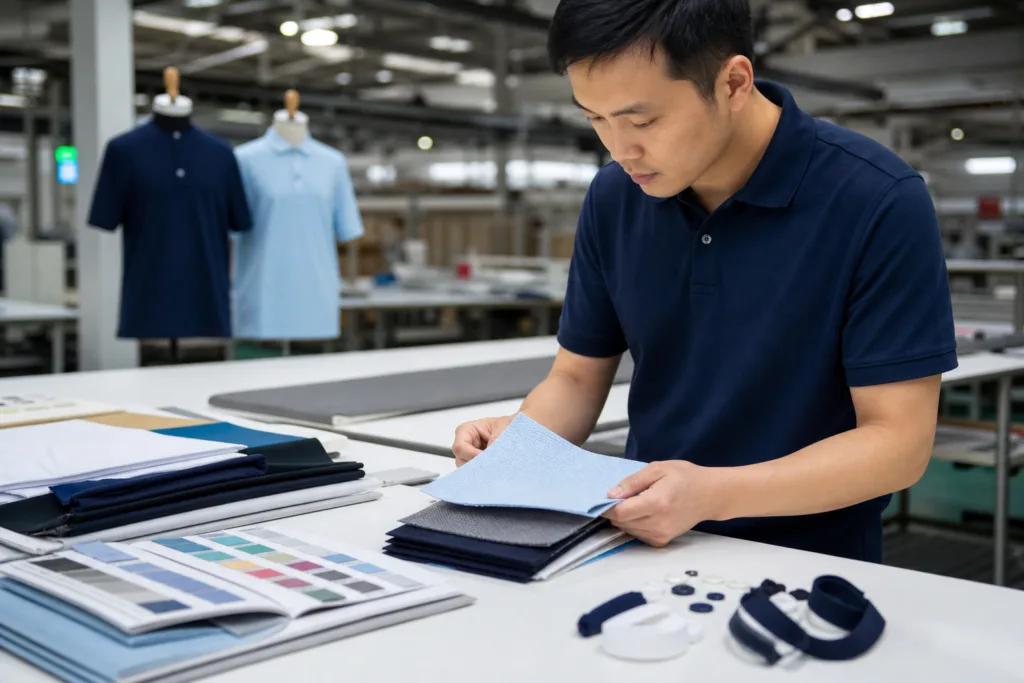
Fabric determines much of a polo’s hand feel, breathability, dimensional stability, color performance, and decoration suitability. GSM is useful, but it does not tell the full story. Two fabrics with similar weight can feel very different because yarn count, knit construction, fiber blend, finishing, and dyeing all influence the final garment.
Cotton pique offers a familiar textured surface and a natural hand feel. It can suit corporate and lifestyle programs, but buyers should align shrinkage expectations and care requirements with the intended use. Polyester performance knits are often selected for moisture handling, color durability, and easier care. Blends can provide a useful middle ground when a softer hand feel and more stable repeat washing performance are both important.
| Fabric direction | Typical strengths | Planning considerations |
|---|---|---|
| Cotton pique | Natural touch, classic texture, traditional polo appearance | Confirm shrinkage allowance, color standard, and post-wash hand feel |
| Polyester performance knit | Lightweight feel, fast drying, strong color retention | Check snag resistance, sheen level, and decoration compatibility |
| Cotton-poly pique | Balanced comfort, durability, and easier care | Specify blend ratio and test approved fabric after washing |
| Stretch performance knit | Mobility and a closer athletic fit | Control recovery, neckline stability, and size tolerance carefully |
In our production work, fabric approval should include more than a cut swatch. Review the surface texture, opacity, stretch, recovery, pilling tendency where relevant, and wash result. If the garment will be worn outdoors or in active settings, test the sample in conditions close to actual use rather than judging only under showroom lighting.
Set GSM, Hand Feel, and Construction as One Specification
For many polos, a midweight pique creates a dependable uniform look, while lighter performance knits may feel more comfortable for golf, events, and warm environments. However, a heavier GSM does not automatically mean higher quality. An overly heavy fabric can feel stiff, retain heat, and increase freight weight; a fabric that is too light may reveal the body, curl at edges, or lack the structure expected for a corporate program.
Construction details deserve equal attention. Collar shape and rib quality affect how the polo looks after repeat wear. Placket length, button type, side vents, sleeve rib, shoulder seam reinforcement, and hem treatment should all be documented in the tech pack or approved sample comments.
- Specify whether the collar should be self-fabric, flat knit rib, contrast tipped rib, or a structured alternative.
- Confirm the number of placket buttons and whether spare buttons are required.
- Choose side vents when movement and a traditional polo silhouette matter.
- Request reinforcement at stress areas for demanding uniform use.
- Approve the hand feel after wash testing, not only before washing.
Build Fit and Size Consistency Into the Pattern Stage
A reliable fit begins with a base size and a clear grading plan. Buyers should not assume that a generic size chart will match their customer or staff population. A slim retail fit, relaxed corporate fit, and athletic golf fit can have different chest ease, sleeve shape, body length, and shoulder proportions even when the label size is the same.
Provide a reference garment only as a starting point, then state what should change. For example, the reference may have the right collar but need more body length, a less fitted waist, or a wider sleeve opening. The manufacturer should convert those instructions into measurable points of measure rather than rely on subjective descriptions.
At Ninghow, we recommend approving a size specification before bulk cutting and confirming tolerances for key measurements. This is particularly important when sizes are distributed across multiple teams, branches, or retail channels, because an inconsistent grade rule can create fit complaints even if the base sample looks correct.
| Fit checkpoint | Why it matters | Buyer action |
|---|---|---|
| Chest and body width | Controls ease and perceived fit | Approve measurements on a worn sample |
| Body length | Affects uniform appearance and tuck-in use | Assess both standing and seated wear |
| Shoulder and sleeve | Influences movement and silhouette | Check reach and arm rotation |
| Grade rules | Protects consistency across the size range | Review size chart before bulk approval |
Match Logo Decoration to the Polo Fabric and Program
Decoration should be selected for the logo, garment use, and expected order quantity. Embroidery gives a dimensional, durable identity and is commonly used for chest logos, but dense stitches can pull lightweight fabric or make a large design feel heavy. Printing may be a better choice for detailed artwork, large areas, or a softer performance-polo result.
For office, hospitality, and distributor programs, custom corporate polo shirt designs often benefit from disciplined logo sizing and a decoration method that remains neat after laundering. Approve the actual logo test on the selected fabric, because the same artwork can behave differently on pique, interlock, or fine performance knit.
- Use embroidery for compact logos, textured brand marks, and a traditional uniform look.
- Use screen printing where broad solid artwork and efficient repeat production are appropriate.
- Use heat transfer for fine detail, multiple colors, names, or smaller variable runs.
- Use sublimation only with suitable polyester-based fabric and artwork requirements.
Thread color, backing, print adhesion, and placement measurements should be signed off during sampling. For a polished chest mark, buyers may consider embroidered polo shirts for refined logo placement, while still checking that the stitch density suits the fabric weight.
What Sampling Should Prove Before Bulk Production
A sample is a decision tool, not merely a visual preview. It should prove that the fabric, pattern, colors, decoration, construction, labels, and packaging direction can be repeated at bulk scale. If several requirements are still undecided, a development sample may be more useful than attempting to treat the first sample as final approval.
Buyers should consolidate comments into one clear feedback document. Conflicting feedback from different stakeholders is a frequent cause of delay. Mark whether each comment is mandatory for bulk production, preferred if feasible, or simply a question for the manufacturer.
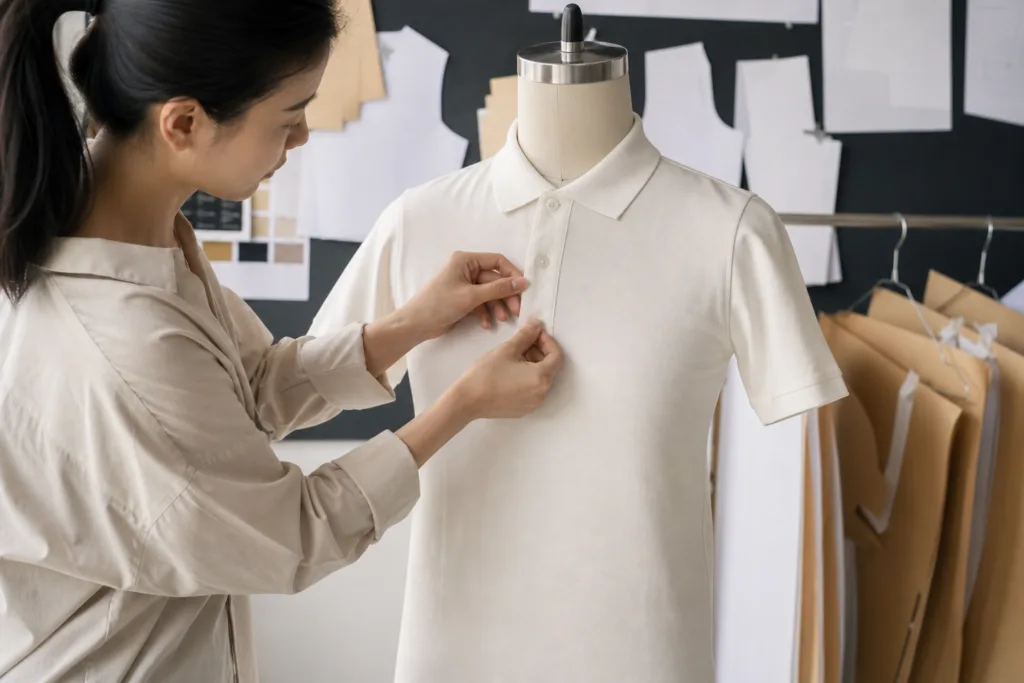
- Compare fabric color and logo color against approved standards in appropriate lighting.
- Measure the sample at key points and check it after an agreed wash process.
- Wear-test movement, collar behavior, button security, and comfort.
- Check all artwork, label wording, size marks, hangtags, and packaging details.
- Record final approval in writing with the approved sample version.
For group programs, coordinated team polo shirt options require extra attention to size breakdown, color consistency, and placement standards so separately packed garments still look unified when worn together.
Understand MOQ and Lead Time as Production Variables
MOQ is shaped by fabric availability, dyeing requirements, trim sourcing, decoration setup, color count, and production efficiency. A lower quantity can be realistic when a suitable stock fabric and standard trims are available. A custom-dyed fabric, special collar stripe, unique buttons, or multiple small colorways may require a different minimum or a higher unit cost.
Lead time should be planned from approved specifications, not from the day an initial inquiry is sent. Sampling, comment revisions, fabric booking, color confirmation, decoration preparation, bulk cutting, sewing, inspection, packing, and shipping each need a place in the critical path. Late artwork or unconfirmed labels can delay an otherwise ready order.
| Production choice | Effect on MOQ or timing | How to reduce risk |
|---|---|---|
| Available fabric color | Often supports smaller, faster programs | Confirm stock before promising delivery |
| Custom fabric dyeing | Adds color approval and fabric planning steps | Lock color standard early |
| Special trims | May require separate supplier minimums | Approve trim details before bulk booking |
| Multiple logo locations | Adds setup and inspection requirements | Provide accurate placement artwork |
Key takeaway: Low MOQ is a planning question, not just a negotiation question. Simplifying colors, trims, and decoration can make a smaller program more feasible without compromising the intended use.
Use QC Checkpoints That Protect Repeatable Polo Quality
Quality control should start before final inspection. Fabric should be checked before cutting, approved measurements should guide in-line sewing checks, and decoration placement should be monitored during production. Final checks then confirm that the finished shipment matches the approved standard rather than trying to correct preventable issues at the end.
For polos, key inspection points commonly include shade consistency, collar symmetry, placket alignment, button attachment, seam appearance, logo position, measurement tolerance, loose thread removal, label accuracy, and packing count. Where multiple colors are produced, compare them against the approved standard rather than against each other.
Common mistakes that create avoidable bulk-order problems
- Approving a sample without confirming post-wash measurement behavior.
- Using a logo file that is not production-ready or lacks color guidance.
- Changing fabric after decoration approval without repeating the logo test.
- Providing only a generic size chart when a specific fit is required.
- Leaving label, barcode, carton, or assortment instructions until the end.
- Adding several custom details to a small order without reviewing MOQ impact.
From a manufacturer perspective, clear written approvals and one current specification file are among the most effective ways to reduce rework. They allow the sample room, sourcing team, production line, and inspection team to work to the same standard.
Prepare a Better Polo Manufacturing Inquiry
A complete inquiry helps buyers receive a quotation that is useful for comparison. Ask suppliers to clarify what is included, which assumptions have been made, and which details could change the final cost or schedule. Price alone does not show whether the proposed polo uses the right fabric, construction, decoration standard, or packaging for the program.
- Attach artwork in an editable or high-resolution format and identify placement.
- State target fabric composition, knit type, GSM range, and preferred colors if known.
- Include a measurement chart, reference images, and desired fit description.
- List quantity by color and size, including any expected repeat order pattern.
- Specify labels, hangtags, folding, polybags, cartons, and shipping destination.
- Ask about sample timing, bulk timing after approval, and quality-control process.
A well-prepared buyer also compares suppliers on their ability to explain trade-offs. A dependable manufacturing discussion should identify where fabric, collar construction, decoration method, or packaging choices may affect cost, durability, MOQ, or lead time.
Make the Final Decision Around Product Performance
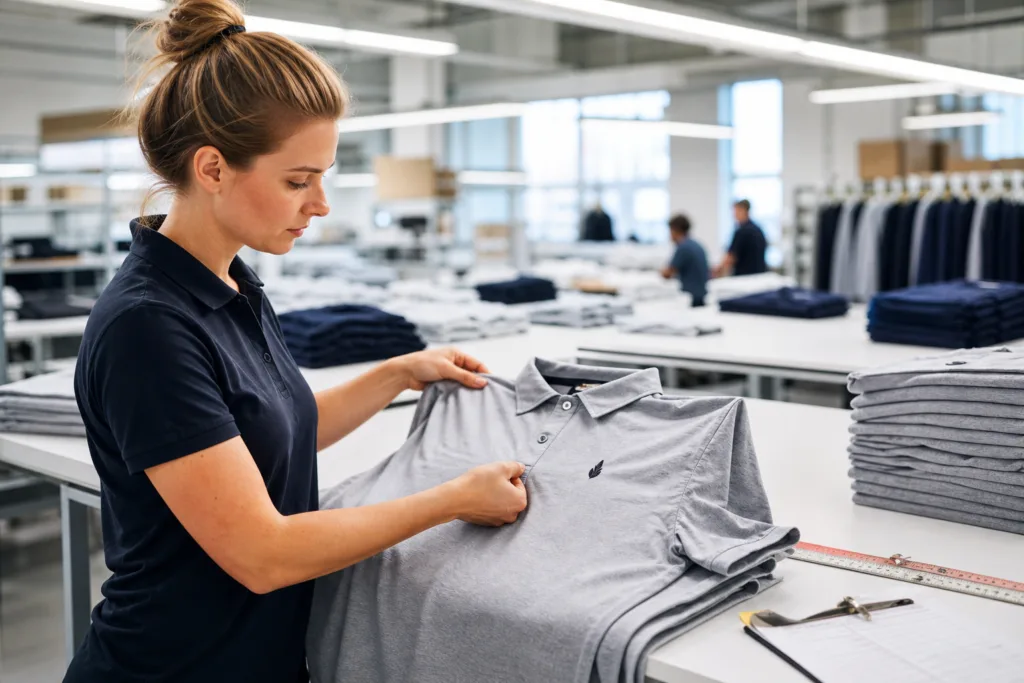
The right custom polo is the one that meets the wearer’s needs, supports the brand presentation, and can be reproduced consistently at the intended quantity. A premium retail hand feel may justify more development work, while a large staff uniform program may prioritize stable sizing, repeat color availability, and easy-care performance.
Before authorizing bulk production, confirm the approved sample, measurement chart, fabric standard, color reference, decoration file, label content, packaging instructions, quantity breakdown, and delivery plan. This final alignment gives every production checkpoint a practical benchmark.
When buyers approach custom polo shirt manufacturing as a connected fabric, fit, branding, and production decision, they gain more control over both quality and budget. The strongest outcome is not the most complex specification; it is the specification that delivers reliable performance for the real program.
Frequently Asked Questions
What fabric is best for custom polo shirt manufacturing?
The best fabric depends on the end use: cotton pique suits a classic textured look, polyester performance knit suits active or warm-weather programs, and blends can balance comfort with easier care. Approve fabric based on hand feel, wash behavior, opacity, color, and logo compatibility rather than composition alone.
What information should I send for a custom polo quote?
Send your estimated quantity by color and size, fabric direction, reference images or tech pack, logo artwork, decoration placement, private-label requirements, packaging needs, and target delivery date. A clear use scenario and fit preference will also help the manufacturer recommend a workable construction.
Can a polo sample be changed before bulk production?
Yes, a sample can be revised before bulk production, and it is better to correct fabric, fit, collar, or logo issues at this stage than after cutting begins. Consolidate feedback into one written set of comments so the next sample version has a clear approval target.
Why does MOQ change for custom polo shirts?
MOQ changes because custom fabric colors, special trims, multiple colorways, labels, and decoration setups each have their own sourcing or production requirements. Using available fabric and standard components can often make smaller programs more practical.
Is embroidery or printing better for a polo shirt logo?
Embroidery is often better for compact, durable chest logos and a traditional uniform appearance, while printing can be better for detailed artwork or larger graphics. The selected fabric weight and surface should be tested because dense embroidery may distort lightweight knits.
What should be checked before approving bulk polo production?
Check the approved sample, fabric and color standard, measurements and tolerances, logo placement, labels, packaging, size breakdown, and delivery instructions before approving bulk production. Written confirmation of these details helps prevent misunderstanding between sampling, sewing, quality control, and packing teams.