


Custom clothing manufacturing becomes easier to control when a buyer turns a broad request into a defined garment brief. For custom polo shirts, that means deciding the end use, fabric behavior, fit, logo method, labeling, order split, and approval process before a factory commits materials or production capacity. A clear plan protects brand consistency while helping sourcing teams compare cost, MOQ, and delivery options on the same basis.
If your project involves uniforms, golfwear, retail polos, or team merchandise, custom polo shirt manufacturing support can connect the brief to practical development work. We can help buyers review fabric choices, refine fit and size specifications, plan embroidery or print placement, organize private-label components, and move an approved sample into a realistic bulk-production and QC plan.
Start With a Polo Brief That a Manufacturer Can Price
The most useful starting point is not a request for a “high-quality polo.” It is a brief that describes who will wear it, how often, where, and what the garment must achieve. A hospitality uniform, a golf polo, and a promotional event polo may look similar at a distance, but they need different fabric priorities, construction choices, and budget allocations.
In our apparel production work, unclear briefs usually create more sampling rounds than difficult designs do. Buyers should state the intended market, target price position, expected order quantity by color and size, and whether the item is a repeat program or a single campaign. This lets the factory recommend options that are actually producible.
- Wearer and application: corporate staff, golfers, retail customers, school teams, or event crews.
- Performance need: moisture movement, stretch recovery, easy care, durability, or a softer cotton hand feel.
- Style direction: classic pique polo, jersey polo, tipped collar, contrast panels, long sleeve, or women’s shaped fit.
- Customization: artwork size, number of locations, color count, label requirements, hangtags, and packaging.
- Commercial plan: expected quantity per color, size ratio, target delivery window, and repeat-order potential.
Key takeaway: A detailed brief gives the manufacturer enough information to identify the right fabric route before sampling begins, rather than trying to correct fundamental choices after a sample is sewn.
How Custom Clothing Manufacturing Changes for Polo Shirts

Custom clothing manufacturing for polos is a coordinated product-development process, not simply adding a logo to a blank shirt. The collar, placket, sleeve rib, body fabric, buttons, and finishing all influence the final appearance. A polished polo must retain its shape and present the logo cleanly after repeated wear and laundering.
Pique is often chosen for its textured, traditional polo appearance, while jersey can feel smoother and lighter. Polyester and polyester blends are common for active, uniform, and golf applications because they can support moisture-oriented performance and color durability. Cotton-rich options can offer a familiar natural hand feel, but shrinkage, colorfastness, and collar stability need deliberate control.
| Fabric direction | Typical use | Buyer priorities | Production watchpoint |
|---|---|---|---|
| Cotton pique | Premium casual and lifestyle polos | Natural feel and classic texture | Manage shrinkage and collar matching |
| Cotton-poly pique | Workwear and regular uniforms | Balanced comfort, durability, and care | Confirm pilling and color performance |
| Polyester pique | Golf, teamwear, and active use | Light weight and moisture management | Check snag resistance and print compatibility |
| Stretch performance knit | Fitted golf and athleisure polos | Mobility and shape recovery | Stabilize seams and choose suitable decoration |
GSM should be considered alongside yarn type, knit structure, and finishing. A lower GSM performance knit can still feel substantial if it has a dense construction, while a heavier cotton pique can feel more casual and textured. Ask to handle fabric swatches and compare washed samples instead of selecting solely from a composition line on a quotation.
For specialty materials, unusual raised surfaces, or vinyl-film components, buyers should discuss regulatory suitability and any needed documentation before fabric approval. The U.S. Consumer Product Safety Commission explains general wearing apparel flammability requirements, which is a useful reminder that product requirements may depend on the materials and destination market.
Choose GSM, Hand Feel, and Construction for the Wearing Scenario
A practical starting range for many polo programs is roughly 180 to 240 GSM, but this is a planning reference rather than a universal quality score. Lighter constructions may suit hot-weather activity, while more substantial piques can give uniforms a structured, durable impression. The right choice depends on climate, intended layering, opacity expectations, and the visual weight the brand wants.
Construction details matter just as much as the body fabric. A collar that is too soft can curl after laundering; one that is overly stiff can feel uncomfortable. Rib cuffs, placket interfacing, neck tape, side vents, reinforced shoulder seams, and button quality should be specified according to the target use rather than copied from a competing product without context.
- Request a fabric composition, knit type, GSM tolerance, and available color route.
- Ask whether collar and cuff rib will be dyed to match the body or selected from stock.
- Review wash behavior, including dimensional change, twisting, pilling, and color transfer where relevant.
- Confirm whether the fabric is in stock or must be developed, as this changes MOQ and lead time.
Build Fit and Size Consistency Into the Pattern
Fit should be approved through measurements and wear testing, not a flat image alone. A polo may appear correct on a hanger but pull at the chest, expose too much at the placket, or ride up during movement. For teamwear and golf apparel, shoulder mobility and sleeve opening comfort can be especially important.
Buyers should supply a size chart with points of measure, tolerances, grading expectations, and the intended fit description. If there is a reference garment, send it with a note describing what should be copied and what should change. A factory needs clear permission to interpret the reference; otherwise, a sample can inherit unwanted proportions.
| Fit decision | What to define | Bulk-production benefit |
|---|---|---|
| Body silhouette | Classic, regular, slim, or relaxed ease | Reduces subjective sample feedback |
| Length | Front/back length and acceptable tolerance | Helps maintain coverage across sizes |
| Sleeve | Length, opening, rib tension, and movement room | Improves wearer comfort and consistency |
| Grading | Measurement changes between sizes | Prevents only the sample size fitting correctly |
At Ninghow, we recommend treating the size set as a production checkpoint, particularly when a new brand fit is being introduced. Approving only one sample size can hide grading issues that affect the sizes most frequently ordered.
Match Logo Decoration to the Fabric and Artwork
The most suitable logo method depends on artwork detail, garment stretch, expected wash frequency, and brand aesthetic. Embroidery gives texture and a durable dimensional look, but dense stitching can distort lightweight or stretchy knits. Screen printing can be efficient for bold artwork at volume, while heat transfer can reproduce detailed graphics and variable names when the selected transfer is compatible with the fabric.
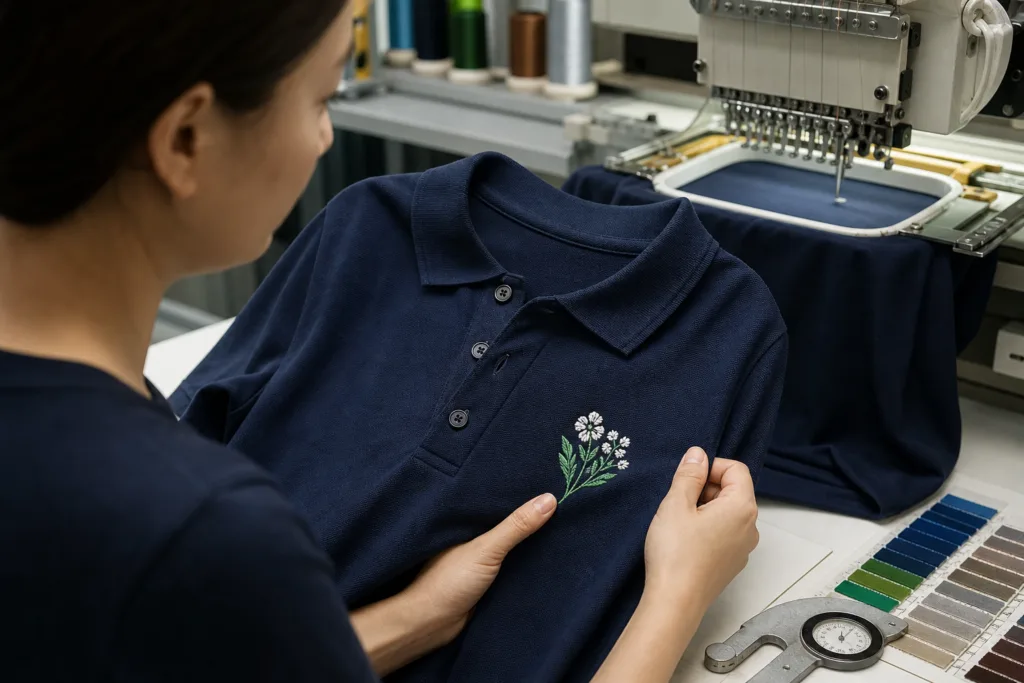
For a traditional left-chest identity on stable pique, consider custom embroidered polo shirts for durable chest branding. The buyer should approve thread colors, backing type, stitch density, and placement from a real sample, not only a digital embroidery file.
Larger artwork, multi-color graphics, or event-focused designs may be better suited to custom printed polo shirts for larger logo artwork. Test prints on the exact fabric because surface texture, stretch, and dye-sublimated bases can change edge clarity and adhesion.
| Method | Works well for | Check before approval |
|---|---|---|
| Embroidery | Chest logos, uniforms, and premium identity | Puckering, backing visibility, and stitch density |
| Screen print | Bold graphics and higher-volume artwork | Ink feel, registration, and stretch cracking |
| Heat transfer | Fine detail, names, and small runs | Adhesion, edge lift, and heat sensitivity |
| Sublimation | All-over polyester performance designs | Color match, panel alignment, and white areas |
Decoration approval should cover position measured from fixed garment points, not a visual instruction such as “slightly higher.” For example, specify distance from the high point shoulder, center front, placket edge, or side seam. This makes placement repeatable across sizes and production lines.
Plan Labels, Trims, and Packaging Before the Sample Is Final
Private-label details often arrive late, yet they affect production timing and cost. Neck labels, care labels, size labels, woven hem tabs, branded buttons, hangtags, polybags, barcode stickers, and carton markings should be included in the development schedule. A custom button or woven label may have a different MOQ and lead time from the garment itself.
Corporate programs benefit from a concise specification that controls logo size, approved colorway, and replacement ordering. Buyers sourcing office uniforms can review corporate polo shirt options for professional uniforms when building a consistent presentation across departments or locations.
- Provide editable vector artwork and a color reference where possible.
- State whether labels are supplied by the buyer or sourced by the factory.
- Confirm care-content requirements for the selling market before label printing.
- Specify folding method, individual bagging, size stickers, master-carton quantity, and shipping marks.
Set Realistic MOQ and Lead-Time Expectations
MOQ is driven by the least flexible component, not just the sewing quantity. Stock fabric and standard buttons can make smaller runs more practical. Custom-dyed fabric, a new collar rib color, specialty buttons, individual name personalization, or multiple colorways can raise the effective minimum because each component needs its own production setup.
A useful quote request separates quantities by color and size, identifies whether fabric can be selected from available options, and states which trims must be custom. This enables buyers to compare a low-MOQ launch route with a more customized repeat-order route instead of expecting both under the same conditions.
Lead time should include material confirmation, lab dip or color approval where required, sample making, buyer revisions, trim production, cutting, sewing, decoration, finishing, inspection, packing, and dispatch. Rushing the visible sewing stage does not solve delays caused by unapproved artwork, incomplete size ratios, or late labels.
Key takeaway: The fastest production plan is usually the one with early approvals, available materials, and a complete purchase order—not the one with the shortest stated sewing time.
Use Sampling to Remove Bulk Production Risk
A development sample confirms the factory’s interpretation of the brief. A pre-production sample confirms the approved material, measurements, trims, decoration, and finishing route that bulk production should follow. For a new polo style, buyers should review both appearance and function: collar behavior, placket balance, logo position, opacity, seam smoothness, and comfort during movement.
Keep feedback consolidated in one approval document. Mixed messages from different stakeholders can lead to untraceable changes, especially when artwork and fit revisions occur together. Mark each change as approved, rejected, or pending, and identify whether it affects cost or timing.
Quality Control Checkpoints That Matter for Custom Polos
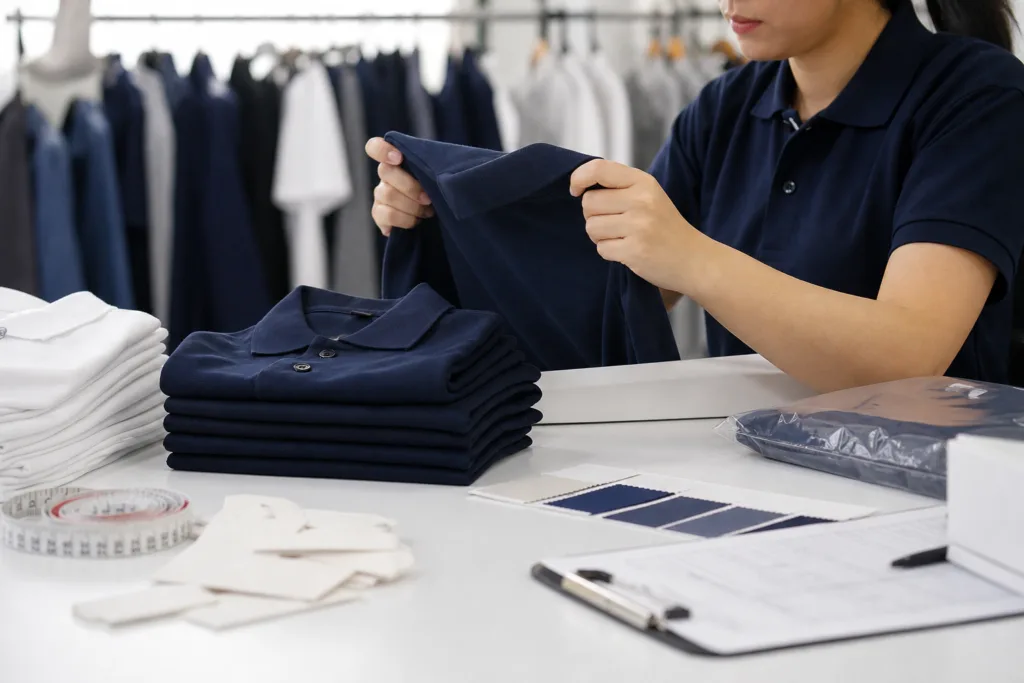
Quality control should be planned from incoming materials through final packing. Fabric inspection can identify shade variation, knitting defects, and weight concerns before cutting. During sewing, teams should check measurements, collar shape, placket alignment, stitch quality, loose threads, and panel matching. Decoration and finishing require their own checks because a garment can be well sewn but still fail the buyer’s visual standard.
| Checkpoint | What to inspect | Why it matters |
|---|---|---|
| Incoming fabric | Shade, defects, GSM, and hand feel | Prevents cutting from unsuitable material |
| First-off garment | Measurements, collar, placket, and construction | Corrects line issues early |
| Decoration check | Color, position, adhesion, or embroidery quality | Protects brand presentation |
| Final inspection | Appearance, measurements, labels, and packing | Confirms shipment consistency |
Agree on acceptable tolerances and defect definitions before bulk production. For club programs, consistent identity is particularly important, so buyers should clarify color matching and emblem position when ordering garments for varied activities and members.
Common Mistakes That Delay a Polo Program
The most common problem is approving a visual mockup as though it were a technical specification. Mockups are useful for communication, but they do not define fabric weight, stitch type, shrinkage allowance, logo dimensions, or grading. A tech pack or clearly organized specification sheet closes this gap.
- Choosing fabric only by GSM without reviewing hand feel, opacity, and performance.
- Using a small logo file that cannot produce clean embroidery or print detail.
- Changing body color after collar rib, thread, or transfers have been approved.
- Approving a sample without recording its measurements and materials.
- Splitting a small order across too many colors, sizes, or custom trims.
- Leaving packing and labeling decisions until garments are complete.
From a manufacturer perspective, the remedy is straightforward: lock the product specification in stages. First approve fabric and color, then fit and construction, then decoration and labels, and finally the pre-production sample. This sequence keeps revisions visible and gives each supplier team a stable instruction set.
Choose a Manufacturing Route That Fits the Program
There is no single “right” polo development route. A retail brand may prioritize a distinctive fit, custom color, branded trim, and a repeatable seasonal fabric. A school or club may prioritize reliable sizing, logo consistency, and reorder continuity. A campaign buyer may need available fabric, a simple decoration method, and quick packaging decisions.
Custom clothing manufacturing works best when the level of customization matches the commercial plan. Use stock materials and standard components when launch speed or small quantities are central. Invest in custom fabric, trims, and pattern refinement when the polo is a long-term brand product with forecasted volume. Clear communication allows the factory to advise where investment improves the garment and where it merely adds avoidable complexity.
Conclusion: Turn a Broad Request Into a Production-Ready Polo
A successful custom polo program begins with a defined wearer, fabric direction, fit standard, decoration plan, and component list. It then depends on disciplined sample approval, realistic MOQ expectations, and quality checkpoints that protect consistency in bulk. Buyers who document these decisions early can move faster while retaining more control over cost and brand presentation.
For brands and sourcing teams, the practical goal is not to maximize customization on every detail. It is to choose the fabric, construction, branding, and private-label elements that make the polo useful for its intended wearer and viable for repeat production.
Frequently Asked Questions
What information should I send for a custom polo shirt quotation?
Send the target quantity by color and size, intended use, fabric preference, reference images, size chart, logo files, decoration locations, label needs, packaging requirements, and delivery destination. If some details are undecided, identify them clearly so the factory can quote alternatives rather than making hidden assumptions.
What is a realistic MOQ for custom polo shirts?
A realistic MOQ depends on whether the fabric, collar rib, buttons, labels, and decoration are stock or custom. Small runs are more achievable with available materials and simple branding, while custom dyeing, special trims, and multiple colorways usually require larger quantities to make production practical.
Should I choose embroidery or printing for a polo logo?
Choose embroidery for a textured, durable logo on stable polo fabrics, especially for traditional chest branding. Choose printing when the artwork is larger, more detailed, or has multiple colors, but test it on the exact fabric to confirm hand feel, stretch performance, and wash durability.
How many samples are needed before bulk production?
Most new styles need at least a development sample and a pre-production sample, although the number increases when fit, fabric, or artwork changes substantially. The pre-production sample should reflect the approved bulk materials, labels, decoration, and measurements as closely as possible.
How can I prevent size inconsistency in a bulk polo order?
Prevent size inconsistency by approving a complete measurement chart with tolerances and reviewing a size set when the fit is new or important. The factory should use approved points of measure, grading rules, and in-line measurement checks rather than relying only on the first sample size.
What causes custom polo production lead times to increase?
Lead times increase when fabric must be developed or dyed, custom trims are delayed, artwork is not final, samples require repeated revisions, or order details change after materials are booked. A complete approved specification and early confirmation of colors, labels, and size ratios are the most effective ways to reduce avoidable delays.
Related Reading
- embroidery, heat transfer, and screen printing on stretch fabrics
- work uniform polo shirt comfort and professionalism
- team polo shirt branding for sports clubs and corporate uniforms
- apparel sampling process for checking logo placement before bulk production
- apparel quality control for consistent logo application