







Your first collection should be small enough to manage, clear enough to represent the brand, and disciplined enough to produce without unnecessary cost risk. In first clothing collection planning, the real challenge is not designing as many products as possible. It is choosing the right mix of styles, colors, sizes, price points, and customization details so the collection feels intentional and can move smoothly from concept to sampling to bulk production.
If your brand is early-stage and needs startup clothing manufacturing support, it helps to work backward from production reality instead of starting with unlimited creative options. We usually advise new brands to define the assortment, fabric direction, fit goals, customization level, and price architecture before samples begin, because those early decisions shape MOQ, lead time, quality consistency, and how scalable the first drop will be.
Why the first collection matters more than most founders expect
Your first drop does more than introduce products. It teaches the market what your brand stands for, and it teaches your team how your product decisions perform under manufacturing conditions.
A weak first collection often has too many styles, too many colors, and no clear priority between image-building products and easier commercial sellers. That usually creates scattered sampling, higher development costs, slower approvals, and inventory that is harder to explain to buyers or customers.
A focused first collection creates clarity. It helps you test demand, gather fit feedback, refine your target customer profile, and build a repeatable product development process.
Key takeaway: The best first collection is usually not the biggest or the most creative. It is the one that proves your brand concept with controlled complexity.
What brand position should be defined before you choose products?

Before you choose styles, define what your brand is trying to be in practical product terms. Founders often start with mood boards and inspiration, but a manufacturer needs operational clarity.
We recommend defining five basics first: target customer, wearing scenario, price level, silhouette direction, and customization identity. These choices affect almost every later decision, from fabric GSM to trim quality to packaging cost.
- Target customer: age range, fit preference, usage habits, and shopping expectations
- Wearing scenario: streetwear, gym, teamwear, golf, athleisure, casual basics, or uniform-inspired
- Price level: entry premium, mid-market, or value-oriented
- Silhouette direction: oversized, regular fit, slim, cropped, relaxed, or performance-cut
- Customization identity: print-led, embroidery-led, minimal branding, bold graphics, or refined private label detailing
Once those five points are clear, product selection becomes easier. Without them, brands often mix categories that do not belong together, such as heavyweight premium fleece with low-cost lightweight tees, or performance silhouettes with fashion sizing logic.
What should the first drop actually do for the business?
The first drop should have one primary job. It can test demand, build identity, or push near-term revenue, but trying to do all three equally often creates confusion.
If your main goal is testing demand, keep the style count low and compare variations carefully. If your main goal is building identity, focus more on distinctive but producible hero pieces. If your main goal is driving revenue, include more repeatable basics with broader size coverage and easier reordering potential.
| First-drop goal | Best product strategy | Main risk to avoid |
|---|---|---|
| Test demand | Few styles, limited colors, clear comparison between fits or graphics | Too many variables at once |
| Build identity | Strong visual consistency, one or two signature products | Overdesigning details that are hard to scale |
| Drive revenue | Commercial basics, broader usability, easier repeat orders | Looking too generic and forgettable |
From our manufacturing perspective, a brand with one clear launch objective usually approves samples faster and makes more disciplined purchasing decisions.
How many styles should a first clothing collection include?
For most startup brands, 3 to 6 styles is a practical range. That is usually enough to show a real collection without creating too many SKUs, fit issues, or fabric sourcing complications.
Each added style creates more than one extra product. It may also create extra patterns, grading work, fabric booking, trims, labels, artwork placements, packaging decisions, and QC checkpoints. That is why style count must be controlled early.
A good first assortment might include:
- 1 hero piece that defines the brand visually
- 1 to 2 support pieces that connect with the hero item
- 1 to 3 repeatable basics that are easier to sell and reorder
When startups ask us about planning a first small apparel order, the discussion often comes back to this point: fewer styles usually means better decisions per style. You can spend more attention on fit, fabric, print placement, labels, and finishing instead of spreading the budget too thinly.
How SKU count grows faster than founders expect
A collection with 5 styles can already become complicated if each style has 3 colors and 5 sizes. That is 75 base SKUs before you add fabric variations, logo color changes, or packaging differences.
For a first launch, keeping style count low is not about limiting creativity. It is about protecting cash flow, simplifying production, and making post-launch analysis useful.
How can you control color options without weakening the brand story?
The simplest answer is to choose a tight color system, not a large color menu. Most first collections work better with 2 to 4 core colors, often built around one hero tone and supporting neutrals.
Color discipline helps in three ways. It improves collection coherence, reduces fabric sourcing complexity, and limits the number of SKUs that need to be carried across sizes.
A practical color structure might look like this:
- 1 anchor color: the shade most associated with the brand
- 1 to 2 neutrals: black, off-white, grey, navy, or similar commercial shades
- 1 accent color: only if it supports the collection story and does not force broad SKU expansion
We often suggest putting all styles into every neutral only if the products have clear sales logic. Sometimes it is better to keep the hero piece in two colors and the support pieces in one or two shared shades so the collection still feels connected.
Key takeaway: A consistent color system usually builds a stronger brand image than offering many color options in the first drop.
How should you build a size range for your target customer and production plan?
Start with your target fit block, then choose the size range. Size planning should be based on who the brand serves, how the garments are intended to fit, and how consistent that logic can be across the collection.
Many first-time founders default to XS-XXL without checking whether that range fits their customer, their style direction, or their order volume. A startup collection may be better served by a tighter size run if demand is still being tested, especially when MOQ pressure is high.
Good size planning includes:
- defining the intended fit: slim, regular, relaxed, oversized, or performance
- building one clear base size for sampling
- using consistent grading logic across related styles
- avoiding unnecessary size expansion before demand data exists
For technical fit consistency, it helps to understand recognized guidance around clothing size designation and body measurements. Even when a brand uses its own fit style, the size chart should still be built on a defined body measurement logic rather than guesses.
| Brand situation | Typical size strategy | Why it works |
|---|---|---|
| Niche fashion fit | Tighter size range with clear silhouette intent | Reduces risk while preserving design identity |
| Commercial basics launch | Broader core size range in best-selling styles | Supports wider sell-through potential |
| Performance or teamwear focus | Fit-led range based on use case and movement needs | Improves function and customer satisfaction |
In our production work, size inconsistency is one of the most common problems in early collections. It usually starts with unclear fit expectations, not sewing quality. A better tech pack and clearer size spec solve many issues earlier than founders expect.
How do you choose the right price tier without losing margin control?
Choose the price tier before approving fabrics and trims, not after. If the intended retail price is unclear, founders often sample products that cannot support margin once manufacturing, freight, packaging, and wholesale or marketing costs are added.
Start from your expected channel. Direct-to-consumer, wholesale, club sales, and distributor sales all need different margin structures. A product that works for online DTC may not work if you also need room for retailer markup.
Price discipline usually depends on these cost drivers:
- fabric type, composition, and GSM
- embroidery, print size, or placement count
- pattern complexity and sewing time
- labels, hangtags, and packaging details
- small-batch inefficiency and MOQ limitations
Founders should separate what customers can see from what only adds hidden cost. For example, a clean heavyweight tee with excellent hand feel and fit can often create more value than a garment overloaded with expensive but unnecessary trim details.
How should you balance hero pieces, support pieces, and basics?
A balanced first collection needs visual leadership and commercial stability. That usually means one or two hero pieces, a few support products, and at least one item that can become a repeatable basic.
Hero pieces create attention. Basics create consistency and easier reordering. Support pieces connect the story so the collection feels intentional rather than random.
| Piece type | Role in the collection | What to watch |
|---|---|---|
| Hero piece | Defines the brand look and creates interest | Do not make it too complex for first production |
| Support piece | Links the collection visually and commercially | Should share color or trim logic with hero piece |
| Basic piece | Offers easier sell-through and reorder potential | Fit and fabric must be reliable, not generic |
From a factory point of view, this balance also helps production flow. If every piece is highly customized, the collection can become slow to sample and expensive to repeat. A mix of statement and stable products is usually healthier.
Which fabrics and garment categories are realistic for a startup?
The most realistic categories are the ones that match your target customer and can be produced consistently within your budget and MOQ level. For many first drops, tees, hoodies, sweatshirts, polos, shorts, and basic joggers are more manageable than heavily engineered outerwear or highly technical multi-panel garments.
Fabric choice affects not only appearance, but also drape, hand feel, shrinkage behavior, print performance, and how premium the product feels at first touch. That is why the same silhouette can perform very differently depending on material selection.
| Garment type | Startup-friendly fabric direction | Main advantage |
|---|---|---|
| T-shirt | Cotton or cotton blend, controlled GSM | Easy to test fit, print, and brand positioning |
| Hoodie or sweatshirt | Fleece or French terry in a clear weight range | Strong value perception and repeatability |
| Polo | Pique or jersey depending on image and use | Good for smart-casual, golf, or uniform crossover |
| Shorts or joggers | Knit or light woven depending on category | Supports set merchandising and average order value |
If order volume is still uncertain, checking low MOQ clothing manufacturing options early can help you choose categories and fabric directions that are more realistic for a first launch. MOQ often depends on whether fabrics and trims are stock-supported or require custom development.
Why GSM and hand feel matter in first-drop decisions
Founders often focus on fabric composition but forget GSM. In practice, GSM affects opacity, structure, warmth, drape, and perceived value. A 180 GSM tee and a 260 GSM tee may both be cotton, but they can support very different price positions and brand identities.
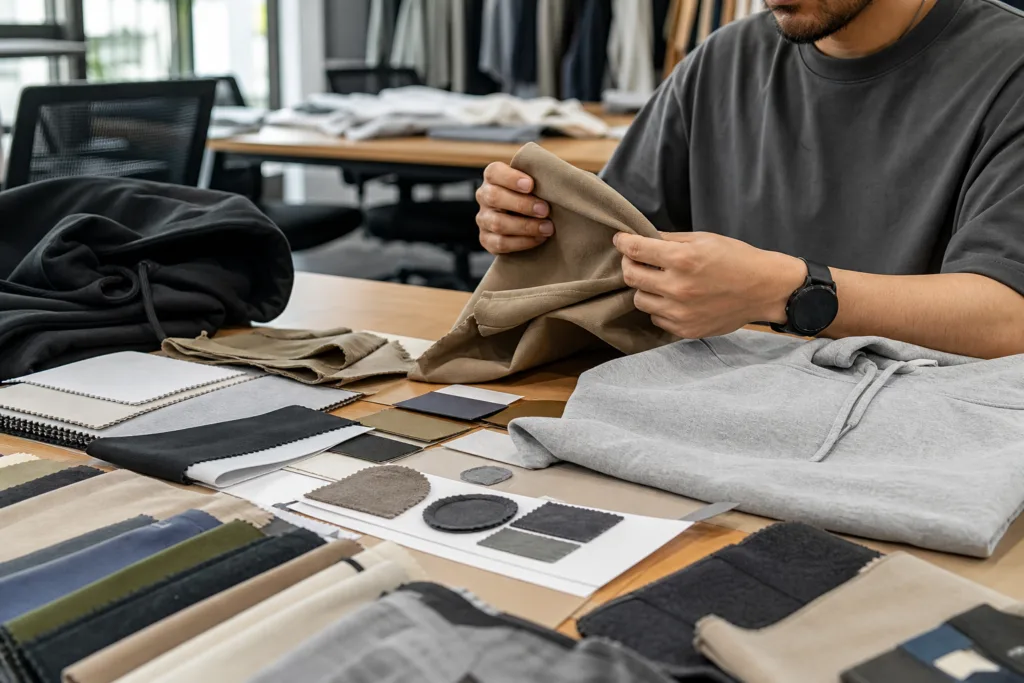
We usually advise startups to compare fabric swatches in hand, not only on paper. The right material should match the intended retail price, wearing scenario, and silhouette. A premium-looking collection can be weakened quickly by fabric that feels too thin, unstable, or inconsistent.
What design consistency rules help a first collection look branded?
Design consistency does not mean every product should look the same. It means the pieces should clearly belong to the same brand system.
The easiest way to create consistency is to repeat a few controlled elements across the collection. Those repeated signals can be subtle but powerful.
- shared silhouette attitude, such as boxy or clean regular fit
- consistent logo treatment, such as embroidery on chest or tonal print
- repeat trim decisions, such as zipper finish, drawcord style, or cuff construction
- matching label language across neck labels, care labels, and hangtags
- coherent packaging, even if simple
This is where Ninghow often sees the difference between a concept and a manufacturable brand presentation. A collection does not need many details, but the details it does include should repeat with purpose.
Key takeaway: Brand consistency usually comes from disciplined repetition, not from adding more design elements.
What should you customize in the first collection and what should stay simple?
Customize the elements that shape brand recognition or perceived value, and simplify the rest. A startup does not need to customize every trim to look serious.
For most first collections, the highest-value customization points are:
- logo application method
- main label and care label setup
- hangtag direction
- packaging presentation
- one or two signature construction or color choices
By contrast, fully custom zippers, metal hardware, many fabric dyes, and highly specific packaging structures may be better left for later stages unless they are central to the brand identity.
| Customization area | Good first-drop choice | Keep simple when |
|---|---|---|
| Logo branding | Embroidery, screen print, or heat transfer with clear placement | You are still testing artwork scale and market response |
| Labels | Consistent woven or printed brand labels | Many special label types add complexity without major benefit |
| Packaging | Clean branded basics | Luxury packaging may absorb budget better used on garment quality |
| Trims | Only visible trims that support the brand image | Fully custom trims can raise MOQ and lead time |
How should you plan MOQ, sample rounds, and lead time?
Plan these together, not separately. MOQ affects fabric choices, sample rounds affect launch timing, and lead time depends on approvals being made on time.
A first collection usually needs at least one development sample and one approval-oriented revision if the brand is building custom fit, graphics, labels, or packaging. More rounds may be needed when the tech pack is incomplete or the design is still changing.
For most new brands, the safer approach is to build the launch calendar around the real apparel sampling process for new collections rather than around ideal dates. Sampling takes longer when fabric sourcing is still open, print files are incomplete, or sizing is not fully approved.
After sample approval, bulk timing should be planned with buffer. Detailed production timeline planning for launch collections matters because material booking, cutting, sewing, decoration, finishing, and packing all depend on approval discipline.
- confirm the style count before sample development expands
- lock core colors before bulk fabric is booked
- approve size specs before final grading is released
- finalize labels and packaging before production enters finishing
- leave time for inspection and possible corrections
From our side as a manufacturer, many delays are not factory delays in the narrow sense. They come from moving targets, repeated design changes, or late artwork and trim approvals.
What mistakes make a first collection harder to produce and sell?
The most common mistake is trying to prove too many ideas at once. Founders want to show range, but the first collection usually performs better when it shows focus.
Other frequent issues include:
- too many styles relative to budget
- too many colorways for uncertain demand
- unclear size logic between garments
- retail pricing that does not match manufacturing reality
- over-customization in low-volume production
- sampling before the brand position is clear
- choosing difficult fabrics without enough testing
A softer but equally important mistake is ignoring replenishment logic. If the best-selling piece cannot be repeated easily because the fabric, print, or trim setup is too complicated, the collection may create attention without building a stable business.
What simple framework can startup brands use for first clothing collection planning?
We suggest using a practical sequence that goes from market logic to manufacturing logic. This keeps creative ideas grounded in actual production decisions.
- Step 1: define target customer, use case, and price tier
- Step 2: choose 3 to 6 styles with clear roles
- Step 3: reduce colors to a controlled brand palette
- Step 4: set fit direction and size range
- Step 5: choose fabrics that match hand feel, margin, and MOQ
- Step 6: decide what branding details matter most
- Step 7: build accurate tech packs and sample priorities
- Step 8: align MOQ, lead time, and launch calendar
This framework helps founders avoid treating product development as a purely visual exercise. In reality, the most successful early collections balance brand identity with production feasibility.
What should you prepare before going to a clothing manufacturer or OEM/ODM supplier?
Bring decisions, not only ideas. A supplier can help refine the collection, but progress is much faster when the brand already knows what needs to be made and why.
A useful pre-manufacturing checklist includes:
- style list with clear product roles
- target customer and fit direction
- size range and base size intention
- color plan and visual references
- target retail price and channel
- fabric preferences or benchmark garments
- logo files and branding placements
- label, hangtag, and packaging expectations
- target launch timing and order estimate
If those basics are clear, sampling becomes more productive and bulk planning becomes more realistic. If they are unclear, every sample round becomes partly a discovery exercise, which adds time and cost.
Launch with a focused collection that is easy to produce, easy to sell, and easy to scale
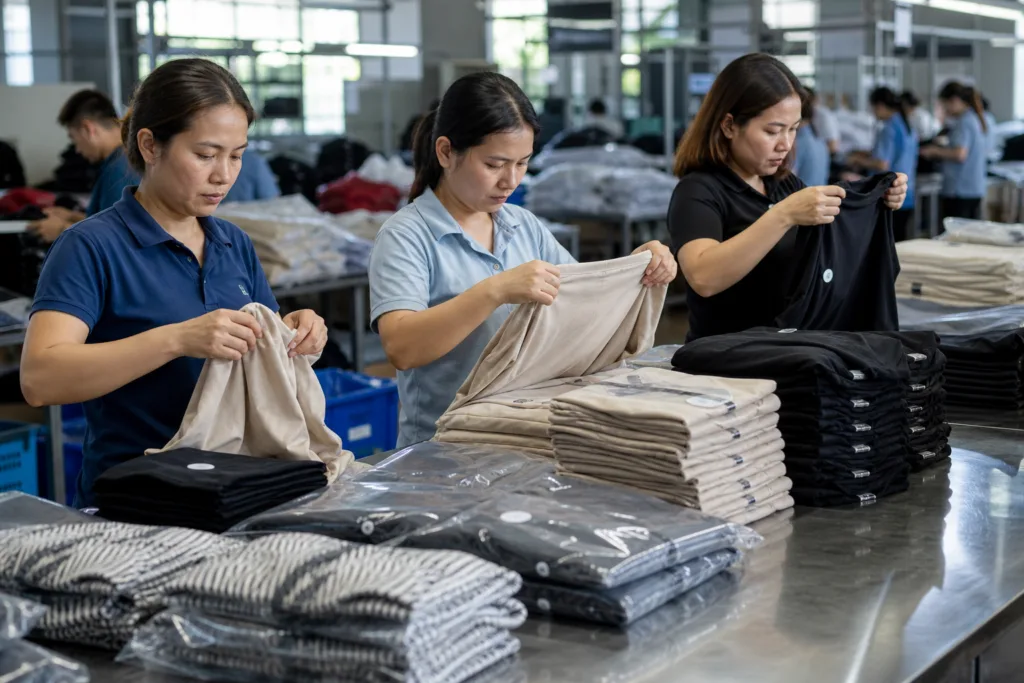
A strong first collection is built on restraint. It controls style count, limits colors, uses a sensible size strategy, protects margin, and repeats brand signals consistently.
In first clothing collection planning, the goal is not to answer every future brand idea in one launch. The goal is to create a first drop that customers understand, that your team can manage, and that a manufacturer can produce with confidence and repeatability.
At Ninghow, we see the best early-stage collections come from founders who make fewer but clearer decisions. When the assortment, fit, fabric, branding, and production plan align, the collection becomes easier to sample, easier to approve, and easier to scale into the next drop.
FAQs
How many pieces should be in a first clothing collection?
For most new brands, 3 to 6 styles is a practical starting point. That range is usually enough to present a real brand story while keeping sampling, MOQ, fit control, and inventory risk manageable. If each style also has limited colors and a disciplined size range, the collection stays much easier to launch and review after sales data comes in.
Should a startup launch many colorways in the first drop?
No, most startups should keep colorways tight in the first drop. A smaller palette usually creates a stronger brand image and avoids unnecessary SKU growth that can strain budget and production planning. In many cases, one hero shade plus one or two strong neutrals is enough to make the collection feel complete.
What is the best size range for a first apparel launch?
The best size range is the one that matches your target customer, fit direction, and order volume rather than a default full-spectrum range. If demand is still untested, a focused size run can reduce production risk while still serving the core buyer. The important part is using a clear fit block and consistent grading logic across related styles.
How do new brands avoid overcomplicating their first collection?
New brands avoid overcomplication by limiting the number of styles, colors, fabric types, and custom trim decisions in the first launch. It helps to decide which one or two branding elements matter most and simplify the rest. This makes the collection easier to sample, easier to cost, and easier to manufacture consistently.
When should a founder talk to a clothing manufacturer during collection planning?
A founder should usually talk to a clothing manufacturer once the brand position, product categories, rough size plan, and price targets are clear enough to discuss feasibility. That timing is early enough to prevent unrealistic fabric, MOQ, or customization decisions, but structured enough for the conversation to be productive. Waiting until every detail is finished is not necessary, but approaching with only vague concepts often slows progress.
What matters most before approving bulk production for a first collection?
The most important step before bulk approval is making sure the sample truly reflects the intended fit, fabric quality, branding details, and construction standards. Buyers should also confirm size specs, color references, label information, packaging requirements, and quantity breakdowns before bulk starts. Clear approvals at this stage reduce the risk of expensive corrections later.