


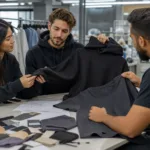

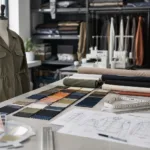



Startup clothing manufacturer problems usually do not begin with one dramatic failure. They start with small gaps between what a new brand expects and what a factory actually needs to produce consistent garments at scale. In our manufacturing work, we often see promising startup brands lose time, budget, and momentum because their first supplier relationship begins before the product brief, budget logic, and development priorities are truly ready.
If your brand is still comparing options for startup-focused clothing manufacturing support, it helps to work with a manufacturer that can guide fabric selection, sampling, logo application, private label details, MOQ planning, and bulk production preparation in a way that matches startup realities rather than enterprise-level assumptions. That kind of support matters most when your first order needs to balance ambition with limited cash flow, limited data, and limited room for error.
The good news is that most first-manufacturer friction is preventable. The core issue is rarely that startups are not serious. The issue is that many early-stage brands approach sourcing with creative energy but without enough production structure.
This guide explains the real mistakes behind failed first factory relationships, what those mistakes look like from a manufacturer perspective, and how to reduce risk before sampling and bulk production begin.
Why the first manufacturer relationship feels harder than many startups expect
The first relationship is harder because apparel production is not only about finding a supplier. It is about translating a product idea into repeatable technical decisions. A factory can only quote, sample, and produce accurately when the brand has made enough choices about fabric, fit, construction, decoration, labeling, packaging, and target cost.
Startups often assume the manufacturer will fill every gap automatically. Some manufacturers can support development, but even then, unclear inputs create slower communication, wider quotation ranges, more sample revisions, and more disagreement about whether the final product is correct.
Key takeaway: Your first manufacturer relationship works better when you treat it as a development partnership with technical requirements, not just a buying transaction.
What really causes startup clothing manufacturer problems
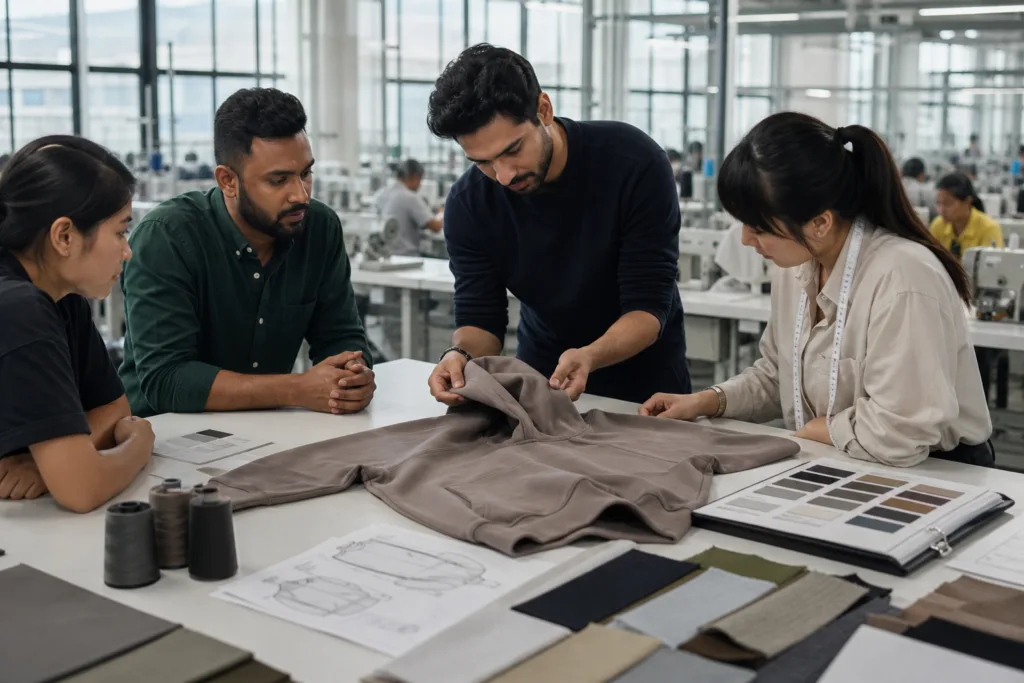
The most common startup clothing manufacturer problems come from three root causes: unclear product goals, unrealistic expectations, and weak production readiness. These issues then appear as late samples, confusing quotes, poor fit, MOQ conflict, quality disputes, or disappointment with the supplier.
From our side as a clothing manufacturer, the pattern is familiar. A startup may want premium fabric, low MOQ, heavy customization, fast lead time, low price, and flexible revisions all in the same project. Each request is understandable on its own, but not every combination is commercially or operationally realistic.
That does not mean startups are difficult customers. It means they need a first-order plan built around priorities.
- What product must be right first?
- Which details are essential versus optional?
- What retail price is the brand targeting?
- What margin is required after production, freight, duties, and packaging?
- What level of customization is realistic for the opening order?
Once these questions are answered clearly, factory communication becomes much more productive.
Why vague product concepts cause problems before production even starts
A vague idea is one of the earliest failure points. If a startup says it wants a “premium oversized tee” or a “luxury hoodie” without technical detail, different manufacturers will imagine very different products. That leads to quotes that are not truly comparable and samples that miss the intended hand feel or fit.
A usable development brief should cover silhouette, fabric type, GSM target, composition, stretch expectations, color direction, logo placement, trim ideas, label requirements, packaging needs, and target order quantity. Even if every detail is not final, the direction must be specific enough for the factory to build from.
We recommend founders review what a startup should send before approaching a factory because better input usually means faster and more accurate feedback on feasibility, cost, and sample planning.
What a clear first brief should include
- Garment category and intended use
- Reference photos or physical samples
- Target fabric composition and approximate GSM
- Desired fit, size range, and key measurements
- Logo method such as embroidery, screen print, heat transfer, or woven patch
- Private label needs including neck label, care label, hangtag, and packaging
- Target quantity by color and size
- Target wholesale or landed cost range
- Required delivery timing
If the startup is unsure on several of these points, that is still manageable. But it should be stated openly so the manufacturer knows the project is in development rather than production-ready.
Why choosing by price alone creates expensive setbacks
The lowest quote is not always the lowest risk. In fact, one of the most damaging startup habits is treating apparel sourcing like simple price shopping. A cheaper quote may be based on a lighter fabric, simpler construction, lower trim quality, weaker pattern work, or less support during development.
We often tell buyers to examine not only the unit cost but the structure behind the cost. When a quote is unusually low, ask what exactly is included and what assumptions are being made. A missing label cost, omitted packaging detail, downgraded GSM, or simplified decoration method can distort the comparison.
This is why the cheapest quote can become the most expensive mistake is such an important sourcing question for startups. The hidden cost usually appears later through rework, quality inconsistency, or a product that does not support the brand position.
| Quote Factor | Low Quote Risk | What Buyers Should Check |
|---|---|---|
| Fabric | Lower GSM or different composition than expected | Request composition, GSM, and swatch confirmation |
| Fit development | Limited pattern adjustment support | Ask how many sample revisions are typical |
| Decoration | Simpler logo method used to lower price | Confirm print or embroidery specs clearly |
| Trims | Basic labels, zippers, drawcords, or packaging | List each trim line by line |
| QC | Minimal inspection process | Ask what checkpoints happen before shipment |
Key takeaway: Compare capability fit and specification accuracy before comparing price alone.
Why over-customizing too early makes the first order harder
Many startups try to launch with every brand detail at once: custom fabric, unique wash, multiple prints, embroidery, branded trims, specialty labels, custom packaging, and several colorways. While that may sound strong from a branding angle, it often makes the first order unnecessarily fragile.
Every added customization layer increases sourcing complexity, approval steps, sample risk, and potential delays. This is especially true when the startup is still learning fit, demand patterns, and actual customer response.
A better first-order strategy is to protect the product identity while simplifying the production path. For example, a startup can focus on one signature fit, one or two core colors, a strong logo execution, and clean private label details rather than trying to customize every component immediately.
Customization details that often create avoidable delay
- Custom-dyed fabrics in small quantities
- Multiple logo techniques on one garment
- Specialty trims sourced from new vendors
- Complex packaging before sales volume is proven
- Too many SKUs across colors and sizes
At Ninghow, we often see startups succeed faster when they validate the core garment first, then expand customization depth after the fit, fabric response, and reorder pattern are proven.
How budget, MOQ, and target retail price get out of sync
Another major friction point is cost structure mismatch. A startup may want a premium heavyweight garment with custom labels and detailed finishing, but also need very low MOQ and still target a competitive retail price. That combination can be difficult because low volume reduces cost efficiency while premium details increase manufacturing cost.
Buyers should work backward from the market price. Estimate your target retail, expected gross margin, packaging cost, freight, duties, and platform or wholesale deductions. The remaining amount is the production budget range. If that number is too low for the desired product, either the garment spec or pricing strategy must change.
| Business Goal | Manufacturing Reality | Adjustment Option |
|---|---|---|
| Low MOQ | Higher cost per unit | Reduce color count or simplify trims |
| Premium hand feel | Higher fabric cost | Focus on fewer SKUs with stronger positioning |
| Complex branding | More setup and sourcing steps | Keep only the most visible branded elements |
| Fast launch | Less room for revision | Use available materials where possible |
This is also where startup founders need honest manufacturer feedback. A good factory should explain where MOQ is driven by fabric availability, trim sourcing, color matching, or production efficiency rather than just giving a yes or no answer.
Why sampling takes longer than startups expect
Sampling is where ideas become measurable garments. It is also where hidden uncertainty becomes visible. If the fit is off, the fabric drape feels wrong, the print placement looks unbalanced, or the neck label scratches, the sample stage reveals it before bulk production does.
Startups often underestimate the time needed for comments, pattern changes, material sourcing, lab dips, trim matching, and resubmission. That creates frustration when their planned launch date assumed immediate perfection from the first sample.
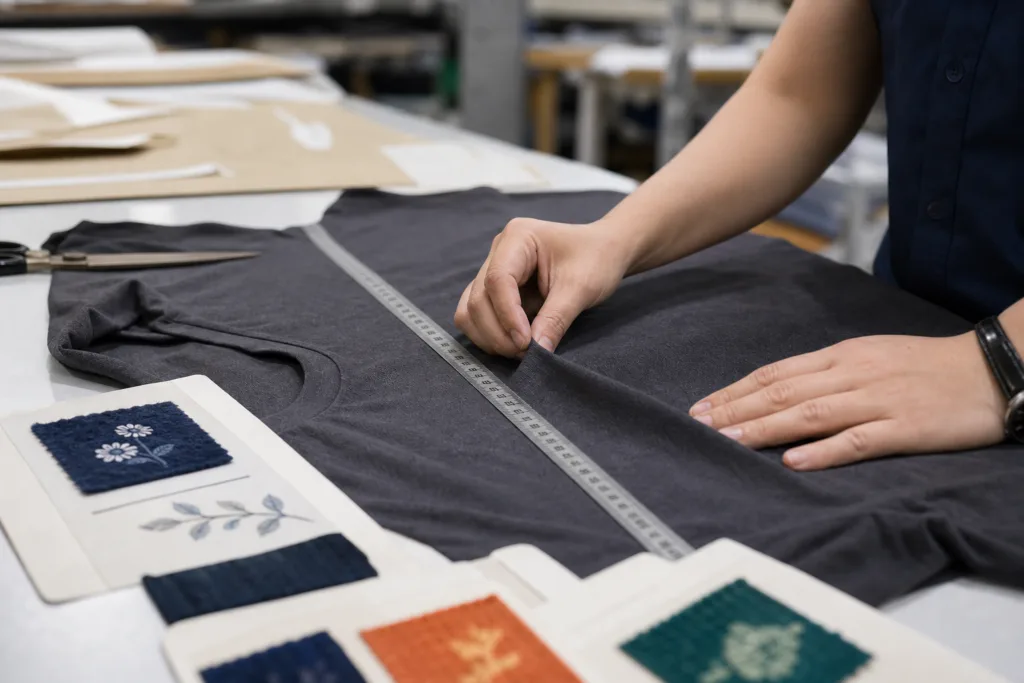
We encourage buyers to study how sampling exposes a manufacturer’s real capabilities because the sample process tells you a lot about pattern control, communication quality, technical understanding, and problem-solving speed.
What realistic sample planning looks like
- Allow time for fabric and trim confirmation
- Expect at least one round of comments for fit or finish
- Use written feedback with photos and measurements
- Approve one standard before expanding colors or styles
- Do not schedule bulk too tightly against a hard launch date
Key takeaway: A sample that reveals issues is useful. A sample process that hides issues is dangerous.
How fabric, fit, and construction trade-offs affect the final product
Many first-time brands focus on appearance first and technical trade-offs second. But fabric choice affects drape, opacity, warmth, shrinkage behavior, print performance, and cost. Fit decisions affect grading, comfort, return risk, and target customer perception. Construction affects durability, shape retention, and labor cost.
For example, a 180 GSM cotton T-shirt and a 260 GSM cotton T-shirt may look similar in a mockup, but they behave very differently in hand feel, silhouette, body, and perceived value. The same applies to jersey versus interlock, brushed fleece versus French terry, or standard rib versus heavier rib at the collar.
When quality expectations are important, measurable standards matter. Startups should discuss fabric testing and apparel quality standards where relevant, especially for shrinkage, colorfastness, seam performance, and fabric behavior. Technical guidance from fabric testing and apparel quality standards can help founders understand why material expectations should be written into development and approval conversations rather than assumed.
| Decision Area | Common Startup Assumption | Production Reality |
|---|---|---|
| Higher GSM always means better | Heavier feels more premium | Too heavy can affect drape, heat, and cost |
| Stretch fabric solves fit issues | Stretch makes sizing easier | Stretch changes recovery, sewing, and grading needs |
| Any factory can copy reference fit | Sample photo is enough | Pattern skill and measurement control matter greatly |
| Construction details are minor | Seams are all similar | Stitch type and reinforcement affect durability and appearance |
From our manufacturing perspective, startups get better outcomes when they choose a few technical priorities and communicate them clearly. If softness matters most, say that. If shape retention after washing matters most, say that. If the brand identity depends on a boxy silhouette, the pattern and GSM should support it.
Why not every factory is equally suited to startup brands
Factories vary widely in how they handle early-stage brands. Some are set up mainly for repeat bulk orders with mature technical packs. Others can support development, fabric advice, fit refinement, and low-to-mid volume planning. The challenge is that many startups assume all manufacturers offer the same level of guidance.
They do not. Some suppliers quote quickly but communicate poorly once revisions begin. Some are strong in simple basics but weak in custom private label projects. Some can handle sportswear or teamwear well but are not ideal for fashion-forward fit development. Some accept low MOQ but only with limited material choices.
This is a good point to evaluate whether Ninghow or any other supplier matches your actual project type. Capability fit should be judged by product category, fabric familiarity, customization method, development support, MOQ logic, and communication clarity.
How to tell if a manufacturer is actually right for your startup
The right manufacturer for a startup is not simply the one that says yes to everything. It is the one whose strengths align with your product, budget, and stage of growth. A supplier that explains constraints clearly is often more useful than one that makes broad promises early.
Questions worth asking before you commit
- What garment categories do they produce most often?
- Can they work from a concept brief, or do they require a finished tech pack?
- How do they handle fit revision and sample feedback?
- What are the MOQ drivers for fabric, trims, and colorways?
- What logo methods do they produce in-house or manage regularly?
- How do they check measurements, workmanship, and color consistency before shipment?
- What lead time assumptions depend on material availability?
A reliable answer should be specific. Vague reassurance is not enough. Startups should also watch for private label manufacturer red flags to watch for such as weak detail control, evasive replies, unrealistic promises, or no clear sample approval logic.
What a startup should prepare before contacting the first apparel manufacturer
Preparation does not mean having every answer. It means bringing enough structure for the supplier to guide the next step responsibly. A startup that is prepared gets better quotations, better sample planning, and fewer misunderstandings.
- Brand position: premium, mid-market, teamwear, gymwear, streetwear, golf, or basics
- Core product focus: start with one hero item or a tight capsule
- Reference materials: photos, competitor references, existing samples, or sketches
- Technical targets: fabric type, GSM range, fit direction, measurements if available
- Customization plan: print, embroidery, labels, hangtags, packaging
- Business targets: order quantity, launch timing, target cost, target retail
- Decision process: who approves samples, colors, and production comments
When the project involves private label development, buyers should also prepare logo files, label text, wash care requirements, and packaging preferences early. Even simple garments become slower when branding files arrive late or change repeatedly after sampling starts.
What a realistic first-order strategy looks like
The safest first-order strategy is simple: simplify, validate, then scale. Start with the product most likely to define your brand and generate repeat demand. Make it technically strong before expanding the range.
For many startups, that means one or two styles, limited colors, controlled size range, and a manageable set of brand details. Once the first bulk order proves demand and fit acceptance, the second round can add more colorways, trims, or garment types with much less risk.
A practical launch structure for first orders
- Choose one hero garment
- Use proven or readily available fabric where possible
- Limit color count to reduce complexity
- Use one primary logo method
- Approve one sample standard before expanding SKUs
- Build reorder potential into the fabric and trim plan
Key takeaway: Early success usually comes from disciplined product focus, not maximum customization.
Warning signs that the manufacturer relationship may fail
Some factory relationships show risk very early. The issue is not always bad intent. Sometimes it is simply a mismatch in communication style, service level, or technical capability. Startups should notice these signs before paying for bulk production.
- Quotes change repeatedly without clear explanation
- Questions about fabric, fit, or trims get vague answers
- Sample comments are ignored or misunderstood more than once
- Lead times are promised without checking materials
- MOQ answers are inconsistent
- No one explains QC checkpoints or approval standards
- The supplier agrees to everything but documents very little
When these patterns appear during development, they often become larger problems in bulk production. It is better to pause and clarify than to push forward because the calendar feels tight.
How to reduce risk in sampling, production, and quality control
Risk reduction starts with documentation. Every approved point should become part of the production standard: fabric, color, measurement tolerances, logo size and placement, trim details, labeling, packaging, and workmanship expectations.
In our apparel production work, the most stable bulk outcomes happen when the sample approval stage creates a clear reference for the line. If the sample itself is still unresolved, bulk production becomes a moving target.
Useful control points before bulk starts
- Approved sample with dated revision status
- Final size spec and grading confirmation
- Fabric and color approval
- Decoration strike-off or embroidery approval
- Label and packaging approval
- Packing ratio confirmation by size and color
- Inspection criteria for measurement and workmanship
Startups should also ask how in-line and final inspections are handled. Even a simple quality process can reduce unpleasant surprises if expectations are aligned before production begins.
Conclusion: align ambition with production reality and the first order gets much easier
Most startup clothing manufacturer problems are not caused by having big goals. They are caused by trying to execute those goals without enough production clarity, cost discipline, or development patience. The first manufacturer relationship improves when the startup knows what must be protected, what can be simplified, and what needs validation before scale.
From a manufacturer perspective, the strongest startup brands are not the ones that ask for the most. They are the ones that prepare well, communicate clearly, respond decisively to sample feedback, and build their first order around commercial reality. If a brand needs support reviewing a brief, refining a sample path, or balancing MOQ with customization, that conversation is most useful before bulk production is placed, not after problems appear.
FAQs
Why do startup clothing brands often struggle with their first manufacturer?
They usually struggle because the product idea, budget, and production expectations are not aligned well enough before sourcing begins. A factory needs clear information about fabric, fit, decoration, quantity, and target cost to guide the project properly, so weak preparation often leads to confusion, sample delays, and mismatched expectations.
What is the biggest mistake a startup makes before contacting a clothing manufacturer?
The biggest mistake is approaching manufacturers with a vague concept instead of a usable development brief. Even if the brand does not have a full tech pack, it should still provide reference images, intended fabric direction, fit goals, logo details, and target quantity so the factory can assess feasibility and quote more accurately.
Should a startup choose the manufacturer with the lowest quote?
No, the lowest quote should be treated carefully because it may reflect lighter fabric, simpler construction, weaker development support, or missing cost items rather than true efficiency. Startups should compare what is actually included in the quote and whether the supplier can deliver the product quality and service level the brand needs.
How many sample revisions are normal for a first apparel order?
One or more revisions are normal for a first order, especially when the brand is still refining fit, hand feel, or branding details. Sampling should be viewed as a technical approval process rather than a one-step formality, and clear written comments with measurements usually improve revision speed and accuracy.
How can a startup reduce MOQ pressure on the first order?
A startup can reduce MOQ pressure by limiting colors, simplifying trims, focusing on one hero style, and using more readily available fabrics when possible. MOQ often depends on fabric sourcing, dyeing, trim production, and production efficiency, so reducing complexity usually creates more realistic options.
What should be approved before bulk production starts?
Before bulk production starts, the startup should approve the final sample, measurements, fabric, color, logo application, labels, packaging, and packing ratio. These approvals create a shared production standard, which helps the manufacturer maintain consistency and gives the buyer a clearer basis for quality control.