








A factory presentation can sound impressive, but clothing manufacturer sample quality is what shows whether the team can actually turn ideas into repeatable production. For buyers comparing suppliers, a sample is where pattern accuracy, fabric judgment, workmanship, revision discipline, and communication habits become visible. That is why experienced sourcing teams rarely rely on a sales deck alone before moving toward bulk production.
If you are comparing suppliers for private label, teamwear, sportswear, or general apparel development, it helps to review the apparel sampling process before judging a factory by price or promises. A structured sample stage shows how the manufacturer handles fabric recommendations, fit comments, logo application, construction details, and production planning before larger commitments are made.
What apparel sampling is actually meant to prove
A sample is not just a visual mockup. Its real purpose is to confirm whether a manufacturer understands your product requirements well enough to build them consistently.
In our manufacturing work, we see buyers use samples for three practical decisions: whether the garment concept works, whether the supplier can execute it, and what needs to change before bulk production. A good sample does not need to be perfect on the first try, but it should reveal a disciplined process.
At this stage, buyers should be looking for proof of:
- pattern and measurement control
- fabric suitability for the target use
- construction logic and seam choice
- branding placement accuracy
- understanding of trims, labels, and packaging details
- clear communication and revision handling
Key takeaway: The value of a sample is not only how it looks on arrival, but how much it proves about the supplier’s process, judgment, and reliability.
How clothing manufacturer sample quality exposes real technical ability
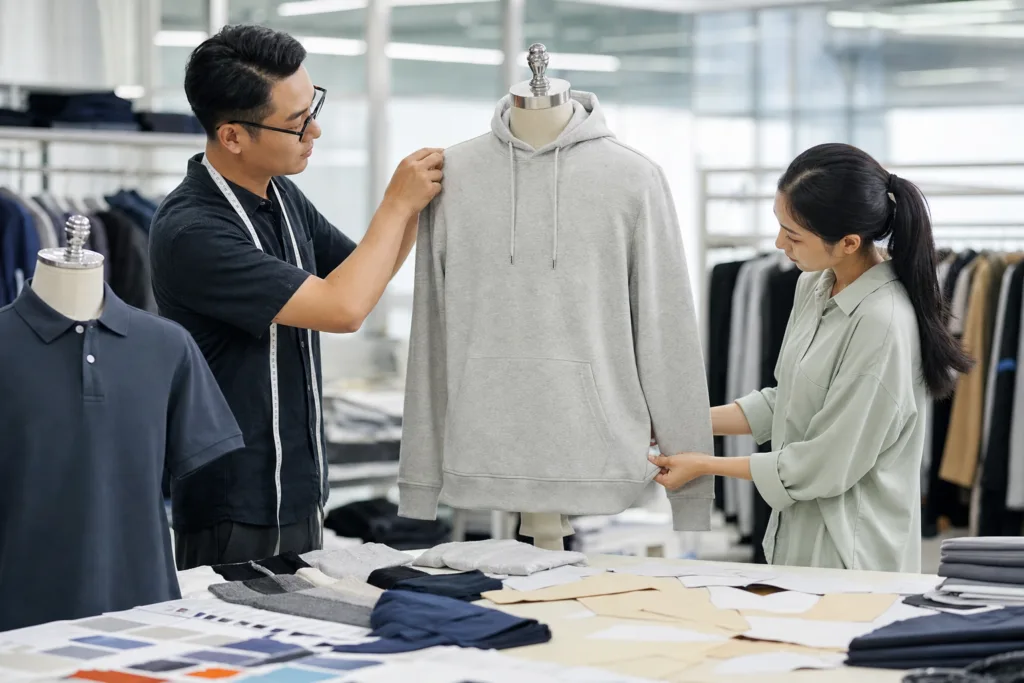
The fastest way to judge a factory is to see how it handles the first physical sample. Even when a buyer provides a clean tech pack, the sample reveals whether the team can interpret that information correctly and turn it into a wearable product.
Strong clothing manufacturer sample quality usually shows up in small details before big claims. The neckline sits correctly, the side seams hang straight, the chest and body balance make sense, the logo placement is measured rather than guessed, and the construction matches the garment’s use. Weak suppliers often miss these basics even when they speak confidently.
Fit and pattern making problems appear early
If the sample twists, pulls, rides up, or looks visually unbalanced, the issue is often not sewing speed but pattern accuracy. A supplier that understands pattern making will adjust shoulder slope, armhole depth, sleeve pitch, body taper, and hem shape based on the garment type and target customer.
For example, a golf polo, oversized streetwear tee, and compression-style sports top cannot share the same pattern logic. The first sample helps buyers see whether the manufacturer understands fit intent or is simply copying measurements without considering body movement and silhouette.
Common sample clues tied to pattern skill include:
- symmetrical collar and placket balance
- consistent left-right panel alignment
- sleeves hanging naturally without twisting
- hem shape matching the intended silhouette
- measurement tolerances close to the spec sheet
Construction knowledge shows in seam choices
A factory may offer many product categories, but the sample shows whether it knows how to build your specific garment. Performancewear, fleece, woven outerwear, and cotton jersey all need different seam logic, stitch density, and reinforcement methods.
This is why buyers should inspect seam behavior, not just appearance. If you want a deeper benchmark, our article on how seam strength tests reveal construction quality explains why seam durability is a better signal than neat-looking topstitching alone.
| Sample Area | What Strong Execution Looks Like | What Weak Execution Suggests |
|---|---|---|
| Shoulder seam | Flat, balanced, stable shape | Stretching, puckering, uneven joining |
| Collar or neck rib | Good recovery and clean attachment | Waviness, twisting, poor shape retention |
| Side seam | Straight hang and panel alignment | Body twisting or distorted fit |
| Hem finish | Even stitch line and clean drape | Tunneling, roping, or curling |
| High-stress points | Reinforced where needed | No support for wear and movement |
How fabric choice in the sample reveals real product understanding
Fabric is one of the clearest tests of whether a supplier understands the product or is only trying to win the order. The sample should reflect the right balance of hand feel, drape, GSM, stretch, opacity, shrinkage risk, and end use.
In practice, the wrong fabric often creates problems that buyers mistakenly blame on sewing. A heavyweight fabric can make a polo collar stand too stiffly. A jersey with poor recovery can distort a fitted tee. A brushed fleece may feel soft but become too warm for active use. Sample review helps separate style ideas from production reality.
What buyers should check in sample fabric
- Does the GSM suit the garment type and season?
- Does the hand feel match the brand position?
- Does the fabric drape correctly on the body?
- Is the stretch and recovery suitable for movement?
- Will shrinkage affect post-wash sizing?
- Does the surface support the chosen print or embroidery method?
Technical evaluation matters here. When a project depends on measurable performance, buyers should ask for evidence tied to fabric test methods for shrinkage, stretch, and seam performance rather than accepting broad claims like “good quality fabric.”
| Fabric Factor | Why It Matters in Sampling | Typical Risk if Missed |
|---|---|---|
| GSM | Affects structure, warmth, opacity, and cost | Garment feels too thin, too heavy, or off-positioning |
| Hand feel | Shapes first customer impression | Brand image mismatch |
| Drape | Influences silhouette and fit appearance | Style looks boxy or collapsed |
| Shrinkage | Changes size after washing | Approved sample does not match bulk after care |
| Color consistency | Affects approval and repeatability | Shade variation across orders |
| Surface stability | Supports printing and embroidery | Logo distortion or puckering |
From our perspective, a serious manufacturer should explain trade-offs during sampling. If a fabric improves softness but reduces structure, or if a lower-cost option increases shrinkage risk, buyers should hear that before approval, not after bulk cutting begins.
What the first sample says about communication and revision discipline
The first sample is also a communication test. It shows whether the supplier reads documents carefully, asks useful questions, and records revisions in a controlled way.
Some factories send back a sample quickly but with many avoidable errors. Fast delivery alone is not proof of good execution. A better sign is a supplier that identifies unclear points early, confirms assumptions, and explains feasible alternatives when requested details conflict with fabric behavior or MOQ realities.
Strong sampling communication usually includes
- clarification questions before cutting
- comments on risky or unclear design details
- measurement sheet confirmation
- logo artwork and placement verification
- written revision notes after buyer feedback
- realistic sample lead times instead of vague promises
When we review development projects at Ninghow, one of the clearest signs of factory maturity is whether the team can explain why a change is needed. That may involve placket length, rib tension, print area limits, zipper sourcing, or size grading logic. The explanation matters because it shows the supplier is solving production issues rather than just accepting comments passively.
Can the factory build from a tech pack, or is it guessing from a photo?
This question is critical. Many supplier problems begin when a manufacturer says yes to a reference image without fully defining measurements, construction, trims, and branding details.
A workable product requires more than visual resemblance. The sample should show that the factory can translate a tech pack into pattern pieces, operation steps, material choices, and quality checkpoints. If it only imitates the look of a photo, bulk consistency becomes risky.
Signs the supplier understands technical interpretation
- measurements follow spec with reasonable tolerance control
- construction details match the requested garment category
- trim choices fit function and price level
- artwork application method suits the fabric
- size labels, main labels, and care labels are placed logically
- revision comments are reflected accurately in the next sample
If the sample misses obvious spec details, buyers should treat that as a warning. It may indicate poor internal communication between merchandising, pattern making, cutting, sewing, and finishing teams.
For buyers comparing factories more broadly, it helps to assess garment factory capabilities and QC checkpoints alongside sample performance. The product may look acceptable in isolation, but its development path often reveals whether the supplier can scale accurately.
How to evaluate stitching, measurements, trims, labels, and finishing details
Sample review should be systematic. Buyers who only look at the front view can miss the issues that later create returns, delays, or costly rework.
A practical review process should include measurement checking, visual inspection, handling, and wear or wash consideration. Even if the order volume is still small, the sample should be treated like a test of future production logic.
Sample inspection checklist for buyers
- Measure key points against the size spec
- Check fit on body or mannequin from multiple angles
- Inspect stitch consistency and seam puckering
- Test stretch areas for recovery and seam stress
- Review logo placement, edge clarity, and durability expectations
- Check plackets, cuffs, zippers, drawcords, and other trims
- Confirm label content, position, and comfort
- Look for loose threads, oil marks, shade variation, or pressing issues
- Compare left and right symmetry
- Review packing requirements if presentation matters for retail
Quality checks should also be structured, especially before a trial run. Our guide to apparel quality control checks explains how inspection standards help buyers move from subjective comments to repeatable approval criteria.
| Checkpoint | Buyer Question | What It Tells You About the Factory |
|---|---|---|
| Measurements | Is the sample within tolerance? | Pattern and sewing control |
| Logo execution | Is placement accurate and stable? | Detail discipline and process control |
| Trims | Do they match quality and function targets? | Sourcing judgment |
| Finishing | Is the garment clean and presentation-ready? | Final inspection standards |
| Labels | Are they correct, readable, and well placed? | Private label execution accuracy |
Why a polished sales pitch can still hide weak execution
Good communication is valuable, but it can create false confidence when buyers do not test execution. A supplier may present many product photos, promise flexible service, and speak smoothly about custom development, yet still struggle with pattern control, trim management, or size consistency.
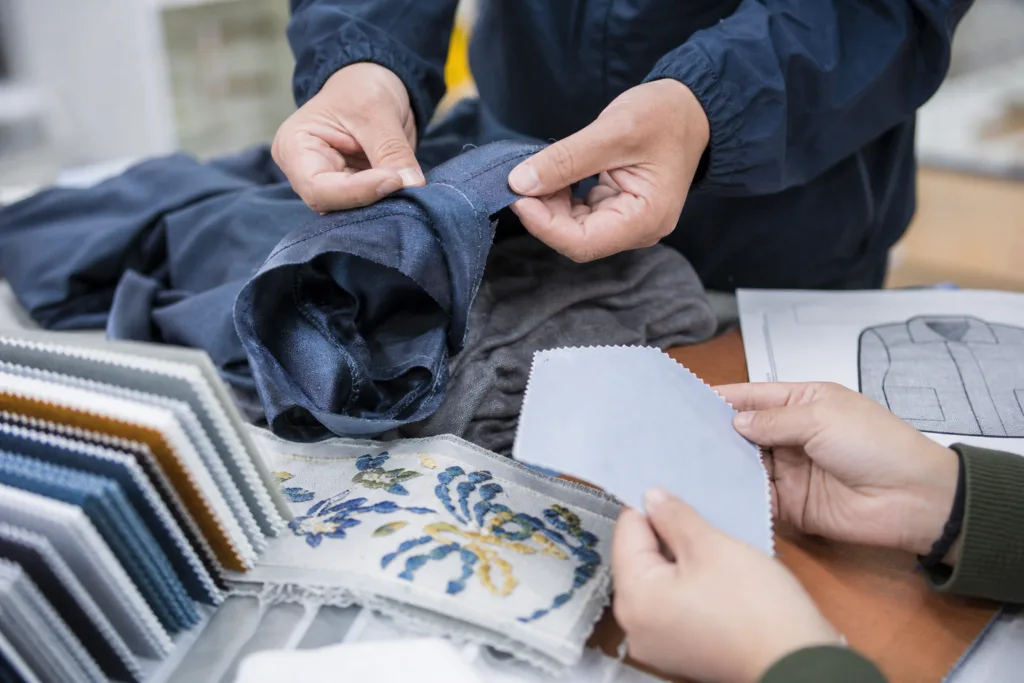
Sampling often reveals these problems quickly. Delayed clarification, repeated mistakes, fabric substitutions without approval, or unexplained spec deviations are stronger signals than polished presentation materials.
Red flags that often appear during sampling
- the sample ignores clear spec sheet instructions
- the factory avoids measurement discussions
- fabric or trims differ from what was confirmed
- revisions are only partly updated
- logo placement changes between iterations without explanation
- turnaround dates keep moving without clear reasons
- the supplier resists wash, shrinkage, or seam testing conversations
Key takeaway: A confident sales pitch is easy to prepare. A controlled, accurate, and well-documented sample process is much harder to fake.
How to judge responsiveness during sample development
Responsiveness is not just about how quickly emails are answered. What matters more is whether the supplier answers the right questions, tracks decisions, and reduces confusion over time.
Good development partners ask focused questions about fit target, logo dimensions, fabric behavior, tolerance priorities, and packaging expectations. Weak ones ask very little, then improvise. The difference becomes expensive during bulk production.
What disciplined responsiveness looks like
- comments are acknowledged point by point
- updated spec sheets or marked changes are shared clearly
- sample lead times are explained realistically
- issues are escalated early instead of hidden
- cost changes are tied to specific revisions
- the next sample solves old issues rather than repeating them
When buyers are unsure about moving beyond development, a small controlled run can reduce risk. That is why many teams first study how to launch a safe trial order with your clothing manufacturer before placing a full production commitment.
Prototype quality, pre-production sample quality, and bulk reliability are not the same thing
Buyers should not treat every sample stage as equal. A prototype proves concept direction. A revised development sample proves correction capability. A pre-production sample should confirm the approved materials, workmanship standard, and production-ready details.
This distinction matters because a beautiful prototype can still hide operational weakness. A manufacturer may hand-finish one piece carefully, but bulk production requires repeatability across cutting, sewing, pressing, trimming, inspection, and packing.
In more regulated product categories, structured sample signoff is also part of broader process control. The idea behind garment prototype testing requirements reinforces that prototypes and pre-production approvals are not just visual checkpoints but validation steps before wider production decisions.
| Stage | Main Purpose | Buyer Should Confirm |
|---|---|---|
| Prototype sample | Check concept and basic construction | Silhouette, feasibility, initial fit direction |
| Revised development sample | Apply corrections | Pattern updates, branding, trim changes, improved workmanship |
| Pre-production sample | Approve production-ready standard | Final fabric, color, labels, packaging, and workmanship |
| Bulk production | Scale consistently | Line consistency, QC discipline, packing accuracy, on-time delivery |
Common mistakes buyers make during sampling
One common mistake is overtrusting a nice-looking sample without asking how repeatable it is. Another is giving vague feedback such as “make it better” instead of marking exact measurement, fabric, and construction changes.
We also see buyers compress the sample timeline too aggressively. That often creates rushed decisions around fabric substitution, trim approval, color matching, and label content. A fast sample that skips technical clarity can create much larger delays later.
Sampling mistakes that increase risk
- approving a sample without checking measurements
- focusing only on appearance and ignoring seam behavior
- failing to document revisions clearly
- comparing prices before confirming equivalent fabric and trims
- approving color from photos only when precision matters
- assuming low MOQ means all custom details are easy to source
- not aligning the approved sample with future QC criteria
Key takeaway: Sampling works best when buyers treat it as a decision system, not just a design milestone.
How MOQ, lead time, and costing shape the sample strategy
MOQ, lead time, and cost are closely tied to sample planning. Buyers often think of sampling as separate from production economics, but the sample is where these realities begin to show.
Custom fabric knitting, dyeing, special trims, woven labels, and branded packaging can all affect MOQ thresholds. If the factory explains these constraints clearly during sampling, that is usually a positive sign. It shows the team is planning the full production path rather than quoting casually.
What buyers should ask before sample approval
- Will the approved fabric be available for bulk at the same quality level?
- Does the chosen trim have a minimum order requirement?
- Will embroidery, print size, or color count affect lead time?
- Are private label components sourced locally or custom made?
- What changes after sample approval would affect cost or delivery?
From our side, the best projects are the ones where sample feedback, costing expectations, and MOQ realities are discussed together. That gives buyers a more honest basis for supplier selection, especially for startups and mid-volume brands.
What a strong sample process looks like for private label and custom apparel
For private label projects, the sample should prove more than garment construction. It should also confirm branding execution, label content, packaging logic, and consistency with the brand’s market position.
A strong development process usually includes organized artwork files, size specs, fit intent, label requirements, trim direction, and a clear comment cycle. This is especially important when the garment includes multiple customization methods such as embroidery, screen print, heat transfer, or woven branding elements.
A buyer-ready private label sample file should include
- tech pack with measurements and construction notes
- logo files in usable format
- fabric composition and target GSM
- color references or approved standards
- label and hangtag requirements
- packaging instructions if retail presentation matters
- comment sheet for each sample round
When this information is prepared well, the sample process becomes a reliable supplier evaluation tool. It also helps us, as a manufacturer, identify where fit refinement, trim sourcing, or decoration method changes may improve cost-performance balance before production.
How to use sampling as part of supplier evaluation before a bulk order
The best way to use sampling is to score the supplier across several areas instead of relying on one impression. Buyers should compare execution, consistency, communication, technical reasoning, and correction speed.
This approach is especially useful when two factories quote similar prices. The better sample process often predicts the lower-risk production outcome, even if the unit price is not the absolute lowest.
| Evaluation Area | Questions to Ask | Why It Matters |
|---|---|---|
| Technical interpretation | Did the factory understand the tech pack? | Reduces costly bulk mistakes |
| Fit and pattern control | Does the garment wear as intended? | Protects customer satisfaction |
| Fabric judgment | Is the material right for function and price? | Improves product-market fit |
| Revision discipline | Were comments applied accurately? | Shows process maturity |
| Communication | Were risks explained early? | Supports smoother production planning |
| Production readiness | Can this sample standard be repeated in bulk? | Determines order confidence |
If a factory performs well in these areas, buyers can move into bulk planning with more confidence. If not, the sample has already done its job by revealing risk before larger money, time, and inventory commitments are made.
Conclusion: the sample is the clearest proof behind the pitch

When buyers want to know whether a supplier can truly deliver, the sample gives the most practical answer. It shows not only how the garment looks, but how the factory thinks, communicates, corrects problems, and prepares for bulk production.
That is why clothing manufacturer sample quality should be treated as a core supplier evaluation tool, not a routine formality. A strong sample process helps brands, startups, and sourcing teams choose manufacturers based on execution reality instead of presentation confidence alone.
FAQs
Why is a sample more reliable than a factory sales presentation?
A sample is more reliable because it shows actual execution rather than claimed capability. It reveals whether the manufacturer can interpret specs, choose suitable materials, control measurements, and apply revisions in a way that can support future production.
What should I check first when evaluating a clothing sample?
You should check fit, measurements, and fabric suitability first because those areas affect the garment’s core performance. After that, review stitching, logo application, trims, labels, finishing, and whether the sample matches your tech pack or reference comments accurately.
Can a good-looking sample still hide bulk production risks?
Yes, a good-looking sample can still hide risk if it was made with unusual attention that is hard to repeat in production. Buyers should ask whether the approved fabric, trims, workmanship level, and construction methods are all realistic for the intended order quantity and timeline.
How many sample rounds are normal before bulk production?
The normal number of sample rounds depends on product complexity, but two to three rounds are common for custom apparel. A simple item with a clear tech pack may need fewer revisions, while fitted, branded, or performance-focused garments often require more development before approval.
Does low MOQ make sample approval less important?
No, low MOQ does not reduce the importance of sample approval because small orders can still suffer from fit mistakes, branding errors, or unsuitable materials. In some cases, low-volume projects need even tighter decisions because custom trim and fabric options may be more limited.
How does clothing manufacturer sample quality help with supplier selection?
Clothing manufacturer sample quality helps with supplier selection by giving buyers a practical way to compare technical understanding, communication, workmanship, and revision discipline. It turns the supplier review process from opinion-based comparison into evidence-based evaluation.