


Choosing between OEM, ODM, and private label clothing is mainly a decision about what you need to control and what development work you are prepared to own. This OEM vs ODM vs private label comparison helps you match the route to your design inputs, budget exposure, customization needs, and approval responsibility.
The labels can overlap. OEM usually describes production from buyer specifications; ODM describes manufacturer-supported product development; private label describes selling a garment under your brand, with the base product and customization scope still requiring confirmation. The lowest apparent development burden is not always the lowest total project cost if missing specifications lead to revisions or unsuitable samples.
Choose OEM, ODM, or Private Label Based on What You Need to Control
Start with the decision that matters most: which product and development choices must remain under your control? A route name should help define responsibility, not replace a project brief.
Use OEM when your specifications are already defined
OEM is generally the clearest fit when you can provide a technical package, approved reference sample, defined measurements, construction details, artwork, materials, or another sufficiently complete specification. The manufacturer’s role is to interpret and produce against those inputs, while you remain responsible for ensuring the specification is complete and consistent.
Use ODM when you need development input
ODM is more suitable when you need help making product-development choices such as fabric, construction, fit, or details. The manufacturer may contribute practical options, but the buyer still needs to approve the design direction, materials, branding, fit, and final sample. ODM assistance does not automatically transfer design rights or third-party intellectual property.
Use private label when the product will carry your brand
Private label means the garment is offered under your brand, but it does not automatically mean off the shelf. Confirm whether the starting point is a standard base garment, a semi-custom product, or a garment developed specifically for your project. Changes to fit, fabric, color, decoration, labels, packaging, or construction can move the work closer to a full-custom development process.
| Route | Best starting point | Main buyer control | First question to confirm |
|---|---|---|---|
| OEM | Buyer specifications or approved sample | Technical requirements and production approval | Are the pattern, artwork, materials, and measurements complete? |
| ODM | Product concept with open development decisions | Design direction and approval decisions | Which choices will the manufacturer develop, and which will the buyer supply? |
| Private label | Branded base garment or custom product | Brand identity and agreed customization scope | What is standard, and what will be modified for this project? |
Budget therefore depends on development responsibility and change scope, not on the label alone. Before requesting a quote, separate design ownership, pattern responsibility, materials, branding components, sample approvals, and the changes you may still request.

Compare Development Responsibility, Customization, and Budget Exposure
The practical difference between routes appears in the work required before bulk approval. Use the comparison below to identify where cost and risk may enter the project.
| Decision area | OEM | ODM | Private label |
|---|---|---|---|
| Design source | Buyer supplies the design or production specification. | Buyer supplies a concept; development choices may be shared. | Buyer selects a base product or requests agreed customization. |
| Pattern and tech pack | Buyer may supply them; confirm who corrects gaps. | Manufacturer may support development; confirm ownership and approval. | Existing base files may be used, or new work may be required. |
| Fabric and trims | Buyer specifies them, subject to feasibility confirmation. | Options may be proposed and compared before approval. | Standard components may be available; custom choices add scope. |
| Fit development | Buyer provides measurements, grading, or an approved reference. | Fit decisions are developed and approved during sampling. | Confirm whether the base fit remains unchanged. |
| Decoration, labels, and packaging | Buyer supplies production-ready requirements. | Both parties confirm artwork, placement, and execution details. | Brand labels, hangtags, and packaging must be listed separately. |
| Approval exposure | Missing or inconsistent specifications may cause revisions. | More decisions require alignment before approval. | Each modification can create a new sample or review point. |
| Confirm before quoting | Pattern ownership, BOM, artwork, revisions, and acceptance criteria. | Development scope, decision owners, rights, and approval stages. | Base style, customization list, branding components, and packaging. |
Common apparel development cost drivers include pattern work, sample revisions, special fabrics or trims, decoration changes, validation needs, and packaging or labeling requirements. Pattern ownership should never be assumed: ask who supplies the pattern, who may revise it, who retains the technical file, and what version is approved for production.
For products sold in the United States, labeling responsibilities should be reviewed for the specific garment and current rules. The fiber-content, origin, and responsible-business labeling requirements are separate from brand decoration and should be assigned during development.
Know When a Change Restarts Development
A change restarts development when it affects a decision that the approved sample, pattern, materials, decoration, or production method was based on. A spelling correction in a file is different from changing the garment architecture.
Usually clarify first
- Correcting an administrative detail without changing the approved product.
- Confirming an already-approved measurement, artwork file, or packaging instruction.
- Aligning document names or version numbers before production, provided the physical requirements are unchanged.
Potential reset triggers
- Garment architecture: silhouette, measurements, grading, collar or placket construction, pocket placement, sleeve shape, or seam details.
- Materials: fiber composition, weight, stretch, finish, color standard, lining, interlining, elastic, buttons, zippers, or other trims.
- Decoration and branding: method, artwork scale, placement, label position, hangtags, packaging, folding, carton markings, or barcode requirements.
These changes can interact. A fabric change may alter fit, appearance, construction, and care instructions. A trim change may affect both construction and the garment’s final appearance. Care-label instructions must be supported for the finished garment, so a material or decoration change may require renewed review rather than a copied label.
Before bulk production, record the approved pattern version, bill of materials, artwork, measurement chart, labels, packaging instructions, and sample comments. Then ask: does the proposed change alter fit, construction, material behavior, legal information, branding placement, or production method? If yes, request confirmation from the development and production teams on whether a new sample or validation is required.
For a T-shirt or polo project, that review may include the fit, fabric surface, decoration, collar, placket, and labels. These are project inputs, not automatic specifications. A manufacturer should confirm the effect of each proposed change before the buyer treats the product as production-ready.
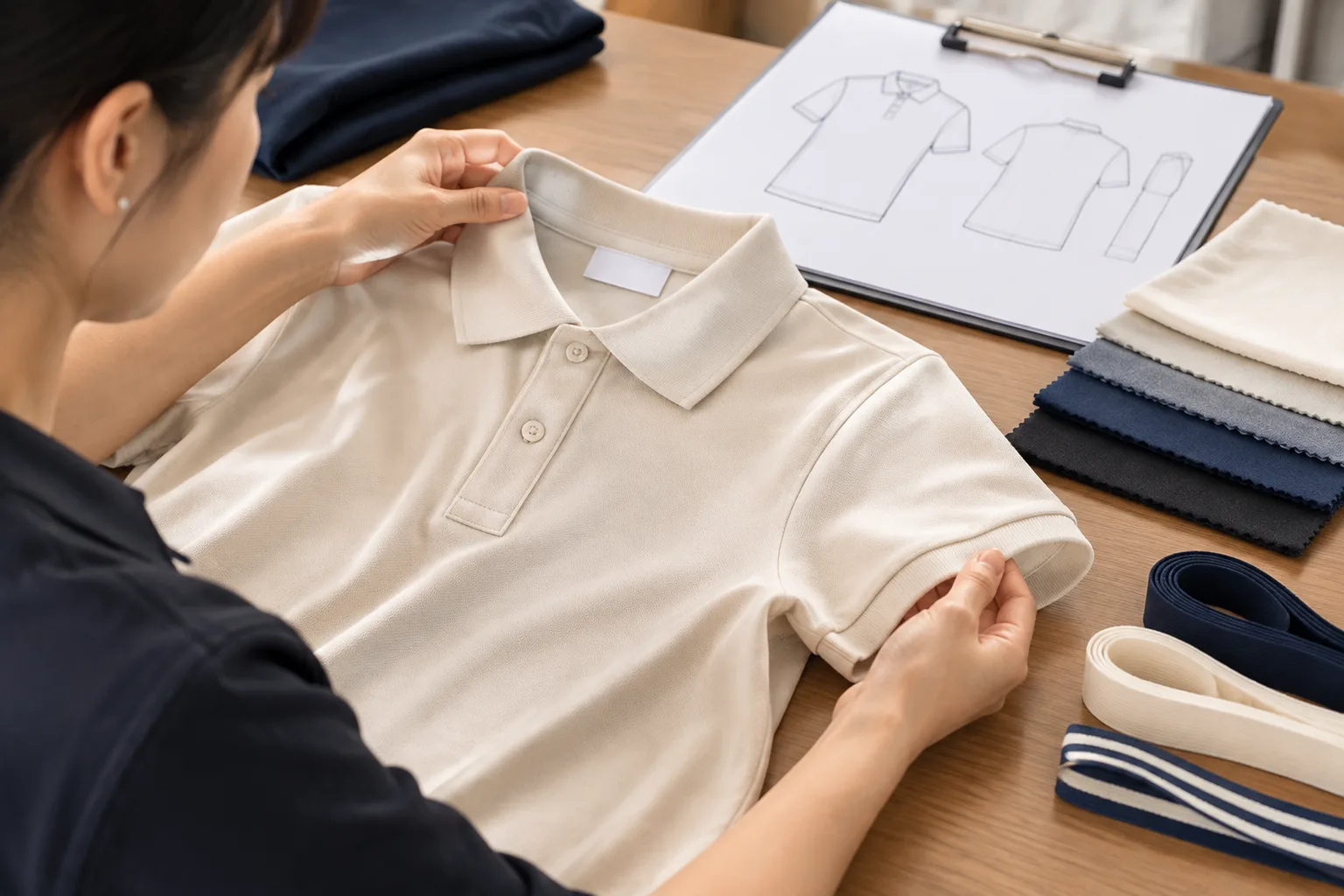
Decide What You Must Supply Before the First Sample
That confirmation should begin with a complete specification brief, even when the project uses a base garment. The brief lets the manufacturer separate feasibility questions, development work, and production details before quoting.
Buyer specification brief
- Project: product category, intended use, target market, sales channel, expected size range, and initial quantity assumptions.
- Product reference: reference images or samples, sketches, technical drawings, measurement chart, fit preference, grading expectations, existing pattern, and technical pack if available.
- Materials: main fabric, weight or composition requirements where known, trims, acceptable alternatives, color standards, and any material evidence already available.
- Decoration: artwork files, decoration technique, placement, dimensions, color references, and whether the artwork is final or open to development input.
- Branding and packing: brand labels, hangtags, legal information, folding method, packaging, carton instructions, and barcode or warehouse requirements.
- Decision ownership: identify what is fixed, what the manufacturer may propose, and what requires written approval before sampling.
Keep visual branding separate from information required for the destination market. For US-bound textile products, FTC guidance covers considerations such as fiber content, origin, and responsible-business identity, but the applicable requirements depend on the product and current rules. Treat this as a review item, not a universal label template.
Ask specifically who supplies and owns the pattern, artwork, grading files, and technical documents. Also confirm whether supplier-developed designs may be used only for this project, whether development or sample charges apply, how revisions are handled, and which documents are delivered after approval. These questions make private label vs full custom clothing easier to compare because they expose the actual development responsibility.
Use Two Buyer Scenarios to Match the Route to the Project
The route becomes clearer when the starting information is compared with the amount of interpretation still required. The following are hypothetical decision illustrations, not Ninghow customer cases or commercial guarantees.
1. Startup with a defined brand direction
Buyer situation: A startup has a finished logo, reference garments, preferred colors, and a plan for branded labels and packaging, but no measurement chart, pattern, complete fabric standard, or production-ready artwork.
Available evidence: logo files, garment references, intended sales channel, target market, size range, and a list of branding components. Evidence gap: fit measurements, construction details, material specifications, label information, packaging files, and a clear ownership agreement for any developed pattern.
Outcome: Clarify. A private-label route with controlled modifications or ODM support may be more practical than calling the brief complete OEM. The buyer should ask which base garment can be adapted, what changes affect fit or construction, and what development documents will be supplied. Pause before sampling if the brand cannot approve the intended garment shape, label information, or artwork version.
2. Established brand with an approved technical package
Buyer situation: An established apparel brand has an approved tech pack, measurement chart, fit block, material standards, decoration artwork, size range, and packaging instructions.
Available evidence: controlled technical files, approved artwork, pattern references, material requirements, and documented approval authority. Evidence gap: confirmation of the manufacturer’s production interpretation, available material alternatives, decoration result on the selected surface, and final label or packaging execution.
Outcome: Go to a scoped OEM review. Buyer-specification-led production may reduce interpretation, but it does not remove the need to confirm construction, decoration, labels, packaging, and any destination-market review. Clarify before approval if a requested substitute changes material behavior, fit, care instructions, or the production method. Pause bulk approval until the revised sample or supporting evidence matches the controlled specification.
Confirm Samples, Fit, Branding, and Quality Before Bulk Approval
Once the route and development scope are agreed, approval should be treated as a controlled handover rather than a visual thumbs-up. A sample can look right while still requiring review of measurements, grading, construction, decoration, or intended wear use.
Build the approval set
- Final approved sample and identified sample version
- Measurement chart, tolerances, and graded size set where applicable
- Approved fabric, trims, colors, and any accepted alternatives
- Decoration artwork, technique, dimensions, placement, and appearance on the chosen garment surface
- Brand labels, hangtags, required product information, folding, packaging, and barcode instructions
- Agreed inspection criteria or other order-specific evidence requirements
Use a change log for every comment. Record the file version, issue, responsible approver, requested action, revised sample status, and the version authorized for production. Changes to garment architecture, fit, material, trims, decoration, labels, packaging, or production method should be reviewed for a possible development restart.
Quality control should verify conformity with the approved specification and sample. Public statements about a supplier’s quality-control topic do not replace order-specific inspection evidence, test reports, or professional review where those are required. For US-bound products, also validate current, product-specific labeling and care requirements; care instructions need a reasonable basis for the finished garment as a whole.
Before bulk approval, confirm six items: route selected, scope confirmed, ownership clarified, reset triggers recorded, final approvals documented, and destination-market requirements reviewed. This is the point at which apparel development cost becomes easier to manage because the approved product, not an ambiguous route label, controls the handover.
For a qualified project review, send the garment category, intended use, target market and destination, expected size range, initial quantity assumptions, reference images or samples, technical files, fabric and trim requirements, logo and artwork, label and packaging needs, and any known pattern or fit information. Identify which elements are fixed and which may be proposed during development.
Frequently Asked Questions
Does private label mean the garment is off the shelf?
No. Private label describes a branding and product route, not necessarily an off-the-shelf garment. A buyer may use a base garment with selected modifications, or request additional development. Confirm the starting product, customization scope, pattern ownership, branding components, and approval process before treating private label as a lower-development option.
Who owns the pattern in an OEM, ODM, or private-label project?
Ownership depends on the agreement and on who supplied or developed the pattern. A buyer-supplied pattern may remain buyer-owned, while a manufacturer-developed pattern may require separate terms for ownership or use. Confirm this before sampling, along with delivery of pattern, grading, and technical files after approval.
Is private label cheaper than full custom clothing?
Not automatically. Private label may reduce development responsibility when a suitable base garment already exists, but modifications, branding, packaging, samples, and revisions still affect apparel development cost. Full custom work may require more buyer input and development, yet the correct comparison depends on change scope, ownership, and approval requirements.
What information should I send to compare OEM, ODM, and private-label options?
Send the product category, intended use, target market, sales channel, size range, quantity assumptions, references, technical files, fit preference, fabric and trim requirements, artwork, labels, packaging, and destination. Mark each item as fixed, proposed, or awaiting approval. Also state pattern ownership expectations and any required documents.
Which changes can restart apparel development after a sample is approved?
A change may restart development when it affects garment architecture, fit, measurements, material behavior, trims, decoration, labels, packaging, or the production method. A minor clarification may only update a record, but the manufacturer should confirm whether a new pattern, review, sample, or approval cycle is needed before bulk production.
Can an OEM or ODM project include custom labels, hangtags, and packaging?
Yes, an OEM or ODM project can include custom labels, hangtags, and packaging when the scope is agreed. Submit artwork, required information, barcode instructions, folding and packing details, and approval ownership. Keep brand components separate from destination-market information, which should be reviewed for the specific product and market.