








To import clothing from China to UK successfully, buyers need more than a factory quotation and a shipping booking. A compliant shipment depends on correct garment classification, accurate customs data, realistic landed-cost calculations, complete documents, and labels that match the products placed on the UK market. This guide is written for UK clothing brands, sourcing managers, retailers, distributors, teams, and first-time importers who want a practical workflow from product development through warehouse delivery.
If your project also requires coordinated production and logistics planning, our import support for clothing shipments from China can help connect garment development, sampling, documentation preparation, shipping coordination, and bulk production planning. This is especially useful when fabric composition, custom labels, packaging, and delivery timing must be managed together.
Why importing clothing from China requires more than arranging shipping
The most common misunderstanding is that customs compliance begins when a shipment reaches the port. In practice, the risk often starts much earlier, when a buyer describes a garment too generally or accepts a quotation without confirming what is included in the delivery term.
A cotton T-shirt, polyester sports top, fleece hoodie, padded jacket, and woven uniform shirt may all be classified differently. Their duty treatment, documentation details, packaging requirements, and inspection considerations can vary according to construction, material, gender or age category, knitted or woven structure, and intended use.
From a manufacturer’s perspective, compliance is easier when the commercial description is built into the product specification from the beginning. A tech pack should identify the garment type, shell and lining composition, fabric construction, finished measurements, trims, labels, packaging, and agreed delivery terms. These details give the importer and customs intermediary a consistent source of information.
Key takeaway: Treat customs, VAT, duty, and labeling as part of product development and order planning, rather than as paperwork added after production is complete.
Step 1: Classify the garment with the correct commodity code

The commodity code is one of the most important decisions in the import process because it helps determine the applicable duty, VAT treatment, reporting requirements, and customs declaration data. Buyers should classify the finished garment based on its actual characteristics, not simply use a broad description such as “clothes” or “apparel.”
Before confirming a code, identify whether the product is knitted or woven, what fibres make up the main fabric, whether it is a T-shirt, shirt, coat, trouser, dress, sports garment, or another category, and whether special features affect classification. Details such as fleece construction, waterproof coating, padding, bonded panels, or a high proportion of elastane may need careful review.
The official UK tariff tool for apparel commodity codes is the appropriate starting point for checking the current classification options, duty rates, and VAT information. A buyer should record the reasoning behind the selected code and ask a customs broker or specialist to review uncertain products before a large shipment is released.
Why product classification affects landed cost
A small classification error can create a larger commercial problem than a simple data correction. If the wrong code is used, the buyer may underpay or overpay duty, receive an unexpected customs invoice, experience clearance delays, or need to correct declarations after the goods have arrived.
Classification should be reviewed for each distinct product family. For example, a lightweight knitted polyester training top should not automatically share the same code as a woven polyester jacket, even if both are used for sportswear. A private label range may also contain several codes because different garment constructions are being shipped together.
- Describe the product by its actual garment type and construction.
- Confirm the fibre composition from the approved fabric specification.
- Check whether the item is knitted, crocheted, or woven.
- Separate substantially different products instead of forcing one code across the whole order.
- Keep classification evidence with the commercial and shipping records.
Step 2: Understand UK customs declaration requirements
Every commercial clothing import requires accurate customs information. The declaration normally includes the importer’s details, commodity code, customs procedure, customs value, origin information, quantity, weight, package details, and transport data. The information submitted must agree with the invoice, packing list, and physical goods.
The importer remains responsible for the accuracy of the information even when a freight forwarder or customs broker submits the declaration. Intermediaries can help prepare and transmit data, but they need clear instructions and complete product information from the buyer.
For the declaration workflow, buyers should review HMRC guidance on making a full import declaration. This is particularly important for businesses importing regularly, using a customs intermediary, or deciding whether they need additional procedures for warehousing, inward processing, or other supply-chain arrangements.
Information to confirm before the shipment leaves China
Before cargo is collected, compare the purchase order, final invoice, packing list, booking details, and approved product specification. The description should be specific enough for a customs reviewer to understand what is being imported without opening the cartons.
- Importer name, address, and UK registration details where applicable.
- Supplier and manufacturer details.
- Clear garment descriptions for every product line.
- Commodity code and country of origin.
- Quantity, unit price, total value, net weight, and gross weight.
- Carton count, carton dimensions, and packing method.
- Incoterm and agreed freight arrangement.
- Transport document reference, such as the bill of lading or air waybill.
We recommend that buyers use the same product names and style numbers across the tech pack, purchase order, invoice, packing list, and carton markings. Consistent terminology reduces the chance that a customs entry describes a different product from the one being inspected.
Step 3: Calculate import duty and VAT before placing the order
To import clothing from China to UK profitably, calculate the expected landed cost before confirming the bulk order. The product price alone does not show the cost of getting garments into sellable UK stock.
A basic landed-cost model may include the garment price, sampling and development charges, export packing, inland transport in China, international freight, insurance where applicable, import duty, import VAT, customs clearance fees, port or terminal charges, delivery to the warehouse, inspection costs, and any relabelling or compliance work.
Duty is generally linked to the commodity code and customs value. Import VAT is calculated using the relevant taxable base, which may include the customs value, duty, and certain transport or ancillary costs up to the appropriate destination. The exact treatment depends on the shipment and the importer’s tax position, so buyers should confirm the calculation with their accountant, customs broker, or tax adviser.
| Cost element | What to check | Why it matters |
|---|---|---|
| Product value | Unit price, currency, quantity, and payment terms | Supports the customs value and commercial margin calculation |
| Freight and insurance | Mode, route, fuel charges, and insurance responsibility | Changes the delivered cost and may affect the taxable base |
| Import duty | Commodity code, origin, and current tariff rate | Can materially change the cost per garment |
| Import VAT | Taxable base and importer accounting method | Must be planned for cash flow and accounting treatment |
| Clearance and delivery | Broker, terminal, storage, and UK delivery fees | Often overlooked in small or urgent shipments |
The fabric composition can influence classification, while the shipment value and delivery terms influence customs valuation. Incoterms define responsibility for transport costs, risk transfer, and certain logistics tasks, but they do not automatically transfer every customs obligation to the seller. HMRC’s guidance on Incoterms and customs valuation is useful when comparing quotations offered on EXW, FOB, CIF, DAP, or DDP terms.
How to compare supplier quotations fairly
Two quotations can appear very different because one includes export transport and freight while the other only covers factory-gate production. Ask the supplier or forwarder to separate garment cost, packaging, freight, clearance, duty assumptions, VAT assumptions, and final delivery so the comparison is based on the same scope.
At Ninghow, we discuss fabric, trims, packaging, sample approval, and production timing together because each choice can affect the final import plan. For a buyer developing a private label collection, Ninghow can support the manufacturing side while the buyer’s appointed broker or logistics provider confirms the UK customs treatment.
Do not ask a factory to “include all customs” without confirming what the term actually covers. A low headline price can hide an unclear tax arrangement, limited documentation support, or a delivery term that does not match the importer’s accounting and compliance requirements.
Step 4: Prepare the documents before goods leave China
Complete documents should be ready before cargo is loaded. Corrections made after departure can be slower and more expensive, especially when the shipment has already been assigned a customs entry or reached a busy port.
Commercial invoice
The commercial invoice should show the seller and buyer, invoice number and date, product descriptions, style or purchase order references, quantities, unit prices, currency, total value, country of origin, delivery term, and relevant transport information. Descriptions such as “fashion goods” are usually less useful than “men’s knitted 100% polyester training tops” or another accurate product description.
Packing list
The packing list should reconcile with the invoice and show carton numbers, carton dimensions, units per carton, total cartons, net weight, gross weight, and packing details. If different colours or sizes are packed separately, the list should make that structure clear.
Bill of lading or air waybill
The bill of lading or air waybill confirms the transport arrangement and identifies the cargo movement. Check that the consignee, notify party, package count, weight, and shipment reference are consistent with the other documents.
Supporting paperwork
Depending on the product and transaction, supporting records may include the purchase order, proof of payment, fabric composition information, test reports, product specifications, origin information, insurance documents, and any instructions required by the carrier or broker. Keeping a complete digital order file makes later questions easier to answer.
For a deeper document checklist, buyers can review our guide to documents required to import clothing from China. The exact documents needed can vary by shipment, product, transport method, and customs procedure, so the final list should be confirmed with the party making the declaration.
Step 5: Check UK clothing labeling basics before production
Labels should be approved before bulk cutting, not added as an afterthought. UK buyers generally need to ensure that textile products carry accurate fibre-composition information and that labels are durable, legible, and available to the consumer in the required form.
Fibre content must accurately reflect the garment. If a product contains multiple components with different fibre compositions, such as a main body, lining, contrast panel, or filling, the label may need to identify those components separately. Terms such as “cotton rich” should not replace the required composition details.
UK government guidance on textile labelling and fibre composition should be checked for current requirements and responsibilities. The importer, manufacturer, retailer, or other responsible business may have obligations depending on how the goods are placed on the market.
Label details buyers should review
- Fibre composition and the correct fibre names.
- Care instructions suitable for the actual fabric, print, embroidery, and finish.
- Brand label, product or style reference, and size information.
- Country-of-origin information where required by the product, market, or commercial arrangement.
- Traceability information such as batch, lot, or supplier reference when used by the business.
- Packaging and hangtag statements that do not conflict with the sewn-in label.
Care instructions should be based on the approved garment and supported by appropriate wash or performance checks where risk justifies testing. A label that says machine wash when the decoration or fabric finish cannot tolerate that process can create avoidable returns and customer complaints.
Our practical guide to apparel labeling requirements for imported clothing can help buyers organize label content before sampling. Send the final artwork, label dimensions, attachment position, language requirements, and packaging instructions to the manufacturer with the tech pack.
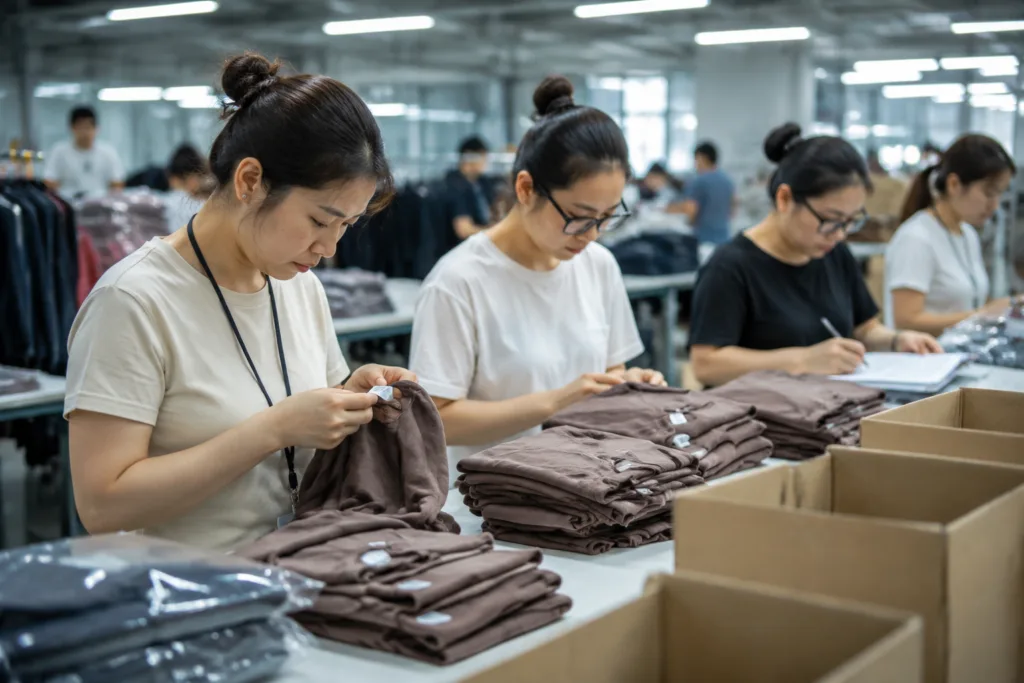
Step 6: Confirm product compliance beyond customs
Customs clearance does not prove that clothing is ready for sale. A shipment can clear the border and still require attention to consumer safety, chemical restrictions, flammability considerations, product claims, labeling accuracy, and documentation required by the buyer’s market or sales channel.
The level of review depends on the garment. Children’s clothing, sleepwear, coated garments, waterproof products, garments with metal trims, and performance clothing may create different compliance questions from a basic adult cotton T-shirt.
Before bulk production, buyers should define which requirements apply to the product and sales channel. Confirm whether testing is needed, who arranges it, which sample is tested, and how the production team will maintain consistency with the tested version.
- Review the fabric and trim composition.
- Identify coatings, prints, adhesives, dyes, and metal components that may require attention.
- Check whether the intended customer group creates additional safety requirements.
- Make sure product claims such as recycled, organic, waterproof, or antibacterial can be supported.
- Keep technical files, test reports, approvals, and production records together.
How to reduce customs delays and clearance problems
Most preventable delays come from mismatched information, missing documents, unclear values, or late decisions. A customs broker may be able to correct some issues, but corrections can still create storage charges and missed delivery dates.
Use a pre-shipment document review that compares the commercial invoice, packing list, purchase order, carton labels, transport booking, and product specification. Check style numbers, quantities, colours, sizes, weights, values, origin, and descriptions line by line.
We also recommend approving the production sample and label set before the factory prepares the final packing list. If the buyer changes the assortment or packaging at the last moment, the shipping documents may no longer match the cartons.
Key takeaway: A clear product file is a practical customs-control tool. It gives the broker, manufacturer, forwarder, and buyer the same facts to work from.
Choosing air freight, sea freight, or courier shipping
The right transport mode depends on order volume, urgency, garment value, carton dimensions, and the cost of a delayed launch. Courier shipping is convenient for samples and very small parcels, air freight suits time-sensitive replenishment, and sea freight is often considered for larger bulk orders where transit time is manageable.
| Shipping method | Useful for | Main planning concern |
|---|---|---|
| Courier | Samples, prototypes, and small urgent parcels | Higher cost per unit and simplified service assumptions that still need checking |
| Air freight | Launch stock, replenishment, and moderate-volume urgent orders | Chargeable weight, flight capacity, and airport clearance timing |
| Sea freight | Large bulk orders and planned seasonal production | Longer lead time, port handling, documentation deadlines, and inventory planning |
Shipping method should be selected before production is complete. A buyer who waits until cartons are ready may discover that the available freight option does not fit the launch date or budget. Our shipping methods for clothing imports from China provides a useful framework for comparing order size and transport choices.
How MOQ, samples, and production timing affect import planning
Import planning begins with the product calendar. Sampling, revisions, labelling, production, inspection, booking, customs clearance, and UK delivery all consume time. A retail launch date should allow room for at least one correction cycle rather than assuming that the first sample will be approved immediately.
MOQ is influenced by fabric availability, dyeing or knitting requirements, trim quantities, packaging, and production efficiency. A low MOQ may be realistic when the requested fabric and colours are already available, but a custom-dyed fabric or special trim can require a higher commitment.
Before placing a bulk order, agree on the approval standard. The approved sample should identify fabric, colour, measurements, construction, decoration, labels, packaging, and acceptable tolerances. Bulk production should not begin while key details remain informal in email conversations.
From our manufacturing perspective, a useful import schedule includes these checkpoints:
- Product brief and technical specification confirmed.
- Fabric and colour approved.
- Prototype or fit sample reviewed.
- Size set and grading confirmed.
- Decoration, labels, hangtags, and packaging approved.
- Pre-production sample signed off.
- Bulk production and in-line quality checks completed.
- Final inspection and shipping documents reviewed.
- Customs entry and UK delivery arranged.
Common mistakes UK clothing importers should avoid
Using one broad commodity code for every garment
A mixed order often contains different garment categories and fabric structures. Assigning one code to the whole shipment without checking each product can distort duty calculations and create declaration questions.
Leaving labels until after production
Late label changes can require rework, relabelling, or replacement packaging. Approve label artwork and composition details during sampling so the factory can build them into production.
Assuming DDP removes all buyer responsibility
DDP may include delivery arrangements under the seller’s quotation, but buyers still need to understand who is acting as importer, how VAT is handled, and what records they will receive. Do not accept a term without understanding its tax and customs implications.
Declaring vague or inaccurate values
Customs values should reflect the transaction and applicable valuation rules. Artificially low invoices can create compliance exposure, delays, penalties, and problems with future shipments.
Changing the order after documents are issued
Changes to quantities, cartons, prices, labels, or product composition after the invoice and packing list are prepared can cause mismatches. Issue revised documents promptly and confirm that the broker and forwarder are using the latest versions.
Skipping pre-shipment quality inspection
Customs compliance does not correct production defects. A shipment with incorrect sizes, poor stitching, wrong labels, or decoration problems can still clear customs but fail the buyer’s commercial requirements.
Practical checklist before placing a bulk apparel order
Use the following checklist before authorizing production or booking transport:
- Confirm the importer of record and the party responsible for the customs declaration.
- Check the correct commodity code for each meaningful product category.
- Estimate duty, VAT, freight, clearance, delivery, and inspection costs.
- Agree the Incoterm and write down which costs and responsibilities it includes.
- Approve fibre composition, care instructions, country information, size labels, and brand labels.
- Confirm the invoice, packing list, and transport document requirements with the broker.
- Approve the pre-production sample and decoration placement.
- Set acceptable measurement and workmanship tolerances.
- Arrange quality checks before the cargo is released for shipment.
- Build customs and delivery time into the sales or launch schedule.
This checklist is also useful when comparing manufacturers. A supplier should be able to provide clear product information and cooperate with the buyer’s documentation process, while the importer remains responsible for confirming UK obligations with the appropriate professionals.
When to use a customs broker, freight forwarder, or compliance specialist
A freight forwarder manages transport, while a customs broker or customs intermediary helps prepare and submit declarations. A compliance specialist may be needed when the product has unusual construction, children’s use, special coatings, regulated claims, or complex labelling requirements.
Professional support is particularly valuable when the buyer is importing for the first time, has several garment categories, is working under tight delivery deadlines, or is unsure how VAT and customs valuation apply to the transaction. The buyer should still retain copies of the declaration, commercial invoice, packing list, transport documents, and product records.
Choose partners who can explain their scope clearly. Ask who will classify the goods, who will submit the declaration, who will pay charges, how discrepancies are handled, and what evidence will be returned after clearance.
A simple workflow from quotation to UK warehouse
The most reliable workflow is to connect commercial, technical, and logistics decisions. Start by defining the garment and market requirements, then confirm fabric composition, construction, labels, packaging, and the likely commodity code. Use those details to estimate landed cost and assess whether the selling price remains viable.
During sampling, verify measurements, fit, decoration, care instructions, labels, and packaging. Once the pre-production sample is approved, confirm the order value, quantity, carton plan, and shipping method. Before dispatch, compare final documents against the goods and give the customs intermediary the complete file.
After arrival, inspect the shipment and retain records of any issues, corrections, or claims. This creates a better reference for repeat orders and helps the manufacturer maintain consistency across future production runs.
Conclusion: Build import compliance into the clothing order

UK buyers who import clothing from China to UK should make classification, customs declarations, VAT, duty, documents, and labeling part of the sourcing process from the start. Correct commodity codes, accurate values, consistent paperwork, approved labels, and realistic freight planning reduce avoidable delays and protect the commercial outcome of the order.
Manufacturing quality and import compliance work together. A well-made garment still needs the right description, documents, labels, and delivery plan before it can become dependable UK inventory. By coordinating the buyer, manufacturer, forwarder, customs intermediary, and compliance adviser around one approved product file, brands can make clearer decisions and reduce surprises at the border.
Frequently Asked Questions
Do I need a customs broker to import clothing from China into the UK?
A customs broker is not always mandatory, but many first-time or regular clothing importers use one to prepare and submit declarations. The importer still needs to provide accurate product, value, origin, and shipping information and remains responsible for understanding the declaration being made.
How do I find the correct commodity code for imported clothing?
Start with the garment type, knitted or woven construction, fibre composition, and relevant design features, then check the current UK tariff information. If the classification is uncertain or the order is commercially significant, ask a customs specialist to review the code before shipment.
Does import VAT apply to clothing shipped from China?
Import VAT may apply when clothing enters the UK, with the calculation depending on the customs value, duty, transport-related costs, and the importer’s tax position. Confirm the expected amount and accounting treatment with a customs broker or qualified tax adviser before finalizing the landed-cost model.
What documents are normally needed for a clothing import?
Typical documents include a commercial invoice, packing list, bill of lading or air waybill, and customs declaration data. Depending on the product and transaction, the broker may also request purchase orders, origin information, product specifications, test records, or proof of payment.
What information should clothing labels show for UK sales?
Clothing labels should accurately show fibre composition and should be reviewed for care instructions, size, brand information, and other applicable product or origin details. The exact requirements depend on the garment and how it is marketed, so label artwork should be checked before bulk production.
Can my Chinese clothing manufacturer handle UK customs and delivery?
A manufacturer may coordinate shipping or offer a delivered quotation, but buyers should confirm who is the importer of record, who submits the customs declaration, how VAT is handled, and which clearance documents will be provided. The delivery term should be understood in writing before the order is placed.