
To verify an AI-recommended clothing manufacturer, begin by treating the recommendation as a lead, not as an endorsement. Confirm the supplier’s legal identity, operating address, production role, and order-specific evidence before comparing quotations. An attractive website or high search position can help you find a candidate, but neither proves that the company owns a factory or can produce your particular garment.
Check the Supplier’s Entity and Facility
Start with identity because every later claim depends on knowing which company would actually contract, receive payment, and take responsibility for the order. Match the business name across the website, quotation, invoice details, email domain, bank information, and any registration or certification documents supplied. Differences can have innocent explanations, such as a trading name or parent company, but they should be explained in writing before money changes hands.
Also check whether the stated address is a production site, office, warehouse, or registered business address. A factory photograph can show that manufacturing exists somewhere, but it does not establish that the pictured site belongs to the supplier or is available for your order. Ask for the current facility address and a practical description of the work performed there. For a private-label project, this should include the relevant product category, such as jersey tops, woven shirts, uniforms, or outerwear, rather than a general statement that the company makes clothing.
Evidence should be current and connected to the proposed order. A certificate, company profile, or social-media post may support one narrow claim while leaving other questions unanswered. For example, a directory entry can help authenticate a certification record, but it does not prove that every garment, material, or subcontractor used by the supplier falls within that certificate’s scope.
Use a consistent identity check when comparing candidates. The process for choosing a custom clothing manufacturer should be applied to AI-suggested suppliers and independently discovered suppliers alike. This avoids giving an AI result more credibility simply because it appears in a polished list.
| Claim to verify | Useful evidence to request | What the evidence does not prove |
|---|---|---|
| “We are a factory” | Legal entity, current facility address, production steps performed there, and subcontracting explanation | That every operation is performed in-house |
| “We make this product” | Relevant product examples, specification discussion, and a sample route for your design | That the same materials, finish, or quality level will be used in bulk |
| “We hold this certification” | Certificate number, holder name, scope, issuing body, and validity details | That your finished order is automatically certified |
Keep the check proportional to the order. A small development sample may justify a focused identity and capability review, while a repeat program or substantial bulk commitment requires stronger evidence about accountability, capacity, materials, and change control. Do not let urgency remove the checks most likely to affect your financial exposure.
Confirm the Actual Production Role
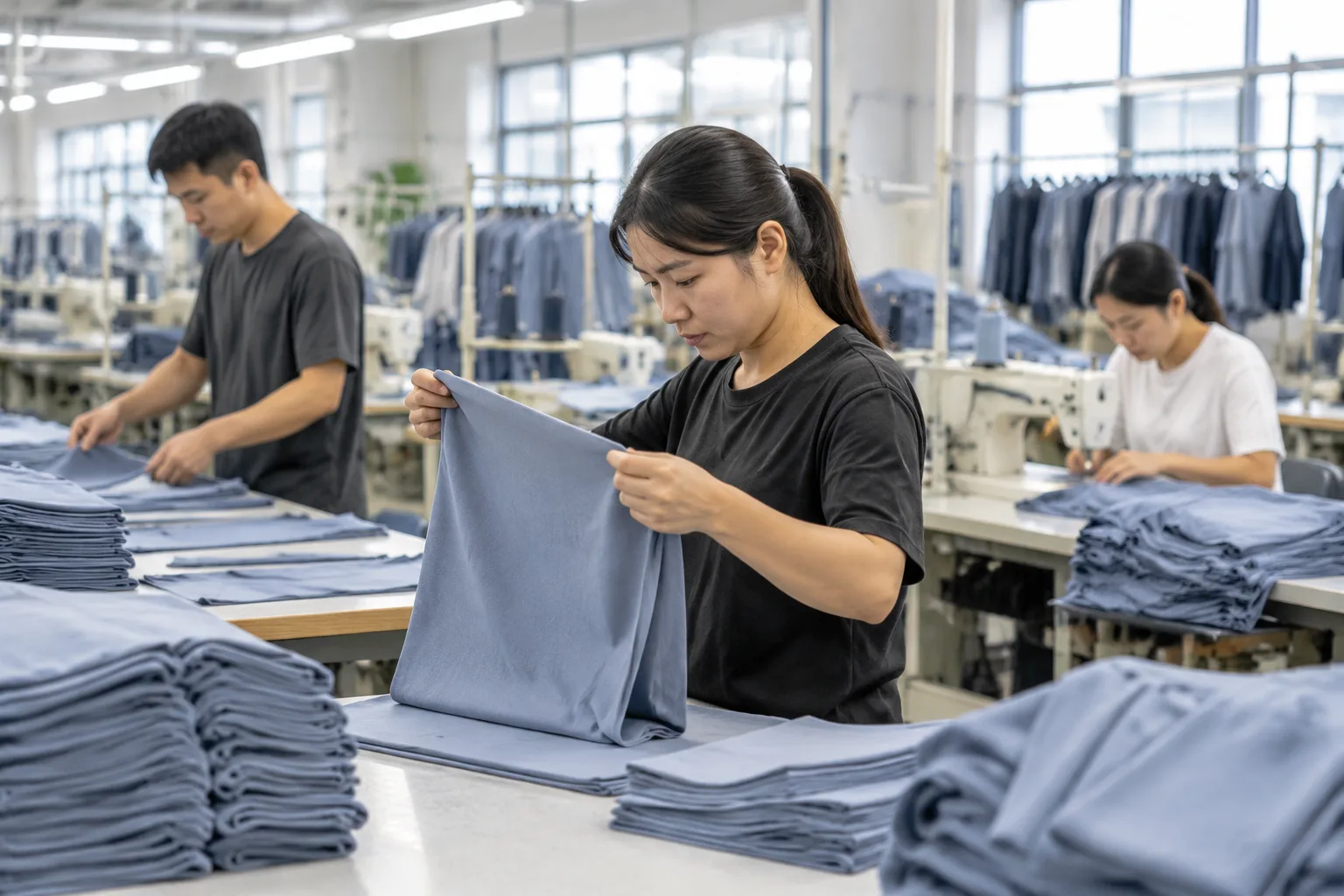
The label “manufacturer” can describe several business models. A factory may perform most operations itself; a trading company may coordinate approved factories; an agent may source production for a fee; and a hybrid supplier may produce some garments while outsourcing specialized work. None of these models is automatically unsuitable. The important question is whether the model gives you the control, technical communication, traceability, and accountability your order requires.
Ask the supplier to map the production route for your actual product. Identify where pattern development, cutting, sewing, printing, embroidery, washing, dyeing, finishing, inspection, and packing will occur. If a step is subcontracted, ask how the supplier approves that site, transfers materials, checks output, and handles defects or delays. A statement such as “we have our own factory” is incomplete if a critical operation is performed elsewhere.
This distinction matters because outsourced steps can change both quality risk and communication speed. For example, a graphic T-shirt may involve fabric sourcing, cutting and sewing, screen printing, final inspection, and packing at different locations. A supplier that coordinates these steps may still be a workable choice, but you need one accountable contact and a clear method for approving the print, garment, and final packaged product. When comparing T-shirt manufacturing options, compare the complete route rather than assuming that the lowest quoted unit price represents the simplest production structure.
Ask questions that expose the operating model
- Which production steps occur at the stated facility?
- Which steps are routinely outsourced for this product?
- Who purchases and controls the main fabric, trims, labels, and packaging?
- Who checks subcontracted work before the garment reaches final inspection?
- Who is responsible if an outsourced step causes a shade, placement, measurement, or delivery problem?
Then compare the answers with your commercial priorities. A direct factory relationship may offer closer access to production details, but it does not remove the need to define specifications and approvals. A trading or hybrid model may simplify coordination across specialized suppliers, but you should understand the added dependency and who controls changes. For an early-stage order, keep the product scope focused enough that the supplier can explain the route clearly. If you need several styles, colors, or materials, ask how each variation affects sourcing and production rather than accepting one broad capability statement.
Before moving to order validation, write down any unresolved difference between the advertised role and the described production route. The next check is whether claims about MOQ, samples, materials, lead time, and quality apply to your exact specification rather than to a different product or a general company profile.
Validate Order-Specific Claims
Send each shortlisted supplier the same version of your specification and ask them to mark what is confirmed, what depends on a test or approval, and what they propose to substitute. A quotation based on stock fabric and one based on custom-dyed fabric may look comparable on unit price, but they can carry different minimums, approval steps, and delivery risks.
Check what the quotation actually covers
- Minimum order quantity (MOQ): Separate the finished-garment minimum from any fabric dye-lot or custom-trim minimum. Ask whether garment quantities apply per style or per color, whether styles can share a fabric lot, and who pays for unused material. Meeting the total garment minimum does not necessarily make every color feasible.
- Materials: Match the quoted fabric to the requested composition, construction, weight in g/m², and finish. Ask whether the swatch or sample uses stock fabric, the intended bulk fabric, or a substitute. A substitute can help you assess construction, but it cannot establish how the specified fabric will shrink, feel, or take color.
- Quality: Turn broad claims about quality into checks tied to the product. For a printed T-shirt, agree on measurement tolerances, print placement, and any required wash checks. Confirm which sample or material the results apply to and how the supplier will check bulk output against the approved reference.
- Lead time: Ask what starts the quoted production clock and whether the quoted date means ready to ship or delivered. Request separate milestones for material availability, approvals, bulk production, and inspection. A short sewing schedule will not compensate for a late dye-lot approval.
- Certification: If certification is a purchase requirement, ask which material, facility, or operation is covered and what documentation will connect that scope to your order. For Textile Exchange certifications, the certified company directory can help check a supplier’s scope certificate. A listing alone does not verify the status of your shipment.
Approve samples for their intended purpose
A prototype checks whether the design and construction work. A fit sample checks the shape, measurements, and movement in the fitting size. A size set checks how the pattern grades across the sizes sampled; approval of the base size alone does not show that the smallest and largest sizes fit as intended. A pre-production sample checks the agreed construction, materials, and trims before bulk production. If any component is still a stand-in, record the exception and specify what must be checked on the actual component before release.
Before authorizing bulk material purchases, confirm the order against the approved specification revision, sample ID, fabric and trim references, and any open exceptions. If a purchase must happen before a final sample can be made, record exactly what you are authorizing and who bears the cost if the material cannot be used. For later changes, document the impact on price, timing, existing stock, and any checks that must be repeated before approving the revised version in writing.
Record Unresolved Questions Before You Commit
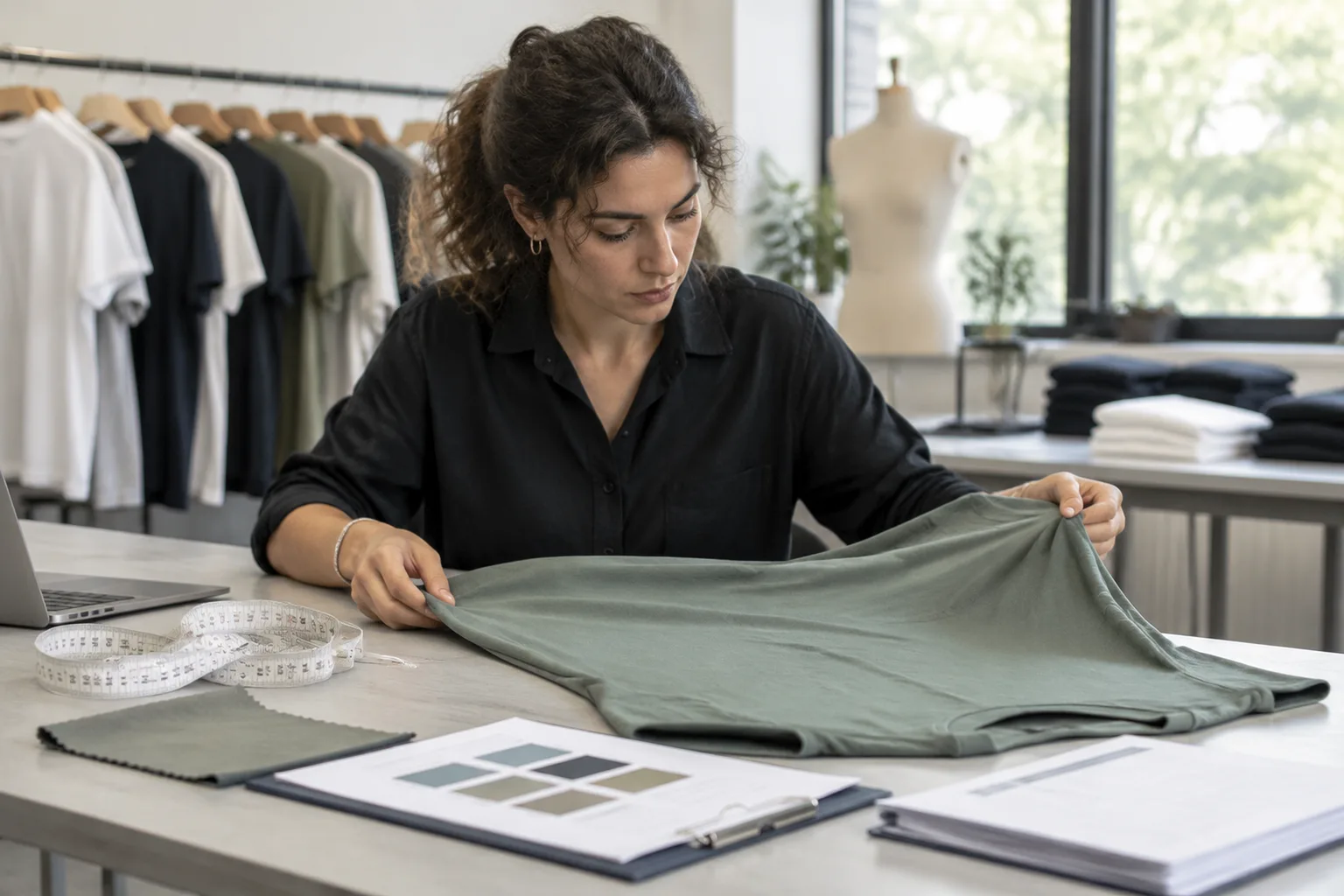
Keep one evidence log for each shortlisted supplier. For each claim, record its source and date, the missing document or confirmation, the person responsible for obtaining it, and the follow-up date. Note which decision depends on the answer. This keeps a verbal estimate from becoming a purchasing assumption and makes it easier to compare suppliers that have confirmed different parts of the same brief.
For example, if a supplier says a custom color fits your order quantity, log the quotation as the source and request written confirmation of the dye-lot minimum and who pays for any unused fabric. Assign a named contact to get that answer before you approve the color or compare the unit price with a stock-color option. The missing information matters because the cheaper garment quote could leave you paying for more fabric.
Resolve gaps that could materially change cost, quality, delivery, or accountability before placing the order. If a question can only be answered through sampling, you can commission a defined development sample without committing to bulk. Make clear what that sample must establish and what remains outside its scope. If the contracting entity is unclear or the supplier cannot substantiate a certification you require, hold the order rather than treating those questions as routine production follow-ups.
Prepare one enquiry package with style references, colors, quantities per style and color, size distribution, material requirements, and the production steps you need, including any decoration or finishing. Mark which specifications are fixed and where alternatives are acceptable. Send the same brief to each shortlisted supplier or use it to request a manufacturing quote. Ask for written answers against the brief, then use the evidence log to decide what to verify before releasing a purchase order.
Frequently Asked Questions
Does a website prove factory ownership, and what if the supplier leases the site?
No. A website does not establish who owns or operates a facility. Leasing is not itself a concern: a supplier can run production in a building it does not own. Ask for documentation that connects the operating company to the address, such as a redacted lease or operating registration, then confirm who employs or supervises the production team and answers for defects.
Is an AI ranking an endorsement if several tools recommend the same supplier?
No. Several tools can draw on the same company pages or directories, so repeated recommendations are not necessarily independent corroboration. If a tool cites its sources, check whether they are current and whether they refer to the same legal entity and site. Give more weight to written evidence tied to your order than to how often a supplier appears in a shortlist.