

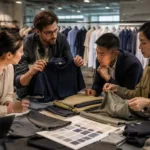






Choosing a long term clothing manufacturer partner is not about finding someone who can only complete a single purchase order. It is about finding a factory that can preserve fit, manage repeat orders, keep quality stable, and understand how your brand develops over time.
If you are still comparing options, it helps to evaluate clothing manufacturer fit for long-term brand growth before you commit to a production path. A good starting point is to look for support across sampling, fabric selection, label and packaging planning, and repeat-order coordination, because those are the areas that decide whether a supplier can become a reliable partner.
Why the difference between a supplier and a long-term partner matters
A supplier can complete an order. A long-term partner can complete that order again, with fewer corrections and less re-explaining. For apparel brands, that difference affects margins, launch speed, customer satisfaction, and how much time your team spends fixing problems that should not repeat.
The relationship also changes risk. If a manufacturer only focuses on the current shipment, each season starts from zero. If the factory keeps records, learns your fit preferences, and understands your decoration standards, every reorder becomes easier and more predictable.
| Area | Typical Supplier Behavior | Long-Term Partner Behavior |
|---|---|---|
| Fit and sizing | Rechecks everything from scratch | Retains patterns, size specs, and adjustment history |
| Sampling | Produces samples without much context | Uses prior approvals to shorten revision cycles |
| Quality control | Checks only the final shipment | Builds checkpoints across cutting, sewing, finishing, and packing |
| Reorders | Needs repeated clarification | Uses previous records to move faster and reduce mistakes |
Key takeaway: the strongest manufacturing relationships are built on memory, consistency, and process discipline, not just on price per unit.
What a Long Term Clothing Manufacturer Partner Should Deliver

Brands usually need more than manufacturing capacity. They need a team that can translate a product idea into a repeatable garment with stable construction and a clear path for future orders. That matters whether you are building a private label collection, sportswear line, team uniform program, or retail assortment.
From our manufacturing perspective, the best long-term relationship starts when both sides understand the product as a system. Fabric, fit, trims, labels, packaging, logo placement, and production timing all affect each other. If one part changes without a clear record, the next order can drift away from the approved version.
- Keep the same fit intent across sizes and reorder cycles
- Document fabric, trims, labels, and artwork clearly
- Reduce sample-to-bulk surprises
- Support practical MOQ planning as the brand grows
- Communicate timing, risk, and approval points early
When a factory behaves like a product development partner, not just a sewing vendor, the brand can scale with less friction. That is especially important for buyers who need recurring orders rather than one-off seasonal trials.
Stable fit and pattern knowledge protect version consistency
Fit consistency is one of the clearest signs of a real partnership. If the manufacturer keeps stable pattern files, size specs, and correction notes, the next run can match the approved version much more closely. If those records are missing, each reorder risks becoming a new experiment.
This is where pattern retention matters. A factory that understands your shoulder slope, sleeve opening, body length, waist tolerance, or athletic fit preference can preserve those details across batches. That saves time and also reduces the chance that customer feedback shifts from “great fit” to “this new batch feels different.”
For products like polos, hoodies, joggers, and teamwear, even small changes can affect how the garment feels on the body. A few millimeters in a key measurement may not sound like much on paper, but in production it can change drape, appearance, and perceived quality.
- Keep a clear tech pack with measurement tolerances
- Save approved sample comments in one place
- Record any size grading changes for future runs
- Confirm whether the next order should match the last approved sample or the last bulk shipment
If the manufacturer asks the right questions early, that is a positive sign. It usually means the team is trying to protect consistency rather than simply pushing the order through.
Supply chain coordination keeps repeat orders moving
Strong supply chain coordination is a practical advantage, not a buzzword. When a factory already knows which fabrics, trims, and decoration methods work for your product, it can reduce approval loops and source more efficiently. That does not always mean the order becomes cheaper, but it often becomes more reliable.
Brands with recurring programs should pay attention to how the factory handles material planning. A good partner will flag issues such as fabric availability, color matching risk, trim lead time, or decoration constraints before they become a production delay. That kind of early warning is often more valuable than a small price difference.
It also helps when the manufacturer understands the business rhythm of repeat production. For example, if your collection reorders every eight to twelve weeks, the factory should plan fabric reservation, sample approval, and bulk slot allocation around that cadence instead of treating each order as an isolated event.
| Coordination Area | What to Ask | Why It Matters |
|---|---|---|
| Fabric availability | Can the same fabric be reordered later? | Protects color and hand feel consistency |
| Trims and labels | Are standard trims kept in records? | Speeds up repeat production |
| Color matching | What is the approval method for bulk shades? | Reduces visible variation between runs |
| Decoration planning | Can printing or embroidery be repeated exactly? | Supports brand consistency |
Re-order efficiency is one of the strongest signs of partnership
Repeat orders should not feel like starting from zero. If the supplier needs the same explanations every time, your team loses efficiency and the production calendar gets harder to manage. A long-term partner shortens the path between approval and bulk because the key decisions already exist in the record.
This becomes even more important when your brand grows. More orders mean more deadlines, more SKUs, and more coordination across sizes and colors. A factory that can support repeat work efficiently will usually help you protect launch schedules and reduce avoidable rework.
For this reason, many brands ask for a clear timeline before confirming the order. Our view is that production timing should be discussed with the same seriousness as price and fabric selection. If you need a practical benchmark, production timeline planning for smoother repeat orders is one of the best ways to keep each reorder aligned with your launch plan.
- Confirm whether the same materials can be reserved again
- Check if approved artwork and size specs are stored for later use
- Ask how the factory handles priority scheduling for repeat clients
- Review whether past production issues were documented and resolved
Quality consistency across batches protects your brand
Quality consistency is the real test of a long-term relationship. A sample can look good once, but the partnership only proves itself when the factory can repeat that standard at scale and across multiple orders. That means controlling fabric, stitching, color, fit, and finishing, not just the final appearance.
In practice, quality control should cover more than final inspection. It should start before cutting and continue through sewing, finishing, packing, and carton checks. Reliable factories also keep approval records so the team can compare current output against the accepted standard instead of relying on memory.
For a deeper technical reference, we also recommend reviewing garment quality control processes that cover fit, durability, seam integrity, and performance factors such as shrinkage. That kind of reference helps brands ask sharper questions when reviewing a factory’s process.
A manufacturer that treats QC as a routine system, rather than a final-stage reaction, is easier to trust for repeat production. That is especially true for products with decorated panels, fitted silhouettes, or performance fabrics where small variations are easy to notice.
Key takeaway: quality consistency is not just about rejecting bad garments; it is about preventing avoidable variation before bulk production is complete.
What we look for before bulk production
From a manufacturing point of view, the most useful controls are simple and repeatable. We want the approval sample, measurement sheet, fabric reference, trim reference, and artwork details to all agree before bulk starts. If they do not, the team may solve one problem while creating another.
That is why buyers benefit from asking how the factory records approvals and how it manages changes. The answer often reveals whether the supplier is built for continuity or only for short-term transactions.
Faster development speed comes from accumulated product knowledge
Development speed improves when the factory already understands your style direction. The second or third style in a program should usually move faster than the first, because the manufacturer has already learned your preferences for fit, finishing, decoration, and packaging. That learning effect is one of the main reasons long-term partnerships save time.
Sampling is where this improvement becomes visible. A good sampling workflow gives the brand room to test the fit and construction before bulk, but it also preserves useful information for the next round. If the sample process is handled well, fewer revisions are needed later.
You can see how this works in practice by reviewing sampling workflows that help refine fit and construction. When sampling is structured properly, the approved version becomes a reference point instead of a one-time event.
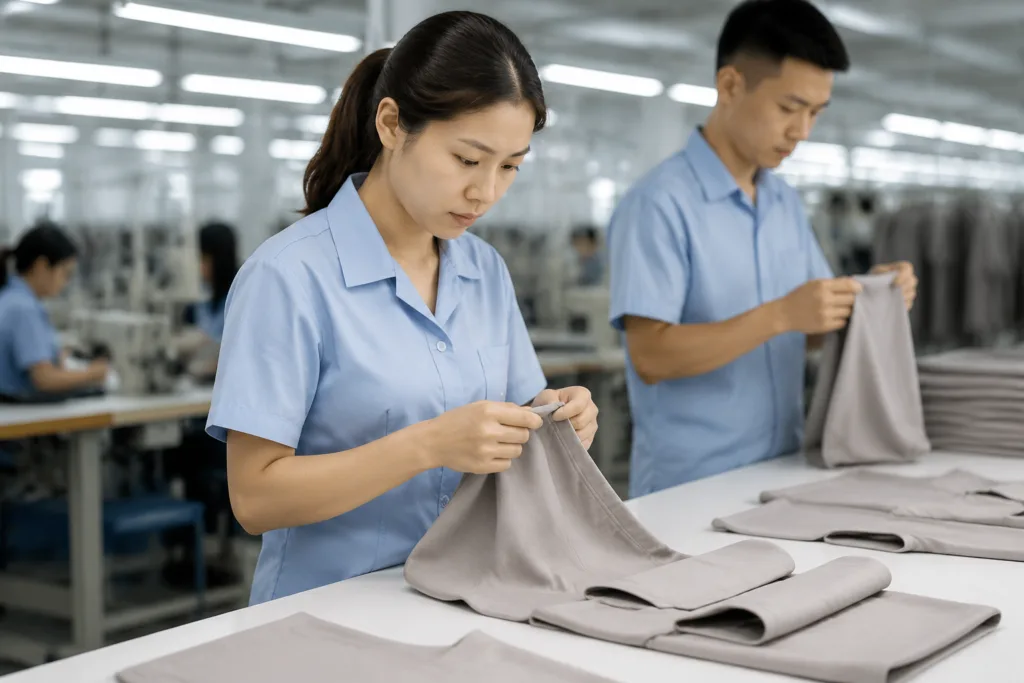
That matters for both startups and established brands. Startups need help translating an idea into a real garment. Established brands need speed without losing consistency. A long-term partner should be able to support both.
- Share reference samples and explain why they matter
- Confirm whether the first sample is for fit, construction, or final approval
- Ask the factory to note all approved changes for future use
- Keep one clear decision-maker on the brand side to reduce delays
Communication habits reveal whether a supplier can become a partner
Good communication is not about constant messaging. It is about clear, structured, and documented communication that reduces confusion. If the factory replies quickly but never confirms details in writing, the relationship may still be fragile.
A stronger partner asks clarifying questions, summarizes decisions, and flags risks early. That is true in fabric sourcing, sample revision, bulk scheduling, and packaging decisions. In other words, communication should make the production process easier to repeat.
At Ninghow, we treat clear communication as part of manufacturing, not an afterthought. When a buyer shares a complete spec, design intent, and reorder expectation, it becomes much easier to protect consistency and avoid version drift.
Signs of healthy communication
- The factory confirms measurements, materials, and decoration methods clearly
- Questions are specific and tied to production risk
- Changes are documented before approval
- Deadlines are explained in relation to sampling and bulk milestones
Customization continuity matters more than one-time customization
Many buyers focus on whether a factory can add embroidery, printing, woven labels, neck prints, hangtags, or special packaging. Those are important, but the real question is whether the factory can repeat the same customization accurately on future runs. That is what turns a production source into a long-term apparel supplier relationship.
Decoration methods also affect production planning. Embroidery may need different stitch settings and placement checks. Screen printing may require separate color control. Heat transfer, sublimation, and woven labels each add their own approval steps. A partner understands those differences and records them for repeat use.
Customization continuity is especially important for private label collections and team programs. If the logo shifts, the packaging changes without notice, or the label positioning moves, the brand experience becomes inconsistent even when the garment itself is acceptable.
- Keep final artwork files organized by style and season
- Store label dimensions and packaging specifications with the approved sample
- Confirm whether decoration alignment must be re-approved for each batch
- Ask how the factory protects repeat color matching on printed elements
How to evaluate whether a manufacturer can support long-term cooperation
The best way to evaluate a possible partner is to look at behavior, not promises. A factory that can explain its process clearly, retain documentation, and anticipate repeat-order risks is usually better prepared for long-term cooperation than one that only answers the price question.
Buyers should also think about the relationship in stages. The first sample, first bulk order, and first reorder each reveal something different. If the factory learns quickly and keeps records well, the relationship can improve over time instead of resetting with every style.
| Evaluation Point | Strong Signal | Weak Signal |
|---|---|---|
| Sampling | Clear revision notes and fit control | Unclear sample purpose |
| Quality system | Defined checks before and during production | Only final inspection |
| Record keeping | Approved specs saved for reuse | Relies on memory only |
| Communication | Specific, documented, and timely | Vague or inconsistent |
| Repeat orders | Faster because of prior knowledge | Requires full reset every time |
Common warning signs that a supplier is not built for partnership
Some suppliers are fine for a single shipment but weak for growth. The warning signs usually appear early if you know what to look for. They include unclear specs, changing answers, inconsistent sample quality, and resistance to documenting approvals.
Another warning sign is when every issue is treated as a one-off exception. If the supplier never builds a repeatable method, your team will spend more time managing the factory than developing the product. That is usually not sustainable for brands planning multiple seasons or replenishment programs.
- The factory cannot explain how it stores approval records
- Material options change without clear explanation
- Reorders require full re-briefs with no reference to prior work
- Quality issues are handled only after shipment
- Timelines are given without clear production milestones
Questions brands should ask before starting cooperation
The right questions help you see how the factory thinks. Ask how patterns are stored, how fit changes are tracked, how fabric reorders are handled, and how the team manages repeat decoration. The answers should sound practical, not vague.
It is also helpful to ask how the factory defines low-risk repeat production. For example, does it keep the same fabric supplier? Does it store trims? Does it compare each bulk run against the approved sample? These questions reveal whether the factory can support your future orders, not just your first order.
- How do you store approved patterns, size specs, and artwork files?
- What happens if we reorder the same style after several months?
- How do you handle fabric and trim availability for repeat production?
- What QC checkpoints are used before packing?
- How do you document changes from sample to bulk?
How to structure the first orders to test partnership potential
The first orders should be designed to test the system, not just the garment. That means evaluating fit consistency, communication quality, sampling discipline, and how well the factory follows the approved reference. A small but well-structured first order often teaches more than a large, rushed launch.
Start with clear priorities. If fit is critical, focus the sample stage there. If branding is critical, test labels, packaging, and decoration repeatability. If delivery matters most, review how the factory plans the timeline and where bottlenecks might appear. If you need a framework for that part of the process, apparel quality control practices that support consistency are essential to review before bulk production begins.
Brands that ask for a second run soon after the first order can learn a lot about the factory’s real strengths. A manufacturer that handles the reorder smoothly is often showing you the basis for a long-term partnership.
What a healthy long-term apparel supplier relationship looks like after multiple reorders
After several orders, the relationship should feel simpler, not harder. The factory should understand your preferred measurements, be able to refer to prior approvals, and communicate clearly when a new issue appears. That is what makes growth manageable.
The best long-term relationships also create better planning. Instead of reacting to every order separately, both sides can forecast fabric, trim, and production needs more accurately. That makes it easier to protect launch dates and keep brand quality steady.
When a manufacturer becomes a true long-term clothing manufacturer partner, the role expands beyond sewing garments. The factory becomes part of your product system, helping you reduce friction while keeping the brand standard stable from one release to the next.
Conclusion

A clothing supplier becomes a long-term partner when it can repeat what matters: fit, quality, timing, decoration, and documentation. Those are the practical foundations that support brand growth, not just one shipment.
If you are choosing a manufacturing relationship for repeat production, focus on how the factory handles sampling, record keeping, QC, communication, and reorder planning. Those details tell you far more than a price quote alone.
For brands that want continuity, the goal is simple: find a partner that can learn your product once, then help you produce it well again and again.
FAQs
How can I tell if a manufacturer is a long-term partner?
A long-term partner can repeat your product accurately and explain its process clearly. Look for strong sample records, consistent communication, documented approvals, and the ability to manage reorders without starting over.
Why does pattern retention matter for repeat orders?
Pattern retention matters because it protects fit consistency across future runs. If the factory keeps approved patterns and size specs, it can reduce version drift and save time on every reorder.
What should I check before approving the first bulk order?
You should check fabric, measurements, decoration placement, label details, packing method, and the quality of the pre-production sample. The first bulk order should match the approved reference as closely as possible.
How do sampling and reorders reduce communication mistakes?
Sampling and reorders reduce mistakes because they create a shared reference. Once the factory has a documented approval, it can compare future production against that standard instead of relying on memory or repeated explanations.
What is the biggest warning sign a supplier is not partner-ready?
The biggest warning sign is the lack of records. If the supplier cannot store approvals, explain repeat-order handling, or document changes clearly, the relationship is likely to stay transactional and inconsistent.
How should I structure first orders to test the relationship?
You should structure first orders around the risks that matter most to your brand, such as fit, branding, timeline, or quality. A focused first order shows whether the manufacturer can learn your requirements and support future reorders.