







Brands usually ask where to find clothing manufacturers when they are really trying to solve a bigger problem: how to find a supplier that can make the right product, at the right quality level, with a process the brand can actually manage. The discovery channel matters because it affects what kind of factory you find, how much information you can verify early, and how much sourcing risk you carry into sampling and bulk production.
If you need a practical way to build a shortlist of clothing manufacturers, the most useful approach is to combine discovery with early qualification. At Ninghow, we see better sourcing outcomes when buyers do not stop at finding supplier names. They also compare garment categories, fabric capability, customization methods, MOQ logic, sample support, and production communication before moving forward.
Why the way you find a clothing manufacturer affects quality, cost, and risk
The source of your supplier list shapes the quality of your shortlist. Search engines often reveal suppliers with clearer websites and stronger content. Trade shows let you compare several manufacturers quickly. Referrals can reduce noise, but they should never replace verification.
From our manufacturing perspective, a weak discovery process often leads to avoidable problems later. Brands may end up speaking with suppliers that do not really specialize in their product category, cannot support their fabric needs, or are not structured for private label development.
Key takeaway: The best answer to where to find clothing manufacturers is not one channel. It is a structured process that uses multiple channels and then filters candidates against your actual production needs.
What kind of manufacturer does your brand actually need?
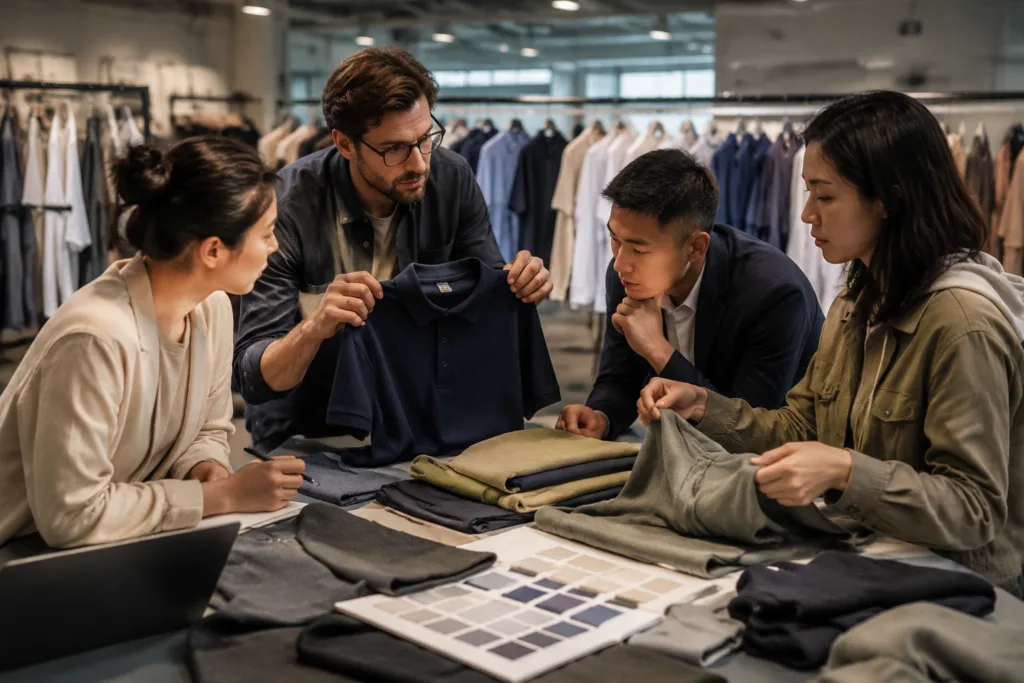
Before searching, define the type of supplier that fits your project. This step saves time because many sourcing problems start when a buyer looks broadly for “a clothing manufacturer” without clarifying whether they need OEM development, ODM options, low MOQ support, or bulk production capacity.
| Supplier need | Best for | What buyers should confirm |
|---|---|---|
| OEM manufacturer | Brands with their own designs, specs, and branding | Pattern development, fabric sourcing, customization accuracy, QC control |
| ODM manufacturer | Buyers adapting existing styles faster | Style library, modification flexibility, branding options, speed to sample |
| Private label manufacturer | Retailers and brands needing labels, packaging, and branded presentation | Label setup, hangtags, packaging, color consistency, reorder ability |
| Low MOQ manufacturer | Startups and trial launches | Which parts are low MOQ, fabric stock limits, trim flexibility, cost trade-offs |
| Bulk production supplier | Established brands and stable repeat orders | Capacity planning, line balance, lead time discipline, consistency in scale |
For example, a startup activewear label may need a factory that can handle stretch fabrics, grading, logo placement, and low-volume sampling. A school uniform buyer may care more about size consistency, repeat fabric availability, and delivery stability. A fashion retailer using ready silhouettes may prefer private label or ODM support.
When buyers define this early, their search becomes more targeted and more realistic.
Where to find clothing manufacturers through search engines
Search engines are often the best starting point because they let buyers search by product, capability, and production intent. Instead of using only broad keywords, use intent-based searches that reflect what you are sourcing.
- custom polo shirt manufacturer
- private label sportswear manufacturer
- OEM hoodie factory low MOQ
- golf apparel manufacturer with embroidery
- bulk T-shirt manufacturer export
- school uniform manufacturer sample development
You can also use search operators to improve results. Adding quotation marks, product categories, country names, and capability terms helps reduce irrelevant listings. This is especially useful when you want factories with a clear category focus rather than general trading directories.
Early in this stage, many buyers also need how to tell a real manufacturer from a trading company. That matters because the communication style, technical depth, pricing logic, and production control can be very different.
What to look for in search results before you click
Search results themselves reveal useful signals. A supplier with clear product pages, capability descriptions, and process pages usually understands buyer concerns better than a site with only generic claims.
- Does the title or page description mention your garment category?
- Is there evidence of OEM, ODM, or private label support?
- Are there pages about sampling, fabrics, customization, or QC?
- Does the site seem built for B2B buyers rather than retail consumers?
If a website talks clearly about garment construction, decoration methods, fit development, and order workflow, that is generally a better sign than a site focused only on broad promises.
What manufacturer websites should prove
Once you land on a site, look for proof of production fit, not just polished design. A useful manufacturer site should help you understand whether the supplier can support your category, customization level, and order structure.
Good websites usually show some combination of category pages, fabric discussion, sample or process pages, and evidence of buyer-oriented communication. At Ninghow, we find that serious B2B buyers typically want to know how the factory handles fit, trims, labeling, logo methods, MOQ conditions, and bulk consistency before they ever ask for a quote.
| Website element | Why it matters | What to question |
|---|---|---|
| Category-specific product pages | Shows actual garment focus | Are the products similar to yours? |
| Customization pages | Shows logo and branding support | Can they explain print, embroidery, labels, packaging? |
| Sampling or process pages | Reveals development workflow | Do they explain revisions, approvals, and timelines? |
| Quality pages | Suggests process discipline | Are QC steps described in practical terms? |
| Detailed contact response path | Shows B2B readiness | Can you submit specs, target quantity, and requirements clearly? |
If the website is too vague, use first contact to test whether the supplier can answer technical questions clearly.
When B2B sourcing platforms are useful and where they fall short
B2B platforms are useful for building a wide first-pass list quickly. They can help when you need to compare many suppliers by product type, region, certification claims, or minimum order range. They are especially practical for early market scanning.
The limitation is that platform profiles often compress complex production reality into short listings. Buyers may see similar claims from very different suppliers, and that makes it difficult to judge real garment expertise without deeper follow-up.
- Use platforms to generate candidate names fast.
- Do not rely on platform badges alone for qualification.
- Move shortlisted suppliers to website review and direct communication quickly.
- Ask category-specific questions before investing time in samples.
In practice, platforms tend to attract a mix of factories, trading companies, sourcing offices, and multi-category suppliers. That does not make them unusable. It simply means the platform is the beginning of screening, not the end of it.
Why trade shows can accelerate shortlist quality
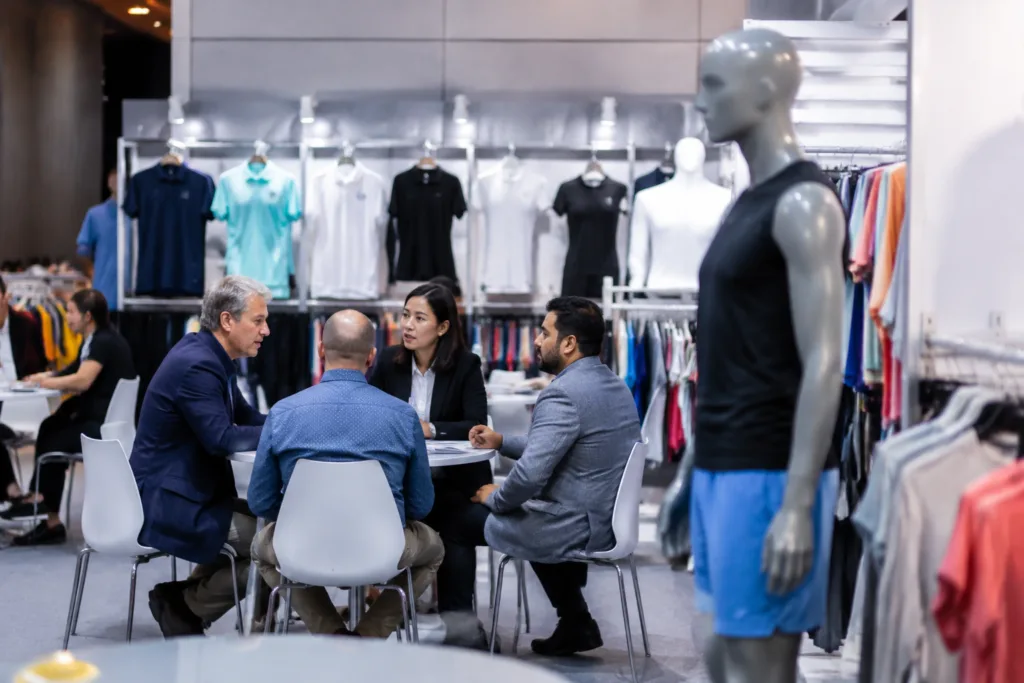
Trade shows are one of the fastest ways to compare manufacturers side by side. They help buyers evaluate product feel, finishing quality, communication style, and category alignment much faster than email alone. Official guidance on how trade shows help brands meet manufacturers and suppliers is useful because events can compress research, introductions, and qualification into a short time window.
From a manufacturer viewpoint, serious trade show conversations usually become productive when buyers arrive with a clear category target, expected order range, and basic customization plan. Without that preparation, it is easy to collect many brochures and still leave without a usable shortlist.
What to ask manufacturers at a trade show booth
- Which garment categories are your strongest?
- What fabrics do you commonly work with for this product?
- Can you support OEM, ODM, or private label?
- What is your normal MOQ by style and color?
- How do you handle sample development and revisions?
- Which logo methods do you produce in-house or manage routinely?
- What export markets do you commonly ship to?
Trade shows are also valuable because you can compare answer quality. A serious supplier usually speaks clearly about fabric options, lead time constraints, and realistic MOQ conditions instead of giving only broad yes-or-no responses.
How referrals and industry networks reduce noise
Referrals can be powerful because they often start with a trust signal. If a brand, buyer, or industry contact has already worked with a manufacturer in a similar category, you may skip part of the broad search stage and move faster into qualification.
However, referrals are not proof of fit. A factory that works well for basic knitwear may not be the right choice for performance sportswear, team apparel, or heavily customized outerwear. The product category, target price, and development complexity still need to match.
Key takeaway: A referral can shorten your search, but it should not replace factory evaluation, sample review, or process verification.
How to combine all channels into one shortlist-building workflow
The most effective sourcing process uses channels in sequence rather than isolation. Search engines help you identify strong-fit suppliers. Platforms add breadth. Trade shows improve direct comparison. Referrals add trust and context.
- Start with search engines to identify category-specific factories.
- Add platform candidates only if they match your product type and order model.
- Use trade shows for direct comparison when timing and budget allow.
- Add referrals from trusted industry contacts.
- Merge all findings into one review sheet.
- Score each supplier before requesting samples.
This method usually produces a smaller but stronger shortlist than relying on only one channel.
How to filter your shortlist before sample requests
Before you ask for prices or samples, filter candidates against production fit. This saves money and helps avoid sample rounds with suppliers that were never suitable in the first place.
| Filter area | What to check | Why it matters |
|---|---|---|
| Category match | Do they regularly make your garment type? | Category experience affects fit, construction, and problem solving |
| MOQ fit | Is your planned quantity realistic by style, color, and fabric? | Low MOQ claims can be limited by material sourcing |
| Fabric capability | Can they source or work with your required composition and GSM? | Fabric drives hand feel, cost, and performance |
| Decoration methods | Embroidery, screen print, heat transfer, sublimation, labels | Logo method affects lead time, cost, and appearance |
| Export experience | Do they understand packaging, communication, and shipment requirements? | Export familiarity reduces operational friction |
| Lead time logic | Can they explain sampling and production timing clearly? | Realistic planning is a sign of process discipline |
One useful next step is reviewing the key questions to ask before comparing factories. Good questions reveal whether a supplier understands your needs or is only trying to move the conversation forward quickly.
What to ask before sending a tech pack or sample request
Ask direct, practical questions first. The goal is not to make the supplier pass a scripted test. It is to check whether they can discuss your product in a clear and technically honest way.
- Which similar products do you make most often?
- What fabric options would you recommend for this use?
- What GSM range usually works for this garment type?
- Can you support custom labels, hangtags, and packaging?
- What information do you need for accurate sample costing?
- How many sample revisions are usually needed before bulk approval?
- What details tend to increase MOQ or delay lead time?
Clear answers are often more important than perfect answers. A reliable manufacturer will explain trade-offs, not just say yes to every request.
How to compare manufacturers after first contact
Once suppliers reply, compare not only price but also communication quality and process transparency. In many sourcing projects, the first response already shows how the relationship may work later during development and bulk production.
Buyers should look at response speed, but they should also judge whether the supplier asks useful follow-up questions. A factory that requests size specs, fabric targets, branding details, and quantity breakdown is often taking the project more seriously than one that sends a fast but generic quote.
- Did they answer your actual questions?
- Did they ask for missing technical details?
- Did they explain MOQ and lead time conditions clearly?
- Did they discuss fabric, fit, or logo method risks early?
- Did they set realistic expectations on development?
When brands move into formal vetting, a basic due diligence checklist for vetting potential suppliers is helpful. Discovery should always be followed by checks on company background, references, capabilities, and other risk signals.
Sample development and costing checkpoints that reveal reliability
Sampling is where many shortlist assumptions get tested. A supplier may look strong online but struggle once pattern work, fabric substitution, measurements, and branding details enter the process.
That is why buyers should understand how sampling fits into manufacturer evaluation. A structured sample process reveals whether the supplier can translate concepts into production-ready garments, communicate issues early, and manage revisions without confusion.
| Checkpoint | What it reveals |
|---|---|
| Cost breakdown clarity | Whether pricing is based on real inputs or rough guessing |
| Fabric proposal quality | Whether the supplier understands use case, hand feel, and cost balance |
| Measurement accuracy | Pattern discipline and size control ability |
| Logo execution | Practical skill in embroidery, print, transfer, or sublimation |
| Revision management | Communication quality and development control |
| Lead time consistency | Planning discipline before bulk production |
In our work, reliable suppliers usually do not promise perfection in the first sample. Instead, they identify what needs adjustment and show how they will correct it.
Red flags that often appear before serious production problems
Most supplier problems do not begin in bulk production. They begin much earlier, during inquiry, costing, or sample communication. Brands that catch these signs early usually avoid expensive delays later.
- Very broad claims with little category specificity
- Unclear answers about MOQ by fabric, color, or trim
- No practical discussion of measurement tolerances or fit
- Prices provided without enough product details
- Inconsistent statements about sampling or lead times
- Weak explanation of decoration limitations
- Little interest in your branding, packaging, or label requirements
Another strong screen is asking about process control. Buyers should review the quality control checks that help narrow your options because QC discipline is often the difference between a workable bulk order and repeated quality issues.
A practical shortlist scorecard for comparing clothing manufacturers
Once you have 5 to 10 candidates, use a simple scorecard. This helps remove bias and keeps the decision focused on production fit rather than only first impressions.
| Criteria | Score range | What good looks like |
|---|---|---|
| Product category fit | 1-5 | Strong history with similar garments |
| Fabric and trim capability | 1-5 | Can discuss suitable materials and sourcing constraints clearly |
| MOQ fit | 1-5 | Order requirements align with your launch plan |
| Customization support | 1-5 | Labels, packaging, print, and embroidery are practical and well explained |
| Sampling quality | 1-5 | Structured revisions and clear development control |
| Communication | 1-5 | Timely, specific, and transparent responses |
| QC and consistency | 1-5 | Clear checkpoints and realistic production planning |
| Export readiness | 1-5 | Understands documentation, packaging, and delivery coordination |
This kind of scorecard is especially useful when different team members are involved in sourcing, merchandising, product development, and procurement.
Recommended channel strategy by buyer type
Different buyers should use different channel mixes. The right strategy depends on order size, category complexity, and how much development support is required.
Startup apparel brands
Start with search engines and referrals, then use platforms selectively. Startups usually need lower MOQ flexibility, direct communication, and help with sample refinement rather than a very large supplier pool.
Established labels
Combine search, trade shows, and referrals. Larger brands should prioritize process depth, compliance conversation, capacity planning, and repeat order consistency.
Sportswear and teamwear brands
Prioritize category specialists. Fabric performance, stretch recovery, sublimation, heat transfer, and size consistency matter more here than broad general apparel capability.
Private label retailers
Look for manufacturers that can handle branded trims, labels, packaging, and repeatable style development. ODM and private label options may speed up launches if the assortment plan is broad.
How we recommend moving from discovery to evaluation before placing an order
At Ninghow, we recommend a simple sequence: define the product need, build a multi-channel shortlist, filter hard before sampling, test communication quality, then evaluate sample execution before confirming bulk production. This keeps the sourcing process practical and avoids overcommitting too early.
For many buyers, the real challenge is not finding names. It is turning a long list into two or three suppliers that match the product, MOQ, branding plan, and delivery expectations. That is where manufacturer-informed screening makes the biggest difference.
Key takeaway: Discovery should lead to qualification, qualification should lead to sampling, and only proven sample performance should lead to bulk production planning.
Conclusion
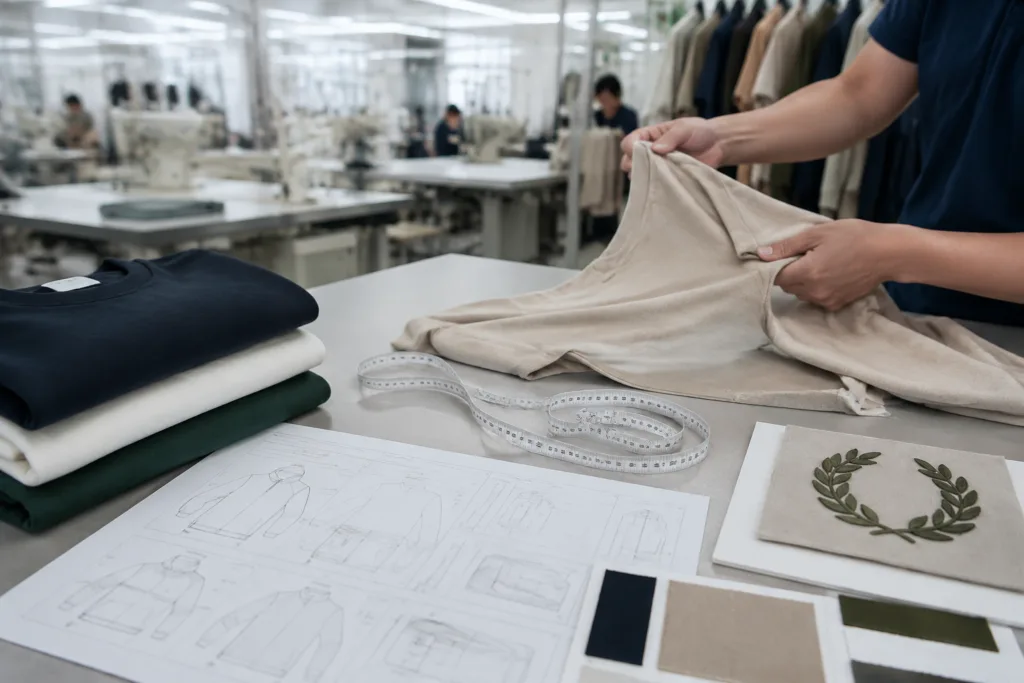
If you are deciding where to find clothing manufacturers, use multiple channels but judge them by one standard: production fit. Search engines help you find focused factories, platforms widen the pool, trade shows speed up comparison, and referrals can improve trust. None of those channels is enough on its own.
The strongest supplier shortlist comes from matching discovery with evaluation. When brands compare category experience, fabric knowledge, MOQ realism, sample quality, customization support, and communication clarity, they make better sourcing decisions and reduce production risk before an order is placed.
FAQs
What is the best place to find clothing manufacturers?
The best place is usually a combination of search engines, trade shows, referrals, and selected B2B platforms. Search engines are often the strongest starting point because they help you find category-specific factories, while trade shows and referrals help verify fit faster through direct comparison and trusted introductions.
How do I know if a clothing supplier is a real manufacturer?
You can start by reviewing the website, product focus, process pages, and the technical quality of their answers. Real manufacturers usually discuss fabric, sampling, customization, MOQ conditions, and production details more clearly, while buyers should still verify company background, references, and operating capability before moving into orders.
Are B2B sourcing platforms good for finding apparel factories?
Yes, they can be useful for creating an initial supplier list quickly, but they should not be your only decision tool. Platform profiles often mix factories, trading companies, and sourcing intermediaries, so direct website review and supplier communication are still necessary before shortlisting candidates.
How many clothing manufacturers should I shortlist before sampling?
Most brands should narrow the list to about three to five serious candidates before starting samples. That range is usually enough to compare communication, costing logic, and development support without wasting time and money on too many parallel sample projects.
What should I ask before sending a tech pack?
You should first ask about category experience, MOQ by style and color, fabric recommendations, decoration methods, private label support, sample lead time, and what information is needed for costing. These early questions show whether the supplier understands your product and whether your project fits their normal production model.
Can a referral replace supplier verification?
No, a referral should only shorten the search stage, not replace evaluation. Even a trusted introduction must still be checked for product-category fit, sampling ability, communication quality, MOQ realism, and production control before you commit to bulk manufacturing.