







Clothing quality inspection in China should happen before final shipment, not after the goods arrive at your warehouse. For importers, sourcing teams, and apparel brands, the practical goal is simple: confirm that bulk garments match the approved sample, meet the spec sheet, and are packed correctly before the balance payment is released and the cartons leave the factory.
If your order depends on reliable apparel quality control checks, the inspection plan should connect product specifications, approved samples, measurement tolerances, logo accuracy, packaging rules, and shipment readiness in one clear process. At Ninghow, we support buyers with fabric review, sample confirmation, production follow-up, quality checkpoints, and bulk packing verification so the inspection is tied to real manufacturing details rather than a last-minute box check.
What buyers should verify first before inspection starts
The first thing to verify is not the carton count. It is the approval standard. A pre-shipment inspection only works when the inspector has a clear benchmark for what is acceptable and what is not.
Before any bulk inspection begins, we recommend confirming these records:
- Final tech pack with measurements, tolerances, construction notes, and artwork
- Approved sample or sealed sample for comparison
- Fabric composition and target GSM
- Color standards such as Pantone references, lab dips, or approved swatches
- Trim approvals for labels, zippers, buttons, drawcords, hangtags, and packaging
- Defect classification rules for critical, major, and minor defects
- Carton packing ratio, assortment rules, and shipping marks
When these documents are incomplete, the inspection becomes subjective. That is where disputes begin. A buyer may reject the goods for issues the factory never understood as a formal requirement, or a factory may ship goods that technically pass a loose interpretation but still create receiving problems.
Key takeaway: The real foundation of clothing quality inspection China buyers need is a complete approval file, because inspection is only as strong as the standard behind it.
How to build a usable inspection standard from the tech pack and approved sample
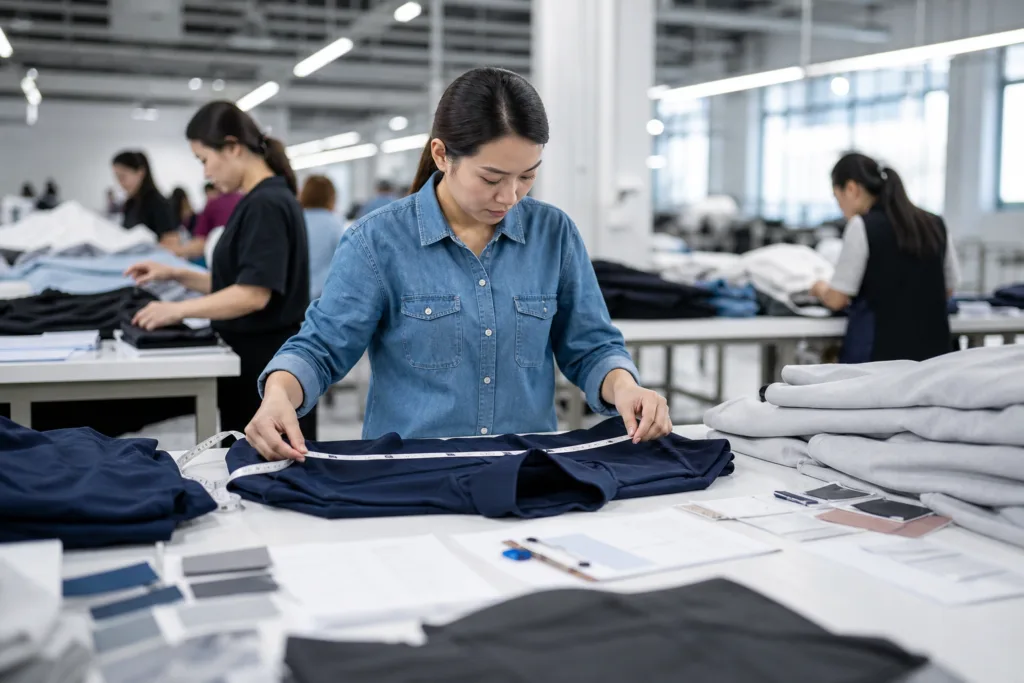
The approved sample is usually the most practical reference point. It shows fabric hand feel, visual appearance, fit direction, label position, logo size, and finishing expectations in one physical product. But it should still be supported by written tolerances, construction requirements, and packing instructions.
From our manufacturing perspective, the most common avoidable problem is relying on comments buried in email threads instead of one controlled spec. If a neckline shape changed during sampling, if the logo moved by 1 centimeter, or if the hem width was revised, that update should be reflected in the final spec sheet before bulk inspection.
Buyers developing new products should also understand how early approvals affect later QC results. A disciplined apparel sampling process reduces confusion because fabric, fit, construction, and branding decisions are already aligned before bulk cutting starts.
Fabric inspection checklist buyers should use before accepting bulk garments
Fabric problems are expensive because they usually affect the whole order, not just a few pieces. If the fabric is wrong in composition, too light in GSM, inconsistent in shade, or unstable after washing, repair options become limited once the goods are sewn and packed.
A practical fabric inspection should check both technical conformity and commercial suitability. The question is not only whether the cloth looks acceptable on the table, but whether it behaves as expected in wear, washing, and repeat ordering.
What to check on fabric first
- Composition against the approved specification, such as 100% cotton, CVC, polyester spandex, or performance blend
- GSM consistency across lots, especially for T-shirts, hoodies, activewear, and uniforms
- Hand feel compared with the approved sample
- Surface defects such as slubs, holes, stains, barre, contamination, or knitting lines
- Stretch and recovery where applicable
- Shrinkage risk after washing or steaming
- Color consistency between panels, rolls, and sizes
GSM matters because it affects drape, opacity, durability, and the customer’s perception of value. A jersey fabric that is 20 to 30 GSM lighter than approved may still look close in photos, but in hand it can feel thinner, less stable, and more transparent.
| Fabric factor | What to compare | Why it matters before shipment |
|---|---|---|
| Composition | Lab record, supplier declaration, approved spec | Impacts labeling, performance, cost, and importer claims |
| GSM | Measured bulk fabric versus target range | Affects hand feel, weight, opacity, and price consistency |
| Hand feel | Bulk garment versus approved sample | Helps catch wrong finishing or different yarn quality |
| Shrinkage | Wash or steam test results | Protects final fit and measurement stability |
| Shade consistency | Across panels and production lots | Prevents mixed-color garments in packed cartons |
When buyers are importing performance products or heavily dyed garments, requesting relevant testing before shipment is sensible. For example, color fastness and shade variation testing for garments can help reduce the risk of bleeding, crocking, or wash-related color problems that may not be obvious during a quick visual review.
How to check garment measurements against the spec sheet
Measurement checking should focus on the points that affect fit, grading consistency, and customer returns. A garment can look neat on a hanger and still fail where it matters most: chest width, body length, sleeve length, waist, hip, rise, or inseam.
The best method is to measure randomly selected pieces from different cartons, sizes, and color lots, then compare each point against the approved tolerance sheet. If the style has multiple fits, such as regular, slim, or oversized, the fit intention must be clear before judging the numbers.
Key measurement control points
- Body width and body length for tops
- Shoulder width and sleeve length
- Neck opening and collar dimensions
- Waist, hip, front rise, back rise, and inseam for bottoms
- Cuff opening, hem opening, and leg opening
- Placket length and pocket placement where relevant
We advise buyers to look for pattern consistency, not just isolated numbers. If one medium size is within tolerance but all larges run short in sleeve length, that may indicate a grading problem rather than random sewing variation.
In practical inspection work, repeated out-of-tolerance results often point to one of three issues:
- The bulk pattern was not updated from the final sample revision
- Fabric shrinkage was underestimated during pattern setting
- Operators were sewing to unstable seam allowances or inconsistent pressing standards
Key takeaway: Measurement inspection is not only about finding a bad piece. It is about confirming that the grading logic stayed intact from sample approval into bulk production.
What to look for in stitching and garment construction
Stitching quality tells you a lot about production control. Poor seam execution usually shows up in durability, appearance, and fit stability at the same time.
A useful inspection should check seam strength, stitch density, thread tension, seam alignment, puckering, skipped stitches, open seams, raw edge control, and overall finishing. Different garment categories need different attention. Activewear may require more stretch recovery in seams, while woven uniforms may need cleaner topstitch alignment and better placket balance.
Common stitching defects that should be flagged
- Skipped stitches
- Broken threads
- Untrimmed thread ends
- Open seams or weak back-tacking
- Seam puckering
- Twisted side seams
- Uneven topstitch spacing
- Asymmetric collars, cuffs, or plackets
- Needle damage on delicate fabrics
Buyers should also inspect stress points. Check armholes, crotch seams, pocket corners, zipper ends, drawcord exits, and side slits. These are the places where complaints tend to appear after wear, especially in teamwear, golf apparel, and sportswear that sees repeated movement.
When a supplier is working under strict market rules, construction checks should also be aligned with the relevant apparel manufacturing compliance requirements for labeling, product claims, and market readiness. Compliance is not the same as visual quality, but the two often intersect in trims, fiber disclosure, care information, and restricted-risk details.
How to inspect logos, branding, and decoration details
Logo accuracy matters because branding defects are highly visible and often impossible to rework efficiently after packing. A garment may pass sewing inspection and still be commercially unusable if the embroidery is rough, the print color is off, or the logo is placed inconsistently.
The inspection should compare decoration against the approved artwork file and sealed sample. Check size, location, color match, angle, edge quality, and adhesion or stitch security depending on the application method.
| Logo method | What to inspect | Common failure risk |
|---|---|---|
| Embroidery | Stitch density, edge cleanliness, backing, placement | Puckering, loose threads, wrong thread color |
| Screen print | Color accuracy, sharpness, registration, coverage | Blurred edges, cracking, off-tone color |
| Heat transfer | Position, adhesion, wash durability, surface smoothness | Peeling, lifting corners, gloss inconsistency |
| Sublimation | Color clarity, ghosting, panel alignment | Shade variation, print shift, image distortion |
We recommend rubbing, light stretch, and basic handling checks on decorated areas during inspection. Even without a full lab test on site, these quick checks often reveal weak bonding, unstable ink coverage, or thread tension issues.
How to control color difference and shade variation in bulk production
Color difference is one of the most common reasons an apparel order looks inconsistent in a retail setting. The problem may be obvious, such as two navy shades packed in one shipment, or subtle, such as sleeve panels appearing slightly different from body panels under store lighting.
Buyers should inspect color under consistent lighting and compare garments by size set, carton, and production lot. The goal is to detect lot variation, panel mismatch, and trim mismatch before shipment. This is especially important for black, red, navy, melange, washed garments, and moisture-wicking fabrics that can reflect light differently.
A practical shade review should include:
- Comparing garments against the approved color standard
- Checking panel-to-panel consistency within the same garment
- Comparing trim color against shell fabric
- Reviewing prints and embroidery thread for tone matching
- Watching for mixed dye lots in the same carton or same size run
If the style has demanding visual standards, ask for lot separation records and dye lot controls before packing. At Ninghow, we usually advise buyers to decide in advance whether slight lot variation is acceptable for the product category, because that decision affects cutting, packing, and inspection judgment later.

What to inspect on trims, labels, and accessories
Trims are easy to underestimate because they are small, but they generate a high share of customer complaints. A wrong zipper pull, scratchy neck label, weak snap, incorrect hangtag, or missing size sticker can create returns even when the garment body is fine.
The inspection should cover functional performance, appearance, and information accuracy. For private label projects, trim review is also where many branding and compliance errors surface first.
Trim and accessory checklist
- Main label brand spelling and positioning
- Size label accuracy and size sequence consistency
- Care label content, fiber composition, and country-of-origin details where required
- Zipper function and smoothness
- Button attachment strength and spare button inclusion if specified
- Drawcord length, end finishing, and symmetry
- Velcro, snaps, toggles, and elastic function
- Hangtag artwork, barcode, and attachment method
- Polybag warning text or labeling requirements where applicable
Incorrect label content can become an import problem, not just a product problem. Before bulk shipment, buyers should verify whether their target market has specific care, fiber, or origin disclosure rules and align trim approval with those requirements.
Packaging review should confirm shipping readiness, not just appearance
Packaging inspection needs to confirm that the goods can move through warehousing, customs handling, and final delivery without confusion or avoidable damage. Nice folding alone is not enough.
Carton packing should match the shipping plan, and the shipping plan should match the buyer’s receiving method. If a retailer expects size-sorted cartons, barcode visibility, and exact carton marks, the pre-shipment inspection should treat those items as pass or fail criteria.
| Packaging item | What to check | Why it matters |
|---|---|---|
| Folding method | Matches approved packing sample | Keeps retail presentation consistent |
| Polybag | Correct size, label, suffocation warning if required | Supports receiving accuracy and compliance |
| Assortment ratio | Correct sizes and colors per carton | Prevents warehouse sorting issues |
| Carton marks | PO, style, color, size range, carton number | Reduces shipping and inventory errors |
| Carton strength | Board condition, sealing, stacking durability | Protects goods during transit |
Timing matters here. If the factory is rushing the final packing stage, inspection can catch the symptoms: wrong assortment, mixed sizes, missing tags, carton overfill, and poor sealing. Good apparel production timeline planning gives enough time between finishing and vessel cutoff to inspect, correct, and repack without forcing compromises.
How AQL pre-shipment inspection works for apparel orders
AQL does not mean every garment is checked. It is a sampling method used to judge whether a lot is acceptable based on the number and severity of defects found in a defined sample size.
For apparel, buyers usually classify defects as critical, major, and minor. Critical defects are safety or serious compliance failures. Major defects make the garment unsellable or clearly below expectation. Minor defects are noticeable but less serious appearance issues.
Simple buyer view of AQL logic
- Select sample size based on the total order quantity
- Inspect sampled garments against agreed standards
- Count defects by severity category
- Compare findings with the acceptance and rejection numbers for the chosen AQL level
In practice, many apparel buyers use stricter limits for major defects than for minor defects, especially for branded or retail-facing programs. The exact level should be agreed before inspection day so there is no argument about pass criteria after defects are found.
Key takeaway: AQL is a decision tool, not a replacement for clear quality standards. If your spec is vague, the sampling math will not solve the real problem.
When to inspect, who should inspect, and what documents to request
The best time for pre-shipment inspection is when at least 80% of the order is packed and the full quantity is complete or nearly complete. Inspecting too early can hide late-stage packaging problems or unfinished goods. Inspecting too late can leave no time to fix defects before shipment cutoff.
Who should inspect depends on the risk level of the order. Some buyers use their own QC staff, some appoint third-party inspectors, and some rely on a manufacturer-managed process with documented reporting. The higher the order value, complexity, or brand sensitivity, the more useful it is to have a structured independent check.
Before approving shipment, request these documents:
- Inspection report with defect photos and quantity summary
- Measurement report
- Packing list and carton breakdown
- Approved sample reference photos if a sealed sample is not on site
- Fabric or trim test reports where relevant
- Corrective action notes for any repaired issues
Common quality problems in China apparel orders and how to prevent them early
Most major failures do not begin at final inspection. They begin earlier in development, communication, or material control. The inspection simply reveals them.
The most common issues we see are:
- Bulk fabric not matching the approved sample
- Measurement deviations caused by shrinkage or pattern changes
- Inconsistent logo placement across sizes
- Shade variation between production lots
- Weak stitching at stress points
- Incorrect labels or packaging marks
- Rushed packing that mixes colors, sizes, or assortments
The most effective prevention is early alignment. Confirm materials before cutting, approve a pre-production sample, lock the packing standard, and establish inspection criteria before bulk output peaks. Buyers using an import clothing from China service should still require this discipline, because logistics support cannot compensate for unresolved quality standards.
How to work with a supplier to fix defects before final payment
The right response to defects depends on defect type, quantity affected, and shipping urgency. Not every issue requires a full remake, but buyers should avoid approving shipment on the basis of informal promises alone.
When defects are found, we recommend agreeing on a corrective action plan in writing. That plan should specify what is wrong, how the goods will be reworked or resorted, who will reinspect, and whether shipment is on hold until the corrected result is confirmed.
A practical defect-handling sequence is:
- Separate critical, major, and minor issues
- Identify whether the problem is isolated or systemic
- Stop packing or shipment release if the issue affects the whole lot
- Agree on rework method and timeline
- Reinspect repaired goods before final approval
- Update records so the same problem does not repeat in the next PO
From a manufacturer perspective, clear evidence helps everyone move faster. Annotated photos, measurement tables, carton references, and piece counts reduce argument and make corrective work more accurate.
Buyer checklist before importing the shipment
Before you authorize final payment and export release, the file should be complete. This is where disciplined buyers reduce receiving risk and create leverage for future repeat orders.
- Final approved tech pack is on file
- Approved sample or sealed sample is clearly referenced
- Bulk measurements are within tolerance or formally accepted
- Fabric, color, and logo checks are signed off
- Trims, labels, and packaging match requirements
- AQL inspection result is documented
- Corrective actions are closed and verified
- Packing list and carton marks are confirmed
- Any required testing or compliance documents are collected
- Shipment release decision is tied to the final report, not assumptions
This checklist is especially important for new suppliers, new product categories, or first-time private label programs. Once a buyer has stable standards and a proven factory process, inspection becomes more efficient, but it should not disappear.
Conclusion

Clothing quality inspection China buyers rely on is really a system of decisions made before the goods leave the factory. Fabric approval, measurement control, seam quality, branding accuracy, trims, packaging, and AQL-based pre-shipment inspection all work together to protect margin, delivery reliability, and customer satisfaction.
At Ninghow, we approach inspection as part of the manufacturing process rather than a final formality. When buyers need support with sampling, production control, private label development, and shipment-ready QC documentation, a structured process makes it much easier to reduce import risk before the cartons are on the water.
FAQs
Should I do clothing quality inspection in China before paying the balance?
Yes, in most cases you should complete pre-shipment inspection before releasing the final balance. This gives you a practical chance to verify measurements, workmanship, logos, trims, packing, and carton readiness while the goods are still at the factory and can still be corrected.
How many pieces should be checked during a pre-shipment inspection?
The number of pieces checked is usually based on an AQL sampling plan rather than 100% inspection of the order. The correct sample size depends on total quantity, defect classification, and the agreed acceptance level, so the standard should be confirmed before inspection starts.
What is the most common defect in imported clothing orders?
There is no single defect for every product, but measurement deviation, shade variation, loose stitching, and logo inconsistency are among the most frequent problems. These issues often come from weak sample control, fabric instability, or unclear bulk production standards rather than from one isolated sewing mistake.
Can a supplier fix defects after the inspection fails?
Yes, many defects can be repaired, resorted, relabeled, or repacked after inspection, but the solution depends on whether the issue is isolated or affects the whole production lot. Buyers should require a written corrective action plan and a reinspection step before approving shipment.
Do I need third-party inspection for every clothing order from China?
No, not every order requires third-party inspection, especially if you have a stable supplier, a mature product, and strong in-line quality control. However, independent inspection is often a sensible choice for first orders, complex private label programs, high-value shipments, or retail orders with strict packaging and compliance requirements.
What documents should I keep after pre-shipment inspection is completed?
You should keep the final inspection report, measurement records, defect photos, packing list, approved sample references, and any corrective action confirmation related to the order. These records help with shipment approval, receiving checks, supplier review, and future repeat production planning.