







A compliant private label clothing order is built before bulk production starts, not after labels are printed or cartons are packed. If your brand plans to sell through retail, e-commerce, distributors, schools, clubs, or international markets, you need more than a logo and a garment design. You need a complete specification for brand labels, care labels, fiber content statements, size labels, hangtags, barcodes, packaging, and market-specific requirements so the finished product can move through production, import, warehousing, and retail without avoidable rework.
If you are preparing a new collection or updating an existing line, it helps to review private label apparel development options early so your labeling, trims, packaging, and compliance decisions are aligned with sampling and bulk planning. In our manufacturing work, we often see that strong private label orders begin with clear artwork files, label content rules, packaging specs, and market targets, because those details affect sourcing, sample setup, production timing, and final QC.
What a compliant private label clothing order needs to include
The short answer is this: a compliant private label clothing order needs a complete specification pack that tells the manufacturer exactly what information must appear on the product, where it must be placed, how it must be presented, and which market rules it must follow.
At minimum, buyers should prepare the following:
- Brand label or main label artwork
- Care label content and symbol requirements
- Fiber content declaration for each style
- Country of origin instruction if required for the target market
- Manufacturer, importer, or responsible party details where needed
- Size label format and placement
- Hangtag content, materials, strings, and attachment method
- SKU, barcode, or GTIN setup for each sellable variant
- Polybags, warning labels, carton marks, and packaging instructions
- Target market list such as US, EU, UK, or other destination countries
- Sample approval checkpoints for labeling and packaging
Key takeaway: A private label order becomes easier to control when labels, packaging, and market rules are treated as part of product development, not as last-minute accessories.
Why compliance matters before sampling and bulk production

Compliance matters early because labels and packaging are not neutral details. They affect artwork setup, trim sourcing, production sequencing, folding method, barcode allocation, and inspection criteria. If a buyer waits until after the fit sample is approved to define label content, the order can lose time during trim rebooking, artwork correction, and packaging revision.
From our factory perspective, the most expensive errors are usually simple ones: incorrect fiber percentages, missing country of origin, inconsistent size label logic, untranslated market content, or a barcode that does not match the final color-size variant. These problems often do not appear during sewing. They appear at final inspection, customer warehouse intake, marketplace onboarding, or customs review.
That is why brands should connect product development with apparel manufacturing compliance basics before trim approvals are finalized. A garment can look correct, fit well, and still create commercial risk if the product information is incomplete or inconsistent.
Brand labels, neck labels, and woven labels: what to specify
Start with the main identity label. This may be a woven label, printed neck label, heat transfer neck label, satin label, or another format depending on garment type, comfort goals, and positioning.
What you should specify is not only the logo. You should also define label type, fold style, dimensions, base color, logo color, attachment method, placement, and whether the same label is used across multiple styles. For T-shirts and activewear, many brands prefer soft printed neck labels or heat transfers for comfort. For polos, hoodies, jackets, and premium knitwear, a woven label is often used for stronger brand presentation.
| Label Type | Common Use | Advantages | Points to Check |
|---|---|---|---|
| Woven main label | Polos, hoodies, jackets | Premium look, durable branding | Fold style, stitch quality, edge comfort |
| Printed neck label | T-shirts, sportswear | Comfort, less bulk | Wash durability, ink clarity, correct size position |
| Heat transfer label | Performance apparel | Clean appearance, soft hand feel | Adhesion, cracking risk, heat setting control |
| Satin label | Fashion and lightweight garments | Smooth touch, good print detail | Fraying risk, print legibility, seam placement |
Also decide whether the brand label is separate from the care label or integrated into one multi-purpose label pack. For some categories, a separate main label plus side seam care label works better. For others, especially simpler basics, a combined neck label solution may reduce trim complexity.
In our experience, clear artwork and exact dimensions prevent many trimming delays. Even a small mismatch in fold allowance or logo size can change the sewn appearance significantly when applied on light knits or narrow neck tapes.
Care labels and washing instructions: required details and common mistakes
Care labels should tell the end user how to wash, dry, iron, or otherwise maintain the garment. The exact format depends on market and brand preference, but the core requirement is that the information must be clear, appropriate for the actual garment construction, and consistent with the fabric and trims used.
Common mistakes include copying care instructions from a previous style, using symbols that do not match the tested fabric performance, omitting special trim warnings, or placing the label where it becomes uncomfortable and gets cut off by the customer. If the label is removed immediately because it scratches, the practical value of the instruction drops.
Buyers should confirm these care-label decisions before bulk:
- Whether the label uses words, symbols, or both
- Language requirements for destination markets
- Any special restrictions for coatings, prints, transfers, or bonded fabrics
- Whether tumble dry is allowed
- Whether ironing is safe around logos or performance finishes
- Whether washing instructions differ by colorway or fabric blend
A care label should not be treated as a generic trim. It is part of product accuracy. When we review samples, we check whether the care instructions align with the garment’s actual make-up, especially for sportswear, brushed fleece, mixed-fiber jersey, and logo-decorated products.
Fiber content labeling: how to state material composition correctly
Fiber content labeling needs to match the real composition of the garment or garment component that the label refers to. If a style is 95% cotton and 5% elastane, that wording must be stated correctly and consistently across labels, hangtags, and product data where applicable. A frequent sourcing error is using development-stage composition text after the fabric has been changed in bulk.
Buyers should also distinguish between shell fabric, contrast panels, rib, lining, padding, and other components when required. The exact labeling logic can vary by market and garment type, which is why the final commercial sample should be checked against the approved bulk fabric specification.
For brands selling into Europe, the official guidance on EU textile fiber composition and label presentation rules is useful because fiber disclosure, language handling, and composition presentation need to follow market expectations rather than internal shorthand used during development.
Key takeaway: Never finalize fiber content labels from an early tech pack alone. Confirm the exact bulk-approved composition first, especially if fabric sourcing changed during sampling.
Country of origin and manufacturer identification requirements
Country of origin requirements depend on the destination market and the selling model. Some buyers need country-of-origin information directly on the sewn label, while others manage certain information through packaging, import documentation, or retailer systems. The key point is to confirm this before label production starts.
Manufacturer, importer, distributor, or responsible-party identification may also be required depending on the product category and country. This becomes especially important when garments are sold under a private label but distributed by a different legal entity in the destination market.
From a production planning standpoint, we advise buyers to decide early whether one universal label can be used across markets or whether different label versions are needed for different destinations. A single-label strategy can reduce trim complexity, but it is not always practical if language or legal content differs by region.
Size labels: placement, sizing logic, and consistency across styles
Size labels look simple, but they create frequent errors in private label production. The problem is usually not the physical label itself. The problem is inconsistency between the size chart, neck label, polybag sticker, carton ratio, and barcode file.
Decide first whether your range uses alpha sizes such as XS to XXL, numeric sizing, age sizing, or region-specific size presentation. Then confirm how that size should appear on every component. For example, if the garment neck label says M, but the barcode file says Medium and the carton mark says MED, your warehouse and retail data can become harder to manage.
Placement also matters. Neck position is common for tops, but bottoms may use waistband or side seam labels. Performance garments may combine printed size marking with separate care content. The goal is a system that stays comfortable, readable, and operationally consistent.
| Size Element | What to Confirm | Typical Risk |
|---|---|---|
| Size label | Format, font, placement | Wrong size sewn into correct garment |
| Size chart | Measurement tolerance and grading | Fit inconsistency across sizes |
| Barcode data | One code per sellable variant | Warehouse scan mismatch |
| Polybags and cartons | Sticker text and ratio packing | Packing errors by size run |
At Ninghow, we usually recommend checking size logic in the sample stage together with label placement, because a clean size system reduces both sewing errors and packing mistakes.
Hangtags, SKU labels, and retail-ready product information
Hangtags do more than show a logo. For many brands and retailers, hangtags carry product name, size, SKU, barcode, price area, color name, composition summary, certification references where applicable, and marketing text. This means they should be planned with the same care as sewn labels.
Specify the following for hangtags and retail stickers:
- Tag dimensions and paper quality
- Single tag or multi-tag format
- Front and back artwork
- Hole position and string type
- Whether price is pre-printed or applied later
- Color naming convention
- SKU structure and variant logic
- Attachment location on the garment
A common issue is designing attractive tags without checking production practicality. Very thick paper, unusual folds, or delicate cords may look good in mockups but slow attachment and increase tag damage during packing.
If the project includes many colors or seasonal drops, your manufacturer should receive a clean master file that links style number, color, size, and tag artwork version. That is often more valuable than a beautiful but isolated PDF layout.
Barcodes, GTINs, and carton marking requirements for retail and distribution
If the garment will be scanned in stores, warehouses, or distributor systems, every sellable variant must be identified correctly. That usually means one barcode setup per style-color-size combination, not one code for the entire style family.
The technical logic behind GTIN and barcode setup for apparel variants is worth understanding early, because barcode mistakes create downstream problems in receiving, replenishment, returns, and sell-through reporting. In practical terms, buyers should lock the SKU matrix before printing tags, stickers, or carton marks.
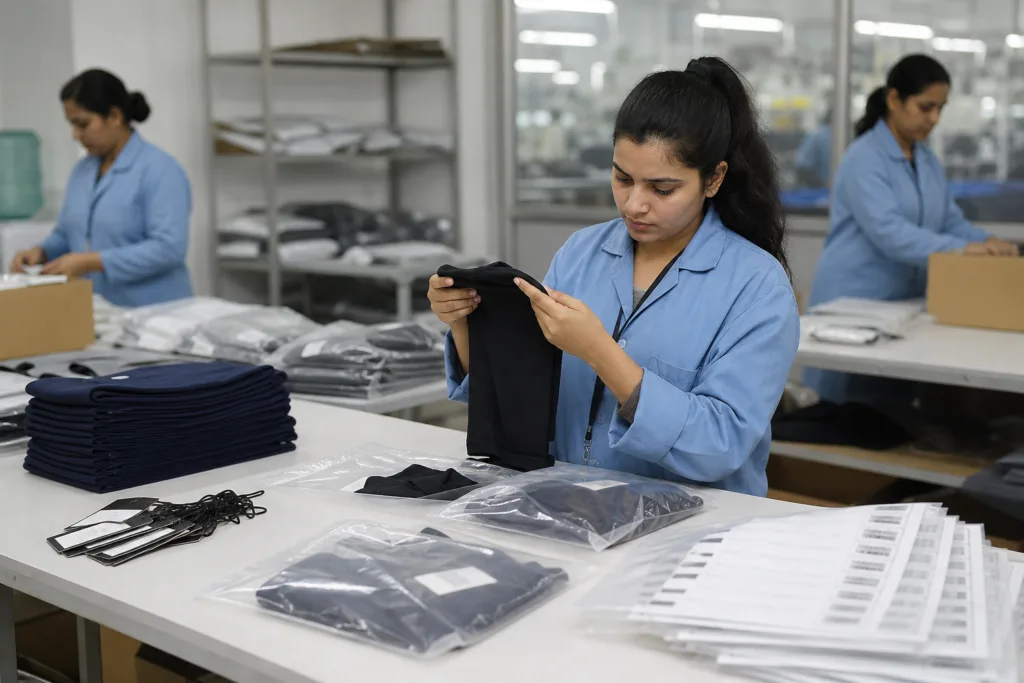
Carton marking should also be specified clearly. This can include style number, color, size range, quantity, carton number, purchase order number, destination, and country of origin marking if required by the buyer or market. Carton labels should be readable, placed consistently, and matched to the packing list.
Key takeaway: Barcode control is not a graphic design issue. It is a product identity issue that touches labels, tags, packaging, warehouse operations, and retailer accuracy.
Packaging requirements: polybags, warning labels, inserts, and retail presentation
Packaging should protect the product, support shipping efficiency, and meet the sales channel requirement. For some orders, a simple folded garment in a labeled polybag is enough. For others, especially retail-ready programs, packaging includes size stickers, suffocation warnings, recycled material statements, insert cards, tissue, hanger setup, and specific folding instructions.
Buyers should define packaging in measurable terms rather than general comments. Instead of writing “nice packaging,” specify bag size, thickness, vent hole requirement, self-adhesive flap type, warning text, sticker position, fold direction, insert dimensions, and carton packing ratio.
| Packaging Item | What to Specify | Why It Matters |
|---|---|---|
| Polybag | Size, thickness, vent holes, flap type | Fit, protection, packing speed |
| Warning label | Required text and language | Retail and safety compliance |
| Size sticker | Position, shape, size code format | Warehouse and store handling |
| Insert card | Material, print, dimensions | Presentation and garment shape |
| Carton | Board grade, dimensions, marks | Transit protection and logistics |
In our production work, packaging errors are often discovered too late because the garment itself is correct. That is why quality checks that support compliant labeling should also include bagging, sticker accuracy, hangtag attachment, carton marks, and assortment verification.
Market-specific compliance checks for the US, EU, UK, and other target regions
Different markets may require different label language, fiber presentation, importer information, packaging statements, or product documentation. Buyers should never assume that one market-ready label automatically works everywhere.
For the EU, fiber composition labeling and presentation rules should be checked carefully, especially when multiple languages or product categories are involved. For the UK, post-import documentation and market handling may differ from EU practice. For the US, brands should review care labeling expectations and any category-specific rules that apply to the garment. For other regions, retailer or distributor requirements may be even stricter than legal minimums.
The practical decision is whether to create one harmonized trim set or multiple region-specific trim sets. If your order is small and sold through one channel, a single-market approach may be more efficient. If you are distributing across several regions, split trim planning early so labels and packaging do not have to be reworked after bulk goods are ready.
How to prepare a label and packaging spec sheet for your manufacturer
The best format is a concise but complete specification sheet that combines artwork, text content, dimensions, placement, material details, and market notes in one place. This does not need to be complicated, but it does need to be unambiguous.
Your spec sheet should include:
- Style name and style number
- Target market or market split by destination
- Main label artwork and dimensions
- Care label wording and symbol file
- Fiber composition statement
- Country-of-origin and company identification instructions
- Size label format and size breakdown
- Hangtag artwork, materials, strings, and barcode file reference
- Polybag spec, warning text, and sticker placement
- Carton marking layout and packing ratio
- Approved languages and text versions
- Reference photos or placement diagrams
This is also where good order process planning for compliant production details becomes valuable. When artwork, text, and packaging instructions are controlled in one document set, manufacturers can source trims more accurately and buyers can review approvals more efficiently.
Sampling checklist: what to verify before approving production
Sample approval should include label and packaging verification, not only fit and fabric. A beautiful proto sample does not protect you if the bulk order later arrives with wrong size labels or incomplete hangtags.
During development, we recommend using structured sampling steps for label and packaging approval so buyers can sign off on trim content, attachment method, barcode placement, and retail presentation before mass production.
Here is a practical sample-stage checklist:
- Does the main label match approved artwork, size, and color?
- Is the care label content complete and readable?
- Does fiber composition match the actual approved fabric?
- Is size identification consistent on the garment, tag, bag, and carton plan?
- Is the hangtag attached in the correct location?
- Are barcodes linked to the correct style-color-size variants?
- Does the polybag fit the garment after proper folding?
- Are warning labels and stickers present where required?
- Are packaging materials acceptable in look and durability?
- Does the sample reflect the target market version?
Key takeaway: If labels and packaging are not approved at the sample stage, the bulk stage becomes a high-risk place to discover low-cost details that cause high-cost delays.
Quality control checks for labels, printing, stitching, and packaging accuracy
QC for private label orders should cover three layers: content accuracy, application quality, and packing accuracy. It is not enough to check whether a label is attached neatly. You also need to check whether the printed or woven information is correct and whether the garment is packed under the right identity.
Typical QC checkpoints include:
- Label text against approved files
- Spelling, punctuation, and language accuracy
- Fiber percentages and care wording
- Placement and seam attachment quality
- Heat transfer adhesion or print durability
- Hangtag correctness and attachment security
- Barcode scan readability
- Polybags, stickers, and warning text
- Carton marks versus packing list
- Assortment ratio by color and size
We also advise checking label comfort and durability where relevant. A care label that is technically correct but too stiff for the garment category can affect wearer satisfaction, especially in sportswear, kidswear, or base layers.
Common compliance mistakes that delay shipments or create rework
The most common mistakes are usually preventable. Buyers often focus heavily on garment design and leave product-information details to later. That creates a mismatch between what was sampled, what was approved, and what is finally packed.
Watch for these recurring issues:
- Using outdated fiber content after fabric substitution
- Missing country-of-origin instruction for the destination market
- Different size naming across labels, bags, and barcodes
- Printing one barcode for several sellable variants
- Forgetting language requirements for a target region
- Approving garment fit without approving label placement
- Ordering hangtags before SKU matrix confirmation
- Using generic care instructions copied from another style
- Failing to review carton marks and packing ratios
- Sending artwork files without dimensions or fold details
From a manufacturer’s perspective, these are not difficult problems individually. The risk comes from discovering them late, when trims are already produced and goods are close to shipment.
A practical pre-production checklist for compliant private label orders
Before bulk starts, buyers should be able to answer yes to the following points:
- The target selling markets are confirmed
- All required label content is approved in final wording
- Fiber composition matches bulk-approved fabric
- Country-of-origin and responsible-party instructions are confirmed
- Size logic is consistent across all materials
- Hangtags and barcode files are matched to variant list
- Packaging specs are approved with measurements and materials
- Carton marks and packing ratios are defined
- Sample approvals include trims and packaging
- QC criteria include labeling and packing accuracy
If several of these points are still open, it is better to pause and close the gaps than to rush into production. Small specification gaps become larger operational problems after cutting and sewing begin.
When to ask your manufacturer for compliance support and document review
You should ask for support as soon as labeling or packaging decisions affect sampling, trim booking, or market allocation. That is especially true if you are launching a new brand, entering a new country, changing fabric composition, or selling through a retailer with strict intake rules.
At Ninghow, we see the best results when buyers share their target market, artwork files, size matrix, SKU plan, packaging expectations, and retail handling requirements early. That allows the manufacturing team to flag issues in trim layout, production sequencing, and QC planning before bulk commitments are locked.
This support is not a substitute for your own legal or market review, but it is a practical way to reduce preventable production risk. A manufacturer can often spot formatting, placement, barcode, packaging, and consistency issues that are easy to miss when several departments are working from separate files.
Conclusion

A compliant private label clothing order is really a coordination exercise between product design, market rules, garment trims, packaging, and production control. The more clearly you define labels, fiber content, care instructions, size logic, hangtags, barcodes, and packaging before bulk, the more stable your order becomes.
For brands and sourcing teams, the goal is not to make the spec pack longer. The goal is to make it clearer. When artwork, wording, placement, SKU logic, and packaging standards are aligned early, compliant private label clothing becomes easier to sample, easier to inspect, and easier to ship with fewer costly corrections.
FAQs
What is included in a compliant private label clothing order?
A compliant private label clothing order usually includes approved brand labels, care labels, fiber content declarations, size labels, hangtags, barcodes, packaging instructions, carton marks, and target-market requirements. The key is that these details are documented clearly and linked to the exact style, color, size, and destination so the factory can execute them consistently.
Do care labels and fiber content labels need to be finalized before bulk production?
Yes, they should be finalized before bulk production because late changes can affect trim sourcing, sewing setup, packing materials, and final inspection. If the garment composition or washing instructions change after labels are made, the order may require relabeling, repacking, or shipment delay.
Can one label set be used for every market?
Sometimes, but not always, because different markets may require different wording, language, importer details, or presentation rules. Buyers should confirm whether one universal trim set is acceptable or whether separate label and packaging versions are safer for the countries where the product will be sold.
How should brands manage barcodes for different sizes and colors?
Brands should normally assign a unique barcode or GTIN-linked identity to each sellable style-color-size variant. This keeps warehouse scanning, retail receiving, replenishment, and returns more accurate than using one code for multiple variants.
What should be checked on a sample before approving private label production?
Buyers should check label content, placement, legibility, fiber composition wording, size logic, hangtag attachment, barcode accuracy, polybag fit, warning labels, and carton marking instructions in addition to garment fit and fabric quality. Sample approval should confirm not only how the product looks, but also how it will be identified and packed in bulk.
When should a brand ask the manufacturer to review labeling and packaging documents?
A brand should ask for review as early as possible, especially before trims are ordered and before bulk production is booked. Early document review helps identify missing text, inconsistent size naming, unsuitable packaging choices, and other issues that are cheaper to fix before production starts.