







Knowing when to scale apparel production is one of the most important decisions a startup brand will make. Move too early, and you can tie up cash in slow-moving inventory, lock in design mistakes, or create fulfillment pressure your team is not ready for. Move too late, and you may miss margin gains, longer-term production efficiency, and the chance to keep winning products in stock.
If your brand is still validating styles, testing fits, or learning how customers respond to different price points, startup-friendly clothing manufacturing support can make the transition much easier. At this stage, brands usually need more than sewing capacity alone. They often need help comparing fabrics, refining fit, setting private label details, approving samples, and deciding whether a style should stay in small-batch mode or move into a more planned bulk run.
The right timing is rarely based on one big sales week. From our manufacturing perspective, the real decision comes down to repeatability. Can the product sell consistently, can the design be reproduced without major changes, and can your business absorb the larger commitment in cash flow, inventory, and operations?
What low MOQ production solves in the early stage
Low MOQ production is useful because it buys learning. It allows startups to test product ideas without overcommitting to one fabric, one fit, or one color range before real market feedback appears.
In early-stage development, small runs help you answer practical questions such as:
- Does the target customer actually like the style and fit?
- Which colors move fastest?
- Is the chosen fabric weight right for the use case?
- Do printed or embroidered logos perform better commercially?
- Which sizes are underbought or overbought?
- Are customers reordering, or only buying once?
This is why many startups begin with flexible low MOQ clothing production options. Smaller batches can reduce exposure while you improve your tech pack, tighten your measurements, and understand real demand instead of projected demand.
Key takeaway: Low MOQ is not just a budget decision. It is a learning phase that helps brands avoid scaling unstable products.
The real question behind scaling: when small-batch learning turns into bulk efficiency

The shift to bulk production should happen when the value of learning from another small run becomes lower than the value of efficiency from a larger run. In other words, once your style, demand pattern, and production requirements are stable enough, bulk production starts making more sense.
This matters because bulk runs usually improve marker efficiency, cutting efficiency, line planning, trim purchasing, and sometimes fabric cost. But these gains only matter when the product being produced is mature enough to justify them.
At Ninghow, we usually see the transition work best when a brand is no longer asking, “Will this item work?” and has moved to, “How do we repeat this item more efficiently and consistently?” That is a very different production question.
What are the strongest signs that it is time to scale apparel production?
The best answer to when to scale apparel production is this: scale when demand is repeatable, the SKU is stable, your margins improve materially with volume, and your operations can handle more inventory. If one of those pillars is missing, larger runs can create more problems than benefits.
Below is a practical view of the main readiness signals.
| Readiness area | What good looks like | Why it matters before bulk |
|---|---|---|
| Sales stability | Steady sell-through across multiple cycles | Reduces risk of overbuying |
| SKU maturity | Fit, measurements, and materials are mostly locked | Avoids repeating known product errors at scale |
| Repeat purchase | Customers or wholesale buyers reorder predictably | Improves forecasting confidence |
| Margin strength | Higher volume lowers unit cost enough to matter | Justifies larger cash commitment |
| Operational capacity | Storage, fulfillment, and working capital are ready | Prevents internal bottlenecks |
| Manufacturing readiness | Fabric, trims, timeline, and QC plan are defined | Supports smoother execution |
How long should demand stay consistent before expanding order size?
There is no universal month count, but demand should usually be consistent across more than one selling cycle before you increase volume meaningfully. A single launch spike is not enough. Consistency matters more than excitement.
For many startups, a safer signal is stable sell-through across repeated drops, seasons, campaigns, or wholesale replenishment windows. If one polo, hoodie, or training top sells well once because of promotion, that is interesting. If it sells well again with similar conversion and fewer customer complaints, that is stronger evidence.
What buyers should watch:
- Similar sales performance across at least two or three repeat opportunities
- Low return rates related to fit, fabric feel, or quality expectations
- Size sales patterns that are becoming more predictable
- Less dependence on heavy discounts to move stock
- Clear demand by color instead of broad uncertainty
From a supply perspective, this is also where risk management becomes important. The guidance in small-manufacturer supply chain readiness is relevant here: scaling works better when demand planning and supplier capacity are reviewed together, not separately.
How do you know a product design, fit, and size range are ready for bulk runs?
A product is ready for bulk when the sample stage is no longer discovering major problems. Minor refinements can still happen, but core decisions should be stable.
That means the following points should already be mostly settled:
- Base pattern and grading logic
- Target fit and ease
- Fabric composition, stretch behavior, and GSM range
- Color standards and acceptable shade tolerance
- Print, embroidery, or trim placement
- Label, hangtag, and packaging requirements
- Wash performance expectations
If your sample comments still involve chest width corrections, sleeve balance issues, neckline shape changes, or fabric substitution debates, bulk is probably too early. Those issues become expensive when multiplied across hundreds or thousands of units.
In apparel production, SKU maturity is not only about appearance. It is about repeatability. The more variables still in play, the less suitable the style is for a large run.
Why fabric and GSM stability matter more than many startups expect
Fabric changes often create hidden production differences. A cotton jersey at one GSM may look similar to another option on paper, but hand feel, drape, shrinkage behavior, opacity, and print response can all change.
For example, a lightweight performance tee and a midweight cotton T-shirt may both be called “T-shirts,” but they behave very differently in pattern tolerance, logo application, and customer expectation. Before scaling, we recommend locking the fabric specification tightly enough that future reorders can be matched with reasonable consistency.
| Area to lock before bulk | Why it matters | Typical startup mistake |
|---|---|---|
| Fabric composition | Affects stretch, feel, care, and performance | Switching fabric after sample approval |
| GSM range | Changes structure and perceived quality | Approving a sample without confirming weight tolerance |
| Size spec | Supports fit consistency across bulk | Using sample fit comments without final graded specs |
| Logo method | Impacts appearance, cost, and lead time | Changing print to embroidery late in planning |
| Trims and labels | Affects MOQ and packaging coordination | Adding private label details after production booking |
How reorder patterns help you judge production confidence
Repeat purchase is one of the strongest signs that a style is ready to scale. Reorders show that demand is not only launch-driven. They also suggest that product-market fit is becoming more stable.
If you have wholesale clients, distributors, teams, or repeat direct customers asking for the same item again, that is usually more meaningful than social interest alone. Bulk production works best when forecasting is linked to repeat buying behavior, not only top-of-funnel attention.
This is where structured apparel order planning for repeat production becomes valuable. Once a style is entering reorder territory, brands benefit from aligning size curves, material reservations, and replenishment timing earlier than they would in an experimental low MOQ cycle.
Key takeaway: A reorder is more valuable than a first order when deciding whether to scale. It reflects confidence, not curiosity.
When higher volume actually improves your unit economics enough to justify bulk
Do not scale just because unit cost goes down. Scale because unit cost goes down enough to improve your business after factoring in inventory risk, cash flow pressure, and possible markdowns.
A common startup mistake is comparing only ex-factory unit cost between 100 pieces and 1,000 pieces. That is too narrow. The real question is whether the bigger run improves gross margin without creating too much idle stock.
Volume may improve economics through:
- Better fabric purchasing efficiency
- Lower per-unit cutting and sewing setup cost
- More efficient print or embroidery setup allocation
- Better trim consolidation
- Lower packaging cost per unit
But these gains can be erased by:
- Slow sell-through
- Storage cost
- Discounting excess stock
- Cash tied up in weak sizes or colors
- Forecast errors on seasonal items
| Question | If yes | If no |
|---|---|---|
| Does bulk lower unit cost materially? | Continue evaluating | Stay flexible |
| Can you sell through within a reasonable cycle? | Bulk may make sense | Keep smaller runs |
| Are markdown risks manageable? | Margin benefit is more real | Cost savings may be misleading |
| Do you have reliable reorder data? | Forecasting is stronger | Demand risk stays high |
Are your operations ready for larger inventory commitments?
Many startups focus on factory MOQ and forget internal capacity. Bulk production is not only a manufacturing decision. It is also a storage, cash flow, and fulfillment decision.
Before increasing order size, check whether your team can handle inbound receiving, SKU organization, size accuracy during picking, returns processing, and shipment timing. If you are moving from 150 units to 1,500 units, operational friction can rise much faster than expected.
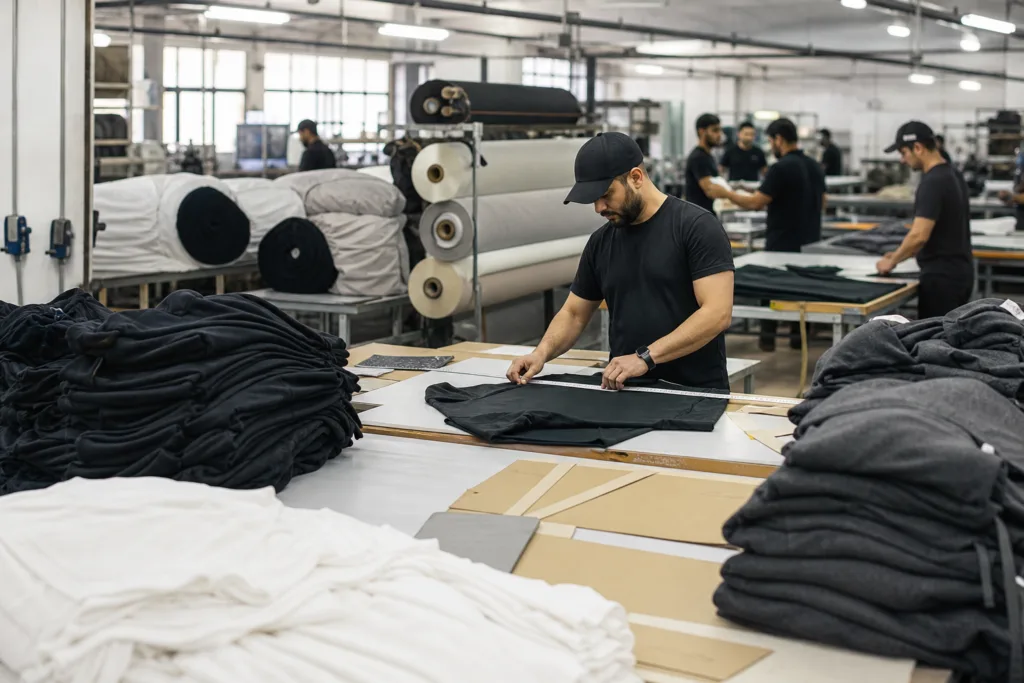
Operational readiness usually includes:
- Enough working capital to cover deposits and balance payments
- Storage conditions suitable for apparel cartons
- Clear SKU coding for styles, colors, and sizes
- Fulfillment process that can manage larger order volume
- Inventory reporting accurate enough to trigger timely reorders
For brands moving into larger programs, lead time coordination also becomes more important. Better forecasting and inventory planning can reduce avoidable delays, which aligns with the supply chain planning principles discussed by NIST MEP on lead-time reduction and inventory coordination.
What manufacturing conditions should be in place before a larger order?
Manufacturing readiness means the product can be produced at higher volume without introducing preventable instability. That includes raw material access, approved construction standards, realistic timeline planning, and a defined QC process.
Before a larger run, we usually want to see clarity in five areas:
- Fabric source is confirmed and available in the required quantity
- Color standard or lab dip approval is documented if needed
- Size specs and graded measurements are finalized
- Print, embroidery, labels, and packaging are confirmed
- Production schedule matches the real critical path
Brands often underestimate timing when moving out of startup mode. Bulk runs may require more structured material booking, pre-production approvals, and line scheduling than a small test order. Reviewing production timing considerations for larger runs early can help avoid unrealistic launch commitments.
At the factory level, consistency matters as much as speed. A larger run with unstable cutting, inconsistent sewing, or changing trims can create a bigger problem than a delayed launch.
Why quality control planning should get tighter as volume increases
As quantities grow, small errors become expensive very quickly. A neckline issue on 50 units is frustrating. The same issue on 2,000 units can affect returns, reputation, and inventory recovery strategy.
That is why brands should define quality control checks before scaling output rather than assuming that a good sample automatically guarantees a good bulk result. Sample approval confirms direction. QC confirms consistency.
Useful pre-bulk checkpoints include:
- Fabric inspection before cutting
- Pilot or size-set confirmation where needed
- Logo placement verification
- Measurement checks during sewing
- Final random inspection before packing
- Carton and assortment verification before shipment
When should a startup avoid scaling and stay with small-batch production?
A startup should usually delay scaling when demand is still unstable, the fit is still being revised, or the business cannot absorb inventory risk comfortably. Staying with smaller runs is often the better strategic choice, not a sign of weakness.
Warning signs include:
- Sales depend mainly on launches, drops, or short-term promotion spikes
- High return rates due to fit or fabric mismatch
- Unclear best-selling size curve
- Frequent changes to artwork, trims, or construction details
- Weak cash position after current stock commitments
- No clear reorder pattern yet
- Uncertain warehouse or fulfillment process
If several of these are true at once, another low MOQ cycle may generate better information than a bulk commitment.
A practical checklist: low MOQ versus bulk production
Use this framework to decide which path fits your current stage.
| Decision factor | Stay with low MOQ | Move toward bulk |
|---|---|---|
| Demand | Still being tested | Repeated and stable |
| Product development | Fit and materials still evolving | Specs mostly locked |
| Forecasting | Guesswork or launch-led | Based on reorder history |
| Margin logic | Bulk savings are marginal | Bulk savings are meaningful |
| Cash flow | Tight and risk-sensitive | Can support larger deposits and stock |
| Operations | Limited storage or fulfillment capacity | Inventory systems are ready |
| Factory setup | Still trialing specs and trims | Production inputs are standardized |
Key takeaway: Bulk production makes sense when your product and business are both becoming predictable. If only one is stable, the transition is premature.
How to reduce risk during the transition from small batch to bulk
You do not always need to jump directly from very low MOQ to a full-scale order. A phased approach often works better.
Practical risk-reduction strategies include:
- Increase quantity gradually on proven colors before expanding the full range
- Scale best-selling sizes first instead of all sizes equally
- Keep fashion colors in smaller runs while core colors move to bulk
- Use a pilot bulk run before committing to a major seasonal quantity
- Reserve fabric for reorders if the style is becoming a carryover item
From our manufacturing perspective, this middle step is often where the smartest decisions happen. Brands can gain some production efficiency without taking on the full risk of a very large buy.
This is also a good stage to bring the manufacturer into the planning discussion early. A capable team can help estimate how fabric availability, trim MOQs, printing setup, and line scheduling will affect the transition.
Common mistakes startups make when moving too early into larger runs
The most common mistake is confusing attention with demand. Strong engagement, influencer visibility, or one successful launch does not automatically justify deeper inventory.
Other frequent problems include:
- Scaling before finalizing fit and graded size specs
- Using a bulk quantity that is too wide across too many colors
- Overestimating demand for fringe sizes
- Ignoring packaging and labeling lead time
- Choosing a cheaper fabric substitute that changes hand feel
- Underestimating warehouse and fulfillment complexity
- Failing to document approvals clearly before production starts
Another major issue is weak communication. If the tech pack, logo file, care label content, and packaging instructions are incomplete, the risk of inconsistency rises sharply in larger runs.
What a clothing manufacturer needs from you before placing a larger order
The smoother your preparation, the safer your scale-up. Before committing to bulk, a manufacturer will usually need a more complete production package than what may have been acceptable during small-batch testing.
Useful inputs include:
- Approved sample reference
- Final measurement spec and tolerance
- Confirmed colorways and size breakdown
- Logo files and decoration method details
- Label, hangtag, and packaging instructions
- Target delivery window and shipping plan
- Forecast assumptions or expected reorder cadence
If a brand is not ready with these details, it does not necessarily mean the project should stop. It usually means the team should spend more time in pre-production planning before increasing volume. At Ninghow, we see better bulk outcomes when that preparation work is treated as part of scaling, not as an afterthought.
How to choose the right timing for startup low MOQ to bulk production

The right timing is usually not the earliest moment a factory can make more pieces. It is the moment your demand, product, and operations are stable enough that larger runs improve efficiency without creating disproportionate risk.
When to scale apparel production depends on the strength of your repeat sales, the maturity of your SKU, the clarity of your size curve, the margin benefit of volume, and your ability to manage the inventory after it lands. If those areas are solid, moving toward larger runs can improve cost control and consistency. If they are still uncertain, another focused small-batch cycle may be the better decision.
For startups and growing brand teams, the smartest path is often a measured one: validate, standardize, scale in steps, and keep the production plan tied to real demand rather than optimism alone.
FAQs
How many successful small runs should a startup complete before moving to bulk?
A startup should usually see success across more than one run before moving to bulk. The key is not a fixed number of orders, but whether demand, fit feedback, and size sell-through are becoming consistent enough to forecast with confidence.
Is lower unit cost a good enough reason to increase apparel order size?
No, lower unit cost alone is not enough reason to scale. The savings need to remain meaningful after you account for inventory risk, cash flow pressure, storage, fulfillment, and the possibility of markdowns on slower-moving stock.
What product issues should be fully resolved before a larger bulk run?
Before a larger run, the style should have a stable fit, approved graded specs, confirmed fabric and GSM, finalized logo method, and clear trims and packaging details. If the sample process is still uncovering major changes, scaling is usually premature.
Can a startup scale only one SKU instead of the whole collection?
Yes, scaling one proven SKU is often the safest approach. Many startups move core best-sellers into larger runs while keeping new styles, fashion colors, or uncertain fits in lower MOQ production until demand becomes clearer.
What is the biggest operational risk when moving from low MOQ to bulk production?
The biggest operational risk is often not manufacturing but inventory handling. If storage, SKU tracking, fulfillment, and returns processes are not ready for higher volume, a bigger order can create internal bottlenecks even when the product itself sells well.
How can a startup reduce risk while testing a move toward bulk production?
A startup can reduce risk by increasing quantity in phases, focusing first on proven colors and sizes, and treating the next larger order as a pilot rather than a full leap. This approach gives the brand more data while still unlocking some manufacturing efficiency.