



The polo shirt manufacturing process looks simple from the outside, but consistent bulk production depends on a long chain of decisions about fabric, fit, construction, decoration, labeling, and quality control. For brands, uniform buyers, teams, schools, and retailers, understanding that workflow helps prevent avoidable delays, sizing issues, logo problems, and cost surprises before an order reaches the factory floor.
If your project involves branded uniforms, teamwear, golf polos, retail collections, or private label basics, it helps to review custom polo shirt production paths before development starts. At Ninghow, we support buyers through fabric selection, fit refinement, logo application planning, sampling, bulk production scheduling, and packaging setup so the final polo program matches both use case and delivery expectations.
What the polo shirt manufacturing process really covers
In practical terms, the process starts before any fabric is cut. A manufacturer first needs clear product requirements, then develops the right fabric and fit direction, confirms trims and decoration methods, approves samples, plans bulk production, and controls quality through packing.
This matters because polo shirts are not just T-shirts with collars. Collar roll, placket shape, cuff recovery, knit stability, and logo placement all affect whether the garment feels premium, performs well, and stays consistent across a size run.
Key takeaway: Buyers usually reduce risk when they treat polo development as a full product-engineering process rather than a simple logo customization job.
Which buyers typically need custom polo shirt production?
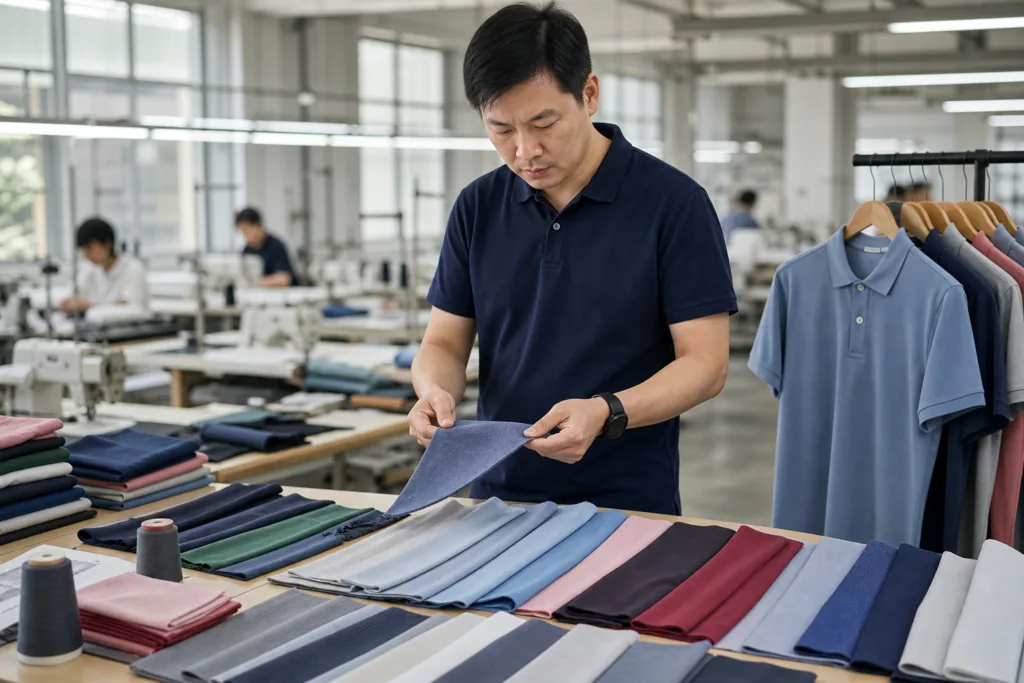
Custom polo production is common across several B2B use cases. The construction requirements may look similar, but fabric choice, branding details, and packaging standards often vary significantly.
- Fashion and basics brands building private label polo programs
- Corporate uniform buyers needing durable, repeatable color programs
- Golf and sportswear brands requiring moisture management and performance stretch
- Schools, clubs, and organizations ordering embroidered polos in multiple sizes
- Retailers and distributors sourcing repeat bulk styles with stable quality
From our manufacturing perspective, the intended use should shape nearly every technical decision. A resort or golf polo may prioritize breathability and drape, while a workwear polo may need stronger color fastness, more durable seams, and easier care after repeated washing.
How to confirm product requirements before development begins
The most efficient orders begin with clear inputs. Before we move into sampling, we usually need the target market, fit direction, fabric preference, logo method, expected price range, size range, colorways, order quantity, and packaging requirements.
If those points are vague, sampling often takes longer and revisions increase. That is especially common when the buyer wants a “premium polo” but has not defined whether premium means heavier cotton pique, smoother jersey, performance stretch, cleaner placket construction, or more structured collar support.
- Define the end use: retail, golf, school, corporate, team, or hospitality
- Provide a tech pack or at least reference images with comments
- Clarify men’s, women’s, youth, or unisex sizing expectations
- State the expected logo locations and decoration size
- Confirm whether private labels, hangtags, and custom packaging are required
- Set realistic MOQ, target price, and delivery timing early
A clear requirement stage saves time later because pattern, fabric, trims, and logo testing can all be aligned from the beginning.
How to choose the right fabric for the polo shirt manufacturing process
Fabric selection is one of the biggest decisions in the polo shirt manufacturing process because it affects hand feel, shrinkage, drape, logo compatibility, and total cost. The most common base options are pique, jersey, cotton-rich knits, polyester performance knits, and blended fabrics.
Pique is often chosen for classic polos because its texture gives a traditional look and a slightly more structured body. Jersey feels smoother and can work well for softer lifestyle polos, while polyester and blended knits are widely used for activewear, uniforms, and golf programs where moisture management and wrinkle resistance matter.
Buyers comparing material options can benefit from this guide to best fabrics for polo shirt manufacturing, especially when balancing appearance, comfort, performance, and budget.
| Fabric Type | Typical Advantage | Possible Limitation | Common Use |
|---|---|---|---|
| Cotton pique | Classic polo texture and breathable feel | Can shrink more if not properly controlled | Retail, uniforms, schoolwear |
| Cotton jersey | Softer hand feel and smooth surface | Less traditional polo appearance | Casual brands, softer basics |
| Polyester pique | Good durability and moisture management | Hand feel depends heavily on yarn quality | Sports, golf, teamwear |
| CVC or TC blends | Cost-performance balance and easier care | May feel less natural than high-cotton options | Corporate uniforms, large programs |
| Stretch performance knit | Mobility and comfort with technical look | Higher material cost in some cases | Golf, active lifestyle polos |
What fabric factors buyers should evaluate before approval
GSM matters, but it is not the only performance factor. A 200 GSM knit can still feel very different depending on fiber blend, yarn quality, knit structure, finishing, and compactness.
We usually advise buyers to review these fabric points together rather than choosing by weight alone:
- GSM and whether the shirt should feel light, balanced, or substantial
- Hand feel, including softness, dryness, smoothness, and surface texture
- Shrinkage behavior after washing
- Breathability and moisture handling
- Stretch and recovery, especially for cuffs and active use
- Color fastness to washing, rubbing, and light where relevant
- Pilling resistance and long-term appearance
Shrinkage is especially important for cotton and cotton-rich polos because knit fabrics can change after wash finishing and laundering. For buyers who want a deeper technical reference on the shrinkage behavior of pique and jersey knits, this industry bulletin is useful background when discussing pre-shrunk fabrics and tolerance planning.
Key takeaway: The right polo fabric is not simply the softest or heaviest option. It is the one that matches the end use, logo method, care expectations, and acceptable cost level.
How pattern making and fit development shape the final polo
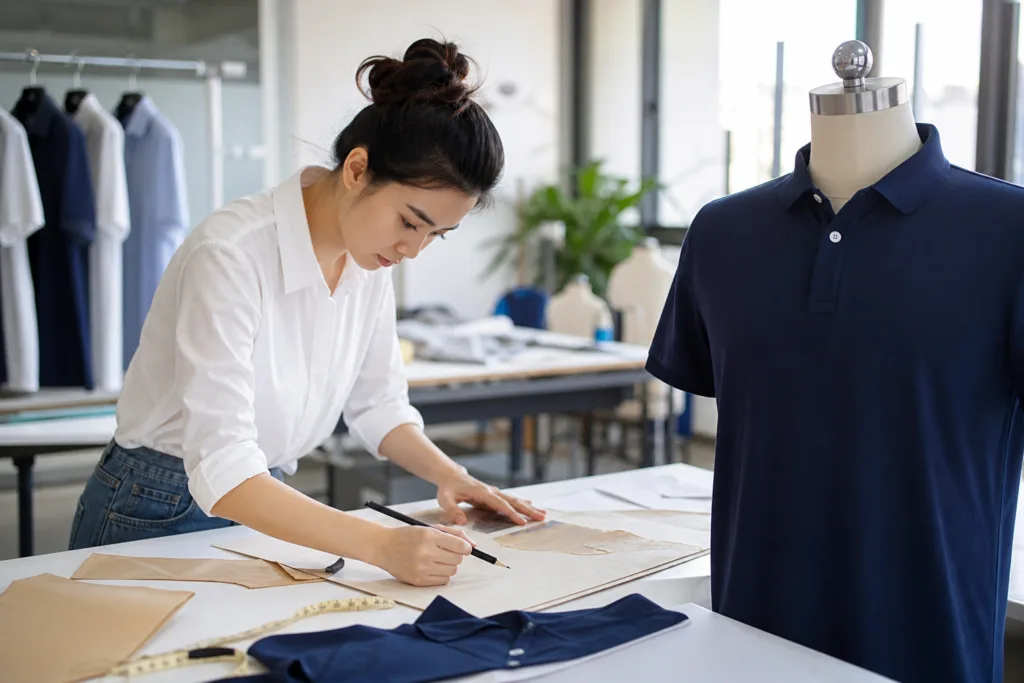
Good polos depend on good pattern development. Even when buyers provide a reference sample, the factory still needs to convert that idea into production-ready measurements, balanced proportions, and sewing-friendly construction.
The main fit choices usually include slim, regular, relaxed, athletic, or boxier silhouettes. Small pattern changes can noticeably affect the garment, especially through the shoulder width, armhole shape, sleeve opening, body sweep, and front placket depth.
Size grading is also critical because a polo that looks good in size M can lose balance in larger or smaller sizes if the grade rules are weak. For buyers working with structured measurement logic, clothing size designation and body measurement standards provides helpful context for how body measurement definitions support consistent size development.
| Component | What Buyers Should Check | Why It Matters |
|---|---|---|
| Collar | Shape, stand, roll, interlining, recovery | Affects premium appearance and wash stability |
| Cuff | Rib quality, stretch, width, rebound | Impacts comfort and long-term shape |
| Placket | Length, topstitching, button spacing | Changes visual balance and ease of wear |
| Body fit | Chest, waist, hem sweep, length | Determines target market suitability |
| Sleeve | Length, opening, pitch | Important for movement and silhouette |
In our production work, collar construction is often where lower-grade polos reveal quality problems first. If the collar knit, fusible support, or attachment method is wrong, the shirt may twist, wave, or lose shape after washing.
Why sample development should never be rushed
Sampling is where the concept becomes measurable. A first proto sample helps confirm whether the chosen fabric, pattern, and construction actually work together in a wearable polo shirt.
The sample stage should not only check appearance. It should also test measurement accuracy, placket behavior, collar shape, stitch neatness, hem balance, logo placement, and fabric response after basic washing when needed.
Buyers who want smoother approvals usually benefit from a structured approach to apparel sampling and fit confirmation, especially when multiple departments need to review fit, branding, and quality details before bulk production.
- Measure the sample against the approved spec sheet
- Check collar points, placket alignment, and button spacing
- Review side seam twisting or fabric torque
- Test whether embroidery or print affects drape
- Wash test if shrinkage or spirality is a concern
- Confirm packaging and labeling mockups when private label is required
When buyers skip careful sample review, bulk problems usually become more expensive. A small issue in a proto, such as placket bubbling or chest logo misplacement, can affect every garment in production if it is not corrected in time.
How to choose the right logo and decoration method
Embroidery is not always the best option, and printing is not always cheaper in practice. The best decoration method depends on logo size, fabric texture, order volume, placement, and the brand image the buyer wants to achieve.
Pique fabrics often suit embroidery well, but dense embroidery on lighter knits can create puckering if backing, stitch count, or placement is poorly handled. Printing can work for fashion polos, promotional programs, and some sporty designs, but the print method must match the fabric composition and expected wash performance.
When comparing decoration choices, this breakdown of embroidered vs printed logo methods can help buyers decide based on appearance, durability, and production suitability.
| Method | Best For | Watchpoints |
|---|---|---|
| Embroidery | Corporate, school, club, premium branding | Puckering, backing choice, stitch density |
| Screen printing | Larger graphics, promotional runs | Surface texture may affect sharpness on pique |
| Heat transfer | Small runs, names, numbers, technical branding | Application temperature and long-term adhesion |
| Sublimation | Poly performance polos | Only suitable for compatible polyester fabrics |
We recommend testing logos during sampling whenever the fabric is textured, stretchy, or lightweight. That single step often prevents distortion, strike-through, or inconsistent placement in bulk.
What materials, trims, labels, and packaging should be approved before bulk?
Before production begins, buyers should lock not only the garment body but also every supporting detail. That includes buttons, collar and cuff yarn color, labels, hangtags, care labels, spare buttons if needed, polybags, carton markings, and folding method.
These details matter because they affect both brand presentation and execution speed. A bulk order can be delayed by something as small as a missing woven neck label approval or an unconfirmed barcode sticker format.
- Buttons: size, color, material, and attachment method
- Neck labels: printed, woven, heat transfer, or tear-away options
- Care labels: fiber content, origin, care instruction, and legal compliance needs
- Hangtags: shape, artwork, string, and attachment point
- Polybags: suffocation warning needs, size sticker, barcode, vent holes
- Cartons: packing ratio, carton dimensions, shipping marks
For private label buyers, this is also the stage to confirm brand consistency across garment identity, not just the chest logo.
What happens in pre-production at a polo shirt factory?
Pre-production is where planning turns into factory instructions. At this stage, the final tech pack, approved sample, bill of materials, color references, size chart, trim approvals, and packing instructions should all match.
At Ninghow, we treat this step as a control point because many bulk problems start with mismatched documents rather than poor sewing skill. If the approved sample says one collar height and the production sheet shows another, the factory can produce the wrong result at scale very quickly.
Typical pre-production preparation includes:
- Order quantity confirmation by color and size
- Fabric booking or in-stock verification
- BOM finalization for trims and labels
- Color approval for body, collar, cuff, and thread
- Marker and cutting planning
- Line loading and production schedule confirmation
- PP sample or pre-production review if needed
Key takeaway: The smoother the pre-production file set, the lower the chance of expensive changes once bulk cutting starts.
How bulk cutting and marker planning affect size consistency
Once fabric is approved and relaxed properly, bulk cutting begins. This stage is not just about speed. It is about using markers efficiently, keeping panels aligned, and protecting measurement accuracy across the full order.
For striped, tipped, or engineered polos, panel alignment becomes even more important. Inconsistent placket matching or sleeve stripe misalignment can make a bulk order look irregular even when sewing quality is acceptable.
Factories typically control cutting quality by checking marker efficiency, lay height, fabric direction, panel numbering, and component bundling. These controls help maintain size consistency from one bundle to the next.
What happens during sewing and assembly in bulk production?
Bulk sewing converts cut panels into finished garments through a sequence of controlled operations. A standard polo may look straightforward, but collar attachment, placket building, and hem finishing all influence appearance and wear performance.
The typical sewing flow includes shoulder joining, collar preparation and attachment, placket construction, sleeve setting, side seam closing, cuff attachment where applicable, bottom hemming, buttonhole making, button attaching, and final thread cleaning.
Construction quality should be judged by more than seam closure. Buyers should also pay attention to seam puckering, skipped stitches, inconsistent topstitching, placket symmetry, collar points, and sleeve balance.
- Collar should sit flat and return well after handling
- Placket should remain straight without bubbling
- Sleeves should look balanced left to right
- Side seams should hang straight without twisting
- Bottom hem should be even and clean
For performance polos, sewing thread choice and stitch elasticity matter more because the fabric stretches under movement. For uniform polos, repeatability and wash durability often matter more than soft drape alone.
Why pressing, trimming, and finishing affect retail-ready quality
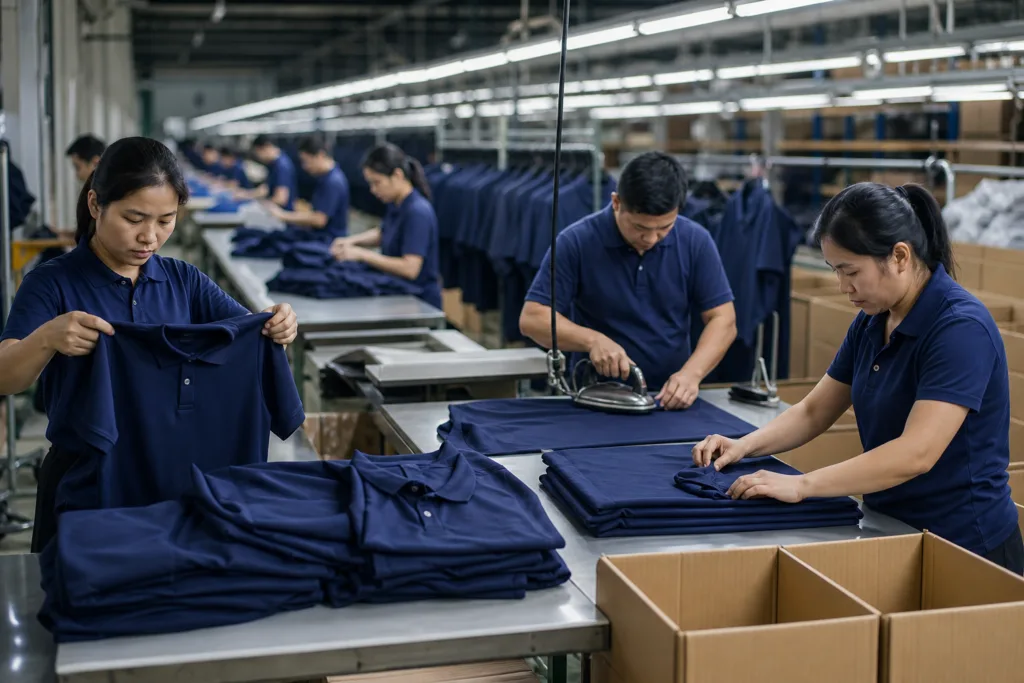
After sewing, the polo still needs proper finishing. Pressing helps set the garment shape, improve presentation, and reveal defects that are easier to miss on an unpressed shirt.
Thread trimming, stain checking, button reinforcement, and appearance review also happen here. A polo can have acceptable construction but still look low grade if loose threads, collar waves, or poor pressing remain visible at packing stage.
This finishing step is especially important for corporate, retail, and gift programs where the buyer expects a clean first impression directly out of the bag.
How quality control should work during and after production
Quality control should not be saved for the final day. Strong factories check quality during incoming materials review, cutting, sewing, finishing, and final packing so problems are found before they spread through the order.
For buyers building repeat programs, understanding apparel quality control standards is useful because QC in polos usually needs both visual inspection and measurable checkpoints.
| QC Checkpoint | What to Inspect | Why It Matters |
|---|---|---|
| Fabric inspection | Shade, holes, knitting faults, hand feel | Prevents defective fabric entering production |
| Cutting inspection | Panel accuracy, notches, alignment | Protects fit and assembly consistency |
| In-line sewing QC | Stitching, placket, collar, logo position | Finds issues before large quantities are completed |
| Final measurement | POM tolerances across sizes | Confirms bulk matches approved spec |
| Final appearance check | Threads, pressing, stains, packaging | Ensures shipment is retail or program ready |
Shade control is another important issue in polos, especially for darker colors or orders with body and collar components dyed separately. We usually recommend keeping approved shade references and checking fabric lots before sewing starts.
How final packaging and shipment preparation should be handled
Packaging is the last production step, but it still affects buyer satisfaction and warehouse efficiency. A well-made polo can still create problems if the folding method is inconsistent, the barcode labels are wrong, or carton ratios do not match the customer’s receiving system.
Before shipment, the factory should confirm folding standard, individual bagging method, size sticker format, carton assortment, net and gross weight, outer carton markings, and any destination-specific document needs.
For bulk programs shipping to retail or distribution centers, packaging instructions should be treated as part of product quality rather than a simple logistics detail.
What mistakes commonly cause trouble in polo shirt production?
The most common mistakes are usually avoidable. They often come from unclear instructions, late changes, or underestimating how many small components affect a finished polo.
- Choosing fabric based only on price without checking hand feel or shrinkage
- Approving a sample without full measurement review
- Skipping decoration testing on textured or stretchy fabrics
- Changing labels or packaging too late in the timeline
- Not confirming color matching for body, collar, and cuff
- Assuming MOQ is the same for every fabric and trim combination
- Expecting fast delivery without locking approvals early
From our perspective, the safest orders are the ones where the buyer makes decisions early and documents them clearly. That reduces rework and protects both timeline and consistency.
How to evaluate an OEM polo shirt manufacturer before placing a bulk order
Buyers should look beyond price and ask how the factory manages the full process. A suitable supplier should be able to explain fabric sourcing logic, sample workflow, pattern control, decoration compatibility, QC checkpoints, and packaging execution in practical terms.
- Ask what polo fabric types the factory handles most often
- Review sample quality, not only sales communication
- Check whether the supplier can support private label trims and packaging
- Ask how fit approval and grading are controlled
- Confirm how in-line and final QC are documented
- Discuss realistic lead times based on fabric and logo complexity
A transparent manufacturer will usually explain trade-offs clearly. For example, low MOQ may be realistic with stock fabric and standard trims, but less realistic for custom-dyed pique, special ribs, or highly customized packaging.
What affects MOQ, lead time, and cost in polo shirt production planning?
MOQ depends on how customized the polo program is. Stock fabric, common colors, and standard trims can support smaller runs more easily, while custom-dyed fabric, unique collar tipping, and fully branded packaging often push minimums upward.
Lead time is affected by sampling rounds, fabric knitting or dyeing, trim sourcing, logo method, production line capacity, QC requirements, and shipping arrangement. Cost is shaped by fabric composition, GSM, decoration, trim count, garment wash or finishing requirements, and the total number of colorways and sizes.
Buyers usually get better results when they define which parts of the polo must be fully custom and which can stay more standard. That keeps the project commercially balanced without losing brand identity.
How we support scalable and transparent polo shirt manufacturing
At Ninghow, we approach polo projects as a coordinated manufacturing workflow rather than a simple finished-garment transaction. That means helping buyers connect fabric choice, fit development, logo testing, trim approval, production planning, and QC into one process that can scale from sample stage to bulk delivery.
For some buyers, the key challenge is fabric and fit. For others, it is private label setup, repeatability across reorders, or balancing MOQ with customization depth. The right manufacturing partner should be able to guide those decisions with clear production reasoning, not just quotations.
Key takeaway: The best polo programs are usually built through clear specifications, disciplined sample approval, and realistic bulk planning from the start.
Conclusion
The polo shirt manufacturing process involves much more than sewing a collar onto a knit body. Fabric structure, GSM, fit, grading, decoration, trims, sample approval, cutting accuracy, sewing control, finishing, and packaging all influence whether the final order performs well in real use and remains consistent at scale.
For brands and B2B buyers, understanding that workflow makes sourcing decisions stronger. When requirements are clear and approvals are disciplined, custom polo production becomes more predictable, more efficient, and better aligned with quality, budget, and delivery goals.
FAQs
What is the most important step in the polo shirt manufacturing process?
The most important step is early product definition because every later decision depends on it. If fabric, fit, logo method, size range, and packaging expectations are unclear at the start, sampling takes longer and bulk production risk increases.
Which fabric is best for custom polo shirts?
The best fabric depends on the use case rather than one universal standard. Cotton pique suits classic retail and uniform polos well, while polyester or blended performance knits are often better for golf, sports, and easy-care programs that need moisture management and durability.
Why do polo shirt samples sometimes need more than one revision?
Polo samples often need multiple revisions because fit, collar shape, placket behavior, shrinkage, and logo appearance can all change once the garment is physically made. A second or third sample is normal when the buyer is refining a private label product instead of copying an already proven factory style.
How does MOQ affect custom polo shirt production?
MOQ affects custom polo production by determining how much flexibility the factory can offer on fabric, color, trims, and packaging. Lower quantities are usually easier when using stock materials, while deeper customization often requires higher minimums to make knitting, dyeing, trim development, and setup costs practical.
What quality checks should buyers ask for before shipment?
Buyers should ask for fabric inspection, in-line sewing checks, final measurement review, logo inspection, finishing review, and packaging verification before shipment. These checkpoints help confirm that the bulk order matches the approved sample in both appearance and specification.
How long does bulk polo shirt production usually take?
Bulk polo production timing depends on fabric availability, sample approval speed, decoration method, order size, and packaging complexity. Programs using ready materials can move faster, while custom-dyed fabrics, branded trims, and multiple revisions usually extend the production schedule.