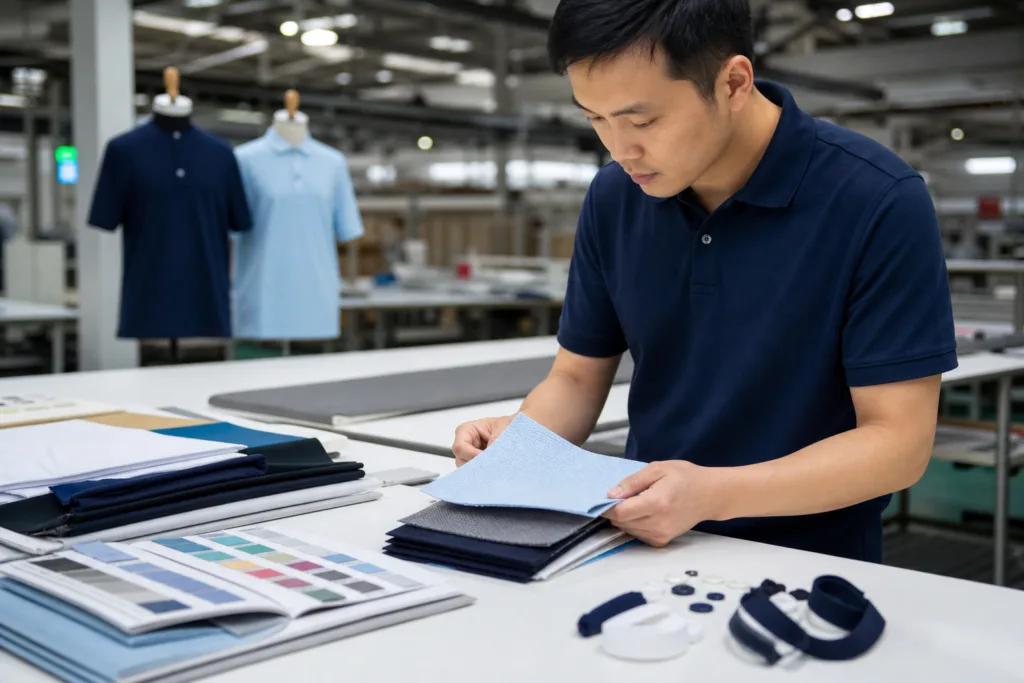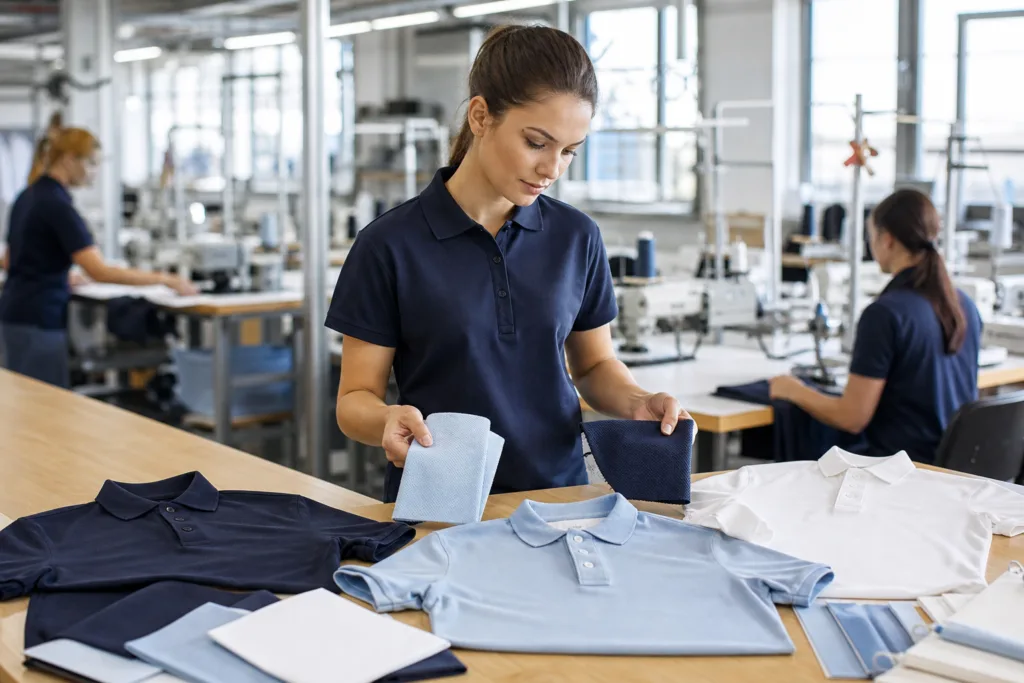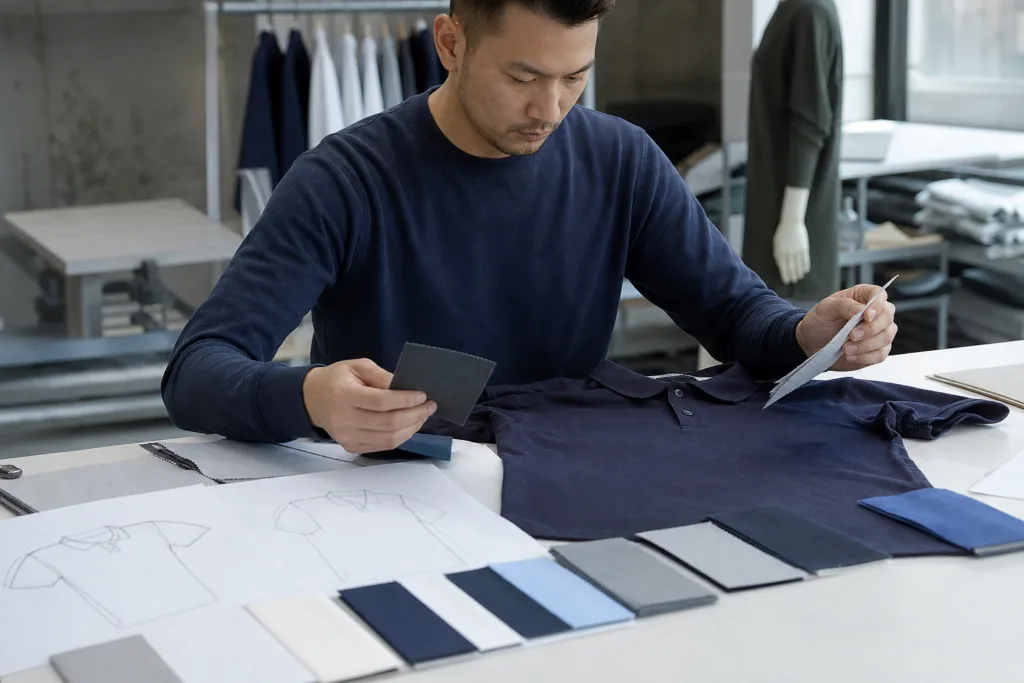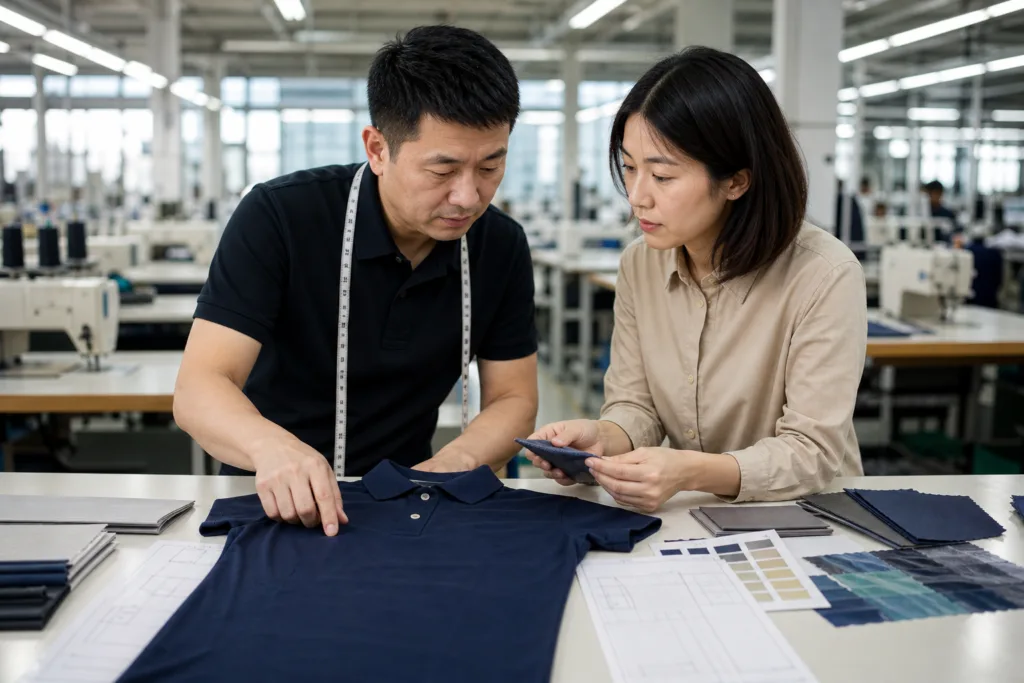
Custom clothing manufacturing team reviewing fabric and garment specifications

How to Define Your Custom Clothing Manufacturing Project Before Requesting Quotes

A reliable quote starts long before a factory calculates a unit price. In custom clothing manufacturing, an early idea must be translated into decisions about product purpose, fabric, fit, decoration, quantity, and quality expectations. The more clearly these decisions are documented, the more comparable supplier quotes become and the less likely a project is to

How to Define Your Custom Clothing Manufacturing Project Before Requesting Quotes Read More »

Apparel manufacturing team reviewing polo fabric swatches and product specifications

Apparel Manufacturing Planning for Custom Polo and Uniform Programs

Successful apparel manufacturing starts before a factory receives an order. Buyers need a defined product, realistic quantity, clear target user, and documented customization requirements so fabric, fit, costing, sampling, and bulk production can move in the same direction. Without those decisions, even a simple polo program can face avoidable revisions, inconsistent sizing, or late changes

Apparel Manufacturing Planning for Custom Polo and Uniform Programs Read More »

Custom polo shirt manufacturing fabric inspection with pique and performance knit swatches

Custom Polo Shirt Manufacturing: Fabric, Fit, MOQ, and QC Guide

Custom polo shirt manufacturing is most successful when buyers define the end use before selecting fabric, fit, decoration, and price targets. A polo for corporate uniforms needs a different balance of durability and logo visibility than a golf polo, retail private-label style, or team garment. Clear specifications early help protect sample timing, size consistency, and

Custom Polo Shirt Manufacturing: Fabric, Fit, MOQ, and QC Guide Read More »

Apparel manufacturing team reviewing piqué fabric swatches for custom polo shirts

Polo Shirt Apparel Manufacturing Planning Guide

Apparel manufacturing decisions become much easier when a buyer defines the garment category, intended wearer, customization level, and order scenario before requesting a quotation. This guide uses the polo shirt as a practical example because its fabric, collar construction, fit, and decoration choices reveal the same planning disciplines that apply across custom apparel production. For

Polo Shirt Apparel Manufacturing Planning Guide Read More »

Apparel manufacturing team comparing fabric swatches for custom polo shirts

Polo Shirt Apparel Manufacturing Planning for B2B Buyers

Apparel manufacturing decisions are easier to control when buyers define the garment, end use, target customer, customization level, and commercial objective before requesting prices. For polos, those early decisions affect fabric sourcing, pattern work, logo methods, minimum order quantities, sampling time, and the consistency a buyer can expect in bulk production. For buyers developing premium

Polo Shirt Apparel Manufacturing Planning for B2B Buyers Read More »

Custom clothing manufacturing fabric selection for premium polo shirts

Custom Polo Shirt Manufacturing Planning for Brands

Custom clothing manufacturing becomes easier to control when a buyer turns a broad request into a defined garment brief. For custom polo shirts, that means deciding the end use, fabric behavior, fit, logo method, labeling, order split, and approval process before a factory commits materials or production capacity. A clear plan protects brand consistency while

Custom Polo Shirt Manufacturing Planning for Brands Read More »

Custom clothing manufacturing product brief with fabric samples and garment specifications

How to Define Your Custom Clothing Manufacturing Requirements Before Requesting Quotes

Requesting a clothing manufacturing quote before defining the product usually creates more questions than answers. A factory needs enough information about the garment, fabric, fit, decoration, quantities, timing, and quality expectations to prepare a useful estimate for custom clothing manufacturing. If your project involves work polos, uniforms, or a coordinated teamwear range, polo shirt manufacturing

How to Define Your Custom Clothing Manufacturing Requirements Before Requesting Quotes Read More »

Custom clothing manufacturing product planning with fabric swatches and garment specifications

Custom Clothing Manufacturing: A Buyer’s Planning Guide for Developing and Ordering Apparel

Custom clothing manufacturing gives brands, teams, retailers, and organizations more control over fabric, fit, branding, construction, and order quantities than simply decorating an existing garment. That control also creates more decisions to manage. A lower-risk apparel order starts with a clear end use, a production-ready brief, realistic quantity expectations, approved samples, and measurable quality requirements.

Custom Clothing Manufacturing: A Buyer’s Planning Guide for Developing and Ordering Apparel Read More »

Custom clothing manufacturing fabric selection and product development

Custom Clothing Manufacturing: A Practical Guide to Developing, Sourcing, and Producing Apparel

Custom clothing manufacturing turns an apparel idea into a repeatable product that can be sampled, approved, produced, inspected, and delivered at the required quality. It is relevant to clothing brands, startups, retailers, sports teams, schools, distributors, and procurement teams that need more control than ready-made wholesale can provide. The strongest projects begin with a clear

Custom Clothing Manufacturing: A Practical Guide to Developing, Sourcing, and Producing Apparel Read More »

Scroll to Top

Get in Touch with Ninghow

Start your clothing business…

Response Time Notice

To help you get the fastest support:

  • 💬 For instant replies, click the “WhatsApp us” icon at the bottom right of this page.
  • 📧 Emails sent by clicking our email address:  [email protected] are typically replied to within 10 minutes.
  • 📝 Form submissions may take more time to receive a response.

If you do not receive a reply within 24 hours via email, please check your spam or junk folder.