

Before taking apparel preorders, confirm the approved garment, minimum quantities, material availability, payment triggers, quantity cutoff, and scheduling conditions with your factory. Brands comparing clothing manufacturers for startups should treat these as release gates—not details to resolve after customers buy. Preorders do not automatically remove MOQ, reserve capacity, or guarantee arrival. Effective preorder apparel production planning separates customer demand from a manufacturing commitment.
Confirm These Factory Gates Before You Open Apparel Preorders
Open preorders only when the product is sufficiently approved and the factory has assessed the expected quantities, materials, and timing. Ask for written confirmation of what can proceed now and what remains conditional.
| Release gate | Confirmation needed |
|---|---|
| Product | Approved sample and controlled specifications; outstanding approvals identified |
| Quantity | Expected range by style, color, and size; applicable minimums |
| Materials | Fabric and trim availability; purchasing or reservation conditions |
| Commercial terms | Quote assumptions, payment milestones, and shortfall responsibility |
| Schedule | Sales cutoff, quantity lock, and conditions for slot confirmation |
| Release authority | Who authorizes the next manufacturing step, and with which documents |
Ninghow’s stated order process places sample approval and order confirmation before bulk material purchasing. Its timeline guidance identifies materials, approvals, and customization as scheduling dependencies—not delivery guarantees.
Copyable prelaunch decision check
- Go: Product, quantity route, commercial conditions, and schedule assumptions have written factory confirmation.
- Clarify: A remaining dependency has a named owner and resolution deadline before commitment.
- Pause: Product approval, minimums, material supply, or scheduling feasibility remains unresolved.
For a project-specific feasibility review, send the approved sample reference, expected quantity range, sales cutoff, and target arrival date. Ask the manufacturer to distinguish preorder closure, formal order confirmation, material commitment, slot confirmation, and bulk-production start.
Approve the Garment Before Customer Demand Becomes a Manufacturing Commitment
Approve a controlled garment version before accepting orders. A design sketch or customer-facing image does not establish fit, construction, or bulk-material suitability. Distinguish approval to present the product from final authorization to manufacture it.
Identify the sample revision and matching specifications: measurements, construction, fabric, color, trims, decoration, labels, packaging, and size range. Resolve fit, shrinkage, appearance, placement, and packing assumptions; mark any outstanding verification explicitly. Product claims need evidence applicable to the actual material and article, not an unrelated report.
For multiple logos or departments, map each artwork version to its size, location, color, garment allocation, and approver. Agree which representative samples require approval rather than assuming one decorated garment covers every version.
Control changes before release
For each requested change, record the affected specification and materials, committed inventory, cost and timing impact, testing or reapproval needs, and written authorization. Issue a revised specification rather than leaving conflicting instructions in messages.
If the sample, artwork, or material remains under review, treat preorder demand as conditional internally—not as a locked production quantity. Approval of an earlier version does not authorize an unreviewed substitution.
Break Down MOQ, Material Minimums, and Quantity Risk by Style and Color
Preorders do not remove a factory’s MOQ. The relevant question is whether the final assortment meets each applicable minimum—not whether campaign demand reaches one headline total.
Ask for separate confirmation of finished-garment MOQ by style and color, fabric purchasing or dyeing minimums, trim and label minimums, decoration setup requirements, size allocation restrictions, and total order quantity. A large total split across many styles or colors may still be unworkable.
Ninghow’s low-MOQ guidance ties feasibility to fabric, customization, and production setup rather than a universal threshold. Evaluating a realistic MOQ for a startup clothing brand therefore requires the actual assortment and material route.
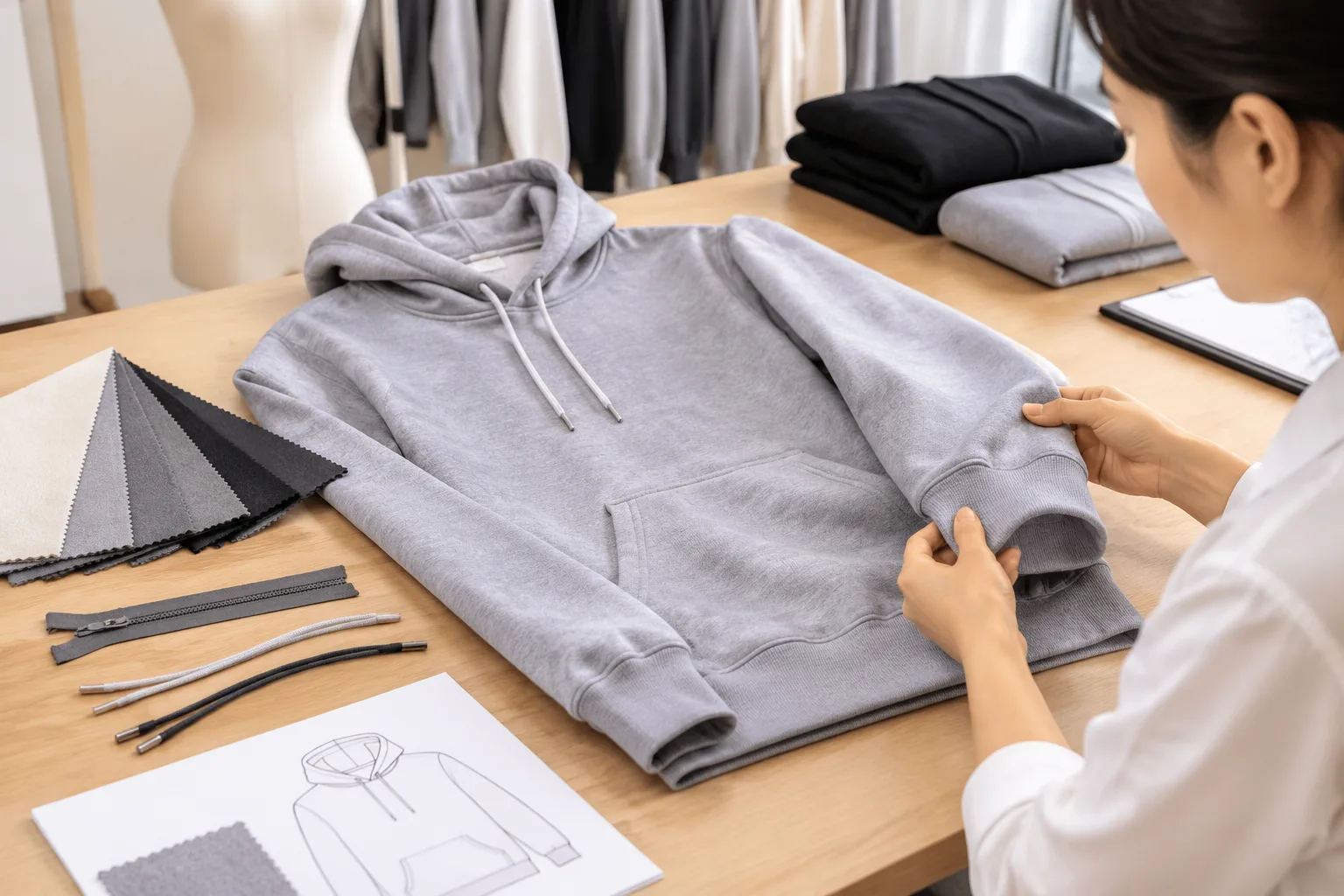
Compare concentrating demand in an approved hoodie with dividing it across several styles. For uniforms, examine logo versions and locations separately even when the base garment is shared. These decisions affect the quantity breakdown the factory must review.
If demand falls below a material minimum, ask about available stock fabrics, shared materials, color consolidation, or buyer-funded excess material. Confirm whether unused material would be purchased, reserved, or remain the buyer’s responsibility. Any reservation needs a quantity, batch, expiry, ownership terms, and unused-stock arrangement. Consolidate, revise the assortment, accept documented exposure, or delay until feasibility is confirmed.
Build a Preorder Cutoff and Production Schedule From Confirmed Inputs
Build the preorder manufacturing schedule backward from destination arrival, separating production, transport, customs, and receiving buffers. A factory production estimate is not an arrival promise.
- Preorder cutoff and quantity lock: The buyer closes demand collection and submits final style/color/size quantities. Late changes require reassessment.
- Order and payment confirmation: The buyer supplies the purchase order and agreed payment; the factory confirms acceptance and remaining release conditions.
- Material commitment: The factory confirms ordering or reservation status and availability. Unsecured supply leaves timing conditional.
- Final approval and slot confirmation: The designated buyer approves outstanding samples or artwork; the factory confirms the production window and its conditions.
- Production, inspection, and packing: The factory confirms completion checkpoints; the agreed inspection and release parties resolve issues before dispatch.
- Dispatch and arrival: The logistics provider confirms routing; the buyer coordinates customs and receiving arrangements.
Hypothetical sequence—not a Ninghow schedule: Day 0 is the customer preorder cutoff. Quantity lock follows reconciliation; order confirmation follows accepted terms and payment conditions. Material commitment, final approval, and slot confirmation must all be resolved before bulk start. Target arrival includes the agreed production window plus logistics and receiving allowances; no durations are assumed here.
A forecast supports capacity discussions but does not itself reserve a slot. Ask what written commitment secures scheduling and how long it remains valid. Late artwork, size or color changes, and material substitutions should trigger an updated schedule before release.
Agree Payment Milestones, Quantity Lock, and the Shortfall or Overage Decision
Once the quantity lock is separated from the customer preorder cutoff, confirm the commercial conditions that make that lock actionable. A written review should cover the deposit or payment timing, balance trigger, currency, payment method, material commitment point, and treatment of cancellations or changes. Do not assume that customer preorder receipts will be immediately available, sufficient, or risk-free for factory payment.
Ask the factory to identify the date on which quantities become binding and what happens before and after that date. Distinguish material reserved for discussion from material covered by an actual purchase order. If unused fabric, trims, labels, or packaging remain after a demand shortfall, confirm who owns them, how long they may be held, and whether an alternative use is possible.
Decide by demand position
- Below target: Check whether quantities can be consolidated by style, color, or shared material route. If the project cannot meet the applicable minimum, follow the buyer’s published customer terms and decide whether to close, cancel, or revise the order. Do not present a refund result or revised price as automatic.
- At target: Confirm the SKU-level quantity lock, material commitment, payment trigger, and remaining approvals in writing before bulk-production start.
- Above target: Set a confirmed cap for the original order. Quantities added after the cutoff may require a new material and schedule review rather than being accepted automatically.
Keep 3 types of tolerance separate in the order and inspection terms: order-quantity variance, measurement tolerance, and defect acceptance. Reaching the total quantity does not compensate for a missing color or size, and an approved measurement tolerance does not define acceptable workmanship. Each field needs its own agreed basis and responsible decision-maker.
Control Material Substitutions, Decoration Versions, and Quality Acceptance Before Bulk Release
Demand changes can create pressure to replace a fabric, trim, label, packaging component, or decoration method after the customer offer is live. Treat every such change as a controlled review. A substitute should be compared with the approved version for appearance, color, hand feel, fit, shrinkage, construction, decoration result, and any claimed performance requirement. Matching fiber content or GSM alone does not prove equivalence.
For decoration, record each artwork version by location, size, color, and application method. A different logo or placement can require separate approval even when the base garment is unchanged. Retain the approved decoration sample and identify the person authorized to accept a revised version.
Color approval also needs a physical reference. A color code or digital value is not, by itself, approval of a fabric or trim match. Review relevant materials under agreed conditions, retain the approved reference, and record any accepted difference. This is especially important when fabric and trims have different surfaces or reflect light differently.
Pre-bulk release check
- Approved fabric, trim, label, and decoration references
- Color approval for the garment and coordinated components
- Size set or other agreed fit reference
- Decoration artwork, locations, dimensions, and version control
- Label content and placement
- Packing method, barcode requirements, and carton or individual-packing instructions
- Separate fields for quantity variance, measurement tolerance, and defect acceptance
- Applicable reports or tests matched to the actual sample, material, color, preparation, method, and date
Do not rely on a laboratory logo or an unrelated report to support a product claim. If a substitution changes an affected requirement, identify what must be rechecked, who approves it, and whether the change affects cost or schedule. No unapproved substitute should be treated as the controlled garment version.
Send a Preorder Manufacturing Readiness Pack for a Written Feasibility Review
A written feasibility review is most useful when the factory receives a complete, version-controlled brief. Send the information below before opening the preorder or confirming the manufacturing order.
Preorder manufacturing readiness pack
- Style names, expected quantities, color breakdown, and size curve
- Approved sample photos or a physical sample reference, plus the current tech pack
- Fabric, trim, label, and packaging specifications, including any proposed alternatives
- Decoration artwork, locations, dimensions, colors, and version approvals
- Barcode, packing, carton, and receiving requirements
- Customer preorder cutoff, target arrival date, destination, and required logistics allowances
- Requested payment milestones, currency, payment method, and quantity-lock date for confirmation
- Any material reservation, replenishment, or unused-material assumptions
Ask the factory to return a written list of confirmed items and open issues. It should address MOQ by style and color, material availability or reservation status, remaining approvals, payment milestones, production-slot assumptions, and risks that could change the schedule. The apparel production timeline should be treated as conditional on the actual inputs, not as a delivery promise.
Before the preorder page goes live, complete these release questions: Is the controlled garment version approved? Are quantities feasible by SKU? Are materials available or reserved under agreed terms? Is the schedule conditional or confirmed? What event creates the quantity lock? What happens if demand misses or exceeds the target? What change would require a new review?
Keep the approved version, assumptions, open issues, owners, and decision dates in one record. That gives both sides a clear basis for deciding whether to proceed, clarify, or pause.
For a project review, send the approved sample or reference, style and color quantities, size breakdown, decoration and label details, preorder cutoff, target arrival date, and destination. Include your material and packing requirements, then use the request a quote route to submit the manufacturing brief for confirmation of project-specific assumptions.
Frequently Asked Questions
Do preorders remove a factory’s MOQ?
No. A preorder collects customer demand but does not automatically remove a factory’s MOQ. Minimums may apply separately to the finished style, each color, fabric, dyeing route, trim, or decoration setup. Ask for a SKU-level feasibility review and confirm whether quantities can be consolidated or require a revised plan.
Should a sample be approved before taking apparel preorders?
Yes, the controlled garment version should be approved before accepting apparel preorders. Approval should cover the sample, materials, fit reference, colors, decoration, labels, and packing requirements relevant to the offer. A changing sample creates a risk that customer orders describe a product the factory has not released for bulk production.
What happens if preorder demand is below the material minimum?
First compare the shortfall with the applicable minimum by style, color, and material route. Possible decisions include consolidating quantities, revising the product, closing the order under the buyer’s customer terms, or accepting documented material exposure. Do not assume a refund, revised price, or unused-material arrangement without written commercial confirmation.
Does a sales forecast reserve production capacity?
No. A sales forecast supports a capacity discussion, but it does not itself reserve a production slot. Ask what written commitment, payment condition, quantity lock, or order confirmation secures scheduling and how long it remains valid. Changes after that point should be reviewed for material and schedule impact.
What is the difference between a preorder cutoff and a factory quantity lock?
The preorder cutoff is the date customer demand stops being collected. The factory quantity lock is the later commercial point at which the confirmed style, color, size, and total quantities become the basis for material and production decisions. The dates may coincide only when the factory has accepted the inputs and terms in writing.
What should a buyer send a clothing factory before requesting preorder production approval?
Send the approved sample reference, tech pack, style and color quantities, size curve, fabric and trim details, decoration artwork, labels, packing requirements, destination, preorder cutoff, and target arrival date. Also state material assumptions, proposed alternatives, payment preferences, and the questions requiring written confirmation about MOQ, schedule, quantity lock, and risk.