






Choosing a custom clothing manufacturer is a commercial decision that affects much more than the unit price. The right partner influences fabric consistency, fit, logo quality, sampling speed, production risk, delivery reliability, and how easily a product line can grow. A supplier that looks attractive on a quote may still create problems if its pattern development, material sourcing, quality control, or communication process is weak.
If your project includes training tops, team kits, or private-label activewear, custom gym apparel manufacturing support can help you assess fabric performance, fit refinement, decoration methods, labeling, sampling, and bulk production planning before you commit to a supplier. At Ninghow, we approach these decisions as connected production requirements rather than isolated services.
What a Custom Clothing Manufacturer Actually Provides
A custom clothing manufacturer may support the full path from product concept to finished garments, or it may specialize in selected stages. Buyers should clarify the scope early because the term manufacturer can describe anything from a cut-and-sew factory to a development partner that coordinates materials, patterns, decoration, packing, and production control.
For a private-label or bulk apparel project, useful manufacturing support can include fabric selection, pattern making, size grading, prototype development, sample revisions, logo application, labels, hangtags, packaging, sewing, finishing, inspection, and shipment preparation. The more of these stages a supplier can manage directly and document clearly, the fewer handoffs you need to coordinate.
- Product development: translating sketches, reference garments, measurements, and performance requirements into a workable specification.
- Material sourcing: comparing composition, GSM, stretch, recovery, breathability, color availability, and minimum material quantities.
- Production: cutting, sewing, decoration, finishing, packing, and the coordination of approved materials and trims.
- Quality control: checking materials, construction, measurements, appearance, decoration, labeling, and packing at defined checkpoints.
- Commercial planning: explaining MOQ, sample charges, lead time, payment milestones, shipping scope, and the assumptions behind a quote.
Key takeaway: Compare the supplier’s production process, not only its product photos. A capable partner should be able to explain how your requirements move from brief to sample to consistent bulk output.
Clarify the Manufacturing Model Before Comparing Suppliers

Private label, OEM, ODM, custom manufacturing, and wholesale are related but not interchangeable. The business model determines how much control you have over the garment, who owns the specifications, and how much development support you should expect.
| Manufacturing model | What the buyer usually controls | Best fit | What to confirm |
|---|---|---|---|
| Custom cut-and-sew | Design, fabric, measurements, construction, and decoration | Brands with a defined product concept | Pattern capability, material sourcing, and sample revision process |
| OEM production | Brand specifications and technical requirements | Buyers with a tech pack or approved reference sample | How accurately the factory can reproduce the specification |
| ODM development | Brand direction, selected modifications, and final branding | Teams that need a faster starting point | Design ownership, exclusivity, and available customization |
| Private label | Brand identity, labels, packaging, and product positioning | Startups and established brands building a named collection | Label placement, trim sourcing, packaging, and repeat-order continuity |
| Wholesale or stock garments | Usually color, quantity, and limited branding | Buyers prioritizing speed over product uniqueness | What can actually be changed and whether stock availability is reliable |
Some suppliers combine these models, but you should still ask which parts are made to your specification and which parts come from an existing template. A private-label order can be commercially useful without being fully custom, while a technically custom garment may require more development time and a higher MOQ.
Define Your Project Before Comparing a Custom Clothing Manufacturer
The best supplier for a performance polo may not be the best supplier for a heavyweight hoodie, seamless activewear item, school uniform, or fashion jacket. Start by defining the product and its use case before requesting prices. This allows each manufacturer to quote against the same requirements.
Start with the garment category and use scenario
- Identify the garment type, such as T-shirt, polo shirt, hoodie, jacket, shorts, pants, training top, or team uniform.
- Explain how the garment will be used, including daily wear, gym training, outdoor activity, golf, workwear, school use, retail, or promotional distribution.
- Describe the target customer, expected retail position, climate, activity level, and required durability.
- Estimate the first order by style, color, and size rather than using only a total garment quantity.
- Separate launch volume from likely repeat-order volume so the supplier can assess both initial feasibility and long-term scalability.
Prepare the product brief and technical information
A useful brief does not need to be complex, but it must be specific. Include reference images or garments, front and back views, target fabric composition, approximate GSM, color references, logo artwork, label requirements, packaging preferences, size range, delivery destination, and a target quantity.
A tech pack should add construction details such as measurement points, seam types, stitch expectations, pocket dimensions, rib specifications, zipper or button requirements, artwork placement, tolerances, and packing instructions. If a full tech pack is not ready, a manufacturer can often help develop one, but the additional development work should be recognized in the schedule and quotation.
Reference samples are useful because they show hand feel, drape, stretch, fit, and construction in a way that images cannot. However, tell the supplier which features must be copied and which features are only visual inspiration. This prevents a sample from becoming an unclear combination of several different references.
How to Evaluate Fabric, GSM, and Performance Requirements
Fabric should be selected against the garment’s use, target price, and construction method. Composition alone does not tell you whether a fabric will feel suitable or perform consistently. Two fabrics with similar fiber content can differ significantly in yarn quality, finishing, stretch recovery, surface appearance, shrinkage, and colorfastness.
GSM, or grams per square meter, is useful for comparing relative fabric weight, but it should not be treated as a complete quality measure. A lighter fabric may be appropriate for breathable training apparel, while a heavier fabric may support a structured hoodie or premium T-shirt. The correct choice depends on fit, climate, silhouette, finishing, and customer expectations.
When a project depends on a specific hand feel or athletic performance, review fabric and trim sourcing for performance apparel as part of the development discussion. The practical goal is to align fabric, trims, construction, and finishing rather than selecting each element independently.
| Fabric consideration | Why it matters | Questions for the manufacturer |
|---|---|---|
| Composition | Affects hand feel, care, moisture behavior, durability, and price | Is the composition verified and available consistently for repeat orders? |
| GSM | Influences drape, opacity, warmth, and perceived substance | What GSM tolerance applies, and does the approved sample match the bulk fabric? |
| Stretch and recovery | Controls movement comfort and whether the garment keeps its shape | Is stretch needed in the fabric, rib, elastane blend, or pattern design? |
| Surface finish | Changes softness, shine, pilling behavior, and print appearance | Which finishing process is used, and can it be repeated across lots? |
| Color availability | Affects MOQ, sampling, delivery, and shade consistency | Is the color stock, standard, or custom dyed, and how is shade approval handled? |
Ask for a fabric swatch or lab-dip approval before approving the garment sample when color and hand feel are commercially important. For repeat programs, record the approved composition, GSM range, shade reference, and supplier code so future orders can be compared to the same baseline.
Assess Fit, Sizing, Pattern Development, and Construction
A garment can be made from the correct fabric and still fail if the pattern is poorly developed. Fit affects return rates, customer reviews, comfort, brand identity, and the amount of alteration required during sampling. Manufacturers should be able to explain how they create the base pattern, apply measurements, grade sizes, and control tolerances.
Check the fit process before approving the sample
- Confirm the sample size and the body measurements used to create it.
- Review the complete size chart, including chest, body length, shoulder, sleeve, waist, inseam, rise, and opening measurements where relevant.
- Ask how the pattern is graded between sizes rather than assuming that each size is scaled proportionally.
- Define measurement tolerances and identify which points are critical to fit and appearance.
- Review shrinkage, stretch, seam allowance, and wash effects before finalizing measurements.
- Check construction details such as seam reinforcement, neck binding, pocket attachment, waistband recovery, zipper alignment, and hem consistency.
For sportswear, fit must also account for movement. A close-fitting top may need different ease, armhole shaping, seam placement, and stretch direction than a relaxed lifestyle garment. For uniforms or teamwear, consistency across sizes may matter more than fashion-forward shaping because multiple wearers need a predictable fit.
We recommend treating the size chart as a production document rather than a marketing afterthought. Once the sample is approved, every important measurement and tolerance should be traceable to the pattern and inspection process.
Compare Printing, Embroidery, Labels, Trims, and Packaging
Customization affects appearance, durability, cost, and production planning. A logo method that looks excellent on a sample may not be the most efficient choice for a large quantity or a particular fabric. Decide the decoration method after considering artwork complexity, order size, fabric surface, color count, stretch, wash exposure, and desired hand feel.
| Customization method | Strengths | Watch-outs | Common use |
|---|---|---|---|
| Screen printing | Strong coverage and suitable for repeated graphic production | Setup requirements, color limitations, and registration control | Cotton T-shirts, uniforms, and bold graphics |
| Heat transfer | Useful for detailed artwork, names, numbers, and smaller runs | Transfer hand feel, peeling risk, and heat compatibility | Teamwear, personalization, and short runs |
| Sublimation | Detailed all-over graphics with no heavy surface layer on suitable fabrics | Usually depends on compatible fiber content and affects the design workflow | Performance sportswear and custom jerseys |
| Embroidery | Creates a durable, dimensional brand mark | Can add weight, stiffness, or puckering on lightweight fabrics | Polos, caps, jackets, workwear, and premium branding |
| Woven or printed labels | Supports brand identity, care information, and size communication | Placement, folding, edge comfort, and legal information must be checked | Private label garments and retail-ready products |
Also confirm the full trim package: neck labels, size tabs, care labels, hangtags, buttons, snaps, drawcords, zippers, elastic, patches, polybags, cartons, and barcode stickers. Small trim decisions can delay a production run if artwork, dimensions, color, or purchase responsibility is unclear.
How the Sample Development Process Should Work
Sampling should reduce uncertainty in stages rather than produce one attractive garment and immediately move to bulk. A professional process normally includes a design or feasibility review, material confirmation, first prototype, fit comments, revised sample, decoration approval, and a pre-production sample that represents the final construction.
Use apparel sampling and material approval to organize the development conversation around materials, measurements, construction, branding, and approval records. At every stage, comments should be written, dated, and linked to a specific sample or revision so the factory and buyer are working from the same version.
- Feasibility review: confirm that the requested fabric, construction, artwork, and quantity can be produced within the intended commercial plan.
- Material approval: approve fabric, color, trims, labels, and decoration tests before they are built into the final garment.
- Prototype or fit sample: evaluate silhouette, measurements, movement, construction, and overall appearance.
- Revision sample: verify that comments were applied correctly and that changes did not create new problems.
- Pre-production sample: approve the version made with final or production-equivalent materials, trims, artwork, and construction.
What to check in a pre-production sample
Do not approve a pre-production sample only because it looks good from a distance. Compare it with the approved specification and inspect the details that are most difficult to correct after cutting begins.
- Fabric composition, GSM, color, hand feel, stretch, recovery, and shrinkage behavior.
- Critical measurements, grading logic, seam allowance, hem width, and symmetry.
- Stitch density, seam strength, thread color, reinforcement, and loose thread control.
- Logo size, placement, color, registration, embroidery density, and surface feel.
- Label content, position, orientation, care instructions, hangtags, packaging, and carton marks.
Keep the approved sample, measurement chart, artwork files, and comments together as the reference package for bulk production. If the factory changes a material or construction detail after approval, request a written explanation and decide whether a new approval is required.
MOQ Planning: Balance Color, Size, Style, and Volume
MOQ is rarely one simple number. A manufacturer may have a minimum per style, color, fabric, size, decoration method, or production batch. A lower quantity may be possible when the fabric and trims are available, while custom dyeing, special fabric development, or exclusive trims can require more volume.

If your launch quantity is limited, review low MOQ clothing manufacturing options with the exact style, color, size mix, fabric, and branding plan. Low MOQ flexibility should be evaluated together with material availability, sample requirements, unit cost, and the possibility of a repeat order rather than treated as a promise independent of the product details.
| MOQ factor | Why it changes the production plan | Useful buyer action |
|---|---|---|
| Style count | Each pattern and construction may require separate setup and approval | Launch with fewer core styles when development resources are limited |
| Color count | Each color may require separate fabric or dye planning | Prioritize colors with realistic demand and confirmed material availability |
| Size spread | Small quantities across many sizes can complicate cutting efficiency | Prepare a size curve based on expected customer demand |
| Custom trims | Labels, zippers, buttons, and packaging may have supplier minimums | Confirm trim MOQ and lead time before approving the main order |
| Repeat potential | Repeat orders are easier when materials and specifications remain stable | Record approved material references and discuss replenishment planning |
Ask the manufacturer to quote the practical order structure, not only a headline MOQ. A clear quote should show whether the minimum applies per style, color, or total order and identify any surcharge for smaller quantities.
Estimate Lead Time Across Every Production Stage
Lead time begins before sewing. Development, material approval, artwork preparation, trim sourcing, sample revisions, purchase order confirmation, cutting, sewing, decoration, inspection, packing, and shipping can all affect the delivery date. A supplier that gives one optimistic production number without defining the starting point is difficult to plan around.
| Stage | Potential delay | How buyers can reduce uncertainty |
|---|---|---|
| Brief and quotation | Missing measurements, artwork, quantity, or packaging information | Send a structured brief and ask the supplier to list assumptions |
| Sampling | Repeated fit changes or late material decisions | Consolidate comments and approve fabric and trims early |
| Materials and trims | Custom dyeing, limited stock, or special components | Confirm availability and reserve critical materials after approval |
| Bulk production | Capacity conflicts, cutting issues, or construction problems | Approve a production-equivalent sample and confirm the schedule in writing |
| Finishing and shipping | Rework, packing changes, inspection findings, or transport limits | Finalize packing instructions and inspection timing before completion |
Build a schedule around approval milestones rather than a single delivery promise. Define when the clock starts, which buyer approvals are required, how changes affect the date, and who owns each decision. This is especially important for seasonal launches, team events, retail appointments, and promotional campaigns.
How Manufacturers Control Quality in Bulk Apparel Production
Quality control is more reliable when it is built into the process instead of left to a final visual check. The control plan should cover incoming materials, pattern and cutting accuracy, sewing construction, decoration, measurements, appearance, finishing, packing, and the handling of nonconforming pieces.
For higher-risk styles, buyers can define measurable inspection criteria, including standardized sewn-seam strength testing for apparel, rather than relying only on visual inspection. The exact testing scope should match the garment’s use, fabric type, construction, and commercial risk, but the principle is consistent: agreed criteria make approval more objective.
- Material inspection: verify fabric shade, composition documentation, width, GSM, surface defects, and trim specifications.
- Cutting control: check marker efficiency, grain direction, panel matching, notches, and size separation.
- In-line inspection: review construction while production is running so recurring problems can be corrected before the entire order is completed.
- Measurement inspection: compare finished garments with the approved size chart and agreed tolerances.
- Decoration inspection: check placement, color, adhesion, embroidery density, print coverage, and distortion on stretch fabrics.
- Final inspection: review appearance, loose threads, stains, labels, folding, packaging, carton quantities, and shipment marks.
Request sample inspection records or a clear quality checklist when the order is commercially important. You should also understand how defects are classified, how rework is handled, and who approves a decision if a lot does not meet the agreed standard.
Key Supplier Evaluation Criteria for Apparel Buyers
A supplier comparison should cover capability, communication, documentation, and scalability. Factory images and a low quote are not enough evidence that a manufacturer can reproduce your product reliably.
- Relevant experience: look for comparable garment categories, fabrics, decoration methods, and end-use requirements.
- Development capability: confirm access to pattern making, grading, sampling, fabric sourcing, and technical review.
- Equipment and process: ask whether the production setup suits your fabric weight, stretch, seams, embroidery, printing, and finishing needs.
- Communication: assess response clarity, revision discipline, English or other required language support, and willingness to identify risks.
- Compliance awareness: review apparel manufacturing compliance requirements that may affect labels, documentation, testing, restricted substances, or the destination market.
- Scalability: discuss how the supplier handles repeat orders, new colors, additional sizes, larger quantities, and seasonal capacity changes.
When you need an integrated partner for product development, private labeling, and bulk apparel planning, Ninghow can be evaluated against these same practical criteria: fabric and trim coordination, sample refinement, customization, production planning, and quality checkpoints. The purpose is not to choose based on a claim, but to confirm whether the supplier’s process fits your product and operating model.
Questions to Ask a Custom Clothing Manufacturer Before Placing an Order
Use supplier questions to expose assumptions before they become production problems. Ask for written answers when the information affects price, timing, specifications, or approval responsibility.
- Which parts of the garment are developed or produced in-house, and which parts are outsourced?
- Can you source the required fabric composition, GSM, stretch, color, and finishing consistently?
- What information do you need to prepare a technical quotation?
- How many sample stages do you recommend for this garment, and what does each sample represent?
- How are size grading, measurement tolerances, and pattern revisions controlled?
- What are the MOQ conditions per style, color, fabric, size, and trim?
- Which decoration methods are suitable for the fabric and artwork?
- What is included in the unit price, and what is charged separately?
- When does the production lead time begin, and which buyer approvals affect the schedule?
- What quality checkpoints are used during cutting, sewing, decoration, finishing, and packing?
- How are defects, rework, shortages, and changes after approval handled?
- Can the supplier support repeat orders and increased volume without changing the approved specifications?
Common Apparel Sourcing Mistakes and How to Reduce Production Risk
| Common mistake | Typical consequence | Better approach |
|---|---|---|
| Choosing from the lowest unit price alone | Unexpected charges, weaker materials, or costly rework | Compare the same scope, materials, decoration, packing, and delivery terms |
| Approving a sample without a measurement chart | Bulk garments vary from the buyer’s fit expectation | Approve measurements, tolerances, and grading with the physical sample |
| Changing fabric after the sample is approved | Hand feel, shrinkage, color, and fit may change | Reapprove the garment when a material change affects performance or appearance |
| Sending incomplete artwork | Incorrect logo size, color, placement, or production setup | Provide vector artwork, dimensions, color references, and placement diagrams |
| Ignoring trim and packaging lead time | Finished garments wait for labels, hangtags, bags, or cartons | Approve the full trim and packing package early |
| Starting bulk production before a production-equivalent sample | Problems discovered after cutting cannot be easily reversed | Use a documented pre-production approval process |
| Keeping comments in scattered messages | Factory and buyer work from different revisions | Use one dated comment sheet tied to sample versions and artwork files |
One of the most preventable risks is unclear ownership. Decide who approves fabric, color, artwork, fit, labels, packaging, final inspection, and shipment release. A supplier cannot reliably meet a requirement that has not been assigned or recorded.
How to Compare Quotes Beyond the Lowest Unit Price
Request comparable quotations with the same technical scope. A low price may exclude labels, packaging, sampling, custom dyeing, inspection, freight, or setup charges. It may also be based on a different fabric weight or a simpler construction than the one you actually need.
| Quote category | What to compare | Why it affects total cost |
|---|---|---|
| Garment construction | Fabric, GSM, seams, pockets, closures, lining, and finishing | Construction complexity affects labor, materials, and rework risk |
| Customization | Print or embroidery method, number of positions, artwork setup, and labels | Decoration and trim scope can change the real unit cost significantly |
| Development | Pattern, tech pack support, sample charges, revisions, and material tests | Development costs are part of the launch investment even if they are not in the unit price |
| Quantity structure | Per-style, per-color, and total order quantities | Smaller or fragmented orders may reduce efficiency or trigger surcharges |
| Delivery scope | Ex-factory, freight, duties, inspection, and packing terms | A factory price is not always the landed cost |
Ask each supplier to state assumptions and exclusions. Then compare not only the estimated total, but also the risk of late delivery, inconsistent quality, unavailable materials, and expensive changes after approval. The most useful quote is one you can understand, reproduce, and update when the specification changes.
A Practical Manufacturer Comparison Checklist
Before selecting a supplier, score the candidates against the same requirements. A simple comparison sheet can prevent a persuasive sales conversation from outweighing production evidence.
- Relevant experience with your garment category and end-use scenario.
- Clear response to your brief, questions, assumptions, and technical risks.
- Suitable fabric, trim, pattern, decoration, and finishing capability.
- Documented sampling stages with clear approval responsibilities.
- MOQ that fits your style, color, size, and launch-volume plan.
- Lead time that includes development, materials, production, inspection, and shipping.
- Quality checkpoints and agreed criteria for measurements, seams, decoration, and packing.
- Transparent quotation with exclusions, surcharges, sample costs, and delivery terms.
- Ability to maintain specifications across repeat orders and increased volume.
- Professional communication that identifies problems early instead of hiding them.
Score both current fit and future fit. A small supplier may be ideal for a carefully managed launch but need a clear plan for larger capacity. A larger manufacturer may have strong production resources but require a more complete technical package. The best choice depends on the balance between development support, control, flexibility, and scale.
When a Manufacturer Is Ready for a Long-Term Private Label Partnership
A long-term relationship becomes practical when both sides can repeat the same product standard without restarting the entire development process. That requires stable material references, controlled patterns, approved artwork, recorded measurement tolerances, clear trim specifications, and a shared process for changes.
Look for a manufacturer that communicates trade-offs honestly. If a requested fabric is unavailable, a good production partner should explain the effect of alternatives on hand feel, performance, cost, MOQ, and lead time. If a decoration method creates risk on a particular fabric, the supplier should suggest a workable option and explain why.
For growing brands, scalability also means maintaining product identity while adding colors, sizes, styles, and order volume. Review how the manufacturer stores specifications, manages repeat materials, schedules capacity, and handles quality feedback. These operational details often matter more to long-term performance than a small difference in the first quote.
Conclusion: Select a Manufacturer That Matches Your Product and Growth Plan
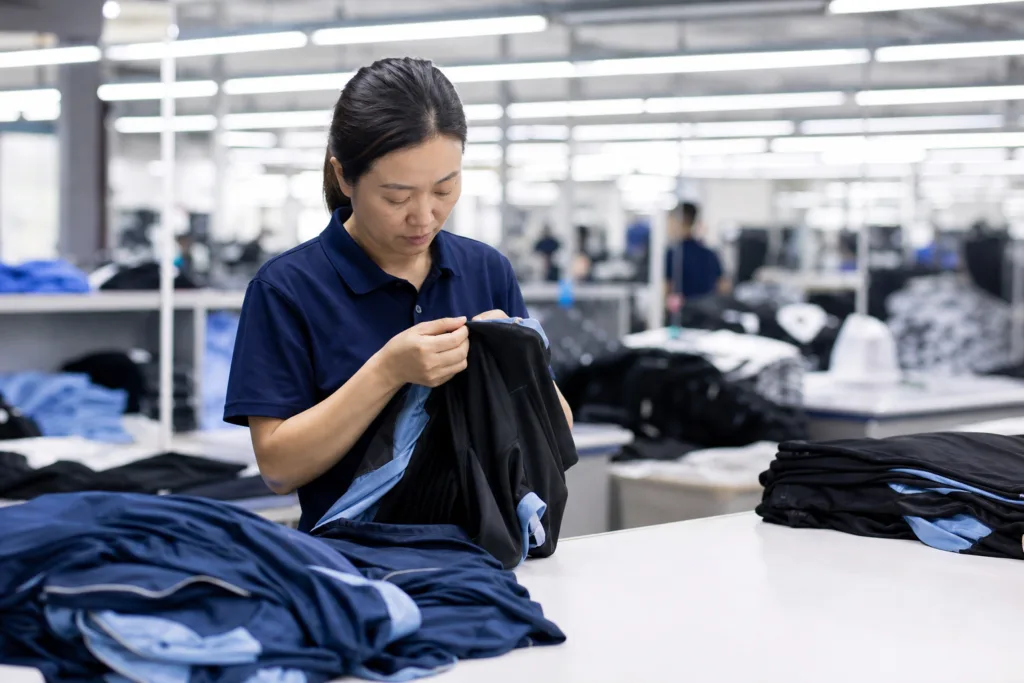
The right custom clothing manufacturer is the one whose capabilities, communication, MOQ structure, quality process, and development support match your actual product requirements. Start with a clear brief, compare fabric and construction choices, confirm fit and customization through samples, and define quality and delivery expectations before bulk production.
Do not treat supplier selection as a one-dimensional price comparison. Evaluate the full production system: materials, patterns, grading, trims, decoration, sampling, inspection, packing, and repeat-order capability. When those details are documented and aligned, private-label and bulk apparel production becomes easier to control, easier to scale, and less exposed to avoidable surprises.
FAQ
What should I send to a custom clothing manufacturer before requesting a quote?
Send a product brief covering garment type, use scenario, fabric expectations, measurements, size range, colors, artwork, labels, packaging, target quantity, and delivery destination. Reference images or a physical sample can clarify appearance, but identify which features are essential and which are only inspiration. The more complete the brief, the less likely the quote is to rely on hidden assumptions.
How do I compare a manufacturer’s quote fairly?
Compare quotes only after aligning fabric, GSM, construction, decoration, labels, packaging, sample scope, quantity structure, delivery terms, and inspection requirements. Ask each manufacturer to list exclusions and surcharges so a low unit price does not hide development, trim, freight, or rework costs. The fairest comparison is based on the same technical scope and total commercial risk.
What is a realistic MOQ for private label apparel?
A realistic MOQ depends on the garment style, fabric availability, custom color requirements, size mix, trims, decoration, and production setup. Stock or standard materials may support a smaller order than custom-dyed fabric or exclusive components. Ask whether the MOQ applies per style, color, fabric, or total order, and evaluate the quantity together with unit cost and repeat-order potential.
How many samples should I approve before bulk production?
Most projects need enough sample stages to confirm materials, fit, construction, branding, and production readiness rather than a fixed number of samples. A prototype may establish the shape, while a revised sample and pre-production sample confirm corrections and final materials. Approve the sample only when its measurements, artwork, trims, and construction represent the version intended for bulk production.
How can I reduce quality problems in a bulk apparel order?
Reduce quality problems by approving a clear specification, recording measurement tolerances, confirming materials and trims, checking decoration, and using inspections during production rather than only at the end. Keep one dated approval package containing the sample, tech pack, artwork, size chart, and packing instructions. Also agree how defects, rework, shortages, and changes will be handled before production starts.
Can one manufacturer support a brand as it scales?
One manufacturer can support growth when it has suitable development capability, stable material sourcing, repeat-order controls, quality systems, and enough production capacity for increased volume. Confirm how specifications are stored, how new colors and sizes are added, and how capacity is reserved during busy periods. A scalable partner should explain both its current limits and the process for expanding the program.