







Choosing a factory based on price or minimum order quantity alone is risky. If you want to choose clothing manufacturer by product type, the real question is whether that supplier understands the fabric behavior, construction details, fit standards, decoration methods, and quality risks that come with your specific category. A factory that performs well on basic cotton T-shirts may still be a poor fit for structured polos, heavyweight hoodies, or stretch sportswear.
If you are trying to evaluate clothing manufacturing options by product category, it helps to look beyond broad capability claims and focus on production evidence. In our manufacturing work, we see that buyers get better results when they compare factories based on category-specific sampling, fabric knowledge, trim control, size consistency, and finishing standards rather than generic promises to make every product.
One of the biggest warning signs in apparel sourcing is the statement, “We can make anything.” Technically, many factories can attempt many categories. That does not mean they have the right machines, production workflow, operator experience, quality checkpoints, or sourcing network for each one.
A category fit is not about whether a factory has sewn a similar garment once. It is about whether they can repeatedly make that product with stable quality in sample and bulk. That includes understanding suitable fabric ranges, pattern balance, sewing methods, labeling requirements, shrinkage control, and acceptable appearance standards for that category.
Why “Can Make Anything” Is Often a Warning Sign in Apparel Sourcing
Buyers should treat unlimited capability claims with caution because apparel categories are not interchangeable. T-shirts, polos, hoodies, and performance sportswear each create different demands in cutting, sewing, pressing, decoration, and quality inspection.
For example, a factory focused on simple jersey basics may be efficient at tubular T-shirts and standard screen printing, but less reliable when asked to handle pique polo collars, rib matching, placket construction, or moisture-management sports fabrics. The same issue appears when a woven shirt factory tries to move into stretch training wear without strong experience in recovery, seam durability, and panel alignment.
Key takeaway: A broad product list is not proof of specialization. Buyers should ask what the factory makes well every week, not what it says it could make in theory.
What Product-Category Fit Really Means for a Clothing Manufacturer
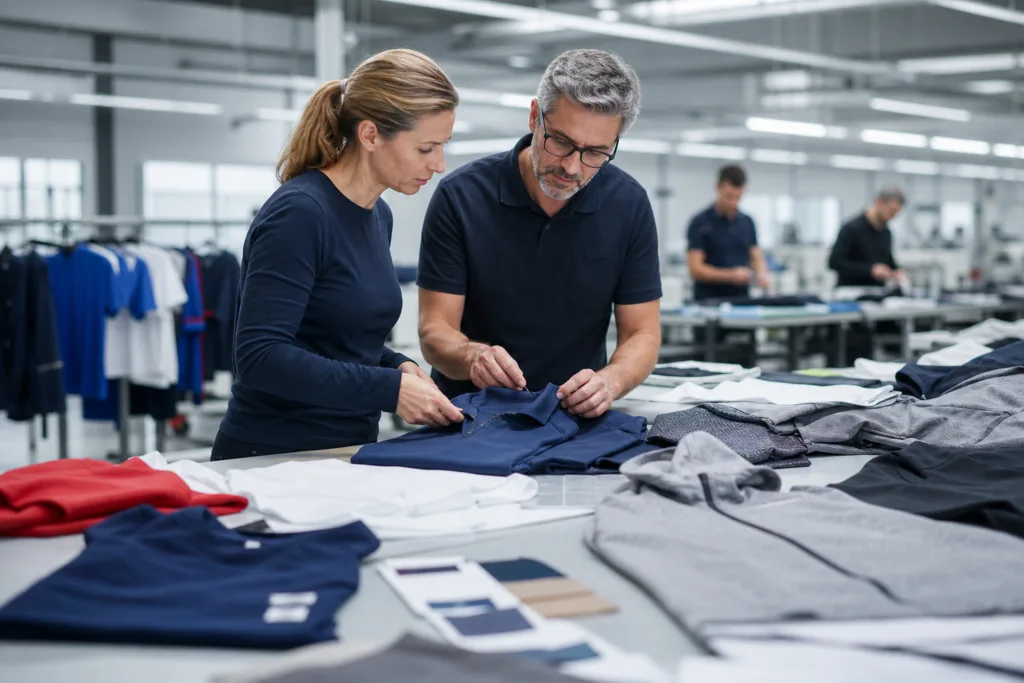
A true product-category fit means the supplier can manage the technical and commercial realities of your garment type from development to bulk delivery. That includes fabric sourcing, sample accuracy, construction quality, logo application, size grading, packaging choices, and realistic lead-time planning.
From our perspective, category fit also means the factory can identify problems early. If your hoodie body fabric is too soft for the intended silhouette, or your polo collar weight does not balance with the body fabric, an experienced manufacturer should raise that before bulk production, not after approval mistakes become expensive.
Good category fit usually shows up in practical ways:
- The supplier asks category-specific questions during inquiry.
- They can recommend suitable fabric compositions and GSM ranges.
- They explain likely production risks before sampling starts.
- They understand which decoration methods work for the garment.
- They can discuss fit, grading, and shrinkage with confidence.
- They set MOQ based on fabric and trim realities, not random numbers.
The Difference Between General Garment Production and True Specialization
General garment production means a factory can produce apparel across several product lines if the specifications are straightforward. True specialization means the team has repeatable experience, process controls, and sourcing habits built around a category.
This difference matters because most bulk order problems do not come from basic sewing alone. They come from unstable fabric performance, weak pattern balance, inconsistent trims, incorrect logo method selection, poor pressing, or inadequate inspection standards for the intended use.
For buyers planning basics, a general factory may be acceptable if the product is simple and the spec is clear. For more demanding categories, specialization reduces development time and production risk. That is especially true when the garment must deliver a specific hand feel, silhouette, technical performance, or brand presentation.
How Your Product Type Changes the Factory Requirements
The right factory for a cotton promotional T-shirt is not automatically the right factory for team polos or premium fleece hoodies. Product type changes the machinery mix, operator skill, sourcing requirements, and finishing standards needed for good output.
| Product Category | What the Factory Must Know Well | Typical Risk if Experience Is Weak |
|---|---|---|
| T-shirts | Jersey behavior, neck rib balance, print compatibility, shrinkage control, soft hand finishing | Twisting, poor neck shape retention, print cracking, uneven sizing |
| Polos | Pique fabrics, collar and cuff matching, plackets, button alignment, shape retention after washing | Wavy plackets, collar collapse, color mismatch, uneven front appearance |
| Hoodies | Fleece GSM selection, rib tension, hood construction, kangaroo pocket placement, brushing and finishing | Heavy but sloppy silhouette, cuff distortion, panel mismatch, unstable shrinkage |
| Sportswear | Stretch recovery, panel engineering, sublimation or transfer compatibility, seam durability, performance testing | Poor recovery, seam stress failure, color migration, inaccurate fit in motion |
| Uniform or teamwear | Size range consistency, logo repeatability, reorder stability, packaging discipline | Inconsistent restocks, wrong logo placement, mixed sizing across batches |
If your project is centered on tees, factory evaluation should include their approach to jersey sourcing, neck construction, and print handling. Buyers exploring custom T-shirt manufacturing support should compare not just fabric options but also how the supplier controls shrinkage, side-seam torque, and print hand feel.
Polos need a different lens. A factory with real polo experience should be able to explain placket structure, collar interlining options, cuff recovery, and how they manage the balance between body fabric and trims. That matters when reviewing polo shirt production paths for brand and team orders where appearance consistency is usually more important than buyers first assume.
Fabric Knowledge by Category: Composition, GSM, Stretch, Shrinkage, and Hand Feel
Fabric is where category fit becomes visible very quickly. A capable manufacturer should explain not only what fabric is available, but why a certain composition and GSM support your product goal, price target, and use scenario.
For T-shirts, the conversation often centers on cotton, cotton-poly blends, combed finishes, compact yarn, and GSM choices that change drape and opacity. For polos, the focus may shift to pique structure, cotton-poly balance, shape retention, and surface appearance after repeated washing. For hoodies, fleece type, brushed interior, face smoothness, and weight stability matter more. For sportswear, stretch ratio, recovery, moisture behavior, and colorfastness become more important.
| Category | Common Fabric Focus | Buyer Questions to Ask |
|---|---|---|
| T-shirts | Single jersey, cotton, cotton-spandex, cotton-poly | What is the expected shrinkage after wash? Is the face suitable for printing? |
| Polos | Pique knit, cotton-poly pique, mercerized options | Will the collar hold shape? Does the fabric pill easily? |
| Hoodies | French terry, brushed fleece, heavyweight cotton-poly fleece | How stable is the GSM after finishing? What is the expected hand feel? |
| Sportswear | Poly-spandex, nylon-spandex, interlock, mesh panels | How is stretch recovery verified? What testing supports colorfastness and durability? |
For knowledge-sensitive categories, testing awareness matters. Industry methods used in textile testing standards help buyers understand whether fabric claims are being checked in a disciplined way, especially for sportswear, colorfastness, dimensional stability, and performance expectations.
Key takeaway: Good category-fit manufacturers talk about fabric behavior in use, not only fiber names and price per kilogram.
Construction Details That Reveal Real Specialization
Construction tells you whether a factory really understands your category. Two factories may use similar fabric, but the one with stronger category experience will produce a cleaner, more stable garment because it handles small details correctly.
For polos, look at placket symmetry, collar points, rib attachment, and topstitch consistency. For hoodies, inspect pocket corners, hood overlap, drawcord eyelet reinforcement, rib rebound, and shoulder shape. For sportswear, examine panel matching, seam type, stretch seam recovery, and smoothness at curved joins.
These details are hard to fake in repeated production. A category specialist usually has standard methods for recurring construction problems. A generic factory may produce an acceptable sample, then lose consistency across bulk sizes and colors.
Fit and Sizing Capabilities: Grading, Pattern Accuracy, and Size Consistency
Fit is one of the clearest separators between factories that merely sew and factories that understand a category. A supplier that truly fits your product type should be able to discuss base size, grading rules, measurement tolerances, shrinkage allowances, and how fit changes across fabrics.
In our experience, buyers often focus on size charts too late. If pattern development is weak, the factory may still produce garments that match point measurements but look wrong on body. This happens when chest, shoulder, sleeve, armhole, rise, or body balance are not proportioned for the intended silhouette.
Hoodies are a good example. Oversized and regular fits need different pattern logic, not just extra width. Buyers reviewing hoodie manufacturing support for private label projects should ask whether the supplier can explain drop shoulder balance, hood depth, rib proportion, and how garment wash or brushing may affect final measurement stability.
A practical fit review should include:
- Base size measurement sheet
- Grading rules across the full size range
- Tolerance standards for key points
- Shrinkage expectation before and after wash
- Fit comments from the sample round
- Confirmation of whether bulk will match approved sample handling
Decoration and Customization Methods by Category
Decoration capability is often presented as a simple menu: screen print, embroidery, heat transfer, sublimation, labels, hangtags, and packaging. In reality, the right method depends heavily on garment type, fabric behavior, logo size, placement, wash expectation, and target price.
T-shirts usually support screen printing and heat transfer well, but print hand feel and cracking resistance depend on fabric surface and curing control. Polos often use embroidery, yet the backing, logo density, and placket area stability must be managed carefully. Hoodies can handle embroidery and print, but thick fleece may distort fine details if the method is not chosen well. Sportswear often requires transfer or sublimation planning based on panel layout and fabric content.
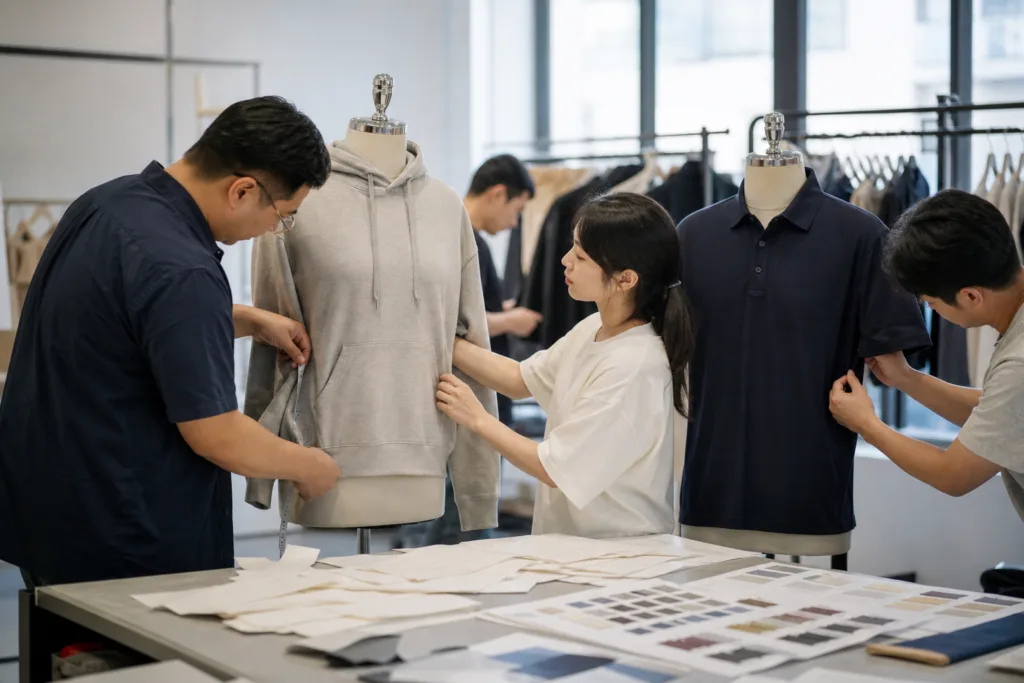
When performance apparel is involved, the production route changes again. Buyers comparing sportswear production options for performance apparel should ask how the factory handles panel placement, stretch-safe logo methods, and color consistency across repeat orders.
At this stage, a manufacturer should also discuss private label details such as woven labels, printed neck labels, size labels, care labels, hangtags, polybags, barcode stickers, and carton packing ratios. These choices affect both MOQ and lead time because trims often carry their own minimums and approval steps.
Sampling Questions That Quickly Expose Whether the Factory Understands Your Product
Sampling is where category knowledge becomes visible fast. A supplier that understands your product asks precise questions before making the sample. A generic supplier often says yes first and then resolves issues through trial and error.
Useful questions include:
- What fabric options do you recommend for this exact use case and target price?
- What shrinkage or recovery risk do you expect with this composition?
- Which construction points are most important for this category?
- What decoration method is safest for this logo and garment surface?
- What parts of the tech pack are still unclear for production?
- What will likely change between sample and bulk?
If the factory gives specific, category-based answers, that is a good sign. If the answers stay broad or avoid tradeoffs, the supplier may not understand the product deeply enough.
MOQ, Lead Time, and Production Capacity: How Category Fit Affects Planning
MOQ is not only a commercial decision. It is often a technical and sourcing decision linked to your product category. Fleece fabrics, custom-dyed rib, specialized trims, sublimation layouts, or branded packaging can raise the practical minimum even when the sewing line itself could handle a smaller run.
A good category-fit factory should explain MOQ by component. For example, body fabric may be available ex-stock, but matching collar rib for polos may require a custom lot. A sportswear order may need low sewing volume but still face print or fabric minimums. This is why honest MOQ discussions are more valuable than simply hearing the lowest number.
Lead time also shifts by category. Basics may move faster if fabric is ready and trims are simple. Polos and hoodies often need more trim coordination and fit review. Performance apparel may require more testing, strike-offs, or color approval. From a manufacturer perspective, realistic planning protects both quality and delivery.
Key takeaway: Category fit affects whether a quote is actually executable. The right supplier explains how fabric, trims, decoration, and approval steps shape MOQ and lead time.
Quality Control Risks When a Factory Is Not Specialized in Your Product Type
When category fit is weak, quality issues usually appear in repeatability. The first sample may look acceptable, but bulk output starts showing problems in fabric stability, logo placement, measurement spread, seam performance, or finishing consistency.
Common risks include:
- Necklines that stretch out or wave after washing
- Polo collars that do not sit flat or match the body color
- Hoodies with inconsistent fleece weight or twisted side seams
- Sportswear seams that fail under stretch
- Mixed logo appearance across production lots
- Size grading that looks inconsistent when laid side by side
Factories serving the U.S. market should also understand category-related labeling and safety expectations, not just sewing execution. Buyers can strengthen due diligence by reviewing U.S. apparel compliance requirements when evaluating whether a supplier is prepared for product-specific responsibilities beyond manufacturing basics.
How to Compare Factories by Product Category Without Being Misled by Sales Claims
The strongest comparisons are evidence-based. Do not ask only whether the factory can make your product. Ask what they make repeatedly, what fabrics they use most for that category, what quality problems they watch for, and what details usually cause delays.
At Ninghow, we find that serious buyers make better decisions when they compare factory answers side by side rather than comparing brochures. The useful difference is usually in technical judgment, not presentation quality.
| Evaluation Point | Strong Category Fit | Weak Category Fit |
|---|---|---|
| Fabric recommendations | Explains composition, GSM, shrinkage, and end use | Offers generic fabric list without reasoning |
| Sample discussion | Raises likely issues before making sample | Promises easy production without questions |
| Construction knowledge | Describes category-specific sewing details clearly | Focuses only on basic sewing capability |
| MOQ explanation | Breaks down fabric, trim, and decoration limits | Gives a flat number without logic |
| QC approach | Names the high-risk points for the product | Uses generic quality statements |
Red Flags That Show a Manufacturer May Not Be Suitable for Your Category
Some warning signs appear early if you know what to watch for. None of them guarantees failure, but several together should slow the buying decision.
- The supplier cannot explain category-specific fabric risks.
- They show many product photos but few technical details.
- They avoid discussing shrinkage, recovery, or size tolerance.
- They give the same MOQ and lead time for very different products.
- They recommend decoration methods without asking about fabric or use.
- They do not mention sample revision or approval checkpoints.
- They cannot explain what changes between sample making and bulk production.
Another red flag is when every garment is quoted through the same template process. Product categories create different development paths. A supplier that treats polos, hoodies, and sportswear as nearly identical projects may be operating too generically for dependable results.
A Practical Checklist for Choosing the Right Clothing Manufacturer by Product Type
If you need to choose clothing manufacturer by product type in a structured way, use a checklist that forces specific evidence. This helps founders, merchandisers, and sourcing teams avoid decisions based on price alone.
- Ask which product category the factory produces most often.
- Request category-relevant sample photos or development references.
- Check whether fabric recommendations match your intended use and price level.
- Review whether they understand key construction details for your garment.
- Confirm fit development process, grading approach, and tolerance control.
- Ask which decoration methods are recommended and why.
- Break down MOQ by fabric, trims, labels, and packaging.
- Review realistic sample and bulk lead times for that category.
- Ask what QC checkpoints they use for the most common category risks.
- Confirm whether reorders can maintain the same fabric and trim standard.
When buyers are unsure how to organize this evaluation, Ninghow typically advises starting with one product category, one target price range, and one clear use case before requesting broad quotations. That makes manufacturer comparison much more accurate.
When It Makes Sense to Use a Category Specialist Versus a Broad-Range Factory
A category specialist makes sense when your product has stricter fit expectations, more demanding fabric behavior, higher branding requirements, or greater performance risk. This often applies to premium polos, private label hoodies, performance sportswear, teamwear, and any product where repeat reorders matter.
A broad-range factory can still be suitable when the garment is straightforward, the spec is mature, and the buyer already controls materials and standards tightly. In those cases, the cost and flexibility benefits may be acceptable if the supplier has at least some proven experience in your category.
The correct choice depends on your development stage. Early-stage brands usually benefit from a manufacturer that can guide fabric, fit, and decoration decisions clearly. More experienced sourcing teams may work successfully with a broader supplier base because they provide stronger tech packs, testing requirements, and QC control.
Conclusion: Choose the Factory That Fits the Product, Not Just the Order
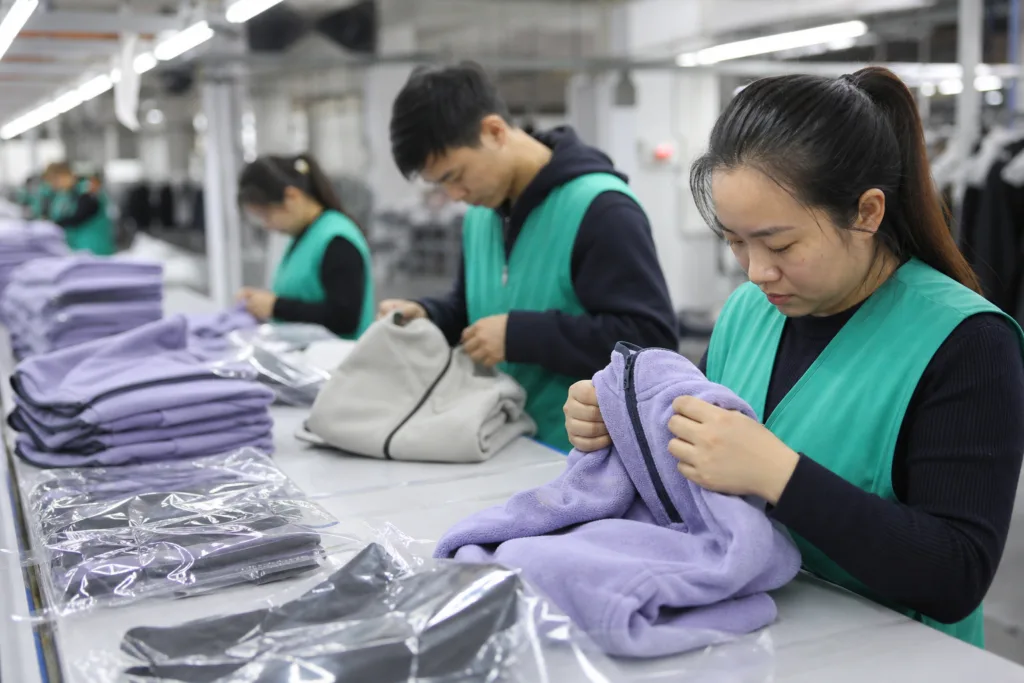
The right manufacturer is not simply the one that accepts your MOQ or returns the fastest quote. The right manufacturer is the one whose process, fabric knowledge, construction experience, fit control, and quality discipline align with your product category.
If you need to choose clothing manufacturer by product type, compare suppliers based on how well they understand your garment in practice. Ask better questions, review category-specific sample logic, and look for evidence that the factory can repeat the result in bulk. That approach usually saves more time and cost than chasing the broadest promise.
Frequently Asked Questions
How can I tell if a clothing manufacturer really specializes in my product type?
You can tell by the specificity of their answers and samples. A real specialist should discuss the right fabric range, construction points, fit risks, decoration limits, and QC priorities for your exact category rather than giving the same response for every garment.
Is it better to use one factory for all apparel categories?
Not always, because different categories need different technical strengths. Using one factory can simplify communication, but it only works well if that supplier has proven capability in each category you plan to develop and can maintain consistent quality across them.
Why does MOQ change based on product category?
MOQ changes because the garment may need different fabrics, trims, dyeing, printing, or packaging inputs. A hoodie with custom fleece and rib, for example, usually has different material realities than a basic jersey T-shirt, so the minimum order must reflect those sourcing conditions.
What sample questions expose weak category knowledge quickly?
The best questions are about fabric behavior, shrinkage, fit balance, decoration suitability, and likely bulk-production risks. If the supplier cannot explain what usually goes wrong in that product category or what they would check first, their experience may be too generic.
Can a good general factory still be the right choice for my brand?
Yes, if your product is relatively simple and your specifications are already clear. A good general factory can work well for straightforward styles, but as the product becomes more technical or brand-sensitive, category-specific experience becomes more important.
What should I compare first when shortlisting clothing manufacturers?
Compare category fit before price, because technical mismatch creates the most expensive mistakes later. Start with fabric understanding, sample logic, construction detail knowledge, fit control, MOQ explanation, and the supplier’s ability to describe quality risks specific to your garment.