






A low minimum order can help a brand launch faster, but the real challenge starts after the first run succeeds. If you want to scale from low MOQ to bulk production, you need more than stronger sales. You need better control of fit, fabric behavior, color consistency, size grading, lead time, and unit cost so that trial order to repeat production becomes a stable process instead of a quality risk.
If your next step is to evaluate low MOQ clothing manufacturing options, it helps to think beyond the first order. Many buyers need a factory that can support initial sampling, practical MOQ planning, logo application choices, private label details, and a realistic path into repeat orders, color expansion, and bulk production without rebuilding the whole product from scratch.
Who should use this guide when planning growth?
This guide is for brand founders, sourcing managers, product developers, teamwear buyers, and private label apparel companies that have already tested a style or are preparing a first run with growth in mind. It is especially useful when the first order is intentionally small, but the product may later expand into more colors, more sizes, or more related SKUs.
From our manufacturing perspective, the best first order is not only sellable. It is also measurable. A trial run should give you enough information to decide whether the garment can be repeated efficiently, whether the size spec is stable, and whether the construction can hold up once volume increases.
What should the first trial order prove before you think about scaling?

The first order should prove five things: the product sells, the fit is accepted, the fabric performs as expected, the branding method is repeatable, and the workmanship level can be maintained in bulk. If one of these is unclear, moving too quickly into higher volume usually creates avoidable waste.
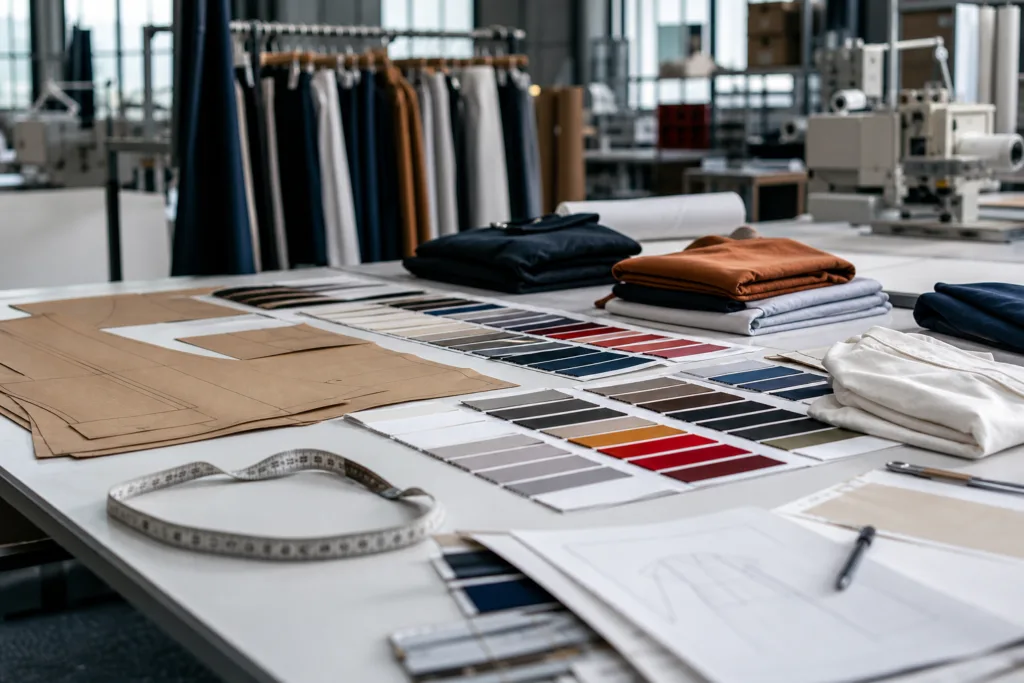
This is why the apparel sampling process for trial orders matters so much. Sample approval is where buyers can confirm hand feel, measurements, construction details, shrinkage expectations, print placement, embroidery size, label setup, and packaging logic before those details become expensive in production.
What buyers should validate in the first run
- Fit on the target wearer, not just on a hanger
- Fabric weight, stretch, recovery, and surface feel
- Color accuracy under normal lighting
- Print, embroidery, or heat transfer durability
- Neck, shoulder, side seam, cuff, and hem workmanship
- Label positions, care label content, and packaging method
- Measurement tolerance and wash result consistency
Key takeaway: A successful trial order is not simply a small order that ships on time. It is a controlled test that tells you what can stay stable and what must be corrected before bulk production.
How do you evaluate whether the product is ready for repeat production?
Start with returns, buyer feedback, internal wear testing, and measurement checks from shipped units. A style is usually ready for repeat production when the core spec is stable, the trim package is repeatable, and any issues found in the first run can be fixed without redesigning the garment.
| Area | What to Review After Trial Order | What It Means for Scaling |
|---|---|---|
| Fit | Customer comments, try-on results, measurement deviations | Determines whether size grading can proceed safely |
| Fabric | Shrinkage, pilling, recovery, colorfastness | Affects repeat consistency and claims risk |
| Branding | Logo clarity, wash durability, placement accuracy | Shows if decoration method is production-ready |
| Construction | Seam strength, loose threads, puckering, shape retention | Reveals whether workmanship can scale cleanly |
| Sales performance | Best-selling color, slow sizes, reorder requests | Guides SKU expansion and MOQ allocation |
A common mistake is treating good sales as the only signal to reorder. In reality, strong sales with weak technical control often lead to a more expensive second order, because corrections are made late and bulk claims become more likely.
What usually changes from trial order to repeat production?
The second order is where planning becomes more technical. The garment may look similar, but the production logic often changes because quantities rise, more sizes are added, packaging becomes more standardized, and color consistency matters more across a larger shipment.
At Ninghow, we usually see three major shifts between a low MOQ run and a repeat order: tighter raw material planning, more precise approval requirements, and stronger production control. Once a style is no longer experimental, buyers need clearer size specs, approved color standards, trim confirmation, and a repeatable quality benchmark.
What the second order should improve
- Measurement control based on real first-order data
- More accurate consumption planning for fabric and trims
- Cleaner label and packaging standardization
- Better cutting efficiency and line balance
- More realistic lead time planning for raw materials and decoration
How do repeat orders become more consistent and lower risk?
The answer is documentation. If the first run was handled through messages and visual confirmation only, the repeat order should be formalized with approved size charts, construction notes, logo specifications, color references, packing rules, and tolerance standards.
Buyers should also decide what must remain fixed and what can change. For example, you may keep the base fabric, silhouette, and embroidery size stable while adjusting only colorways or packaging. That reduces the number of variables changing at once.
A practical repeat-order control list
- Approved sample reference or sealed sample
- Final measurement chart with tolerances
- Confirmed fabric composition and GSM target
- Logo artwork and decoration dimensions
- Color references for body fabric and trims
- Carton packing ratio by size and color
- Inspection points for appearance and measurement
Key takeaway: Scale works better when you freeze the core spec first, then expand one variable at a time.
How should you expand colors without increasing errors?
Color expansion should come after the base style is stable. If fit, shrinkage, or workmanship is still unsettled, adding more colorways creates more approvals and more failure points at the same time.
For repeat orders, we recommend reviewing which colors can be matched from available stock programs and which need custom dyeing. Low MOQ projects often rely on stock fabric colors for flexibility, while larger reorders may justify custom dye lots for brand accuracy and improved unit cost.
New colorways also affect printing and embroidery. A logo that reads clearly on black may not work the same way on heather gray or bright red. Thread contrast, print opacity, underbase requirements, and heat transfer edge visibility should be checked before bulk approval.
| Color Expansion Choice | When It Works Best | Main Risk |
|---|---|---|
| Stock colors | Fast repeat orders and lower MOQ planning | Shade availability may change over time |
| Custom dye colors | Established styles with stronger volume | Higher MOQ and longer lead time |
| Light-to-dark logo adaptation | Multi-color collections | Decoration method may need revision |
How do you expand sizes without losing fit consistency?
Size expansion should be based on a proven base size and a clear grading plan, not guesswork. Many brands sell well in a narrow size range first, then add more sizes quickly without checking how shoulder width, sleeve opening, body length, rise, or leg opening should scale proportionally.
This matters even more for knits, washed garments, and performance fabrics. Before locking bulk specs, buyers should review shrinkage behavior and fabric movement because those factors affect real post-wash measurements. Standards-related guidance on dimensional stability testing for shrinkage, fit, and repeat-order consistency is especially relevant when a first-run style will expand into fuller size ranges.
In practice, size grading is not only about adding centimeters evenly. A larger chest may require different armhole logic, hem sweep balance, and neck opening adjustments. The more technical the garment, the more important it is to build the grade from a validated fit block rather than from a simple spreadsheet.
What buyers should check before adding more sizes
- Which base size was approved and fit-tested
- Whether the garment is slim, regular, or oversized
- Whether fabric stretch changes the grading approach
- How shrinkage affects final garment measurement
- Whether plus sizes or youth sizes need separate fit review
Good grading reduces returns and protects brand credibility. Poor grading often looks acceptable on paper but becomes obvious when customers compare sizes side by side.
When is it smart to add more SKUs?
Add SKUs only after the original style is operationally stable. A strong-selling T-shirt should not immediately become ten styles, four fits, and eight colors unless your supply planning, trim management, and sales data justify that complexity.
A better path is to expand in layers. First, repeat the winning style. Second, add the most requested colors or sizes. Third, introduce closely related SKUs that can share fabric, trims, labels, and packaging. This approach improves purchasing efficiency and lowers inventory risk.
For example, a successful cotton T-shirt may scale into long sleeve, oversized, or hoodie versions more smoothly if the brand keeps the same label set, color family, and core fabrication logic. Shared inputs make MOQ planning easier and reduce supplier-side changeovers.
How does MOQ usually change from trial order to bulk?
MOQ often becomes more flexible per unit cost, but stricter per color, fabric program, and trim setup. A low MOQ first order may be possible because the style uses stock fabric, standard labels, and a simple print. Once you request custom dyeing, multiple size breaks, woven labels, or branded packaging, MOQ conditions may change.
| Production Stage | Typical MOQ Logic | Why It Changes |
|---|---|---|
| Trial order | Lower MOQ with limited options | Uses available materials and simplified setup |
| Repeat order | Moderate MOQ by color or style | Improves planning and decoration efficiency |
| Bulk production | Better cost at higher volume | Supports custom fabric, trims, and optimized cutting |
Buyers should not ask only for the lowest MOQ. The better question is which MOQ level unlocks the right balance of customization, consistency, and cost.
Where do cost savings usually come from when volume grows?
Cost optimization should come from efficiency, not from hidden quality cuts. The strongest savings usually come from better marker efficiency, consolidated material purchasing, simplified trim variation, standardized packaging, and fewer last-minute changes.
Fabric decisions matter most. Small runs may tolerate a higher fabric cost because waste and setup are proportionally high anyway, but repeat production benefits from stable fabric planning, consistent width, and reliable shade control. Industry education on quality testing factors that influence apparel performance and production cost supports the same principle: better upfront testing can reduce claims, rework, and inconsistency later.
Practical ways to lower unit cost without weakening the product
- Use one core fabric across more than one SKU
- Reduce unnecessary trim variations
- Standardize hangtags, polybags, and carton specs
- Plan repeat colors instead of frequent one-off shades
- Choose decoration methods based on artwork and volume, not habit
- Approve construction details that sew cleanly at scale
Sometimes the lowest-cost option is not the best-value option. A slightly better fabric or more stable print method can protect sell-through and reduce complaint rates, which is often more important than saving a small amount per piece.
What needs re-approval before scaled production?
Not every repeat order needs a full development cycle, but some changes should always trigger re-approval. New fabric source, new wash, new color, revised logo size, updated packaging, and expanded size grading all deserve review before cutting bulk.
If the style stays technically identical and the same materials remain available, approval may be lighter. But if any core variable changes, a confirmation sample is usually cheaper than discovering the issue during inspection.
This is also where buyers benefit from a clear production calendar. Understanding production timing for repeat and bulk orders helps teams decide when to approve lab dips, size sets, pre-production samples, and packing details without compressing the shipment schedule.
What should be on the bulk production readiness checklist?
Before placing a larger order, buyers should confirm that sales confidence is matched by technical readiness. If one side is missing, the order may scale in quantity but not in reliability.
- Approved fit sample or sealed production reference
- Final grade rules and complete size range
- Confirmed fabric source and color standards
- Decoration approval for every colorway
- Label, care label, and packaging confirmation
- Booking plan for raw materials and production window
- Inspection method and acceptance standard
- Reorder quantity logic by size and color
When teams move from trial order to repeat production, clear responsibility also matters. Someone should own spec control, someone should own artwork and packaging, and someone should approve changes formally.
Which quality risks often appear only after an order scales up?
Scaling exposes problems that small runs can hide. Shade variation across lots, measurement drift between sewing lines, logo placement inconsistency, fabric shrinkage differences, and packaging errors become more visible as quantity and SKU count increase.
That is why buyers should define quality control checkpoints for scalable production before bulk starts, not after problems appear. In our production work, we focus on checkpoints at fabric inspection, cutting, inline sewing, decoration, finishing, and final packing because defects are cheaper to fix earlier.
Common scale-up quality failures
- Different hand feel between fabric lots
- Uneven collar shape or placket alignment
- Measurement shift after wash or finishing
- Embroidery thread color mismatch on new colorways
- Inconsistent size stickers, polybags, or carton ratios
Key takeaway: The larger the order, the less room there is for informal control. Written standards and early inspections protect repeatability.
How should you plan lead times for reorders and seasonal growth?
Lead time planning should be based on materials, decoration, approvals, and seasonality, not only on sewing capacity. Repeat orders can move faster than first orders, but only if the approved materials remain available and the buyer does not introduce too many changes at once.
Seasonal businesses should also work backward from launch date. If you want color expansion for a new season, you may need extra time for lab dips, sample confirmation, fabric booking, and size-set review. The earlier this is scheduled, the easier it is to maintain quality while improving cost efficiency.
What mistakes cause growing brands to lose control after a successful trial order?
The most common mistake is scaling with too many new variables at once. Brands often increase quantity, add colors, expand sizes, change packaging, and modify branding in the same order. When everything changes together, it becomes hard to identify the source of problems.
Another mistake is assuming the first pattern automatically works across all sizes and fabrics. A good sample in one size does not guarantee a good grade in six sizes, especially when fabric stretch or wash treatment changes.
We also see buyers push cost down too early. If the product still needs fit correction, branding refinement, or fabric stabilization, aggressive cost cutting can make the second order worse instead of better.
How does a long-term manufacturing partner help with scaling?
A good manufacturing partner supports growth by keeping product knowledge from one order to the next. That includes fit history, approved materials, decoration specs, grading logic, and previous production issues that should not be repeated.
From a manufacturer standpoint, this continuity is valuable because scaling is easier when the factory already understands the garment’s purpose, target customer, and quality priorities. It also makes color expansion, repeat planning, and future SKU development more structured.
The goal is not simply to place bigger orders. The goal is to build a repeatable product system that can handle volume growth without losing the original product strengths that made the trial run successful.
Conclusion
To scale from low MOQ to bulk production successfully, treat the first run as a technical learning stage, not just a sales test. When fit, fabric behavior, decoration, grading, lead time, and QC are documented clearly, trial order to repeat production becomes much more predictable. That is how brands expand colors, sizes, and SKUs while improving cost control without giving up consistency.
If your team is planning the next order, the smartest move is to decide which elements should stay fixed, which should change, and what must be re-approved before volume increases. A disciplined growth path usually beats a fast but unstable one.
Frequently Asked Questions
When should a brand move from a low MOQ order to bulk production?
A brand should move to bulk production when the trial order has validated sales demand, fit consistency, fabric performance, and repeatable workmanship. If customer feedback is strong but technical issues are still unresolved, it is usually better to place one more controlled repeat order before making a larger volume commitment.
Do repeat orders always have a lower unit cost?
No, repeat orders do not always have a lower unit cost because new colors, added sizes, branded trims, or custom fabric can increase cost even when quantity rises. Lower pricing usually becomes more realistic when the style stays technically stable and the factory can improve material planning, cutting efficiency, and production flow.
How many sizes should be added after a successful first order?
The number of sizes should be based on sales data, target customer demand, and whether the base fit has been properly tested for grading. Adding too many sizes too quickly can create measurement inconsistency, so it is often better to expand in stages and review fit results before widening the full size range.
What changes usually require a new sample before bulk production?
New samples are usually needed when the fabric source changes, a new color is added, the logo method is revised, the wash treatment is updated, or the size range is expanded. Even when the style looks similar, small technical changes can affect hand feel, shrinkage, appearance, and final measurements in production.
How can buyers reduce risk when adding more colors and SKUs?
Buyers reduce risk by keeping the base garment stable and introducing one controlled change at a time, such as adding a new color before adding a new fit or fabric. This makes approvals easier, improves traceability if a problem appears, and helps production teams maintain consistency across growing SKU counts.
What is the biggest mistake when scaling apparel production after a trial order?
The biggest mistake is expanding quantity, colors, sizes, trims, and packaging all at once without a stable technical foundation. Growth is much safer when brands lock the winning core specification first, then scale step by step with clear approvals, realistic lead times, and defined quality checkpoints.
Related Reading
- From First Private Label Order to Repeat Production: How Brands Should Improve Sales, Reorders, SKUs, Fit, and Packaging
- Low MOQ Private Label Clothing: Feasibility, Limitations, and the Best Customization Path Before You Order
- How to Plan a First Small Clothing Order
- Stock Fabric vs Custom Fabric for Low MOQ Apparel Production: How to Choose the Right Option for Small-Batch Clothing Orders
- Why Apparel Sampling Reveals the Real Capabilities Behind a Clothing Manufacturer’s Sales Pitch