







If you are comparing a polo shirt supplier vs manufacturer, the real question is not only who can quote your order fastest. It is who can control the outcome you need over time. For buyers developing private-label polos, managing repeat programs, or scaling branded collections, the difference affects fabric consistency, fit accuracy, logo execution, lead times, and cost visibility. A trader or general supplier may be useful in some situations, but a direct manufacturer usually gives stronger control when your project depends on repeatable quality and deeper customization.
If your project involves branded uniforms, golf polos, teamwear, retail basics, or performance tops that need dependable fit and trim consistency, it helps to review polo shirt manufacturing options for brands before choosing a sourcing route. At Ninghow, we support buyers with fabric selection, collar and placket development, logo application planning, private-label trims, sampling, and bulk production preparation so decisions are based on production reality rather than just a quote sheet.
The quick answer: what separates a supplier from a manufacturer
In simple terms, a polo shirt manufacturer makes the garment or directly controls the production process inside a factory system. A supplier or trader may source the garment from one or several factories and then resell it to you. That means the manufacturer usually has better visibility into pattern making, sewing construction, fabric matching, quality control, and production scheduling.
For standard, low-risk, non-custom orders, a trader can be enough. For custom fits, private-label packaging, repeat color programs, or long-term volume planning, working directly with a manufacturer is often more reliable because the team you speak with is closer to the production line and the technical decisions that affect the final polo.
Definitions buyers should keep separate
Polo shirt manufacturer
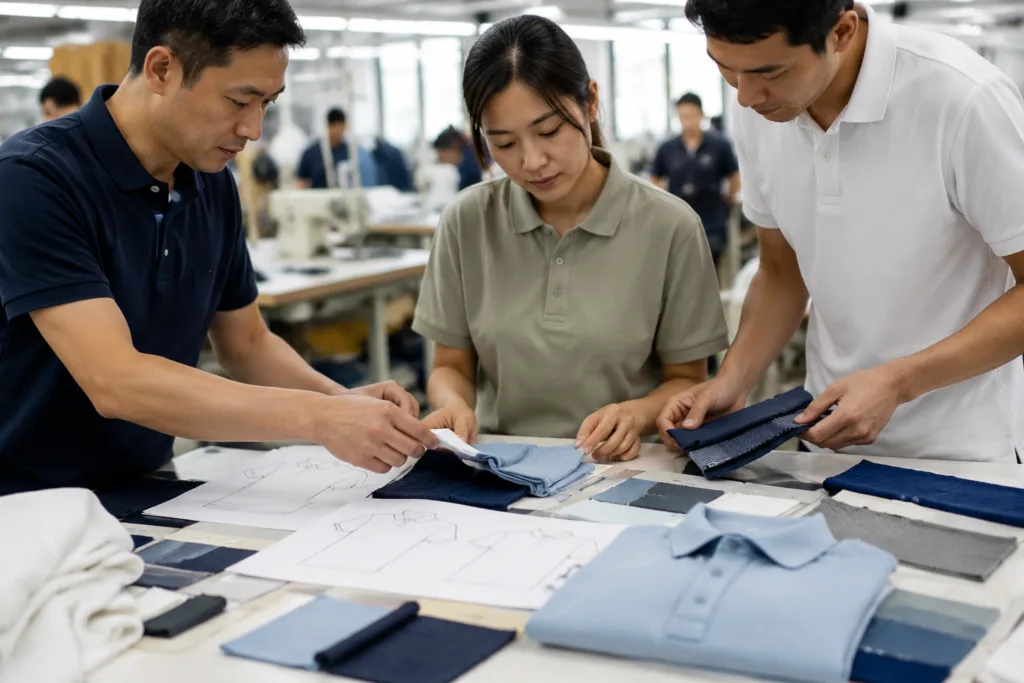
A manufacturer owns or directly operates production capability. That may include pattern development, sample making, cutting, sewing, embellishment coordination, finishing, and packing. In many programs, the factory also works with nominated fabric mills and trim suppliers while managing inspections and production booking.
Polo shirt supplier or trader
A supplier or trader may not own the factory assets. They often coordinate quotations, samples, sourcing, and shipping through third-party factories. Some are organized and useful, but the buyer is one step further away from the actual people controlling fabric, workmanship, and timelines.
Agent or distributor
An agent may represent one or more factories and help with communication, QC, or local support. A distributor may hold stock or resell finished goods. These models can work well when speed and local availability matter more than deep customization.
What each partner actually controls
| Area | Manufacturer | Supplier or Trader |
|---|---|---|
| Production assets | Usually direct access or ownership | Usually outsourced to partner factories |
| Pattern and fit revisions | Direct technical feedback | Relayed through another party |
| Fabric and trim approval | Closer to mill and cutting plan | May depend on supplier chain updates |
| QC staffing | In-line and final inspection can be integrated | Often relies on external checks or factory reports |
| Lead-time control | Better production booking visibility | Lead time influenced by third-party allocation |
| Cost transparency | More direct discussion of cost drivers | Additional margin layer is common |
From our manufacturing perspective, control is the key issue. A buyer may see only one commercial contact, but behind that contact there can be a very different level of access to pattern files, sample room calendars, dye-lot planning, and corrective action on the line.
Which type of partner fits different buyer scenarios
One-off or simple replenishment orders
If you only need ready styles, simple embroidery, or mixed small quantities from different product categories, a trader can be practical. The convenience comes from consolidation rather than technical depth.
Private-label startups
Startups usually benefit from a manufacturer when they need custom neck labels, branded plackets, fit adjustments, fabric decisions, and sample refinement. These are technical tasks, not just sourcing tasks.
Retailers building a repeat polo line
Retail buyers need consistency across seasons. The more important repeat fit, shrinkage control, and color continuity become, the more direct factory alignment matters.
Teams, clubs, and schools
Some teamwear projects need fast small runs and multiple logos. If the order is simple and urgent, a local supplier may help. If the program is annual and repeat-based, a manufacturer can establish stable specs and size continuity.
Scalable apparel brands
Brands planning growth usually gain from direct manufacturing relationships because scaling depends on repeatable methods, not just low entry pricing.
Why the polo shirt supplier vs manufacturer decision affects cost transparency
Many buyers compare only the final unit price, but that hides the most important question: what is included, and who is controlling the variables? Factory pricing usually reflects fabric, collar and cuff components, trims, sewing labor, overhead, packaging, and profit. A trader adds another margin layer and may also add buffer costs for communication risk or subcontract uncertainty.
| Cost component | Typical direct factory discussion | Typical trader discussion |
|---|---|---|
| Fabric composition and GSM | Can be adjusted with clear trade-offs | Often quoted as a package price |
| Collar, cuff, and placket construction | Technical options explained directly | May be simplified unless requested |
| Logo method | Embroidery, print, transfer compared by application | Quoted as an add-on line |
| Private-label trims | MOQ and setup clarified | Sometimes bundled with less visibility |
| Margin | Factory profit only | Factory profit plus trading margin |
This does not mean every manufacturer quote is lower. A good manufacturer may quote slightly higher because the spec is correctly understood and the risk has been priced honestly. That can save money later by reducing remake risk, late changes, and reject rates.
Sampling efficiency depends on technical access
Sampling is where the gap between a trader and a manufacturer becomes visible very quickly. If your tech pack is incomplete, fabric substitutions are possible, or fit comments need discussion, direct access to a sample room is valuable. We often see buyers save time when they understand the apparel sampling process for faster approvals and fit checks before launching development.
Common sample stages for polo shirts
- Proto sample: checks basic design interpretation and construction approach.
- Fit sample: checks measurements, balance, body length, sleeve opening, collar stand, and overall silhouette.
- PPS or pre-production sample: confirms bulk-ready workmanship, approved fabric, colors, trims, and artwork placement.
- PDS if needed: used when print or decoration approval is critical before full bulk commitment.
Typical timelines depend on fabric availability and comment quality. A straightforward stock-fabric proto may take around 7 to 10 days. A custom-dyed or revised private-label polo can require several weeks across multiple rounds. Direct manufacturers usually shorten the loop because fit comments do not need to pass through multiple intermediaries.
Customization depth is usually much stronger with a manufacturer
For custom polos, the visible logo is only part of the project. The deeper value is in the details that make the garment feel like your brand: pattern shape, neck tape, placket depth, reinforced shoulder seams, side vents, branded buttons, woven labels, size labels, wash labels, polybags, cartons, and hangtags.
At Ninghow, these details are easier to coordinate when the buyer provides a clear sourcing brief, target price range, use case, and expected reorder plan. A factory can then advise what should be customized immediately, what can be standardized at launch, and which trim decisions will affect MOQ most.
Customization points that matter for polo programs
- Base pattern versus fully custom pattern
- Men’s, women’s, youth, or unisex grading rules
- Pique, jersey, interlock, cotton-rich, or performance blends
- Rib collar and cuff quality, shape retention, and color matching
- Placket construction, button spacing, and reinforcement
- Hem finishing, side split design, and seam clean appearance
- Embroidery backing, print durability, or heat-transfer placement
- Private-label trims and packaging systems for retail or team issue
Manufacturing specifics that matter for polo shirts
Fabric choice
Pique is the classic polo option because it offers texture, breathability, and a recognizable hand feel. Jersey creates a smoother and often softer surface. Performance polos may use polyester or blended knits for moisture management and color stability.
GSM and hand feel
Lighter polos may feel cooler and more flexible, but they can show body outline more easily and may feel less substantial for uniform use. Midweight polos often provide the most balanced commercial result. Heavier constructions can look premium but must still drape well and remain comfortable.
Collar and placket construction
Collars are a common weak point. Poor rib recovery, incorrect fusing, or unstable placket stitching can make a polo look cheap even when the body fabric is good. A manufacturer should be able to explain how collar stand, rib tension, and placket reinforcement are controlled.
Reinforcement and durability
For teamwear, schoolwear, and repeat uniforms, shoulder taping, side vent reinforcement, bartacks where needed, and shrinkage testing matter more than a headline price difference.
Quality management is easier to trust when the factory owns the process
Buyers should ask how checks happen before, during, and after sewing. Strong factories do not treat quality as only a final inspection event. They build checkpoints into fabric inspection, cutting, in-line sewing review, measurement control, decoration approval, finishing, and packing. For a useful benchmark, review apparel quality control and inspection procedures and compare them against the factory’s own process.
Key polo QC points
- Fabric defects, shade variation, and roll consistency
- Shrinkage and color fastness where relevant
- Chest, length, shoulder, sleeve, and collar measurements
- Placket symmetry and button alignment
- Collar shape retention after wash testing
- Logo placement and embroidery cleanliness
- Loose threads, puckering, seam slippage, and panel twisting
- Carton ratio accuracy and label-pack consistency
A trader can arrange inspections, but a manufacturer can usually implement corrective action faster because the issue is identified on the line instead of after packing.
Traceability and supply-chain control reduce repeat-order risk
Repeat orders fail when the product looks close, but not close enough. The second order may use a slightly different knit structure, collar rib, dye lot, or button tone. Direct factory relationships make it easier to preserve approved references, store trims, lock measurement tolerances, and align with the same source mills when possible.
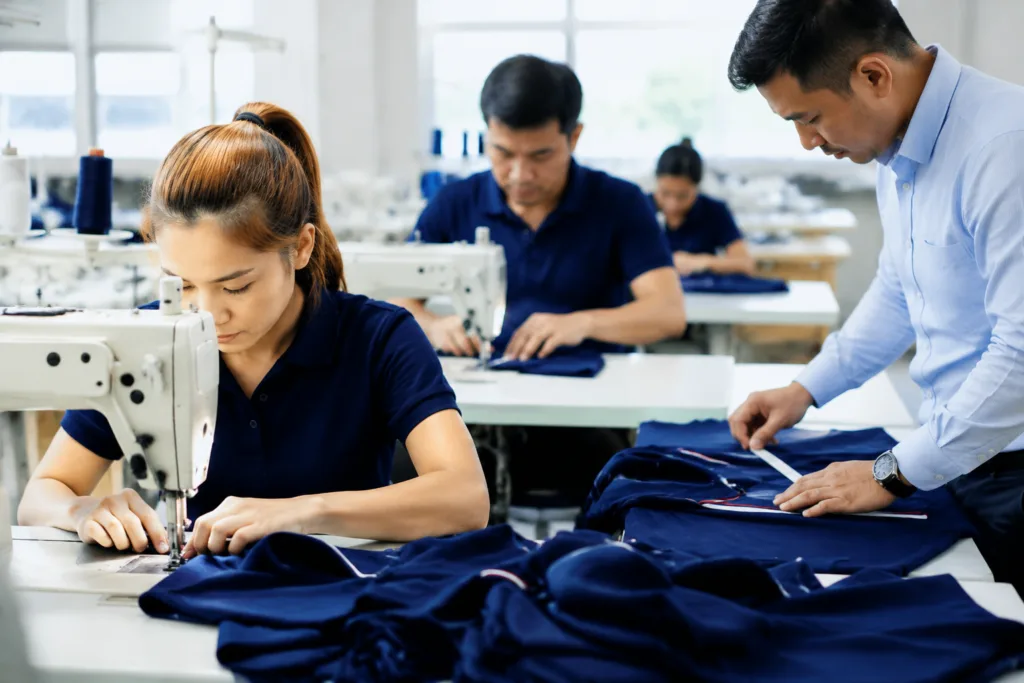
For polos in seasonal color programs, dye-lot planning is especially important. If a color must match previous deliveries or coordinate across multiple garments, the manufacturer should explain how lab dips, bulk shade approval, and lot segregation are handled. A trader may communicate that process well, but they do not always control it directly.
MOQ, flexibility, and scaling are more nuanced than many buyers assume
Some buyers think traders always offer lower MOQs and factories always insist on high volumes. The reality is more nuanced. Factory MOQ depends on fabric type, dye method, trim customization, line efficiency, and whether the order can be batched with similar products. Buyers exploring low MOQ clothing manufacturing options for small-batch projects should ask which elements drive the MOQ rather than asking only for a low number.
Ways factories can support smaller starts
- Using stock fabric or core yarn colors
- Starting from an existing polo block pattern
- Standardizing buttons and some trims
- Reducing colorways in the first run
- Combining sizes and colors across a single production plan
- Launching with woven labels first and custom packaging later
For growing brands, a direct manufacturer relationship usually becomes more valuable over time because once the style is approved, scaling additional colors or reorders is more structured.
Lead times and reliability improve when planning is direct
Lead time is not just sewing time. It includes material booking, lab dips, sample approvals, decoration setup, line allocation, finishing, packing, and shipment release. When buyers work directly with the factory, they can understand which milestone is critical and where delays are likely to occur during peak seasons.
Seasonality matters. Before holidays or uniform intake periods, sample rooms and production lines are tighter. A manufacturer can usually give a more realistic delivery window because they know the queue, capacity, and material readiness. A trader may quote aggressively first and then renegotiate after checking actual space.
IP protection, pattern ownership, and exclusivity are practical issues
For private-label programs, buyers should clarify who owns the pattern files, graded specs, embroidery files, artwork placements, and custom trim molds if any are developed. A direct factory relationship often gives cleaner documentation because the technical files are created where the garment is made.
That does not mean buyers automatically own everything. Ownership should be written into the sample agreement or production contract, especially if the buyer has funded development. If your polo includes exclusive neck labels, custom buttons, or a unique fit block, define whether those are reserved for your brand and how unused materials are handled after production.
Communication differs more than buyers expect
One of the biggest advantages of a manufacturer is not only price or MOQ. It is communication quality. When sample comments mention collar roll, armhole shape, chest tolerance, or placket bubbling, those are technical issues. A factory merchandiser or technician can answer with practical solutions. A trader may still be responsive, but the information often needs to travel through another layer first.
If you are evaluating candidates, it helps to compare not only quotations but also how they explain fit changes, decoration risks, and production checkpoints. This is why we recommend reviewing How to choose a polo shirts manufacturer: practical selection criteria and using the same checklist across all options.
When a trader adds real value
A balanced sourcing strategy should acknowledge that traders can be useful. They may add value when you need mixed-category consolidation, local inventory, multilingual coordination across several factories, or very small irregular buys that are not efficient for a factory account.
However, their limitations become clear when you need deep style development, repeat quality stability, direct corrective action, or transparent answers on why a collar, fabric, or shrinkage result changed. The more technical your polo program becomes, the more the extra layer can slow decision-making.
Cost-performance trade-offs in real buying scenarios
Private-label startup needing design control
If the brand wants a custom fit, branded labels, selected GSM, and a signature collar shape, direct manufacturing is usually worth the higher development effort. The startup gains a cleaner path for future repeat orders and size consistency.
Sports team needing rapid small runs
If the program changes every season and speed matters more than fabric development, a trader or local supplier may work well, especially when blank inventory or simplified customization is acceptable.
Retail buyer needing seasonal scale
A retailer with planned reorders will typically benefit from a factory relationship because consistency, booking discipline, and repeat spec control generate value beyond the initial price.
A practical checklist to evaluate a polo shirt manufacturer
- Ask whether they make polos regularly or only quote them occasionally.
- Request details on fabric options, common GSM ranges, and collar construction methods.
- Check whether they support custom patterns, grading, and fit comments.
- Review sample rules: costs, rounds included, revision timelines, and approval process.
- Ask about shrinkage, color fastness, and measurement tolerance controls.
- Request factory photos or videos that show sample room, cutting, sewing, finishing, and packing.
- Confirm who manages embroidery, print, heat transfer, or other decoration steps.
- Ask how private-label trims are sourced and what MOQs apply to each component.
- Clarify standard lead times for proto, PPS, and bulk production.
- Ask what happens if in-line defects or color issues are found during production.
Sample-to-bulk workflow with realistic timing
| Stage | Main buyer action | Typical timing |
|---|---|---|
| Tech pack and sourcing brief | Send measurements, artwork, fabric target, labels, packaging, target price | 1 to 3 days to prepare |
| Proto sample | Review construction and design interpretation | 7 to 10 days if materials are ready |
| Fit review and comments | Provide clear correction notes and measurement changes | 2 to 5 days |
| Revised fit sample | Confirm fit, grade logic, and style details | 7 to 14 days |
| PPS or pre-production sample | Approve bulk-ready standard | 7 to 12 days after materials are ready |
| Bulk production | Approve final booking and inspection plan | Usually 25 to 45 days depending on order and materials |
These are planning ranges, not promises. Lead time expands when fabrics are custom-developed, comments are incomplete, or artwork files arrive late.
Negotiation and contract points that protect both sides
- Define MOQ by color, style, and total order, not just a single headline number.
- Clarify sample charges and whether they are refundable against bulk.
- Set payment milestones that match material commitment and shipment release.
- Include tolerance standards for measurements and shade variation where relevant.
- State when pre-shipment inspection occurs and what happens if goods fail.
- Document ownership of patterns, artwork files, and custom trims.
- Agree on replacement, repair, or credit logic for verified quality issues.
Good negotiations are specific. Vague agreements create expensive misunderstandings later.
Common mistakes when moving from a trader to a manufacturer
- Sending only reference photos without a usable tech pack
- Assuming a factory can infer target fit from a competitor sample
- Requesting very low MOQs while also requiring custom fabric and packaging
- Approving samples without wash testing or measurement verification
- Ignoring collar and cuff quality because the body fabric looked acceptable
- Changing artwork, labels, or carton requirements after production booking
- Comparing prices without aligning fabric, GSM, and decoration methods
The easiest way to avoid these mistakes is to treat the polo as a technical product, not just a visual product.
How to prepare your sourcing brief before contacting a manufacturer
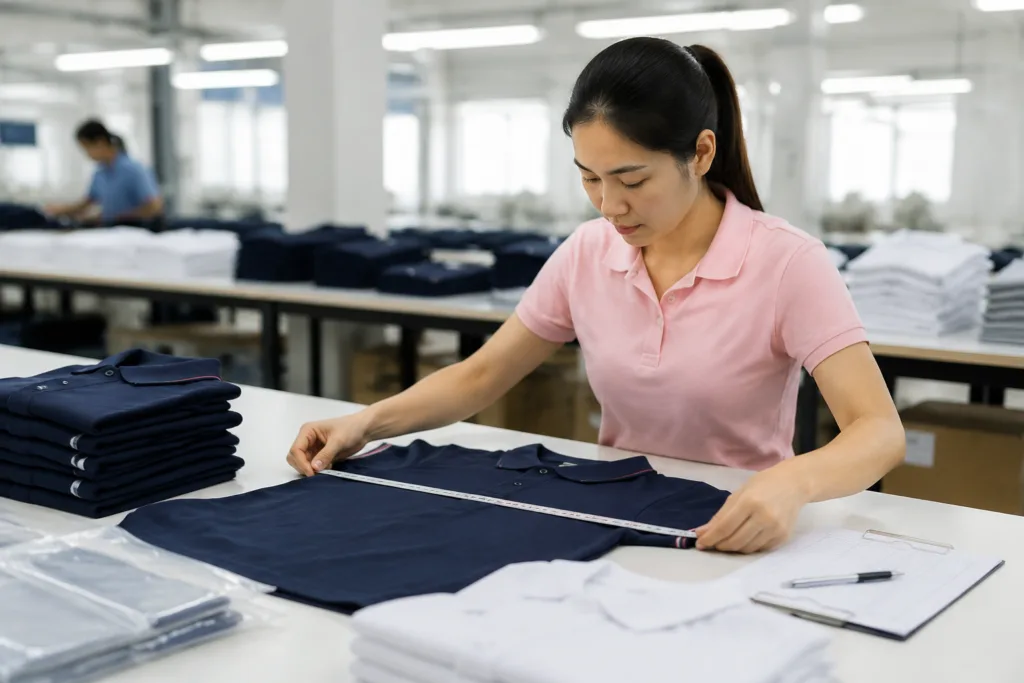
Your brief should include style reference images, intended use, target customer, size range, expected order quantity, target FOB or landed thinking, fabric preference, GSM range, color requirements, logo method, packaging expectations, and required delivery timing. If fit is important, include a measurement chart and clear notes on desired silhouette.
When buyers prepare this properly, the manufacturer can quickly identify whether the project should use a stock fabric route, a custom-developed route, or a phased launch that reduces risk in the first production run.
FAQs
Who usually pays for polo shirt samples?
In most cases, the buyer pays sample charges, especially for custom polos with new patterns, private-label trims, or special fabrics. Some manufacturers may credit part of the sample cost back after a confirmed bulk order, but this should be agreed in writing before development starts.
What is a realistic MOQ for a custom polo shirt order?
MOQ depends on fabric sourcing, color count, decoration method, and trim customization. A simple polo using stock materials may start at a relatively modest level, while a fully private-label style with custom-dyed fabric, branded buttons, and special packaging will require a higher MOQ to make production efficient.
Can a manufacturer help if my tech pack is incomplete?
Yes, but the process will be slower unless the missing details are clarified early. A capable manufacturer can help refine measurements, construction points, labeling, and artwork placement, but buyers should still provide as much direction as possible to avoid unnecessary sample rounds and quote changes.
Do buyers own the pattern and graded size specs after development?
Not automatically. Ownership of patterns, graded specs, embroidery files, and custom trim assets should be defined in the sample agreement or production contract, especially if the buyer has paid development fees. Clear ownership terms prevent disputes when you reorder or move production later.
Why do lead times change between the first quote and final booking?
Lead times often change because material readiness, sample approvals, peak-season capacity, and decoration scheduling shift during the project. A direct manufacturer can usually explain the exact reason more clearly, which helps buyers adjust approvals and booking decisions before delays become expensive.
When does choosing a manufacturer matter more than choosing a trader?
It matters more when you need custom fit control, repeat quality, private-label trims, transparent costing, stable lead times, and a product that must be reproduced accurately across future orders. For simple, mixed, or highly irregular buys, a trader may still be useful, but manufacturers are generally the better fit for long-term polo programs.
Conclusion
The choice between a polo shirt supplier vs manufacturer should follow your business model, not just the lowest initial quote. If you need consolidation, local stock, or a simple one-off purchase, a trader can be a workable solution. If you need custom development, clearer costing, repeat-order consistency, better QC control, and scalable private-label production, a direct manufacturer usually offers the stronger foundation. For most brands and organized buyers building a polo program instead of placing a one-time order, that difference becomes more valuable with every reorder.