







Choosing a factory for polos is rarely just about price. For brand founders, sourcing managers, wholesalers, and procurement teams, the real question is how to choose a polo shirts manufacturer that can consistently translate your product brief into the right fabric, fit, branding, and delivery performance without creating avoidable quality or scheduling risk. A polo looks simple on the surface, but in production it combines knit fabric behavior, collar structure, placket construction, color control, decoration choices, and size consistency, all of which can expose weak supplier capabilities very quickly.
If your project involves teamwear, retail basics, golf polos, corporate uniforms, or private-label performance tops, Ninghow provides custom polo shirt manufacturing support that helps buyers align fabric selection, collar and placket construction, logo application, sample refinement, and bulk planning before costly mistakes appear at production stage. This is especially useful when you need a supplier that can bridge development decisions with commercial realities such as MOQ, lead time, packaging, and repeat-order consistency.
This guide is written to help you make a defensible supplier decision. We will focus on the practical criteria that matter most: fabric sourcing, sample workflow, MOQ logic, quality checkpoints, lead-time reliability, communication quality, and the difference between an acceptable manufacturer and a good long-term fit for your polo program.
Quick decision checklist for selecting a polo shirts manufacturer
Before you compare quotations, use this short list to screen whether a supplier is even qualified for your project. In our manufacturing experience, many sourcing problems begin because buyers compare factories that are not built for the same product complexity or service level.
- Fabric capability: Can the supplier source or produce the knit structure you need, such as pique, jersey, or interlock, at your target GSM and hand feel?
- Color control: Can they manage lab dips, Pantone matching, contrast collars, and repeat color consistency?
- Construction experience: Do they regularly produce polo-specific features such as rib collars, cuff ribs, reinforced plackets, side vents, and taped neck seams?
- Decoration options: Can they advise when embroidery, screen print, heat transfer, or sublimation is appropriate for your order size and fabric type?
- Sampling workflow: Do they have a clear proto, fit, PP, and size-set process?
- MOQ fit: Is their minimum realistic for your style count, color count, and branding needs?
- Quality system: Do they run inline and final inspections and explain their AQL method clearly?
- Lead-time realism: Are timelines broken down by fabric, trims, sampling, approvals, and bulk production instead of a vague promise?
- Communication quality: Do they understand tech packs, tolerances, and revision control?
- Compliance support: Can they provide relevant testing or certification records when required by your market?
If a factory cannot answer these points directly, move carefully. Polos are often repeat styles, and repeated inconsistency becomes more expensive than a slightly higher initial price.
Define your polo project before you compare suppliers
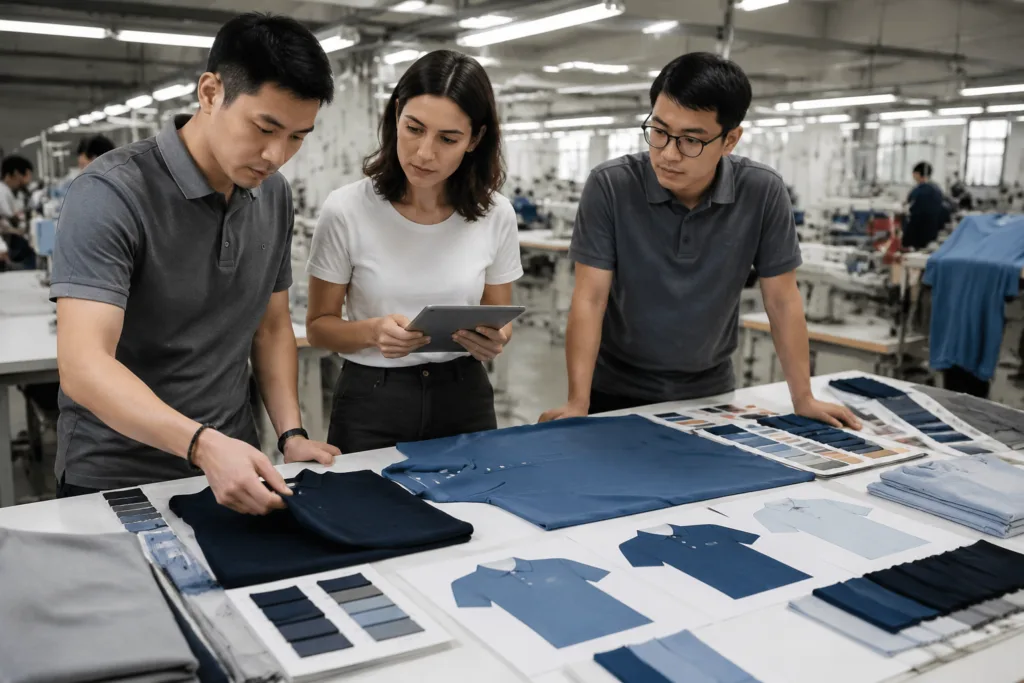
The strongest buying decisions start with a clear brief. A manufacturer can only quote and plan well if the product definition is specific enough. Before you request prices, define the pillars of your program.
Product spec pillars to clarify
- Knit type: pique for a classic textured look, jersey for smoother softness, interlock for a fuller hand feel and stability.
- Fabric composition: 100% cotton, cotton-poly blend, polyester performance fabric, spandex blend, or recycled blend.
- Target GSM: lightweight, standard, or heavier premium feel depending on climate, use case, and price point.
- Collar and placket: flat knit rib collar, self-fabric collar, contrast tipping, hidden buttons, covered placket, or standard two- or three-button placket.
- Decoration: left chest embroidery, sleeve print, heat-transfer logo, woven patch, or multi-location branding.
- Trim list: buttons, neck tape, labels, hangtags, size stickers, polybags, cartons.
- Fit block: slim, regular, relaxed, men’s, women’s, youth, unisex, or athletic cut.
- Target ex-factory price: a realistic cost range tied to retail positioning and margin goals.
When buyers skip this step, they often receive quotations that look comparable but are built on different assumptions. One factory may price a 180 GSM cotton-poly pique, while another assumes 220 GSM cotton interlock with embroidery and premium buttons. The numbers are not truly comparable.
Match the manufacturer type to your needs
Not every apparel factory serves the same buyer profile. If you are evaluating how to choose a polo shirts manufacturer, start by matching supplier model to your development stage and product complexity.
OEM, ODM, private label, and cut-and-sew compared
| Model | Best for | Strengths | Limits |
|---|---|---|---|
| OEM | Brands with defined specs | Good control over fabric, fit, trims, branding | Requires clearer tech pack and approvals |
| ODM | Fast launch with modified existing styles | Shorter development path, easier starting point | Less uniqueness in pattern and construction |
| Private label | Brands wanting ready-to-brand styles | Efficient for labeling, packaging, and brand presentation | May offer fewer silhouette changes |
| Cut-and-sew development | Custom fit blocks or technical polos | Highest design control | Longer development and higher complexity |
For example, a startup testing one or two core polos may benefit from private label clothing production for brand-ready polos if the priority is speed and controlled customization. A golf or sportswear brand developing a distinct fit block with moisture management and precise color standards may need a more technical OEM or cut-and-sew partner.
Fabric and material capabilities to verify
Polo success depends heavily on knit fabric performance. This is where many suppliers sound capable in sales conversations but become vague when asked about shrinkage, pilling, colorfastness, or collar behavior after washing. We advise buyers to test fabric capability early, not after price negotiation.
Understand the supplier’s fabric sourcing model
Ask whether the supplier uses in-house knitting, nominated mills, open-market mills, or buyer-supplied fabric. Each model changes lead time, control level, and minimums. In-house or stable mill partnerships can improve repeatability, while open-market sourcing may offer flexibility but introduce shade or hand-feel variation between lots.
Common polo fabrics and practical specs
- Cotton pique: classic look, breathable, textured surface, often around 180 to 240 GSM depending on market position.
- Cotton-poly pique: better durability and lower wrinkle sensitivity, often practical for uniforms and promotional programs.
- Poly performance pique: quick-dry, common in sports and golf polos, but decoration method must match fabric behavior.
- Jersey: softer and smoother, more T-shirt-like, usually used where comfort is prioritized over traditional polo texture.
- Interlock: denser, smoother, more stable, often selected for premium hand feel.
Request exact composition, GSM tolerance, width, shrinkage expectation, colorfastness target, and finishing details such as moisture wicking, anti-pilling, or UV treatment where relevant. If your market requires sustainability claims, ask how fiber content will be documented.
Color matching and lab-dip control
For solid polos, especially corporate or school uniforms, color control matters as much as fabric quality. Ask about Pantone referencing, lab-dip approval steps, and tolerance for bulk shade variation. For heather, mélange, or contrast details, confirm whether collar and body are dyed separately and how shade consistency is controlled. A reliable supplier should explain approval stages rather than simply saying “same as sample.”
Construction and finishing capabilities that affect repeat quality
Polo construction is full of small details that strongly influence perceived quality. A well-priced garment can still look weak if the collar curls, the placket bubbles, or the side vents twist after washing.
Key points to verify
- Collar type and recovery after wash
- Rib cuff consistency between lots
- Placket reinforcement and button spacing
- Neck tape application and seam cleanliness
- Stitch type, stitch density, and seam balance
- Side vents and bar-tack reinforcement
- Hem shape and differential between front and back if used
- Label attachment, tear-away option, and private label finishing
From our manufacturing perspective, collars deserve special attention. A body fabric may pass visual inspection while the collar reveals the true quality level after wash testing. Ask whether the supplier has standard collar constructions for cotton pique, cotton-poly, and performance poly, and whether interlining or stabilizing methods are used when needed.
In projects that involve multiple approvals, our team at Ninghow often recommends documenting stitch count, placket width, button diameter, vent depth, and neck tape width directly in the spec file. That prevents preventable variation across sample rounds and bulk repeats.
Customization and decoration capabilities
Logo application should be chosen based on fabric type, order size, logo detail, and use scenario. A decoration method that looks fine on a showroom sample can fail in wash durability or distort a lighter knit in production.
Embroidery considerations
Ask how many embroidery heads are available, what size frames are used, and whether the supplier manages digitizing in-house or externally. For chest logos, confirm stitch density, backing choice, thread brand or standard, and whether the logo has been adjusted for pique texture. Fine lettering often needs simplification to sew cleanly on textured knits.
Printing and transfer methods
- Screen printing: efficient for simple graphics and volume, but less common on classic corporate polos than tees.
- Heat transfer: useful for small runs, names, numbers, or sharp logo detail, especially on performance fabrics.
- Direct-to-garment: usually limited for large polo programs due to speed and consistency considerations.
- Sublimation: excellent for full-coverage polyester programs, not for cotton polos.
When discussing decoration, ask for wash test expectations and placement tolerances. Logo misplacement of even a small amount is very visible on polos because the placket and chest area create clear reference lines.
Private label trims and packaging
Brand-ready polos often require more than neck labels. Confirm woven main label, size label, care label, hangtag stringing, barcode sticker, fold method, polybag spec, carton assortment, and any retailer compliance standards. This is where hidden cost often appears if the quote only covers the garment body.
Sample development and approval workflow
A polo sampling workflow should not be improvised. Factories that skip formal approvals often create expensive arguments during bulk production. Buyers should understand the apparel sampling process for fit and approvals before confirming their supplier, because the sample system tells you how disciplined the production system will be later.
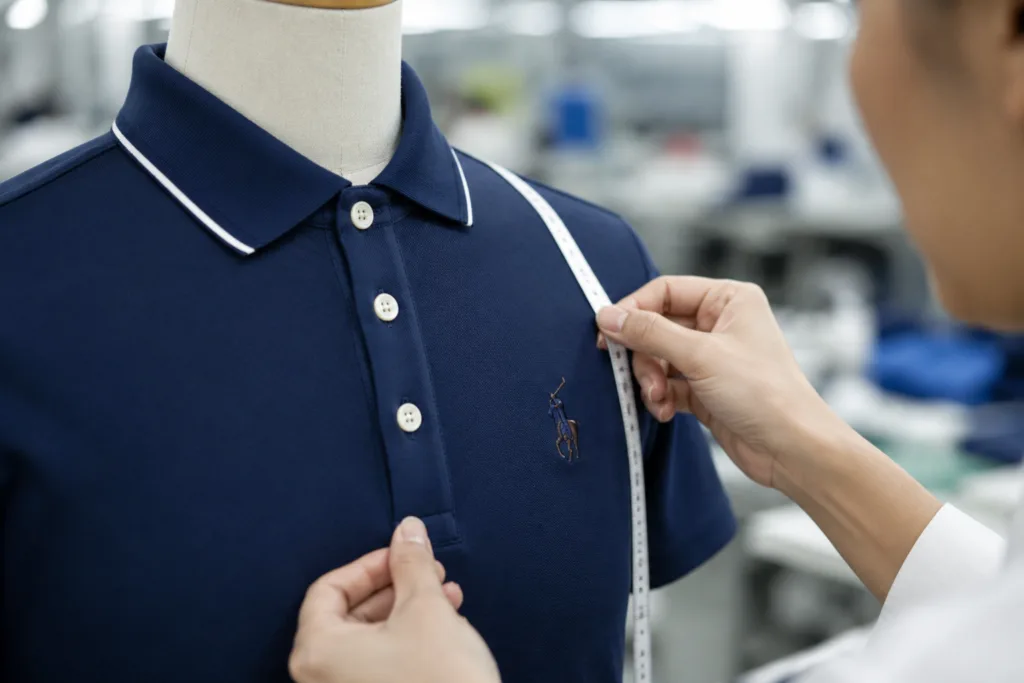
What should be in a polo tech pack
- Front and back sketches
- Construction callouts for collar, placket, cuffs, hem, vents, and seams
- Measurement chart with point-of-measure definitions
- Tolerance table
- Fabric code, composition, GSM, finish, and color reference
- Trim list with button, label, and packaging details
- Logo artwork files and placement dimensions
- Stitch or seam notes where critical
Recommended sample sequence
For custom polos, a normal flow may include proto sample, fit sample, pre-production sample, and size set if sizing risk is meaningful. Timelines vary by complexity and fabric availability, but the key is not speed alone. The key is whether each stage has a clear objective. A proto proves construction direction. A fit sample verifies pattern and measurements. A PP sample locks the approved standard before bulk. A size set checks grading consistency.
How to evaluate a polo sample objectively
- Check body and sleeve measurements against tolerance
- Assess collar roll, shape retention, and symmetry
- Inspect placket flatness and reinforcement
- Measure button spacing and alignment
- Review stitch density and loose-thread control
- Examine side vents, hem balance, and seam twisting
- Wash test for shrinkage, puckering, and logo durability
- Confirm hand feel matches target market position
MOQ, pricing structure, and cost breakpoints
MOQ is not one number. It changes with fabric type, color count, logo method, and trim customization. A supplier may accept a lower garment MOQ but require higher minimums for dyed fabric, rib collar customization, or printed packaging. This is why negotiation works best when you understand the cost drivers.
What usually affects MOQ
- Custom-dyed fabric versus stock fabric
- Custom knit collar or cuff ribs
- Embroidery setup and logo count
- Screen print color count
- Private label trims and packaging
- Special washes or finishes
- Number of colorways and size ratios
For startups, a realistic negotiation lever is often simplification rather than price pressure. You may lower MOQ by using stock body fabric, standard buttons, fewer colorways, shared packaging formats, or one embroidery position instead of several. Ask the supplier what specific choices reduce the minimum and what compromises that creates.
Cost components to request in a quote
| Cost area | What to ask for | Why it matters |
|---|---|---|
| Fabric | Composition, GSM, width, usage, wastage | Largest cost driver on most polos |
| Trims | Buttons, labels, neck tape, packaging | Often under-quoted early |
| Labor | Sewing and finishing assumptions | Helps compare construction complexity |
| Decoration | Embroidery count, print setup, transfer fees | Affects MOQ and repeat cost |
| Development | Lab dips, sample fees, PP fee, size set cost | Important for budgeting launch stage |
| Logistics | Packing method, delivery term, carton details | Needed for landed-cost planning |
Lead time, capacity, and scheduling reliability
A supplier should explain lead time by stage, not just promise a shipment date. Buyers often underestimate how much time is consumed by fabric knitting or dyeing, lab dip approval, logo digitizing, trim development, sample revisions, and production queue scheduling. Review the supplier’s apparel production timeline and realistic lead times with buffers for approvals and peak-season congestion.
Questions to ask about scheduling
- What lead-time assumptions depend on same-day approvals?
- When is fabric booking triggered?
- How much queue time is included before cutting starts?
- What happens if a lab dip or PP sample is rejected?
- Which months are peak capacity periods for polos or uniforms?
- Can repeat orders use a faster path with pre-approved materials?
For seasonal launches, we suggest building approval buffers into your calendar rather than hoping the factory will absorb delay. A good schedule is one that still works when one step slips slightly.
Quality assurance and testing requirements
Quality control should be visible, not implied. If a supplier says “we check everything,” ask how. Serious factories describe incoming material checks, inline inspection points, measurement audits, final inspection, and shipment release criteria. Buyers comparing factories should ask to review their approach to apparel quality control standards for polo production because the process reveals how issues are prevented, not just found at the end.
QC checkpoints that matter for polos
- Fabric shade and defect review before cutting
- Pattern and marker confirmation
- Inline sewing checks for placket, collar, and side vent consistency
- Measurement audits during production
- Decoration placement verification
- Final visual and measurement inspection using an agreed AQL standard
- Packing checks for labels, assortments, and carton accuracy
Tests buyers should consider
- Colorfastness to washing and rubbing
- Pilling resistance
- Shrinkage after wash
- Seam strength or tensile performance where relevant
- Spirality or twisting on knit styles
- Flammability or chemical compliance if required by market
Suggested tolerances depend on your market, but the main point is to agree them before bulk production. Size disputes are much easier to prevent than to solve after shipment.
Compliance, communication, and technical interpretation
Compliance documents matter for many buyers, but communication discipline matters for every buyer. Certifications can support confidence, yet they do not replace active project management. Ask about relevant standards such as OEKO-TEX, GRS, REACH-related compliance support, or social audit frameworks if your channel requires them. Then test the supplier’s real working style.
What to measure in supplier communication
- Response time and completeness
- Ability to read and question a tech pack accurately
- Version control for revised files and comments
- Willingness to flag risk early instead of saying yes to everything
- Use of photos, videos, measurement sheets, and approval records
- Cadence for pre-production meetings and issue escalation
A supplier that asks precise questions is often safer than one that gives instant blanket agreement. Good technical interpretation reduces hidden assumptions around fit, fabric substitution, and trim availability.
Red flags, decision framework, and a short case example
As you narrow your shortlist, look for patterns rather than isolated issues. One delayed email may be normal. Repeated vagueness is not.
Common warning signs
- Quotations without clear fabric or trim assumptions
- Reluctance to discuss tolerances or test standards
- Sample quality that changes dramatically between rounds
- Overpromised lead time with no stage breakdown
- Conflicting answers from sales and production contacts
- Hidden fees for labels, packaging, or lab dips introduced later
- Claims of “any MOQ” without explaining conditions
A practical scoring template
| Criteria | Suggested weight | What to evaluate |
|---|---|---|
| Technical fit | 20% | Fabric, collar, placket, decoration capability |
| Sample quality | 20% | Fit, construction, wash result, consistency |
| Price structure | 15% | Transparency, cost realism, repeat-order logic |
| MOQ fit | 10% | Works with your style and color plan |
| Lead time reliability | 15% | Detailed schedule and capacity realism |
| QC system | 10% | Inspection checkpoints and corrective action |
| Communication | 5% | Clarity, speed, technical understanding |
| Compliance support | 5% | Relevant documentation and buyer requirements |
Low-MOQ specialist versus high-volume OEM
Consider a brand launching a premium cotton-pique polo in three colors. A low-MOQ supplier may offer faster entry with simpler trims and flexible quantities, which is valuable for demand testing. A high-volume OEM may offer stronger cost efficiency and more stable fabric programs, but only once the forecast is large enough to justify custom knitting, dye lots, and reserved capacity. The right choice depends on your stage: launch learning versus scaled repeatability. The mistake is choosing a factory optimized for a stage you have not reached yet.
Negotiation, onboarding, and practical next steps
Once you have identified one or two suitable suppliers, move into structured onboarding. Confirm payment terms, approved sample hierarchy, revision control, packaging standards, defect handling, and who signs off lab dips, PP samples, and shipment release.
What to ask in your first serious supplier email
- What polo fabric types and GSM ranges do you produce most often?
- What is your MOQ by style, color, and logo method?
- Can you share your standard sample sequence and timing?
- How do you control collar quality and bulk color consistency?
- What tests do you normally run for polo programs?
- What information do you need for an accurate quote?
- Can you break down lead time by development, materials, and production stages?
- What private label trims and packaging can you support?
- How do you handle fit revisions and measurement tolerances?
- What are the main risks you see in our program?
Sample request checklist
- Approved tech pack version
- Measurement chart and tolerances
- Fabric and trim references
- Logo files and decoration method notes
- Wash-care expectations
- Packaging requirements
- Target timeline and decision dates
These steps make supplier comparison much more objective. They also reduce the chance that price becomes the only decision variable.
Conclusion
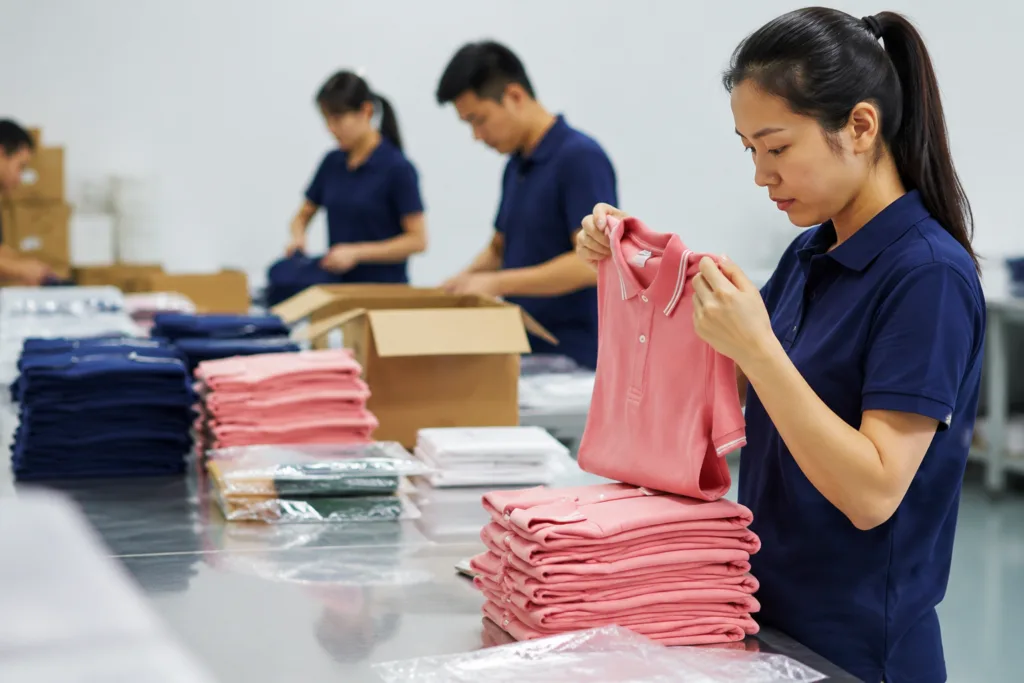
If you are deciding how to choose a polo shirts manufacturer, prioritize technical fit before headline cost. A suitable supplier should understand knit fabric behavior, collar and placket construction, decoration limits, sample discipline, MOQ logic, quality control, and realistic scheduling. For most buyers, the best decision comes from comparing three to five suppliers against the same specification set, then scoring them on sample quality, communication, risk transparency, and repeat-order readiness rather than relying on quotations alone.
At Ninghow, we see the strongest polo programs come from early alignment on fabric, fit, trims, testing, and approval flow. Whether your need is private label basics, uniform programs, or custom OEM polos, the safest path is structured development, clear benchmarks, and a factory relationship built on specifics instead of assumptions.
FAQs
Can I negotiate MOQ for custom polo shirts?
Yes, but the most realistic way to negotiate MOQ is to simplify the program rather than only asking for fewer units. Using stock fabric, standard buttons, fewer colors, one logo placement, and standard packaging can reduce minimums more effectively than price pressure alone. Ask the factory which parts of your brief create the highest minimum and what specific changes would lower it.
Should the manufacturer supply the fabric or should I source it myself?
That depends on your control needs and internal resources. If you have a nominated mill and strong fabric knowledge, buyer-supplied fabric can work, but it also adds coordination risk. For many brands, a manufacturer-managed fabric program is more practical because the factory can align fabric performance, shrinkage behavior, and cutting efficiency with the garment construction, as long as specifications and testing are clearly agreed.
What is a realistic lead time for custom polo shirt production?
Lead time varies by fabric availability, number of sample rounds, color approvals, and decoration complexity. A realistic plan should separate development, material booking, bulk production, and finishing instead of giving one vague total. If your order includes custom-dyed fabric, branded trims, or multiple approvals, build extra buffer time rather than assuming the fastest estimate will hold.
Which logo method is best for polo shirts?
There is no single best method for every program. Embroidery is common for corporate, school, and premium polos because it is durable and familiar, but dense embroidery can affect lighter knits. Heat transfer can work well for sharp detail and smaller runs, while sublimation is suitable for polyester performance polos. The right choice depends on fabric type, logo detail, order size, and wash expectations.
How do I judge whether a polo sample is good enough to approve?
Check it against measurable criteria rather than appearance alone. Measure key points against your spec and tolerance table, inspect collar shape, placket flatness, button alignment, stitch consistency, side vents, and logo placement, then run a wash test for shrinkage, twisting, and decoration durability. A sample should not only look correct on day one; it should also behave like a production standard.
What are the biggest mistakes buyers make when selecting a polo shirts manufacturer?
The most common mistakes are sending incomplete tech packs, comparing quotes built on different assumptions, approving samples without wash testing, underestimating trims and packaging costs, and trusting photos more than physical samples and measurement records. Another major mistake is choosing a supplier for low entry price even when their communication, QC process, and capacity are not a good fit for repeat business.