



Introduction: The Value of Accurate Garment Measurement in Production
Perfectly fitting garments don’t happen by accident—they start with precise measuring. For any apparel brand, designer, or factory, knowing how to measure garments for production is the essential foundation that prevents costly mistakes, production delays, and, most importantly, rework. Whether you source from large-scale factories or specialize in small batch orders, unreliable measurements mean fit headaches, wasted fabric, and unhappy customers. This guide equips you with the step-by-step garment measuring methods used in real factories, simple checklists for all main styles, and insider tips to minimize errors before they multiply across an entire production run.
Why Measuring Garments for Production is Mission-Critical
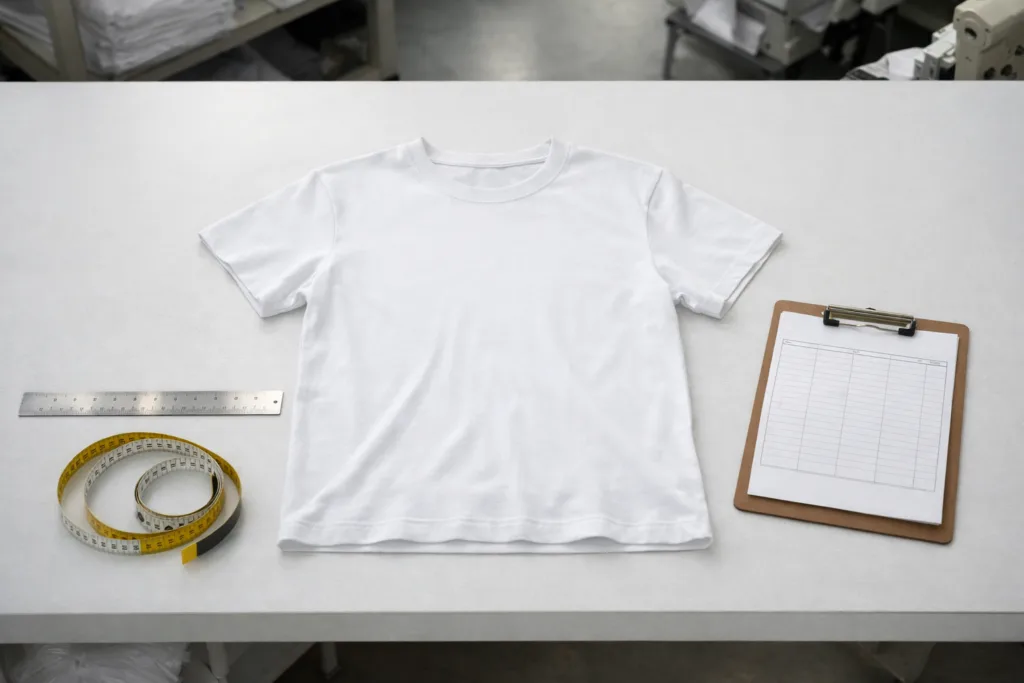
Every wrong measurement introduces a domino effect leading to fabric waste, poorly aligned patterns, and unpredictable fit. For brands scaling up, the impact deepens: inaccurate measurements force changes downstream—on cutting, sewing, and finishing lines. Standardizing measurement ensures your XS through XXL samples all fit as intended. The result? Consistent customer experiences, fewer returns, and no late-night calls from the factory. If you care about smooth delivery and brand reputation, measurement is your non-negotiable starting point.
Essential Tools Needed for Measuring Garments
Before you begin, assemble these tools for professional accuracy and repeatability:
- Flat, even measuring table or surface
- Flexible measuring tape (non-stretch)
- Metal ruler (for hard edges or seams)
- Square (to check perpendicular points, especially for sleeves and hems)
- Markers or fabric pencils (if tracing measurement lines)
- Garment measurement chart, matching sample size specs
Key Measurement Points: The Essential List for Apparel Production Teams
Every garment type has unique measurement points, but core locations include:
- Chest/Bust width
- Waist width
- Hip width
- Total body length
- Sleeve length (side neck, shoulder, or armhole version)
- Shoulder width
- Hem width
- Armhole or biceps circumference
How to Measure T-Shirts and Knit Tops Correctly
Lay the garment flat on your measurement table, smoothing out wrinkles without stretching the fabric. Standard points include:
- Chest: Underarm point to underarm point, straight across front
- Body length: Highest point of shoulder (HPS) to bottom hem
- Sleeve length: Shoulder seam to end of cuff or hem
- Shoulder width: Seam to seam, straight across back
For detailed distinctions between t-shirt designs, refer to the Scoop Hem vs Straight Hem T-Shirt Guide for real-world measurement differences.
How to Measure Shirts: Wovens, Polos, and More
Start on a flat, smooth surface and keep buttons fastened. Crucial measurement points include:
- Chest width: 1 inch below armhole, straight across front
- Waist width: Narrowest torso point
- Shoulder: From left to right seam ends
- Sleeve: Center back to shoulder seam, then down to end of cuff
- Back length: Center back neck seam to hem
- Cuff diameter
How to Measure Hoodies and Sweatshirts
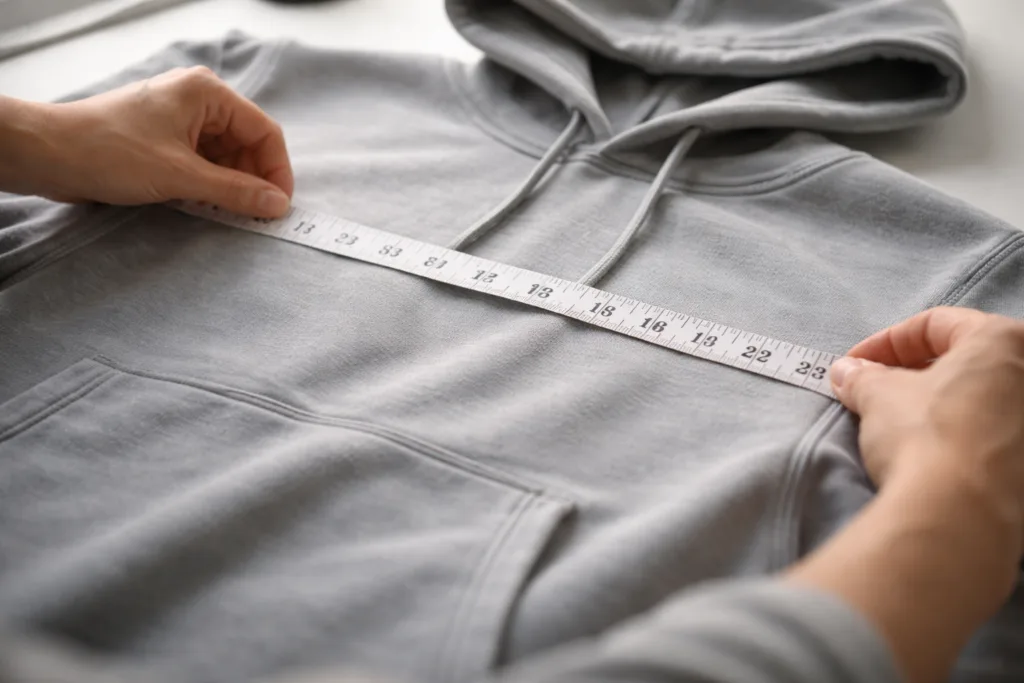
Lay the garment face up and flatten out the hood if present. Focus on:
- Chest width
- Body length (front and back, especially if hem shapes differ)
- Sleeve length
- Hood opening
- Hem and cuff width
Reference our guide to hoodie fit to avoid bagginess—critical for style-focused brands wanting a sharp silhouette.
How to Measure Jackets and Outerwear
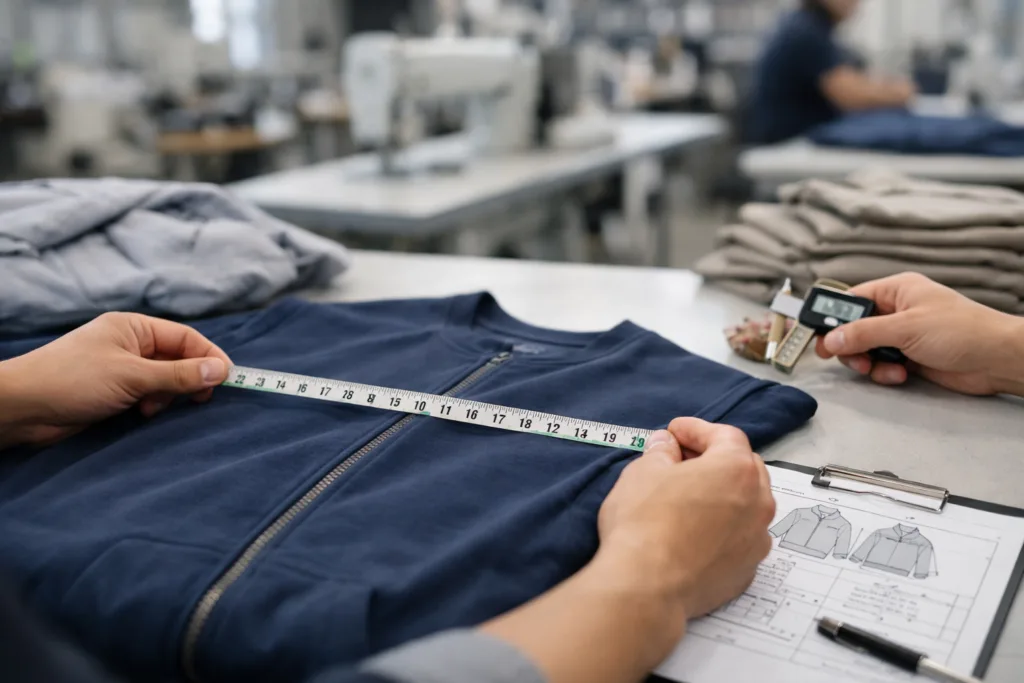
For heavier garments, align all seams before measuring. Points include:
- Chest width, both zipped and unzipped
- Waist width
- Hem and sweep width
- Sleeve length
- Shoulder to shoulder
- Back length
- Armhole circumference
How to Measure Pants and Trousers
Pants are always measured flat-front, waistband buttoned. Measurements:
- Waist width (side-to-side, then double for total)
- Hip width (deepest point across seat)
- Thigh width (1 inch below crotch)
- Inseam: Crotch seam to hem
- Outseam: Top of waistband to bottom hem
- Leg opening
How to Measure Shorts for Bulk Production
Shorts use similar points as pants, but pay extra attention to inseam (affects style) and crotch depth. Always note elastic or adjustable waistband specs.
How to Measure Dresses and Skirts for Manufacturing
For dresses: bust, waist, hips, body length (shoulder or HPS to hem), sleeve if present. For skirts: waist, hips, front and back lengths, hem.
How to Measure Swimwear and Activewear—Special Considerations
These styles often use stretch fabrics. Measure flat-resting (do not stretch out), and document maximum tolerable stretch when required. Double-check measurements for linings or pad inserts. Ninghow’s team always verifies swimwear measurements by running a single sample wash/dry cycle to check for shrinkage before creating PPS (Pre-Production Samples).
See the step-by-step process for starting a swimwear line for sample and fitting best practices.
How to Measure Kidswear: Unique Factors for Size and Fit
For kids’ clothing, size increments are often smaller. Follow the main adult methods, but always note adjustments for rapid growth and safety. Document size grading increments clearly, since even 0.5 cm margin errors will stack up across multiple age groups.
Flat vs. 3D Measuring—Which Method for Which Garment?
Flat measuring means laying the garment on a flat, hard surface (most common for production). 3D measuring, such as draping on a dress form, is best for extremely fitted or asymmetric pieces. State measurement method on your tech pack and keep all factory samples consistent.
Documenting Garment Measurements: The Sample Spec Sheet
Each style needs a sample spec sheet. Include:
- Garment sketch or photo
- Size breakdown (XS, S, M, L…)
- Each key measurement point, with diagram arrows if possible
- Tolerances (+/- range allowed, e.g., ±0.5cm)
Establishing Size Tolerances: Real-World Manufacturing Ranges
No factory can meet every measurement precisely. Standard tolerance ranges are usually ±0.5–1.0 cm for main points. Set realistic tolerances based on garment type, price point, and your brand’s QC acceptance.
The Factory Sample Review Process: Catching Issues Before Bulk Production
Once your sample arrives, re-measure every point against your sheet. Flag any out-of-tolerance measurements before approving for mass production. Document everything in your production file. If working with OEM/ODM partners, verify that their in-house QC routine matches your points.
How Often to Measure: From Proto Sample to Bulk Shipment
Measure at every major approval step:
- Proto sample: For design and primary fit
- Fit sample: For wearer trial
- PPS (Pre-Production Sample): Factory trial before full order
- Bulk random QC: At least 10% of pieces in each size
Common Measurement Mistakes That Cause Rework
Even veteran teams make errors—sometimes based on assumptions or poor communication. Top mistakes:
- Not laying garments completely flat before measuring
- Measuring over wrinkles or folds
- Using inconsistent tools (stretchy tape, old rulers)
- Confusing half and full circumference points
- Missing tolerance discussion with factory before approval
How to Prevent Measurement Errors and Minimize Rework
Following a clear, written procedure is vital. Always double-check which measurement method your tech pack follows. Train every in-house and factory team member. For tech packs, Ninghow’s production supervisors recommend attaching labeled diagram images—this eliminates confusion far better than just words. Don’t hesitate to ask your manufacturing partner to send measurement photos of random finished goods for spot checks.
Digital Tools and Tech Packs: Upgrading Your Measurement Workflow
Digital pattern software can automate most spec sheets and quickly create size grading breakdowns. Always save digital versions for revision tracking. If adopting a production management tool, make sure it can attach photos, PDF diagrams, and version logs—not just numbers. Visit the Cut and Sew Manufacturing Guide for more on tech pack integration into real supply chains.
Industry Terms and Glossary: Measurement Jargon Demystified
Not sure about a term? Here are a few essentials:
- HPS: High point of shoulder (top seam near neck)
- Sweep: Hem opening circumference
- CBL: Center back length
- Spec: Measurement specification for one point
- Tolerance: Acceptable up/down range from spec
Best Practices for Communicating Measurements with Your Factory
Send a unified specification sheet, with diagrams and labeled photos. Note measurement units (cm/inches). Confirm every team uses the same ‘start’ and ‘end’ points. Conduct a live video measurement walkthrough if language or diagram gaps exist.
How to Measure Garments for Production
Measuring garments for production requires patience, precision, and a repeatable process. Start with the correct tools and a flat work surface. Align the garment. Take each measurement at the widest or highest point, writing numbers clearly into your sample spec document. Mark your tolerance range. For each new style, run a sample fitting (in-house or with external testers), then finalize measurement points and communicate them to your manufacturer. Rinse and repeat at every approval stage—including spot checks during bulk production.
Conclusion: Accurate Measurement—Your First Line of Defense Against Production Problems
Solid measuring habits reduce production rework, cutting waste and avoiding last-minute changes. Building measurement accuracy into every stage (sample to bulk QC) keeps your factory partners confident, your brand reputation strong, and your end customers delighted with every order. Don’t let ‘close enough’ stand in for quality—set procedures now, and rework won’t be a constant fear.
Frequently Asked Questions
What if my factory’s measurement doesn’t match my sample?
Immediately compare both parties’ measurement methods and tools. Request photo proof. If inconsistencies remain, send a full labeled measuring video and clarify tolerance.
How do I measure a garment with a curved hem or raglan sleeve?
Always measure length at the longest point for curved hems. For raglan sleeves, run tape from the neck’s mid-point to cuff, following the seam curve.
What are typical tolerances for garment measurements?
Most production settings accept ±0.5–1.0 cm for main points, but double-check with your factory and list exact ranges on your tech pack to prevent arguments.
Should I measure before or after washing finished garments?
Both. Measure first to check sewing accuracy, then after standard wash/dry to confirm shrinkage meets your allowance. Note shrinkage % on your spec sheet.
How do I minimize confusion if I use multiple factories?
Share the same labeled diagrams, spec sheets, and measurement rules with each partner. Schedule spot checks and random sample reviews for consistency across sites.
Can digital tools replace manual garment measurements?
Digital patternmaking automates spec sheets, but physical samples must still be measured by hand before approving samples for bulk production.
Related Reading
- Launch Small, Win Big: The Ultimate Guide to Low MOQ Production Tactics
- Your Checklist for On-Time, Bulk Teamwear Orders That Fit Every Player
- How to Approve Samples Efficiently and Avoid Post-Production Nightmares
- Preventing Costly Pattern and Fit Changes During Apparel Production
- The Practical Playbook for Reducing Apparel Returns — Pattern, Fit & QC Control
