


Choose a custom hat manufacturer by testing each candidate against one controlled product brief. Define the hat’s construction, fit, materials, branding, quantities and required dates first. Then ask every supplier for evidence and a quote against that same specification. A low unit price or an attractive sample is not enough if the proposal assumes a different hat, excludes necessary work or leaves approval responsibilities unclear.
The immediate task is therefore not to find the longest list of custom hat manufacturers. It is to make your design specific enough that unsuitable candidates can be ruled out and the remaining proposals can be compared on equal terms.
Define Your Custom Hat Requirements
Prepare a one-page requirement brief before requesting prices. Include reference images, intended wearer and use, hat type, construction, fit, materials, colors, branding locations, quantities by variation, labels, packaging, delivery destination and required arrival date. Mark the brief with a revision number and date so that later answers can be traced to the correct version.
Reference images communicate the intended appearance, but they do not replace written specifications. A supplier may interpret the same photograph differently, especially where the image does not reveal internal structure, exact materials, rear closure or size system.
Separate Fixed Requirements From Preferences
Classify each choice as fixed, preferred or open to supplier recommendation. A fixed requirement might be a particular silhouette required for a collection, while a preferred requirement might be the closure type if 2 options would serve the same user.
This distinction changes the sourcing decision. A candidate that cannot meet a fixed requirement may be unsuitable, but a candidate proposing a documented alternative to a preference may still deserve consideration. It also prevents quiet substitutions: any suggested change can be reviewed against the original priority rather than accepted as if it were equivalent.
Specify Quantities by Actual Variation
State quantities by style, color and size or adjustment format instead of giving only an overall total. For example, an order described only as “1 hat design in 3 colors” leaves unanswered how many units belong to each color and whether all colors use the same material, decoration and closure.
Variation matters because a supplier may face a constraint at a level below the total order. A material, dyed color, patch, buckle or other component may have its own purchasing or setup condition. At this stage, record the requested breakdown without assuming that colors or styles can be combined to satisfy a minimum; ask each candidate to explain how its conditions apply.
Set the Intended Use and Approval Priorities
Describe where, how and by whom the hat will be worn. A fashion accessory, staff uniform hat and event giveaway may prioritize shape, repeated-use comfort, brand appearance and packaging differently. Avoid turning the use statement into an unsupported performance claim. Instead, use it to identify what must be checked in samples.
List the approval priorities in order. These could include crown shape, fit range, logo appearance, closure operation or compatibility with a packaging format. This gives the supplier a clearer basis for development and gives your team a consistent reason to approve, revise or reject a sample.
Choose the Hat Styles and Materials
A broad label such as “baseball cap” is not a complete manufacturing specification. Suppliers need to understand the parts that create the desired silhouette and fit. Record each visible or functional variable, and ask candidates to identify any element that remains ambiguous.
Describe the Crown, Panels and Structure
Specify the intended crown profile, panel arrangement and whether the crown should hold a defined shape or have a softer form. Note visible seam layout, front-panel treatment, ventilation details and any lining or internal support that is important to the design. If you do not know the technical name, annotate reference images and ask the supplier to confirm its interpretation in writing.
These details matter because 2 hats with similar front views can behave differently when worn. Panel geometry and internal structure affect the silhouette, while seam placement can alter where a logo sits or crosses a construction line. Compare candidates on whether they can reproduce the complete construction, not merely offer a roughly similar category.
Define the Visor, Closure and Size System
Describe the visor or brim shape, intended curvature and visible finishing. For adjustable hats, identify the preferred closure type and how it should look and function. For fitted or multi-size products, state the required size range and ask the supplier to propose measurement points and a size specification for approval.
Do not rely on “one size” as a complete fit instruction. Adjustability does not show which head sizes the product is intended to accommodate or whether the closure remains comfortable and secure in use. The buyer and supplier should agree on measurement methods and acceptance criteria rather than applying an unverified universal tolerance.
Connect Materials to Use and Decoration
Record the preferred shell, sweatband and lining materials, including color and surface appearance where relevant. If exact material details are not yet known, describe the outcome you need—such as a particular hand feel, visual texture or shape—and request physical swatches or sample components before approving a substitute.
Material selection also interacts with decoration. A surface that looks appropriate on its own may not support the intended logo appearance in the same way as the reference. Ask candidates to sample the proposed decoration on the actual production material and construction whenever feasible. A sample made with substitute material can help review shape or placement, but it cannot establish that the final combination will look or behave the same.
Decide How You Want to Customize the Hats
Determine whether your project needs branding on an existing base style or development of a more fully customized hat. Both routes can produce a branded product, but they demand different supplier evidence. The distinction should be explicit before comparing prices or schedules.
Distinguish a Decorated Base Hat From Custom Construction
A decorated-base route starts with an existing hat style and adds branding such as embroidery, a patch, printing or labels. It can reduce the number of construction decisions, but the available silhouette, material, color, closure and fit remain limited by the selected base.
Custom construction changes one or more underlying elements, such as the pattern, panel arrangement, crown profile, materials, visor, closure, internal components or trims. This route requires more detailed specifications and construction approval. Do not assume that a supplier offering logo application can also develop or control all of these elements.
| Comparison criterion | Decorated base style | Custom construction |
|---|---|---|
| Starting point | Existing hat model | Project-specific construction brief |
| Main buyer decisions | Base selection, color, branding and placement | Pattern, profile, components, materials, fit and branding |
| Most useful early evidence | Physical base sample and decoration sample | Relevant construction samples and development plan |
| Key limitation to verify | Available base options may restrict the design | More variables require controlled samples and approvals |
| Supplier question | Is this exact base available for the required variations? | Which construction elements will be developed, approved and controlled? |
Match Branding Methods to the Hat Design
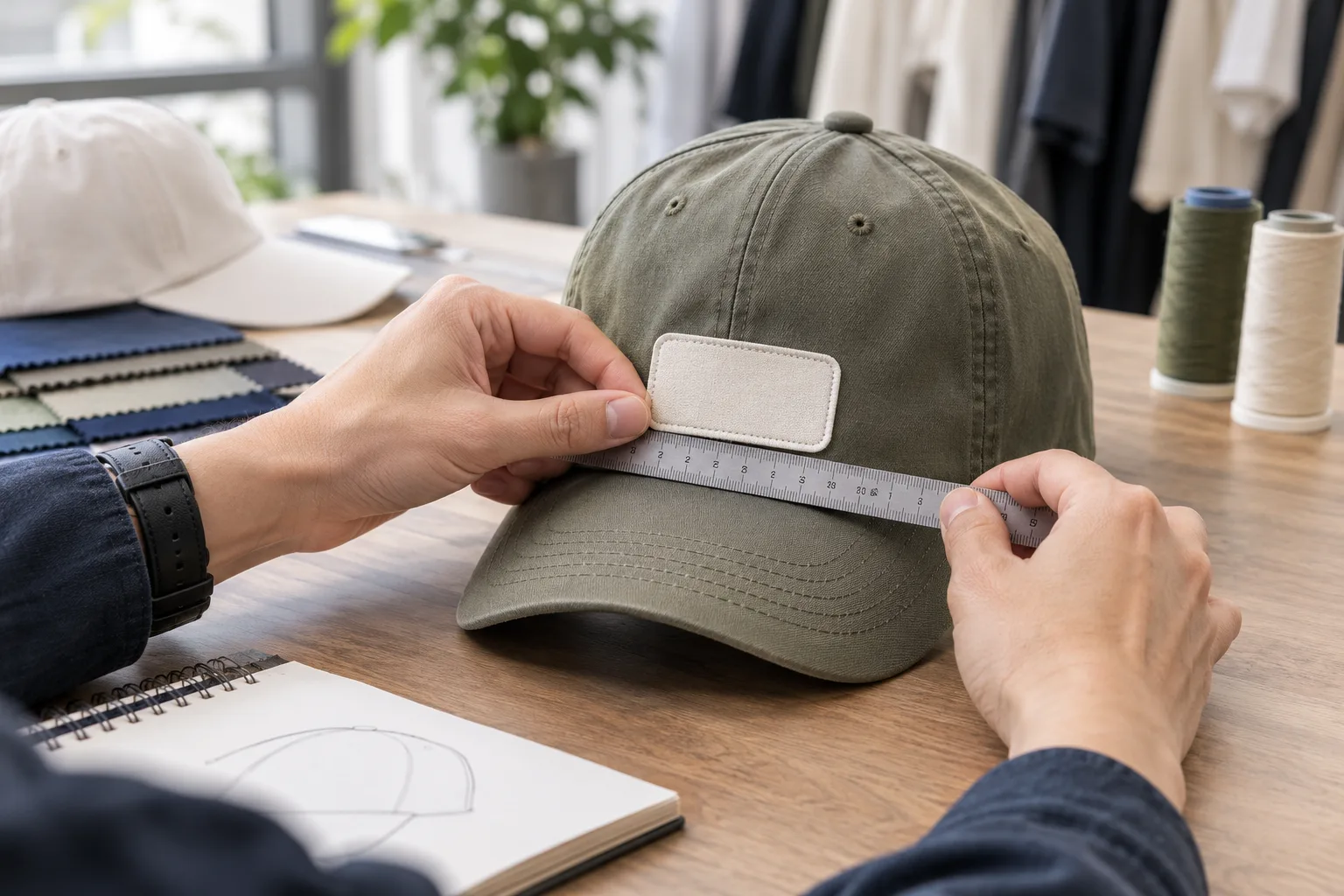
Define the branding location, artwork dimensions, colors, orientation and desired visual effect. Also identify whether the logo crosses seams, sits on a curved surface or must interact with ventilation, a closure or another component. These conditions can affect placement and appearance even when a supplier offers the named decoration process.
Ask candidates to explain how they would apply the artwork to the specified hat construction and what file or sample they need from you. Compare the result on the intended substrate rather than approving a process name in isolation. If a patch or other separate component is proposed, confirm its material, edge treatment, attachment method and approved position.
Request Evidence for the Chosen Customization Route
For a decorated base style, request the exact base reference, available variations, an undecorated physical sample where appropriate and a decoration sample that reflects the intended material and placement. Confirm whether decoration, labels and packaging are included in the same proposal or coordinated through another party.
For custom construction, request examples relevant to the required profile, panel structure, closure and branding method. Ask which operations are handled directly, which are subcontracted and who is responsible for checking outsourced work. Relevant evidence is more useful than a large portfolio of unrelated hats.
Treat effects on price, minimum quantity and timing as project-specific until each supplier reviews the same brief. A more customized route may introduce additional development or setup considerations, but only a written proposal can show which conditions apply to your combination of construction, materials, branding and quantity.
Evaluate Custom Hat Manufacturers
Once the product and customization route are defined, evaluate each candidate against the same evidence request. A broad statement such as “we make custom caps” does not establish that the supplier can control your particular crown structure, closure, material and decoration combination. Relevant physical samples, process details and written approval steps provide stronger evidence than a general portfolio.
Check Production Capabilities and Responsibility
Ask the supplier to map the proposed production route from material and component sourcing through construction, decoration, inspection and packing. For each stage, identify whether it is performed directly or subcontracted. Subcontracting is not automatically a problem, but responsibility must remain clear when an outsourced patch, buckle, embroidery operation or other component does not match the approved specification.
Request examples that share the important variables in your brief. A sample with a similar logo but a different crown construction proves little about shape control; a sample with the right silhouette but a different branding method does not prove decoration capability. If no single example matches the complete project, ask for separate evidence covering construction, fit, materials and branding, followed by a project-specific sample.
Also ask who approves materials and components, how revisions are recorded, what checks occur before bulk production and who authorizes corrective action. The goal is not to collect vague quality assurances. It is to understand how an approved requirement becomes a controlled production instruction.
Use Different Samples for Different Decisions
Assign every sample a defined purpose. A showroom or reference sample can demonstrate general workmanship. A prototype can test the proposed construction and silhouette. A fit or size sample can check measurements and wearer interaction. A decoration sample can resolve logo dimensions, colors, stitch or edge appearance and placement. A pre-production sample should represent the approved production-ready combination as closely as agreed.
Do not approve one stage based on evidence intended for another. For example, a prototype made with substitute material may help confirm panel arrangement, but it cannot establish the final surface appearance, hand feel or decoration result. If a material or component changes after approval, identify which affected characteristics must be sampled again rather than treating the substitute as automatically equivalent.
For every submitted sample, record its specification revision, materials, components, branding method and known deviations. Return one consolidated comment sheet with photographs and measurement references. This reduces the risk that separate messages create conflicting instructions.
Inspect Hat Samples Systematically
Review the sample against the approved brief rather than judging only its overall appearance. Begin with the crown: check profile, panel alignment, left-to-right symmetry, seam paths, internal structure and how the hat holds its intended shape. Then examine the visor or brim for shape, centering, curvature and consistent finishing.
Operate the closure repeatedly and examine its attachment, alignment and usable adjustment. Check the sweatband, internal seams and other contact areas for comfort during a short wear review. For fitted or multi-size designs, measure the agreed points using the agreed method; do not introduce an assumed tolerance after the sample arrives.
- Construction: crown shape, symmetry, panel matching, seams, visor alignment and internal finishing.
- Fit and function: agreed measurements, adjustment range, closure operation, comfort and stability when worn.
- Branding: artwork size, position, orientation, color, edge or stitch appearance and interaction with seams or curves.
- Components: closure, sweatband, labels, patches, trims and any approved hardware.
- Presentation: cleanliness, folding or shape protection, individual packaging and required pack identification.
Classify findings as approval requirements, requested improvements or observations. Keep the approved sample and comment record as references, while recognizing that one good sample does not by itself prove bulk consistency. The production agreement still needs defined inspection and acceptance rules.

Compare Quotes, Minimums and Lead Times
A commercially useful comparison requires more than placing unit prices side by side. Each proposal must refer to the same hat, quantity breakdown, approval route and delivery scope. Otherwise, a lower figure may simply exclude a component, use a different material or stop at a different point in the logistics chain.
Normalize Every Quote to One Specification
Issue the same dated specification revision to every shortlisted supplier and require the revision number on the response. Ask candidates to state any deviation, substitution or unresolved assumption separately. If one supplier proposes an alternative, retain both the original requirement and the alternative so that the commercial effect remains visible.
Separate the quoted product cost from sample charges, artwork or decoration setup, patterns, molds or other tooling, custom components, labels, packaging, inspection, freight and any other disclosed charges. Record currency, payment terms, trade terms, destination, quote validity and exclusions. Also confirm whether quoted prices apply to the requested quantity by style, color and size or adjustment format.
Do not combine 3 different acceptance questions into one tolerance. Record permitted order-quantity variance, measurement tolerances and defect acceptance rules separately. Receiving the correct total number of hats does not resolve shortages in a specific color, and a measurement within tolerance does not make an appearance defect acceptable.
Break Down Minimums by Their Actual Constraint
Ask what each minimum applies to: the complete order, one construction, each style, each color, a particular material, a dyed batch, a closure, a patch or another component. A supplier may accept the overall order quantity while a selected material or branded component remains infeasible at the requested variation breakdown.
Request a written explanation of which variations can be combined and which cannot. If the requested breakdown does not work, ask for alternatives such as using a stocked component, reducing the number of colors or sharing a common material across styles. Compare the design consequence as well as the commercial consequence; a feasible alternative is useful only if it still satisfies the fixed requirements in your brief.
Where excess material or components may result, clarify whether they are included in the quoted price, returned, stored, reused or disposed of. Do not treat unused inputs as automatically available for a future reorder unless ownership, identification and storage conditions are documented.
Build a Milestone-Based Schedule
Replace a single headline lead time with a sequence of dated dependencies. At minimum, distinguish specification confirmation, material and component readiness, sample production, buyer review, revision cycles, pre-production approval, bulk production, inspection, packing, transportation, customs where applicable and receiving buffer.
For each milestone, record the required input, responsible party and event that starts the next stage. Production time should not be interpreted as an arrival commitment when approval, freight or customs time is outside that estimate. Likewise, a requested delivery date is not yet a workable schedule if artwork or final materials remain unresolved.
Ask how changes affect the schedule. A revised logo position may require only a decoration review, while a new crown material or closure could affect sourcing, sampling and construction approval. Preserve contingency time around buyer decisions and logistics rather than assuming every stage will begin immediately after the previous one.
Choose a Manufacturer and Prepare Your Inquiry
The final choice should be traceable to the project’s priorities. Use the same scorecard and inquiry packet for every candidate, then document why a supplier was shortlisted or rejected. This makes the decision easier to defend when the lowest quote is not the best match.
Score the Shortlist With Weighted Criteria
Create criteria for requirement fit, relevance of production evidence, sample and approval process, communication quality, commercial terms, schedule assumptions and change control. Assign weights totaling 100% according to the project’s actual risks. For example, a distinctive custom silhouette may justify more weight on construction evidence, while a date-sensitive event program may place more weight on material readiness and milestone credibility.
Define what each score means before reviewing candidates. This limits the influence of a polished sales presentation or one attractive sample. Record both the score and the evidence behind it, including any condition that must be resolved before selection. A candidate with missing information should not receive the same confidence as one that has supplied relevant, inspectable evidence.
Use the weighted result to support judgment, not replace it. A supplier that fails a fixed requirement should not win merely by scoring well on lower-priority factors. Consider marking such requirements as pass-or-fail gates before applying the weighted comparison.
Assemble a Complete Inquiry Packet
Send every candidate one controlled packet containing the product brief, annotated reference images, artwork files, colors, construction and material requirements, measurement expectations, quantity by variation, labels, packaging, destination and requested arrival date. State which requirements are fixed, preferred or open to recommendation.
Include the required sample stages and ask the supplier to identify what each proposed sample will verify. Request a quote that separates included and excluded charges, identifies quantity constraints, states schedule dependencies and lists deviations from the specification. If an exact material or component is not available, require the proposed substitute to be identified rather than silently incorporated.
Use consistent file names and revision numbers across the brief, artwork, measurement sheet and comment records. A complete packet does not prevent all questions, but it makes those questions specific and allows competing responses to be compared without reconstructing what each supplier received.
Resolve Assumptions Before Selection
Convert every unresolved point into a written clarification question. Typical issues include whether the quoted base style is exact or approximate, whether decoration is performed by a subcontractor, which colors can share a minimum, what the pre-production sample will contain, when the schedule begins and what the stated delivery term includes.
Update the specification after accepting any change and ask the supplier to acknowledge the final revision. Keep the agreed quote, sample comments, deviations and milestone schedule together. Verbal assurances should not remain the only record of a decision that affects construction, appearance, quantity, cost or delivery.
When your packet and comparison sheet are complete, you can send them to shortlisted suppliers or request a manufacturing quote. The practical next step is to issue the same revision to each candidate and compare only the responses that clearly identify assumptions, exclusions and responsibility.
Frequently Asked Questions
Can I approve a custom hat sample made with substitute material?
Approve only the decisions that the substitute can reasonably demonstrate. It may be useful for reviewing panel arrangement, general shape or placement, but it cannot confirm the final material’s color, texture, hand feel, decoration appearance or behavior. Record the substitution and require another approval for every affected characteristic before bulk production.
Can quantities from different hat colors be combined to meet a supplier minimum?
Sometimes, but this must be confirmed for the specific project. A supplier may combine colors at the total-order level while a dyed material, closure, patch or other component has a separate minimum. Ask for the minimum by style, color, material and component, and request written confirmation of which variations may be combined.
Should I reject a manufacturer that subcontracts hat decoration?
Not solely because it subcontracts. Evaluate whether the supplier identifies the subcontracted operation, approves the decoration against your specification, inspects incoming work and takes responsibility for correction. The concern is loss of control or unclear accountability, not subcontracting itself. Request a project-specific decoration sample and documented approval route before selection.