


The safest way to plan an apparel manufacturing cost breakdown is to build a dated, assumption-led model rather than ask AI to invent a factory quote. Separate one-time setup costs from recurring unit costs, identify the physical inputs behind each line, and mark anything that still needs written confirmation.
For a hoodie, for example, the estimate may include fabric, rib, cord, eyelets, sewing, washing or finishing, decoration, labels, packaging, freight and import-related charges. A basic T-shirt may have fewer components, but its fabric consumption, size range, print coverage and packaging can still change the result. A useful reference for the product-specific drivers is this guide to hoodie manufacturing cost.
List Material and Process Inputs
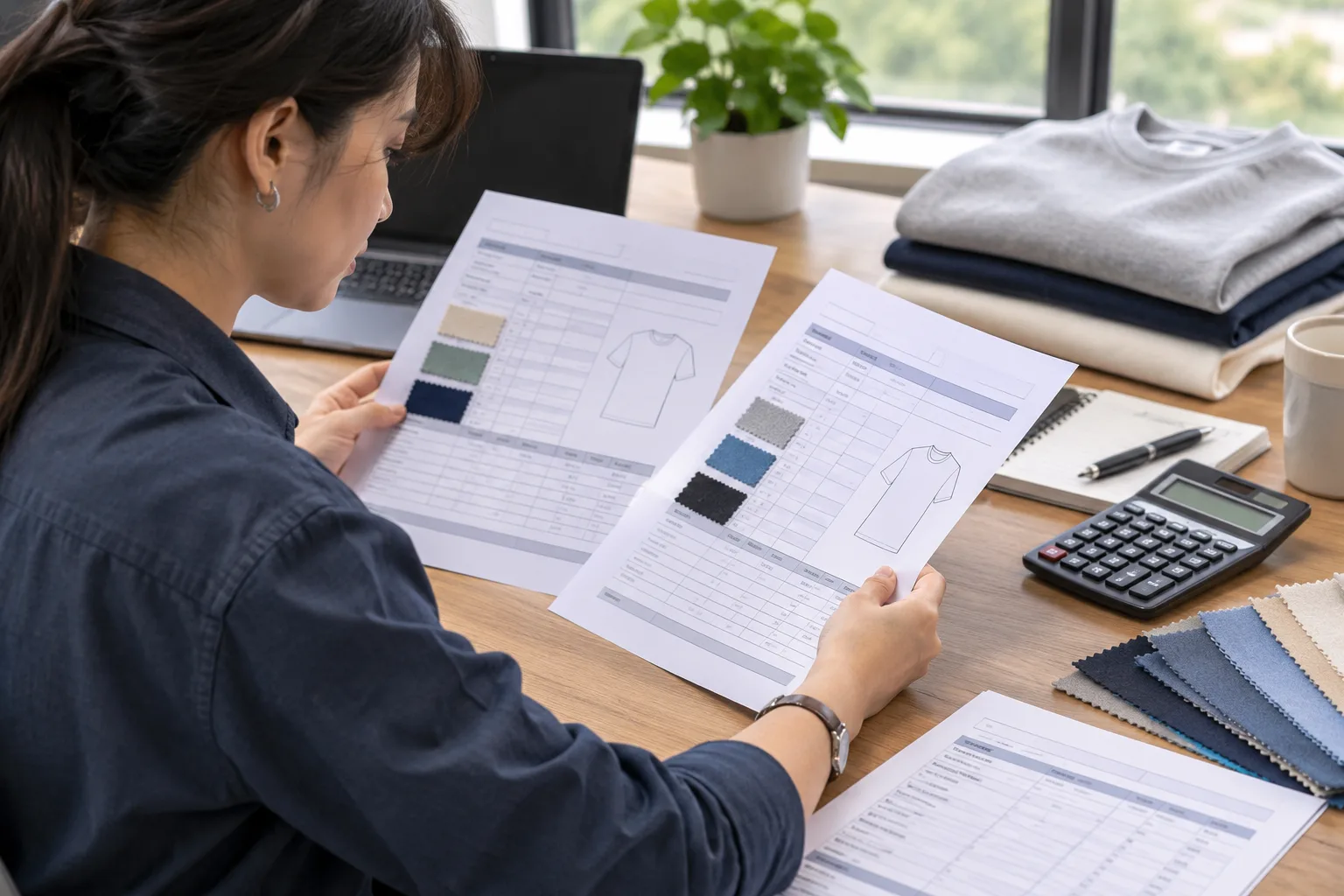
Start with the specification, not the price. Record the garment type, fabric composition, target weight, usable fabric width, size range, size ratio, colorways, artwork locations, decoration method and packing format. These inputs explain what the supplier must buy, cut, sew, decorate and pack.
Fabric consumption should be based on the actual pattern, usable width and planned size mix rather than garment weight alone. A heavier fabric does not automatically reveal how many meters are required: a wide fabric, large size ratio, directional print or matching requirement can change the cutting plan. Ask that net pattern consumption and purchasing allowance appear as separate lines, so a material reserve is not confused with the garment itself.
Next, divide the cost model into two groups:
| Cost group | Typical examples | Why it changes the decision |
|---|---|---|
| One-time or development | Pattern work, sampling, artwork setup, molds or special development | It can be significant for a small launch but spread across more units as quantity rises. |
| Recurring per-unit | Fabric, trims, labor, decoration, labels and packing | It normally scales with the order, although quantity breaks or process changes may alter the unit rate. |
Do not assume that every setup charge is automatically one-time. A new artwork location, colorway, size range or decoration process may require separate approval or development. Different logo sizes, positions and colors can also need separate samples even on the same base garment. Keep each version in the model instead of averaging unlike specifications together.
Include process inputs that buyers often leave vague. “Printed logo” is not enough: note the artwork dimensions, locations, number of colors, coverage and required finish. “Custom packaging” should identify the bag, carton, inserts, barcode or labeling requirements. If you are comparing a T-shirt program with a hoodie program, use equivalent specification fields; a T-shirt manufacturing comparison based only on garment weight will not be meaningful.
Mark Missing Prices
Every cost line should carry a status. Use “confirmed” only when the amount comes from a written, identifiable source that matches the current specification and has a date. Use “dated estimate” for a market or supplier reference that may have changed. Use “allowance” when a planning value is needed but the basis is limited. Use “missing” when no defensible amount is available.
This prevents an old quote from looking more precise than it is. A fabric price from a previous season may not match the current composition, width, dye lot, order quantity or delivery term. A historical sewing charge may also exclude decoration, packing, inspection, development or freight. Keep the date and scope beside the number rather than hiding them in a note.
Several missing inputs have an outsized effect on confidence:
- Material basis: composition, target weight, usable width, color treatment and whether the price is per kilogram, meter or finished garment.
- Consumption basis: approved pattern, size ratio, marker efficiency, shrinkage assumption and purchasing allowance.
- Decoration basis: artwork version, placement, dimensions, colors, stitch or print coverage and whether setup is charged separately.
- Commercial basis: quantity by color and size, delivery destination, packaging, currency, payment terms and quote validity.
- Specification control: the file version, sample status, measurements, tolerances and person responsible for approval.
AI can organize these fields, calculate subtotals and show how a changed assumption affects the result. It should not silently supply a factory’s fabric rate, labor rate, minimum order quantity or lead time. If the pattern or size mix is missing, the model should say that consumption is unresolved, not present a decimal that implies measurement.
For a practical control, keep three figures where possible: the known subtotal, the unresolved amount and the resulting planning range. Do not label the range as a manufacturer quote. Instead, use it to decide which questions must be answered first. A missing fabric price may matter more than a minor packaging allowance; an unknown decoration method may matter more than a small currency fluctuation.
Compare Scenarios
A cost model becomes useful when it shows how a decision changes both unit cost and the total cash requirement. Compare like with like: keep the garment measurements, size ratio, artwork coverage, delivery destination and currency consistent unless that is the variable being tested. Otherwise, a cheaper result may simply reflect a smaller specification or omitted service.
| Scenario variable | What to hold constant | What to compare | When it matters most |
|---|---|---|---|
| Order quantity | Garment, materials, decoration and packing | Setup cost per unit, recurring unit cost and total order value | When development charges or quantity breaks may be spread across more units |
| Fabric choice | Pattern, size mix, usable width and finish | Material price, consumption, treatment and resulting garment cost | When a lower price per kilogram may require more consumption or a different finish |
| Decoration method | Artwork size, placement, colors and coverage | Setup, application, rejection risk and per-unit charge | When print, embroidery or other methods are not equivalent in coverage or appearance |
| Packaging | Garment count, destination and labeling requirements | Bag, carton, inserts, handling and logistics charges | When retail presentation or individual labeling is required |
Show the arithmetic in separate columns: one-time costs, recurring cost per unit, quantity, and total project cost. A simple planning formula is total project cost = one-time costs + (recurring unit cost × quantity) + shipment and other order-level charges. The unit planning figure should then be labelled clearly, because dividing every project cost by units can make a small order look more expensive even when the underlying recurring production rate has not changed.
Hypothetical example: if Scenario A has a one-time setup cost of $300, a recurring cost of $12 per garment and a quantity of 100, its project cost before separate freight is $1,500. If the same specification is ordered at 500 units, the project cost is $6,300 before freight, while the setup allocation falls from $3 per garment to $0.60 per garment. These figures illustrate the calculation only; they are not a factory price or market quotation.
Use sensitivity checks to find the assumptions that deserve confirmation first. Change one input at a time, such as fabric price, consumption, quantity, decoration rate or freight allowance, and record the effect on the total. A small percentage change in a high-value fabric input may matter more than a large percentage change in a minor trim. Conversely, an uncertain setup charge can dominate a small launch because it is not multiplied by quantity.
For each scenario, record the specification version and confidence status of the changing input. If two options use different fabric widths or decoration coverage, ask the manufacturer to confirm both the physical basis and the commercial basis. This turns the model into a focused list of questions instead of a false ranking based on incomplete figures.
Obtain Written Quotes
Once the scenarios identify the important unknowns, convert the model into a concise request for quotation. Send one controlled specification package rather than a collection of conflicting messages. Include the garment description, measurements and tolerances, fabric composition and target weight, size and color quantities, artwork files and locations, labels, packaging, delivery destination and required currency.
Give the request a version number and date. List each requested quantity separately if you are comparing order sizes, and identify which assumptions are fixed and which alternatives you want priced. For example, ask for the same hoodie specification with 2 decoration methods, not for a vague “best logo price.” This helps the supplier explain whether the difference comes from setup, application, coverage or approval requirements.
Ask the manufacturer to state what the quoted amount includes and excludes. The written response should address, as applicable:
- Material, trims, sewing, decoration, labels and packaging;
- Pattern, development, sample and revision charges;
- Minimum quantities by style, color and size;
- Sample requirements, approval points and the sample version used;
- Inspection, rework or other quality-related services, if offered;
- Freight, duties, taxes, delivery terms and destination assumptions;
- Currency, payment schedule, quote validity date and any quantity breaks;
- Estimated production and shipping timing, stated as an estimate rather than a guarantee.
Do not compare a delivered quote with an ex-factory quote as though they were equivalent. Also check whether the quoted fabric is based on the same width, composition, finish and color standard used in your model. If a manufacturer proposes a substitution, record it as a new scenario and request approval before treating its price as comparable.
Keep a change log after the quote arrives. Record the date, supplier, specification version, changed line, old amount, new amount and reason. A revised artwork location or size mix can affect sampling, decoration and consumption, even when the base garment appears unchanged. For multiple logo versions, maintain a version matrix showing the artwork, placement, color, quantity and approval owner.
Before bulk material purchasing, confirm the approved specification and quote in writing. Ninghow’s described order process includes sample approval and order confirmation before bulk material purchasing; buyers should still ensure that their own approved version, inclusions and commercial terms are stated in the final record. When the package is ready, use the request a manufacturing quote route and submit the controlled specification rather than relying on a headline target price.
Your practical next step is to export the model’s missing-input list and attach it to the RFQ. Ask the manufacturer to answer each open line, date the response and identify any substitution before you approve the quote.
Frequently Asked Questions
Can AI estimate a reliable unit cost?
AI can calculate a planning unit cost when the inputs, units, dates and assumptions are supplied clearly. It can organize a bill of materials, separate setup charges and run scenarios. It cannot know a manufacturer’s current fabric, labor, minimum-order or freight terms without a source. Treat the result as a decision model until a written quote matches the controlled specification.
Which costs are one-time?
Pattern development, initial sampling, artwork setup and special development are often treated as one-time costs, but the treatment depends on the specification. A new colorway, decoration location, artwork version or size range may require additional approval or setup. Ask the manufacturer to identify each charge separately and confirm whether it applies once per style, color, artwork version or order.
How should I compare 2 manufacturer quotes with different inclusions?
Normalize both quotes before comparing them. Place materials, decoration, packaging, sampling, freight, duties, taxes, payment terms and delivery assumptions in separate lines, then mark each as included, excluded or unclear. If one supplier uses a different fabric width, artwork coverage or delivery term, create a separate scenario rather than calling the lower headline price cheaper.