
For buyers comparing polo shirts manufacturers, the choice between yarn-dyed and printed stripes starts with the design—not a presumed price advantage. Compare both routes using the same repeat, fabric requirements, quantity, and seam-matching priorities. Then approve physical color, surface feel, and a representative garment before bulk material release. Neither route automatically delivers lower cost, better durability, or easier alignment.
Yarn-Dyed or Printed Stripes? Choose the Route From the Design and Approval Priorities
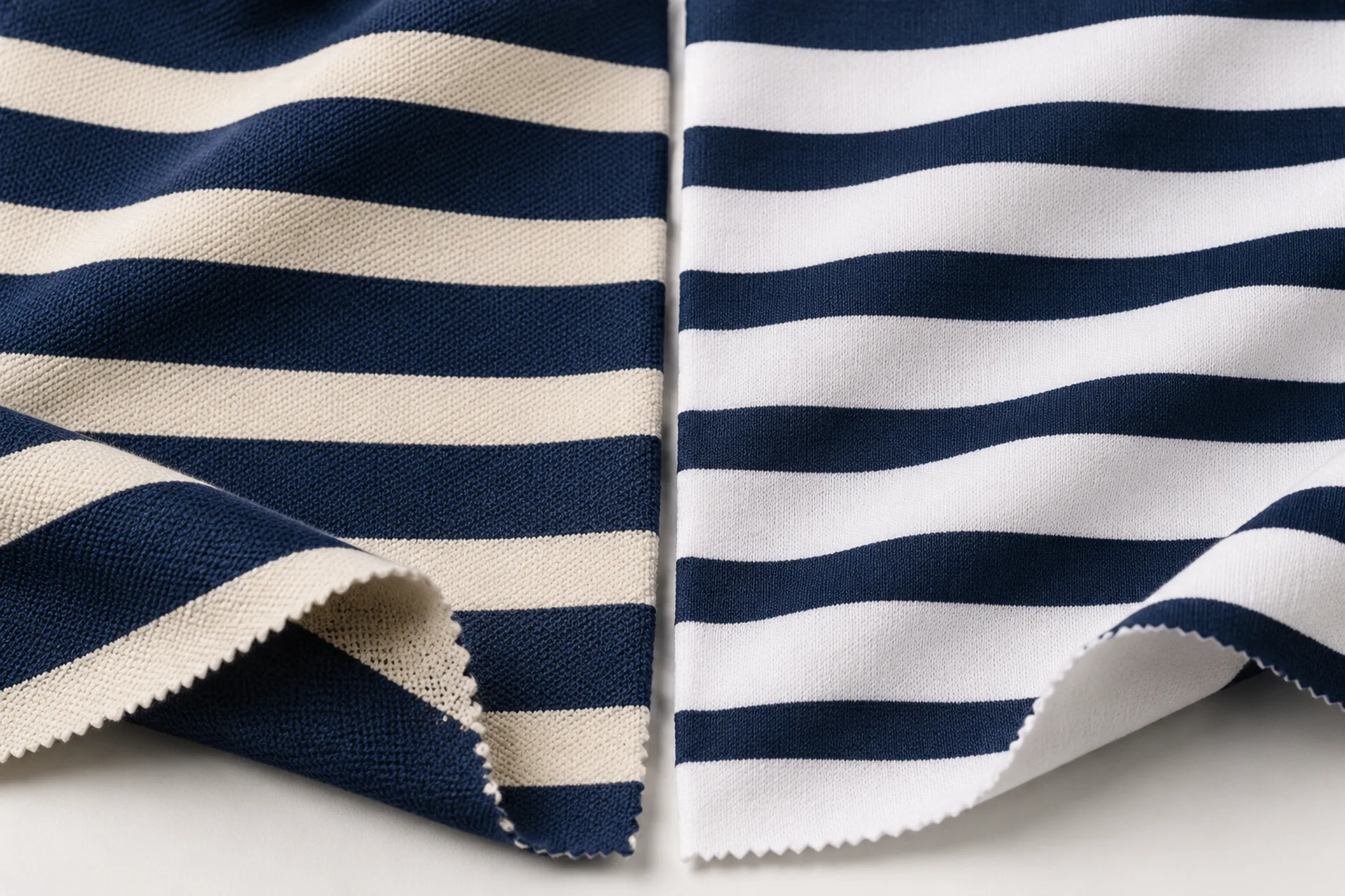
Striped polos are not always yarn-dyed. Yarn-dyed polo stripes use colored yarns arranged within the knitted structure; printed stripe polos apply the stripe artwork to a prepared fabric surface.
Consider yarn-dyed development when an integrated knitted appearance and a planned repeat are priorities. Compare printing when artwork flexibility or a particular surface effect matters. In either case, confirm feasibility against the actual construction, color requirements, hand feel, order quantity, and cutting plan.
Ninghow describes OEM production from buyer specifications and ODM development assistance. A project discussion should establish which route is feasible rather than assume either is available for every design.
1. Hypothetical example: regular golf polo stripes
Situation: A golf brand wants high-contrast horizontal stripes with strict side-seam alignment. Available evidence: Repeat artwork and marked matching zones. Evidence gap: No knitted swatch or pattern-placement review. Outcome—Clarify: Prioritize a yarn-dyed feasibility review, but do not release bulk material until repeat construction and garment alignment are demonstrated.
2. Hypothetical example: changing stripe layouts
Situation: A startup is testing irregular layouts across several small color stories. Available evidence: Editable artwork and provisional quantities. Evidence gap: No print trial, confirmed base fabric, or route-specific quantity requirements. Outcome—Clarify: Compare printed development first for artwork flexibility; proceed only after supplier confirmation and physical sample review.
Convert Stripe Artwork Into a Repeat Specification Before Comparing Quotes
A stripe repeat is the complete sequence before the design starts again. Specify each band’s width, color order, direction, and total repeat height. Define horizontal repetition too, or state that the stripes run continuously across the width. Mark the intended stripe position at a fixed garment reference point.
Use identical design assumptions when comparing routes:
| Decision input | Yarn-dyed review | Printed review |
|---|---|---|
| Design and repeat | Confirm knitted sequence feasibility | Confirm artwork scale and placement |
| Surface and color | Review actual knitted swatch | Review strike-off on proposed fabric |
| Matching and cutting | Use the same matching map, patterns, and usable-width assumptions | |
| Quantity | State total units and breakdown by colorway and size; request route-specific requirements | |
Copyable stripe specification brief
- Artwork: File version, stripe widths, sequence, total repeat, direction, and placement reference.
- Fabric: Construction, composition, target GSM, hand feel, stretch expectations, and proposed usable width.
- Matching: Required continuity at body joins, sleeves, placket, pocket, and collar; permitted variation.
- Color: References and required lab dips, knitted swatches, or printed strike-offs; a color code is not physical approval.
- Order and review: Quantities, size mix, intended care, approval owner, and sample requirements.
Ninghow’s sampling guide requests garment specifications, measurements, tolerances, and decoration details. Include these alongside the repeat drawing. For a reference polo, distinguish features to retain from those to change—especially fit, construction, stripe appearance, and feel.
Compare Color, Surface Feel, Stretch, and Wash-Review Requirements Without Making Blanket Claims
Compare physical samples made in the proposed constructions, not just artwork or fabric names. Inspect the face, reverse, stripe transitions, and cut edges to understand how each route produces the intended appearance. Neither method alone establishes softness, stretch recovery, opacity, or wash durability.
Check stripe sharpness and contrast both relaxed and stretched as expected in wear. Feel across stripe boundaries and compare the body fabric with the collar and placket. A satisfactory flat swatch may still need garment-level review to assess how these components work together.
X-Rite’s explanation of metamerism and lighting-dependent color matching describes how colors can match under one light but differ under another. A shared color identifier therefore does not establish a physical match.
Use a consistent sample-review routine
- Compare actual knitted or printed samples under agreed lighting, alongside the intended collar and trims.
- Record observations on feel, opacity, stripe appearance, movement, and recovery.
- Review washing under the proposed care conditions for changes in dimensions, color, surface, and component compatibility.
- Retain an identified physical approval reference and document any unresolved differences.
A wearer review can supplement these checks with fit and movement feedback. Treat findings as evidence about that sample and review conditions—not proof of a universal advantage for either stripe route or a performance certification.
Set Stripe-Matching Expectations at Side Seams, Sleeves, Plackets, and Collars
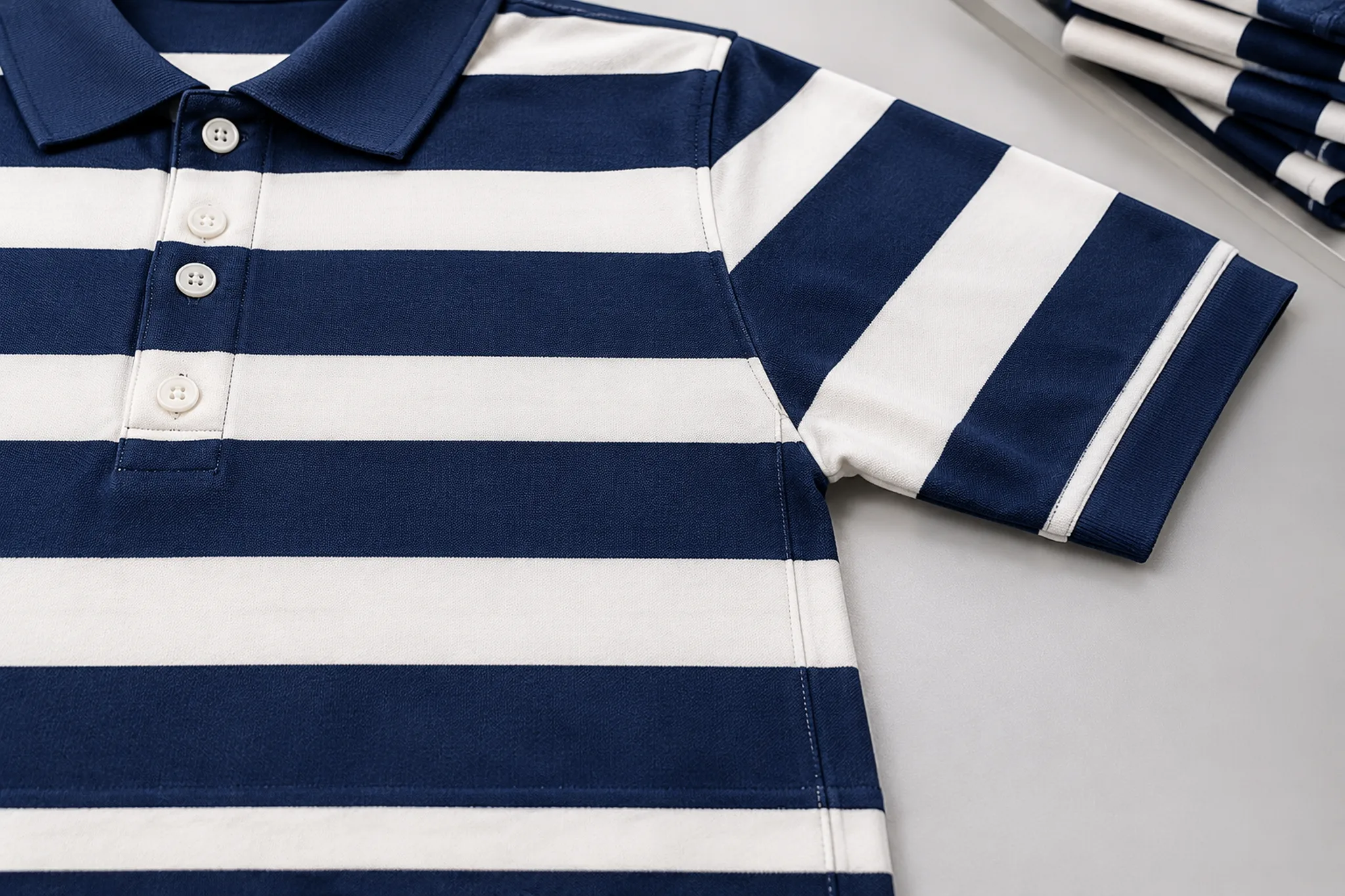
Stripe matching should follow the garment’s visual priorities. Start with continuity between front and back body panels at the side seams, then assess sleeve joins, pocket edges, and the relationship between body stripes, placket, and collar. Not every component needs to continue the body repeat.
Mark each zone in the technical drawing using must match, preferred, or no requirement. Identify the stripe or reference line to align, rather than writing only “match all stripes.” Agree any acceptance tolerance through the production specification; do not leave it to visual interpretation after sewing.
Curved armholes, sleeve shaping, and separately constructed collars can make full continuity different from matching straight body seams. Decide where controlled variation is acceptable and confirm it on the representative polo, including relevant size-dependent differences.
Stripe matching in garment production depends on repeat dimensions, pattern placement, usable fabric width, shrinkage assumptions, marker planning, and sewing alignment—not simply whether the stripe is knitted or printed. Requiring panels to start at specific repeat positions can constrain the cutting layout and increase fabric consumption. The effect needs a pattern-based estimate, not a standard waste percentage.
Before approving the matching plan, require the sample review to identify which reference lines align, where variation remains, and whether the result meets the marked priorities. Changes to repeat size, fabric, or pattern placement should trigger review of the affected matching assumptions.
Understand How Repeat, Matching, Quantity, and Cutting Yield Affect the Cost Discussion
That pattern-based estimate should sit at the center of the cost comparison. A useful quote separates material development, fabric production or printing setup, cutting complexity, stripe matching, sampling, and garment construction where applicable. Combining these items into one garment price makes it difficult to see which assumption is driving the result.
Ask for the estimate basis in writing. It should identify the paper pattern, usable fabric width, size ratio, stripe repeat, shrinkage assumption, and the basis for purchasing loss or reserve. Keep estimated net garment consumption separate from any additional material allowance. Garment weight alone is not a reliable substitute for a pattern-based estimate.
Compare yarn-dyed and printed routes with the same artwork, fabric specification, color count, size range, quantity, and matching priorities. Quantity may affect which route is practical, but do not assume a fixed minimum, setup charge, or price threshold without project-specific confirmation. A route that appears less expensive before matching or sampling may not remain so after the full production assumptions are included.
| Cost input | What the buyer should compare |
|---|---|
| Design and color | Repeat dimensions, color references, number of colors, and approved physical references |
| Material route | Yarn-dyed knitted development or printed fabric development, including route-specific setup assumptions |
| Cutting and matching | Must-match zones, marker constraints, usable width, size ratio, and estimated consumption |
| Approval | Swatches, strike-offs, garment samples, comments, and any required rework |
| Order context | Quantity by color and size, construction, decoration, packaging, and destination |
For a dyeing-led development route, the buyer may also review custom fabric dyeing as part of the material discussion, subject to the specific fabric and project requirements.
Approve Swatches, Strike-Offs, and a Representative Polo Before Bulk Material Release
Once the cost assumptions are visible, approve the route through physical evidence rather than artwork alone. Start with the approved stripe artwork and repeat specification, then review the proposed material route and color references. A yarn-dyed development should be checked through a knitted stripe swatch; a printed route should be checked through a printed strike-off. Keep the base fabric, trim, and decoration in view because the stripe does not appear in isolation on the finished polo.
Next, review a representative garment sample. Check stripe placement, side-seam alignment, sleeve relationships, placket transitions, collar appearance, fit, hand feel, and construction. Compare colors under the lighting conditions relevant to the approval process. A color identifier or match under one light does not by itself establish a physical fabric match; lighting and material can change the perceived result.
Record the approved version, physical reference, comments, matching priorities, measurement tolerances, and named buyer approver. If the buyer later changes the color, repeat size, fabric, trim, pattern, or matching expectation, use written change control. A substitute material should be re-evaluated against the affected appearance, fit, process, and performance requirements rather than treated as automatically equivalent.
- Approve the artwork, repeat, color references, and placement map.
- Approve the route-specific swatch or strike-off.
- Approve the representative polo, including prioritized matching zones.
- Record accepted variation, open issues, and the responsible approver.
- Confirm the approved version before bulk material purchasing.
Sample approval confirms the reviewed specification and appearance; it does not prove an untested performance or compliance result. Keep material readiness and approval milestones visible in the production plan because changes or late approvals can affect project scheduling.
Send a Manufacturer-Ready Stripe Brief for a Feasibility Review
A manufacturer-ready stripe brief should make the design measurable before a feasibility review begins. Include the polo silhouette, intended use, target fabric composition or fabric specification, construction requirements, size range, quantity by color and size, and delivery destination or planning context.
Attach the stripe artwork with the complete repeat dimensions, color references, stripe direction, placement map, and matching priorities. Mark each zone as must match, preferred, or no requirement. State whether you want yarn-dyed, printed, or an objective comparison, and identify the priority order among cost, surface feel, color precision, flexibility, and matching.
List decoration, labels, packaging, wash-care expectations, and any supplied reference sample separately from the stripe-fabric decision. A reference sample should identify what must be retained, what may change, measured dimensions, and any authorized design use. The brief should also ask for the feasible route, required samples, estimated consumption basis, approval milestones, and the assumptions behind the quotation.
Stripe brief checklist
- Polo sketch or tech pack with measurements, tolerances, construction, and decoration details
- Repeat artwork with dimensions, color references, direction, and placement map
- Quantity by color and size, size range, destination, and planning context
- Fabric target, hand-feel requirements, wash-care expectations, and supplied reference sample details
- Matching matrix covering side seams, sleeves, placket, collar, and other visible zones
- Preferred route or request for a yarn-dyed versus printed comparison
- Required physical approvals: knitted swatch, printed strike-off, garment sample, or all applicable items
Keep buyer-owned design decisions separate from manufacturer development input. This gives both sides a clear basis for reviewing materials, patterns, approvals, and any later change. The more precisely the repeat, quantity, matching priorities, and hand feel are stated, the more meaningful the feasibility and quotation review can be.
For a project review, send the repeat artwork, color references, desired stripe placement and matching priorities, quantity by color and size, target hand feel, fabric or composition requirements, and any reference polo or tech pack. Qualified buyers can request a quote with these inputs so the route and assumptions can be reviewed for the specific project.
Frequently Asked Questions
Are striped polos always yarn-dyed?
No. Striped polos can use yarn-dyed knitted fabric or printed fabric, depending on the repeat, color requirements, surface expectations, matching priorities, quantity, and approval plan. The route should be selected from the actual design and confirmed through physical swatches or strike-offs plus a representative garment sample.
Which seams should be stripe-matched on a custom polo?
Prioritize visible side seams, sleeve seams, placket transitions, and collar edges according to the garment design. Mark each area as must match, preferred, or no requirement. Perfect alignment everywhere may constrain cutting and sewing, so the priority map should be approved with the garment sample.
Does stripe matching affect fabric consumption?
It can. Requiring panels to start at specific positions in the stripe repeat may constrain marker planning and fabric width usage. The effect depends on the paper pattern, usable width, size ratio, repeat, shrinkage assumptions, and matching zones. Request net consumption separately from purchasing loss or reserve.
What should be approved before ordering custom stripe fabric?
Approve the artwork, repeat dimensions, color references, route-specific knitted swatch or printed strike-off, and a representative polo. Check placement, matching, fit, hand feel, construction, trim relationships, and lighting conditions. Record the approved version, comments, tolerances, accepted variation, and buyer approver before bulk material purchasing.
Is yarn-dyed or printed better for a custom striped polo?
Neither route is universally better. Yarn-dyed and printed stripes can differ in color control, surface feel, repeat flexibility, matching behavior, sampling needs, and cost assumptions. Compare both using the same artwork, fabric target, quantity, size range, and matching priorities, then decide from physical evidence and project-specific estimates.
What information should a buyer send for a yarn-dyed versus printed stripe comparison?
Send the polo silhouette or tech pack, repeat artwork, dimensions, color references, placement map, matching priorities, fabric target, hand-feel requirements, quantity by color and size, size range, destination, decoration, and reference samples. State whether you prefer yarn-dyed, printed, or an objective comparison and identify the required approval samples.