



A polo with a home-wash care label is not automatically suitable for an industrial laundry program. Buyers need to define the actual washing, drying, finishing, handling, and repetition conditions, then evaluate the complete decorated garment against those conditions. This guide uses the scope of polo shirts manufacturers as a starting point, but approval should depend on project-specific evidence rather than a standard product description.
Do Not Approve a Home-Wash Polo for Industrial Laundry Without a Garment Trial
For commercial laundry uniform polos, the first decision is whether the finished garment has been evaluated in the buyer’s real operating conditions. A home-wash label describes domestic care instructions. It does not establish compatibility with a laundry provider’s process, drying method, finishing, chemical exposure, handling system, or expected repetition.
Define the laundry program before choosing a fabric or approving a sample. Request the laundry provider’s written process details, including applicable settings, drying and finishing steps, handling method, and intended repetition. Then test the polo as a complete garment, including collar, placket, buttons, thread, labels, and decoration.
| Risk area | What may change | Evidence to request |
|---|---|---|
| Process exposure | Dimensions, shade, surface appearance, and component condition | Process version and complete-garment trial record |
| Heat and drying | Fit, collar shape, placket flatness, and fabric appearance | Pre- and post-process measurements and photographs |
| Handling and finishing | Creasing, distortion, seam appearance, and presentation | Inspection notes after the actual handling route |
| Decoration | Logo security, legibility, distortion, and surrounding fabric appearance | Decorated sample evaluated after processing |
ISO 15797 provides simulated industrial-laundering test procedures for workwear. It does not create one universal pass limit for every polo, laundry program, color, decoration method, or buyer. Treat it as part of a defined evidence plan, not as an automatic qualification label. Without a report or trial record matched to the actual garment and conditions, do not describe the polo as industrial-laundry qualified.
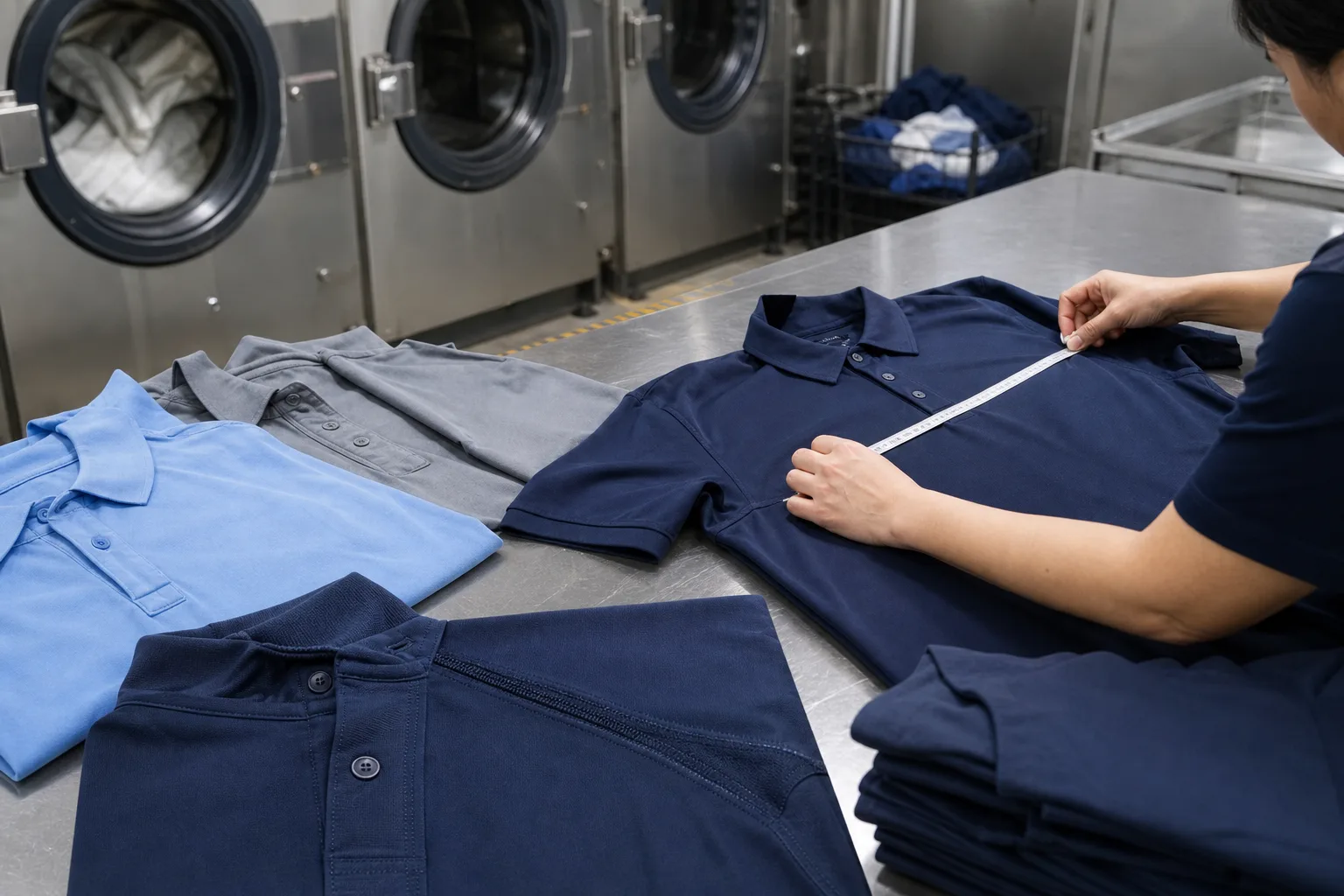
Write the Laundry Program Into the Polo Specification Before Sampling
Turn the laundry provider’s process into a version-controlled specification before sampling. The brief should connect the garment to its use: who wears it, what work they perform, how it is collected and returned, what appearance is required, and what evidence will decide approval.
Pre-sampling specification checklist
- Record the laundry provider, process version, washing method, chemicals or process inputs supplied by the provider, drying, finishing, handling, and intended repetition.
- State whether the garment is rented, centrally laundered, returned to wearers, or managed through another defined system.
- Describe the wearer role, movement, work environment, stain exposure, replacement expectations, and presentation requirements.
- List colorways, size range, decoration locations, artwork versions, label details, and packaging or sorting requirements.
- Define measurement points, tolerances, inspection timing, approval owner, and document version.
Separate mandatory requirements from preferences. A preferred hand feel or appearance should not override a required dimensional or decoration check. A reference sample can help communicate shape and construction, but retained details and requested changes should be converted into measurable specifications. Ninghow’s sampling guidance also identifies garment specifications, measurements, tolerances, and decoration details as useful development inputs. Buyers can use the custom clothing manufacturing requirements guide to organize those inputs before requesting samples.
| Specification field | Buyer entry |
|---|---|
| Garment identity | Style, color, size range, and revision |
| Laundry program | Provider document, process version, drying, finishing, and repetition |
| Use case | Role, movement, environment, and appearance requirement |
| Inspection plan | Measurement points, tolerances, photographs, and approval owner |
Do not infer missing settings from a generic care label. Confirm numerical tolerances, inspection frequency, and acceptance criteria with the responsible buyer, laundry provider, laboratory, or applicable standard.
Select Fabric, Collar, Placket, Buttons, and Thread as One Laundry System
Specify the polo as a system. Fabric selection alone cannot establish how the finished garment will respond to repeated commercial laundering. Review dimensional change, shade, surface appearance, comfort, and fit together with the collar, placket, buttons, thread, seams, and other trims.
| Component | Decision to make | Evidence to review | Approval owner |
|---|---|---|---|
| Fabric | Construction, color, surface, and fit requirements | Finished-garment measurements and appearance | Product and quality teams |
| Collar and placket | Structure, reinforcement, shape, and flatness | Photos and post-process inspection | Design or uniform owner |
| Buttons, thread, and seams | Attachment and construction details | Component condition after processing | Technical and quality teams |
| Size set | Measurement points, grading, and tolerances | Pre- and post-process measurement chart | Fit owner |
Set the post-laundry fit standard before approving the size set. A fabric report may support a material decision, but it does not replace measurements and appearance checks on the completed polo. Final fabric composition, GSM, construction, and tolerances should remain project-dependent until the defined process and sample evidence are reviewed.
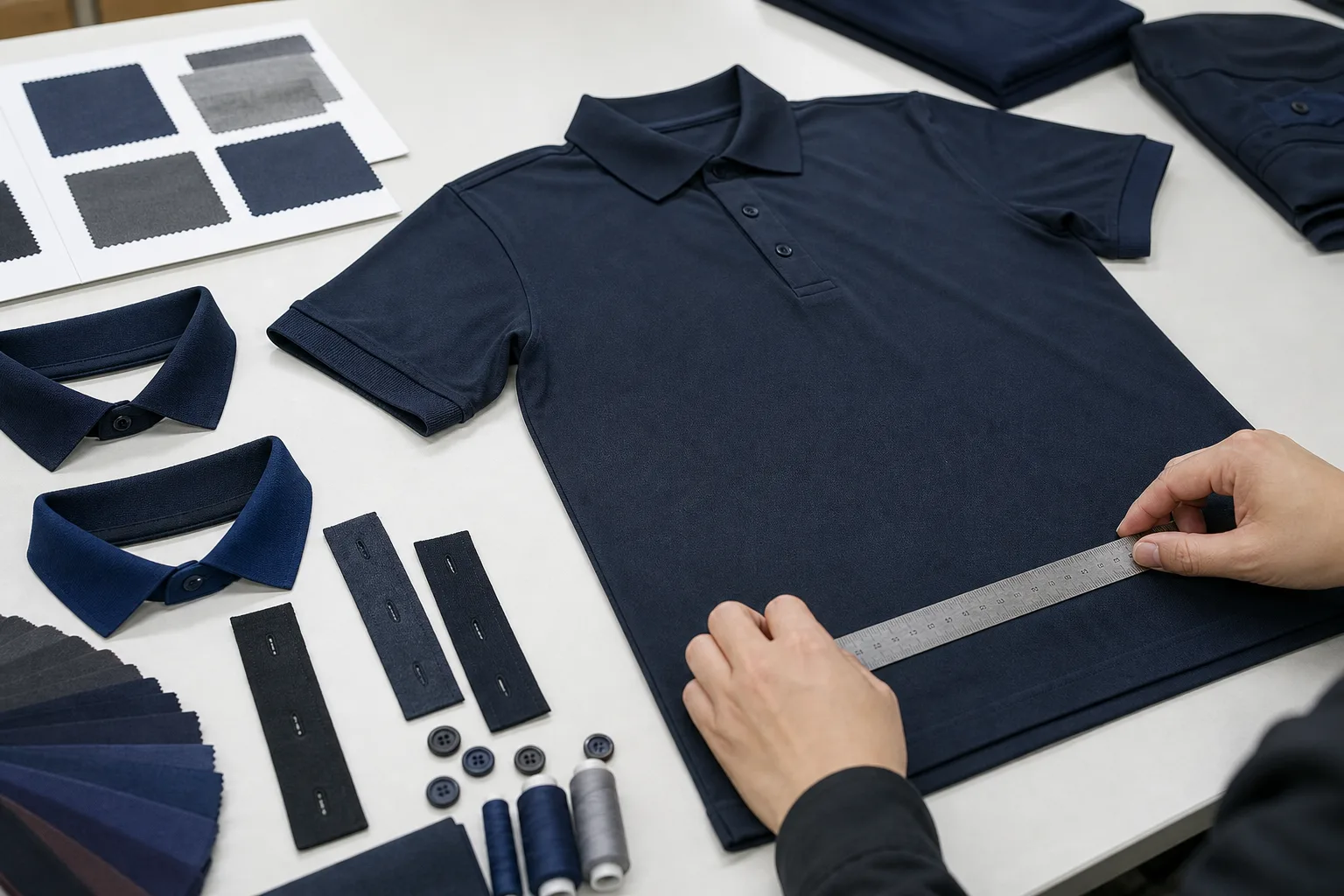
Test Logos, Labels, and Packaging Details on the Finished Polo
Test the actual logo and identification details with the finished polo. Decoration can change the garment’s appearance and behavior, so a fabric-only test or separate decoration sample is not enough for approval.
Record the decoration method, stitch or ink coverage, placement, size, colors, backing where relevant, garment color, and artwork version. Check security, legibility, flatness, distortion, and the appearance of the surrounding fabric after the defined laundry process. Review embroidery, transfers, prints, woven labels, care labels, heat applications, and other trims when they are part of the finished specification.
Logo version matrix
| Version | Artwork and size | Placement and garment color | Sample and approver |
|---|---|---|---|
| 1 | Department or location artwork | Measured position and colorway | Required sample; named approver |
| 2 | Alternate artwork or coverage | Measured position and colorway | Separate review if changed |
Do not treat one logo version as evidence for every artwork size, placement, coverage level, or color combination. Retain the approved artwork files, placement measurements, color references, label details, and post-process observations. Packaging should also be specified when it affects traceability, sorting, care information, or distribution.
Agree the Test Protocol and Inspection Record Before Ordering Samples
With the decoration and packaging details recorded, define how the complete decorated garment will be evaluated before ordering development samples. A useful plan names the laundry process version, the test operator or facility, the polo and logo versions included, and the measurements and observations required before and after processing.
Build the evidence plan
Confirm the relevant ISO 15797 workwear method and conditions before testing. ISO 15797 provides simulated industrial-laundering procedures for workwear, but it is not an automatic certification for a polo and does not establish one universal pass limit for every buyer, laundry, garment, or decoration method. The applicable method, process conditions, inspection points, and acceptance criteria still need project-level agreement.
Keep the evidence categories separate. A laboratory report can document a defined method and sample. A controlled commercial laundry trial shows how the finished item behaves in the buyer’s operating process. A wearer trial addresses movement, fit, comfort, and practical acceptance. One type of evidence should not be presented as proof of the others.
Use a complete-garment inspection record
Inspect the polo before processing and after the agreed number of cycles or handling stages. Record the sample identity, size, color, fabric or material reference, decoration version, laundry-process version, date, operator, and any deviations from the planned procedure. Photograph the same views before and after where visual comparison matters.
- Dimensions: record the agreed measurement points, tolerances, and dimensional change for body, chest, length, shoulder, sleeve, and key collar or placket points.
- Construction: check collar shape, placket flatness, seams, hems, buttons, buttonholes, labels, and loose or distorted components.
- Appearance: inspect color, shade change, surface condition, pilling or fuzzing where relevant, press marks, distortion, and overall presentation.
- Decoration: check adhesion or stitch security, edge condition, legibility, placement, cracking, lifting, puckering, and the surrounding fabric.
- Decision: state whether the sample is approved, requires clarification or correction, or is paused pending additional evidence.
Use an evidence matrix with columns for requirement, method, sample identity, result, decision, corrective action, responsible approver, and approval date. This makes a report traceable to the actual garment rather than to a similar fabric, undecorated component, or earlier artwork version. A Custom Clothing Manufacturing Project Planning Guide can also help organize development inputs and approvals.
Run a Wearer and Commercial Laundry Trial Before Bulk Approval
Once the controlled inspection plan is agreed, connect it to actual uniform use. A commercial laundry uniform polo may look acceptable on a table yet reveal fit, movement, sorting, or finishing problems when worn during a full shift and processed through the buyer’s normal route.
Select representative trial units
Do not test only the easiest size or one convenient sample. Include representative sizes, colors, logo versions, and wearer roles. Select roles according to the work involved, such as front-of-house movement, repeated reaching, equipment handling, or service tasks. Keep each unit linked to its sample version, size, color, artwork, and laundry-process version.
Use a consistent wearer questionnaire and post-process inspection form. Ask wearers to assess reach, bending, arm movement, collar behavior, sleeve and hem position, comfort, appearance, and whether the size chart reflects the intended fit. Record observations separately from personal preference. A disliked color is different from a collar that loses its intended shape, and a preferred looser fit is different from a measurement outside the approved tolerance.
Document the operating trial
The record should identify the laundry provider or internal process, process version, garments submitted, cycle information where available, drying and finishing route, sorting or repair steps, and inspection dates. Add before-and-after photographs and note any missing, mixed, damaged, or incorrectly processed units. If the process changes during the trial, open a new version rather than combining results.
Log issues by category: dimensional change, shade or surface appearance, collar and placket behavior, seam or trim condition, decoration, labeling, packaging, wearer fit, or handling. For each issue, record the proposed corrective action, revised sample or measurement, responsible reviewer, and status. This gives the buyer a clear route from observation to specification change instead of relying on an informal sample comment.
Use the wearer trial to supplement, not replace, defined testing and inspection. It can reveal practical-use issues that a single material metric does not capture, but it is not a standardized performance certification or representative human study. Bulk approval should wait until the laundry evidence, garment inspection, wearer feedback, and corrective actions point to the same approved version.
Release a Controlled Bulk Specification and Reorder File
After the trial closes, release one controlled bulk specification and retain the evidence that supports it. The approved sample should be identifiable and tied to the final garment measurements, tolerances, materials, construction, laundry program, decoration, and inspection decisions.
Lock the handover file
Include the fabric and color references; collar, placket, buttons, thread, seams, and hems; measurement chart and tolerances; decoration files and placement measurements; labels; packaging and sorting instructions; laundry-process version; inspection points; test records; photographs; and approval dates. Assign versions to the tech pack, artwork, sample, test protocol, and laundry program. Ninghow’s public sampling guidance identifies garment specifications, measurements, tolerances, and decoration details as useful development inputs, but project requirements still need confirmation.
For bulk and repeat orders, compare the production reference against the approved sample and file. Define checks for identity, measurements, shade, construction, decoration, labels, packaging, and any agreed inspection or AQL plan. AQL is an agreed sampling approach, not permission to manufacture defects. Safety, labeling, or other applicable regulatory checks must be handled separately where relevant.
Buyer enquiry checklist
| Input | What to provide |
|---|---|
| Use and volume | Wearer roles, target quantity by size and color, destination, and reorder expectations |
| Laundry | Provider process, washing and finishing conditions, repetition target, and process documents |
| Garment | Reference sample or tech pack, fabric preference, measurements, fit, collar, placket, and trim requirements |
| Branding | Logo files, locations, dimensions, colors, decoration method if known, labels, and packaging needs |
| Evidence | Current failure samples, existing reports, required inspection points, and requested sample or trial plan |
Before approval, confirm which evidence applies to the exact color, size range, decoration version, construction, and laundry process being ordered. Do not carry an approval from one garment or artwork version into another without review.
Qualified buyers can contact Ninghow with the laundry process and process version, wearer roles, target quantities by size and color, logo files and locations, sizing or tech-pack inputs, destination and packaging needs, and any current failure samples or existing reports. These inputs support a project review of the material and sample-testing requirements.
Frequently Asked Questions
Can a home-wash polo be used in an industrial laundry?
Not automatically. A home-wash label and an industrial-laundry process can differ in washing, drying, finishing, chemicals, handling, and repetition. Treat a home-wash polo as unqualified until the complete garment, including its trims and decoration, is reviewed against the buyer’s defined commercial laundry program.
Should the logo and collar be tested with the garment?
Yes. The logo and collar can interact with the garment during laundering, affecting appearance, shape, adhesion, stitching, or surrounding fabric. Test the decorated polo in its intended construction and process, and identify the artwork version, placement, size, color, and collar design in the inspection record.
Does ISO 15797 specify a universal pass limit?
No. ISO 15797 describes simulated industrial-laundering test procedures for workwear, but it does not create one universal pass limit for every polo, laundry process, decoration, or buyer. Agree the applicable method, conditions, inspection points, and acceptance criteria for the specific project.
What should a commercial laundry trial document?
Document the process version, facility or operator, garments and sample identities, sizes, colors, decoration versions, cycle information where available, drying and finishing route, inspections, measurements, photographs, defects, wearer feedback, corrective actions, and approval status. Record deviations so results remain traceable to the actual trial.
Which polo measurements should be checked before and after industrial laundering?
Agree points that represent fit and structure, such as body length, chest, shoulder, sleeve length, hem, collar dimensions, and placket position. Record the pre-process measurement, post-process measurement, change, and tolerance. Use the approved measurement chart rather than applying a generic pass percentage.
What information should a buyer send when requesting an industrial-laundry polo sample?
Send the laundry process and conditions, wearer roles, target quantities by size and color, logo files and locations, fabric and fit preferences, measurement chart or tech pack, packaging needs, destination, and any current failure samples or reports. Identify the requested evidence and the sample versions to be reviewed.